Chapter 1: The Bell of Morning
In the bright kingdom of Larkhill, the castle bell rang once, twice, three times—clear as a silver spoon tapping a cup. It was the morning signal for all good folk to begin their work.
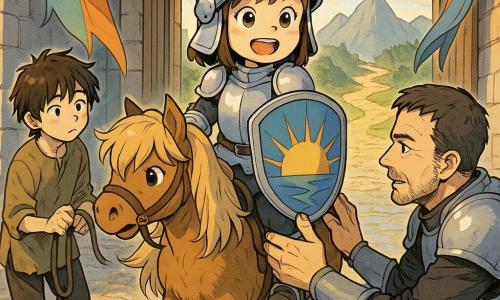
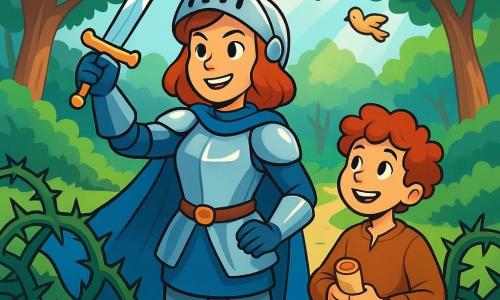
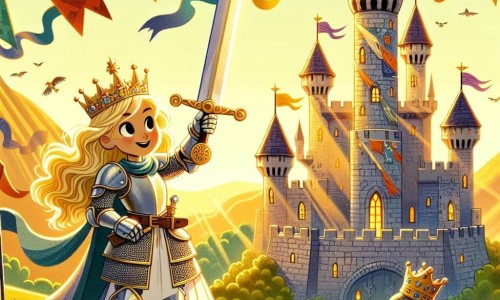
Lady Elowen, the bravest knight in the king's service, was already dressed and ready before the last ring faded. Her armor shone like a tin kettle scrubbed clean, and her cloak was as red as a ripe apple.
Elowen was famous for many things: her quick thinking, her kind smile, and her courage. But the cooks praised her most for something else.
“On time,” said Cook Bram, wagging a wooden spoon at her. “Always on time! If the sun ever overslept, Lady Elowen would wake it up.”
Elowen laughed. “I would knock politely first.”
In the Great Hall, King Aldren sat with a map spread across the table. Beside him stood Sir Puddles—Elowen's trusty pony—chewing hay as if hay were the deepest and most important puzzle in the world.
“Lady Elowen,” the king said, “our people will soon hold the Festival of Lanterns. But the storehouse is thin. We need supplies—bread, beans, apples, cheese, and good oats. Will you gather provisions from the villages beyond the river?”
Elowen placed her fist over her heart. “Gladly, Your Majesty. A knight's quest is not only swords and dragons. It is also sacks and baskets.”
Sir Puddles snorted, as if agreeing. Or perhaps he was simply proud of his hay.
The king smiled. “The road is safe, yet long. Take this list, take this seal, and take my thanks in advance.”
Cook Bram leaned in and whispered, “And if you bring back honey cakes, I will sing a song in your honor.”
Elowen raised an eyebrow. “That may be the most dangerous part of the quest.”
With a light, brave heart, she fastened the king's seal to her belt, packed empty sacks, and stepped into the sunlight. The adventure of provisions had begun.
Chapter 2: The River Without a Bridge
Elowen rode through green fields where sheep dotted the hills like small clouds that had fallen down. She passed a mill where the wheel clapped and splashed, and she waved to children chasing a runaway hoop.
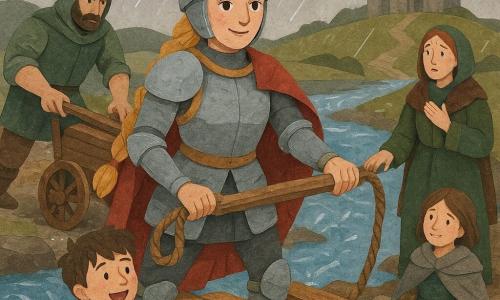
By midday she reached the River Bramble. It usually flowed under a wooden bridge, but today the bridge was gone.
Not broken. Not burned. Just… missing.
A sign stuck in the mud read: “Bridge is taking a rest. Please do not bother it.”
Elowen blinked. “That is not how bridges work.”
A little boat bobbed near the shore. In it sat a thin ferryman with a hat so wide it looked like a flying pancake. He held a fishing rod and frowned at the empty air, as if the fish had been rude.
“Good day,” Elowen called. “Has someone taken the bridge?”
The ferryman sighed. “Not taken. Borrowed. The Bridge Guild said they needed it for repairs. They towed it away like a sleepy log.”
“A whole bridge?” Elowen asked. “How does one tow a bridge?”
“With great confidence,” said the ferryman. “And many ropes.”
Elowen studied the river. It was not wild or scary, but it was too wide for Sir Puddles to jump, and Elowen would not risk him slipping. A knight was bold, yes—but also wise.
She tapped her chin. “Then we must cross another way. How much for a ferry ride?”
The ferryman's eyes brightened. “One joke.”
Elowen smiled. “All right. Why did the knight bring a ladder to the bakery?”
The ferryman leaned in.
“Because he heard the buns were on the top shelf.”
For a moment there was silence. Then the ferryman burst out laughing so hard his hat wobbled like a jelly. “A fine price! Hop in, noble knight!”
Sir Puddles stepped into the boat with careful hooves, as if the floor might argue with him. Elowen steadied the sacks and held the side rail.
The boat slid across the river, smooth and calm. On the far bank, Elowen bowed. “Thank you.”
“Come back with another joke!” the ferryman called.
Elowen saluted. “If I find one in a cheese wheel, I will save it for you!”
Chapter 3: The Village of Mixed-Up Signs
Beyond the river lay three small villages: Appleford, Beanmeadow, and Oatendale. Elowen's plan was simple: visit each one, gather supplies, and return before sunset tomorrow. A punctual knight kept time as carefully as treasure.
But when she reached Appleford, something was odd. The sign at the gate said: “WELCOME TO BEANMEADOW. PLEASE ENJOY OUR BEANS.”
Inside, baskets of apples sat in neat rows, red and gold and shining. A farmer scratched his head beside them.
Elowen dismounted. “Good sir, is this Appleford?”
“It is,” the farmer said. “Or it was yesterday. Today our signs are confused. The sign painter, Master Quill, sneezed while painting and mixed up the boards. Now travelers wander in circles, looking for beans and finding apples, looking for oats and finding—well—more apples.”
A child nearby held up an apple and announced, “I found the beans!” Then she took a bite and frowned. “These beans are crunchy.”
Elowen chuckled kindly. “No harm done, but it will slow trade.”
The farmer nodded. “It already has. The bean carts went to Oatendale, the oat sacks went to Beanmeadow, and the cheese… I do not know where the cheese went. Cheese is sneaky.”
Elowen remembered the king's list. She needed all of it, and quickly. She could simply ride to each village and ask around, but that would take too long. The sun was already leaning west.
She straightened her shoulders. “Courage is not only charging forward. Sometimes courage is stopping to think.”
Elowen gathered the villagers in the square. “Friends of Appleford, let us solve this like knights of old—by using our minds. We will make a new map, right here.”
She borrowed chalk from the schoolhouse and drew three big circles on a wooden board: APPLES, BEANS, OATS. Then she asked questions.
“Who saw the bean carts pass?”
“Which road did the oat sacks take?”
“Has anyone smelled cheese going north?”
The last question made everyone sniff the air with great seriousness. Sir Puddles tried too, then sneezed in a very proud way.
Soon the story became clear. Elowen assigned helpers like a captain guiding a friendly army.
“Marla,” she said to a strong baker, “take two carts and bring back the beans from Oatendale.”
“Jory,” she said to a quick-footed boy, “run to Beanmeadow and tell them the oat sacks are meant for them.”
“And I,” Elowen said, “will ride to Master Quill and ask for new signs before the moon is up.”
The farmer's eyes widened. “Can it be done?”
Elowen lifted her chin. “A quest for food is still a quest. And a knight does not leave a kingdom hungry or confused.”
She rode to the sign painter's cottage and found Master Quill surrounded by paint pots, boards, and a very guilty-looking goose with blue feet.
Master Quill groaned. “My signs are a mess! The goose ran through the paint, I sneezed, and then I painted ‘BEANS' on an apple like a fool.”
Elowen's voice stayed gentle. “Mistakes happen. We fix them. That is also bravery.”
Together they worked fast. Elowen held boards steady while Quill painted. When he slowed, she told him a story of famous knights who mended fences and carried water, and how those deeds mattered too. The tale seemed to steady his hand.
By twilight, three fresh signs were ready, bold and clear.
Chapter 4: The March Home
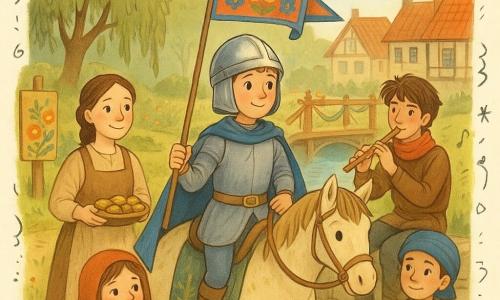
At dawn, the villages were buzzing like happy bees. The bean carts returned to the right place. Oat sacks piled neatly where they belonged. Appleford's apples shone in proud towers.
And the cheese? It was found in a wagon that had taken a nap under a tree. The driver said, “I only closed my eyes for a blink!” The villagers laughed and helped him load it properly.
Elowen checked the king's list again: bread, beans, apples, cheese, and oats. All gathered, all counted, all tied down tight.
The farmers pressed small gifts into her hands: a ribbon for Sir Puddles, a warm roll for the road, and one honey cake wrapped in cloth.
“For Cook Bram,” Elowen said, smiling.
Sir Puddles wore his ribbon as if he had won a grand tournament. He pranced twice, then remembered he was carrying heavy sacks and returned to a sensible walk.
The ride back to Larkhill felt heroic, like a song with a strong beat. Elowen kept her pace steady. When the sun was high, she stopped to let Sir Puddles drink. When clouds gathered, she covered the supplies. A knight cared for her horse and her mission.
At last the castle towers came into view. The bell rang again, welcoming her home—right on time.
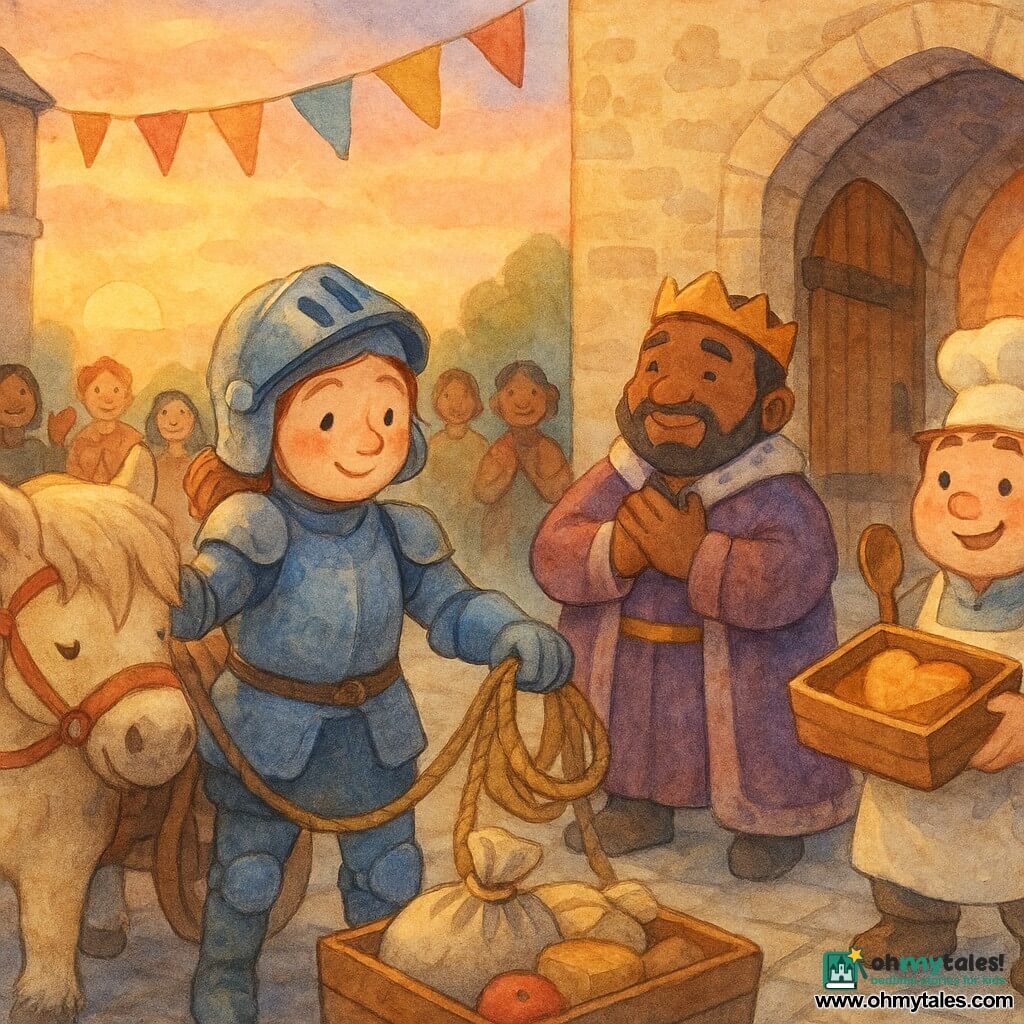
In the courtyard, King Aldren and Cook Bram waited. The cook's spoon was ready, as if it were a tiny sword.
Elowen slid from the saddle and opened the sacks. “Provisions for the Festival of Lanterns,” she announced. “Apples that know they are apples. Beans that are proud to be beans.”
Cook Bram peeked inside and gasped. “Cheese! Oats! Bread! And—by my apron—honey cake!”
King Aldren's eyes shone. “Lady Elowen, you rode far and solved trouble with wit and courage. The kingdom is stronger because you were bold enough to act and wise enough to think.”
Elowen bowed, then handed Cook Bram the honey cake. “Guard it well.”
Cook Bram sniffed it lovingly. “I shall. And I shall sing—”
Elowen held up a hand. “Perhaps later.”
Laughter bubbled through the courtyard like warm soup.
Elowen looked at Sir Puddles and patted his neck. “We did well.”
Sir Puddles snorted in a way that sounded very much like, “Of course we did.”
And as the castle doors opened wide and the smell of baking drifted out, Lady Elowen said, simply, “Thank you.”