Chapter 1: The Notebook Who Counted Breaths
Nell the notebook lived on the second shelf of a kid-sized science workshop, right between a jar of bright paperclips and a roll of masking tape that always stuck to itself.
Nell was careful. Nell was neat. Her pages were lined like quiet sidewalks, ready for footsteps.
But lately, Nell's cover felt heavy.
On the workbench, the tools chatted the way tools do—soft clinks, tiny squeaks, the proud ping of metal. The magnifying glass liked to brag. The ruler liked to straighten everyone's feelings. The stopwatch liked to hurry the air.
Nell liked to listen.
Today, the workshop smelled like lemon wipes and warm plastic. Sunlight lay in rectangles on the floor, as if someone had cut the afternoon into tidy pieces.
Nell heard the announcement before she saw it.
The workshop bulletin board—corky, creaky, and very official—cleared its throat with a tacky little rattle.
“Attention,” it said, holding up a new card with a pushpin. “Tonight: Mini Science Showcase. Everyone may share a small experiment or invention. Small is fine. Honest is better.”
The word “share” fluttered inside Nell like a loose page.
Nell had ideas. She always had ideas. She collected them in pencil, tucked under headings, numbered carefully.
But ideas were safe on paper.
Sharing was… out loud.
Nell's spiral tightened. Her pages warmed. A tiny curl formed at one corner, the way nervousness always started.
On the bench, Pip the pencil hopped once and landed with a brave tap. “Nell! You should do it. You write the best plans.”
Nell whispered, “Plans aren't the same as doing.”
Pip rolled closer, the eraser end first, like a gentle nudge. “Doing starts with a line.”
Nell looked at her first blank page and tried to do what she always did when thoughts raced: she counted breaths.
In… one, two.
Out… one, two.
In… slow.
Out… softer.
Her lines waited. Patient. Kind.
“Just one small step,” Nell told herself. “Just one.”
She wrote, very neatly:
PROJECT: Paper Bridge Test
GOAL: Build a bridge that holds ten washers
RULE: Try. Record. Improve.
She paused and added, under it, smaller:
REMEMBER: Breathe. Try again.
The workshop didn't get quieter. It never did. But Nell felt a little steadier, as if someone had tightened her binding the right way.
One small step, she thought.
And then another.
Chapter 2: The Workshop of Friendly Clatter
In the afternoon, the science workshop woke up fully.
The beakers clinked hello. The plastic trays slid into place. The big fan in the corner hummed like a sleepy bumblebee.
No people came in—only the workshop's own crew, busy and bright. The robots on the charging dock blinked their blue eyes in a slow rhythm. The old cardboard box labeled “SAFETY GOGGLES” sighed dramatically every time anyone walked by, even though no one was wearing anything at all.
“Safety is a feeling,” Boxy liked to say. “A lifestyle.”
Nell perched open on the workbench. She could see the “Recycling Bin,” who was proud and a little stern, and “Glue,” who was friendly but had no sense of personal space.
A small wind-up crab named Crank scuttled across the tabletop. “Showcase tonight!” Crank announced to no one in particular. “I'm doing a dance routine.”
“It's science?” asked the ruler, lifting one eyebrow line.
“It's movement,” Crank said. “Movement is physics. Therefore: science.”
The ruler sighed in a straight, measured way. “Fine.”
Nell's project list sat at the top of her page like a mountain she had drawn herself.
Paper bridge. Ten washers. Improve.
She watched the paper stack on the side table. It looked harmless. It always did. It was just paper, pale as winter sunlight.
But building something meant risking a flop. A sag. A snap.
Nell felt the old habit tug: stay perfect, stay quiet, stay safe.
Pip tapped the margin of Nell's page. “Read me your first step.”
Nell swallowed—though notebooks don't have throats, they do have moments where the world seems too big for their covers.
She read anyway. “Step one: fold two strips into beams. Step two: tape to two chairs.”
The chairs were nearby—little wooden chairs with scuffed legs. They were patient. They had held many things in their time: backpacks, lunch boxes, and once, a dramatic tower of marshmallows that leaned like it was telling a secret.
The chairs spoke together, their voices creaky but kind. “We can be your riverbanks.”
“A bridge needs riverbanks,” Nell murmured.
“And a river needs courage,” said the magnifying glass, surprisingly gentle for someone who loved being right.
Nell inhaled.
In… one, two.
Out… one, two.
She turned to a fresh page and wrote:
TODAY'S PROMISE:
I will try even if I'm not sure.
I will be respectful.
I will not laugh at anyone's mistakes—not even mine.
Pip's graphite tip gleamed. “That's a good promise.”
Nell looked at the workshop, at all the busy items with their own hopes and squeaks and tiny fears.
“Okay,” she said. “Let's build.”
Chapter 3: The First Bridge, the First Bend
Nell guided the process the way she guided everything: step by step, line by line.
Two paper strips. Folded into long triangles. Beams. Stronger than flat paper, like confidence folded into shape.
Tape held the folds. Tape also tried to stick to everyone's feelings.
“Stop hugging my corner!” Nell snapped when tape pressed too close.
Tape let go instantly. “Sorry! I'm enthusiastic.”
Nell softened. “I'm… nervous.”
“Nervous is allowed,” said Boxy from the shelf. “But reckless is not.”
The ruler measured the gap between the chairs. “Fourteen centimeters,” it declared. “No cheating.”
“No cheating,” Nell agreed. Respect mattered. The rules mattered. Everyone mattered.
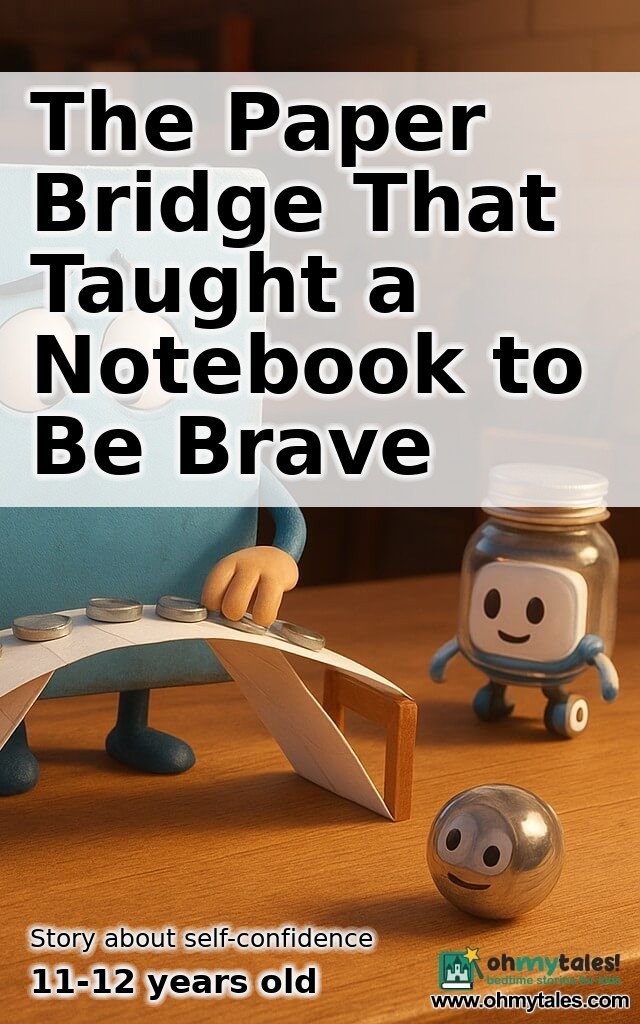
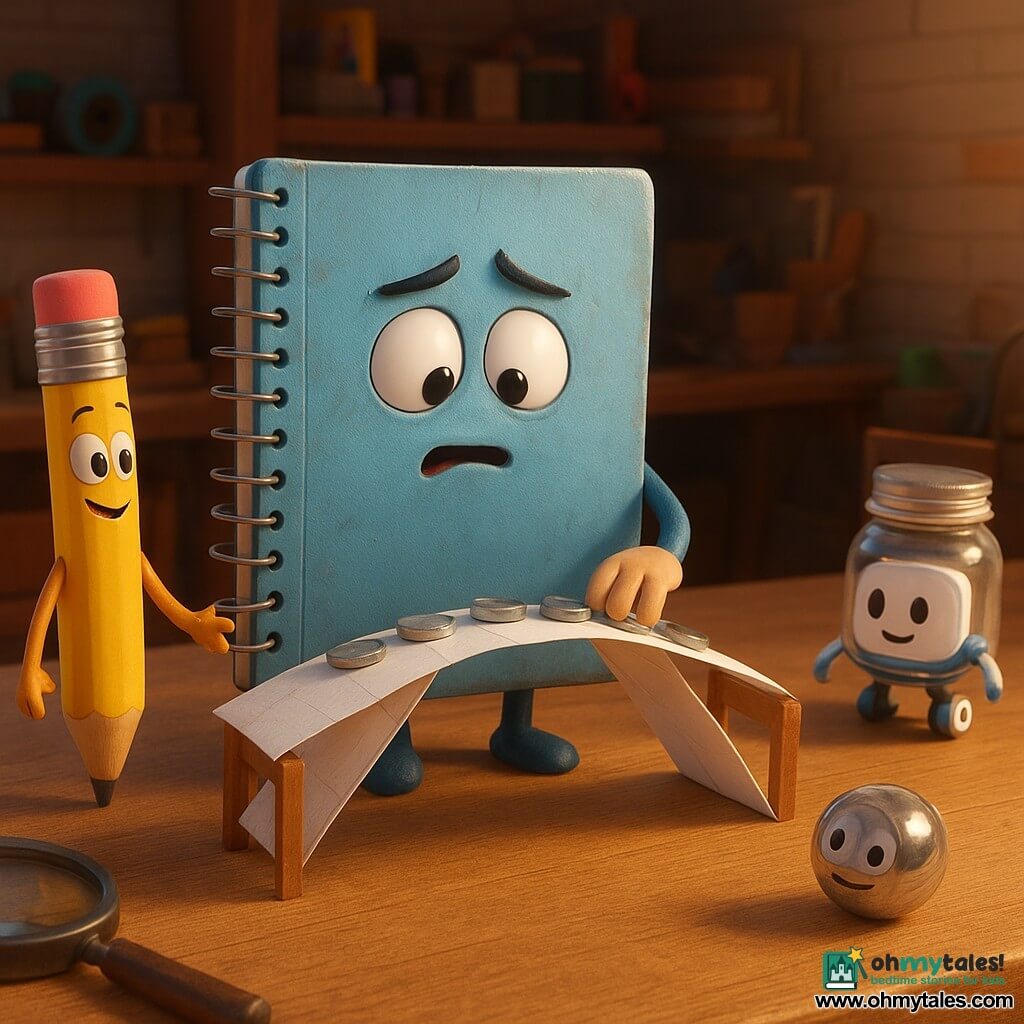
She laid the beams across the chairs. She added a flat deck on top, taped along the edges like a tiny roadway.
It looked… good.
Nell's pages fluttered with hope.
“Washer time!” chirped Pip, bouncing.
The jar of washers—Jasper—rolled forward with a serious clink. “I am prepared to be placed upon the bridge with dignity.”
“One at a time,” Nell said. “And if it fails, we learn.”
Crank the crab paused his dance practice to watch. Even the robots blinked a little faster.
Nell placed the first washer in the middle.
The bridge held.
Second washer. Still steady.
Third. Fourth.
At five, the paper made a sound like a quiet sigh.
At six, the deck dipped. Not much. Just enough to be noticed.
Nell's spine—well, her spiral—tightened again. Her mind raced: It's going to collapse. Everyone will see. Everyone will know you only write, you don't do.
She wanted to shut herself. To snap closed and hide her pages.
Pip leaned near her title line and whispered, “Breathe first.”
Nell did.
In… one, two.
Out… one, two.
She placed the seventh washer carefully, hands-of-the-mind steadying, as if her thoughts could hold the bridge up.
The bridge trembled.
Eighth washer.
A rip sounded—small, sharp, like a tiny paper scream.
And then the middle buckled. The washers slid into the gap between the chairs, clinking down like disappointed raindrops.
Silence spread across the bench.
Nell's cover felt hot. Her best page felt ruined. Her perfect plan lay there with a ripped center.
Crank broke the silence by saying, very softly, “Well. Gravity still works.”
A few tools chuckled, kindly. Not at Nell. At gravity. At the way the world insists on being the world.
Nell stared at the torn paper. Her eyes—if she had them—would have been watery.
“I failed,” she whispered.
The ruler cleared its throat. “Incorrect. You tested. The result was ‘holds seven, collapses at eight.' That is information.”
Jasper the washer jar clinked gently. “I, for one, felt respected throughout.”
Tape scooted forward with careful space this time. “We can fix it. Or we can build a new one. You decide.”
Nell's pages trembled. But somewhere inside the trembling, a calmer thought arrived, plain as a line:
If the first try worked perfectly, there would be nothing to learn.
She turned to a clean page.
She wrote, slowly, like she was stitching herself back together:
RESULTS:
Held: 7 washers
Failed: at 8 washers
OBSERVATION: middle ripped
IDEA: add supports under the deck
NOTE: I felt embarrassed. I breathed. I'm still here.
Then she added one more sentence, in a firmer hand:
Next step: Try again.
Chapter 4: The Second Try and the Kind Voices
The workshop shifted into “helping mode,” which sounded like gentle chaos.
The robot named Dot rolled over with a tray of paper clips, its wheels whispering on the table. “SUPPORT SUGGESTION,” Dot said in a calm beep. “TRIANGLES. TRIANGLES ARE STRONG.”
The magnifying glass nodded dramatically. “Ah yes. Triangles. My favorite shape. Very… undeniable.”
“Not everything needs to be undeniable,” Nell muttered. Then she caught herself and added, softer, “But thank you.”
Nell didn't want a crowd pressing close. She didn't want advice that felt like a storm. She wanted respect. She wanted room.
So she did something brave in a quiet way.
“Everyone,” she said, voice steadying, “I like help. But I need one helper at a time.”
The workshop paused.
Then the chairs creaked approvingly. “Clear boundaries,” they said. “Excellent.”
Pip grinned—at least, pencils can grin with their posture. “That's confidence too.”
Nell chose Dot as her first helper.
Together, they folded small triangle braces and slid them under the bridge deck like tiny knees holding up a heavy thought.
Tape offered short strips, not sticky hugs. Jasper waited patiently, clinking to himself like a meditation bell.
As Nell worked, she repeated the same calm phrase, like a rhythm:
“Fold. Press. Tape. Breathe.”
“Fold. Press. Tape. Breathe.”
She wasn't perfect. One triangle ended up lopsided. Another stuck to tape and had to be rescued. Nell's page got a smudge where Pip's tip slipped.
Each time, Nell paused.
In… one, two.
Out… one, two.
“Messy doesn't mean bad,” Nell told herself. “Messy can mean real.”
When the second bridge was ready, it looked slightly odd—like a paper animal with extra ribs.
Crank saluted. “May your bridge be weird and powerful.”
Nell snorted a small laugh. It surprised her, popping out like a bubble. The tightness in her spiral loosened.
“One washer,” she said.
The bridge held.
Two. Three. Four.
At seven, Nell's cover tried to panic again, remembering the rip. She kept her voice even.
Eight.
The bridge dipped, but the triangles held.
Nine.
The chairs stayed steady. The tape stayed calm. The workshop held its breath with Nell.
Ten.
The bridge stayed up.
For a moment, nobody spoke. Even the fan seemed to hush.
Then Jasper clinked joyfully, “DIGNITY MAINTAINED!”
Dot beeped, “SUCCESS CONFIRMED.”
Pip tapped Nell's page twice—tap, tap—like applause in code.
Nell stared at the bridge, and something warm spread through her pages. Not loud pride. Not bragging. Just a quiet, steady feeling:
I can improve.
She wrote:
SECOND TEST:
Held: 10 washers
What changed: added triangle supports
What I did well: tried again, asked for space, stayed respectful
How I feel: proud… and tired (in a good way)
She paused, then added:
Confidence is not a jump. It's a staircase.
Chapter 5: The Showcase Moment
Evening came softly, as if the daylight was putting on slippers.
The science workshop turned golden. Shadows stretched long and slow. The bulletin board wore a new card that said “SHOWCASE TIME” in bold marker, underlined twice.
Everyone arranged themselves in a semicircle on the floor and benches.
Crank performed his physics dance with dramatic spins and one accidental tumble. He popped back up and bowed. “Friction got me,” he announced. “Respectfully.”
The ruler demonstrated “The Straight Line Challenge,” which was mostly the ruler being smug while the string tried its best.
Glue presented a “Stickiness Spectrum,” which involved three different papers and one apology. “I stuck to the wrong one,” Glue admitted. “But I learned the difference between ‘quick' and ‘careful.'”
Nell listened and clapped by fluttering a page corner. She didn't laugh at mistakes. She didn't wince when things went wobbly. She felt something new: she belonged among the wobble.
Finally, the bulletin board called, “Nell the notebook!”
Nell's cover tingled.
She carried her bridge plan page open like a banner, and the bridge itself rested between the two chairs, ready.
The workshop lights—tiny LEDs under the shelves—made the paper look bright and brave.
Nell cleared her imaginary throat.
“My project,” she said, “is a paper bridge that can hold ten washers. My first bridge held seven. It collapsed at eight. I felt embarrassed.”
Crank whispered loudly, “Embarrassment is just your brain doing push-ups.”
Nell blinked at him. “That is… strangely helpful.”
A gentle chuckle passed through the group.
Nell continued. “Then I tried again. I added triangle supports. I asked for one helper at a time. And I breathed.”
She looked at Jasper. “With dignity.”
Jasper clinked, touched.
Nell placed the washers one by one, narrating like a calm weather report.
“One. Two. Three…”
At eight, her pages wanted to tremble. She pressed them flat with care.
“Eight,” she said. “Still holding.”
“Nine. Ten.”
The bridge stayed strong.
Nell didn't throw her pages into the air. She didn't shout.
She simply let the quiet pride sit beside her, like a friend.
“I learned,” she finished, “that confidence can be built. Not all at once. Fold by fold. Try by try. And also… with respect. For others. And for myself.”
The workshop was quiet for a heartbeat.
Then the chairs creaked a warm, satisfied creak. The ruler nodded. Dot beeped a celebratory pattern. Pip tapped a steady drumroll on the wood.
Even the magnifying glass said, softly, “Well observed.”
Nell felt her cover lift, lighter than it had been all week.
She wrote one last line at the bottom of the page, right there in front of everyone:
I did something hard, and I stayed kind.
Chapter 6: The Little Party of Small Steps
After the showcase, the workshop turned into a tiny party, the kind that feels safe and cozy.
Boxy produced paper confetti from somewhere deep inside himself. “I have layers,” he said proudly. “And snacks.”
The “snacks” were not food—there were no people to eat them—but party tokens: shiny stickers, colorful rubber bands, and a new roll of graph paper that smelled like fresh possibilities.
Dot played a gentle playlist of beeps that sounded almost like lullabies. The fan hummed along, slower now.
Crank led a conga line that lasted exactly three steps before he got distracted by a loose screw and made friends with it.
Nell sat on the bench with Pip beside her and her bridge between the chairs like a quiet monument.
Tape leaned over, careful not to cling. “I'm proud of you,” Tape said. “And I'm proud you told me to back up earlier.”
Nell nodded. “Thank you for listening.”
The ruler added, “Your measurements were consistent.”
“That,” Nell said, “is the ruler's version of a hug.”
“It is,” the ruler admitted, not denying it.
Nell opened to a clean page. She liked clean pages at the end of the day. They felt like smooth pillows.
She wrote, as the party softened around her:
TODAY I LEARNED:
— Trying is brave.
— Failing is data.
— Asking for help is smart.
— Asking for space is also smart.
— Respect makes a workshop feel safe.
— Confidence grows in small steps.
Pip watched the words appear. “Do you feel different?”
Nell listened to herself. To the calm in her pages. To the steady way her spiral held.
“I feel… possible,” Nell said.
Outside the workshop windows, night pressed its cool hands against the glass. Inside, the lights were warm, and the confetti was mostly swept into one happy corner.
Nell closed herself gently.
Not like a slam.
Like a goodnight.
And as she rested on her shelf, she repeated the same soothing rhythm she had used all day—simple, steady, true:
In… one, two.
Out… one, two.
Small step.
Small step.
Tomorrow, there would be more pages.
And Nell would meet them, one line at a time.