Chapter 1: The Terrace with the Blue Chairs
Leo stood at the open door and watched the late afternoon light settle on the apartment terrace. It turned the concrete warm-looking, like toast. Two blue plastic chairs sat by the railing, and a small table held a pot of mint that always tried to escape its own soil.
From inside, his mom called, “Leo, can you bring the laundry basket out? It's too nice to waste the breeze.”
Leo lifted the basket with both arms. It bumped his hip. Socks tried to leap out like they were making a break for freedom.
He stepped onto the terrace and breathed in. Mint. Sun-warmed dust. Somewhere nearby, someone was cooking onions. The city sounded soft at this hour, like it was trying not to wake anybody.
Across the courtyard, Mr. Rahman was watering his plants. He raised a hand. “Good evening, Leo!”
“Hi,” Leo said, and gave a quick wave. He liked Mr. Rahman. Mr. Rahman always said hello like it mattered.
Leo clipped a T-shirt onto the line. The clothespin snapped shut with a neat little click. Click. Click. Click. Small sounds. Small jobs. Things you could finish.
On the table, his school bag leaned against the mint pot. Half his math workbook stuck out, as if it wanted attention.
He pretended he didn't see it.
Tomorrow, Leo's class would do their “Skill Share” presentations. Each student had to teach the class something real: a recipe, a simple trick, a hobby, a small lesson. No slides required, just clear steps and confidence.
And Leo had chosen… juggling.
It had sounded brave when he wrote it down. It sounded exciting when his friend Maya said, “That's so cool!”
Now it sounded like three apples falling forever.
His mom came out with a clothespin bag around her wrist. “You're very quiet,” she said, gentle as the breeze.
“I'm thinking,” Leo said.
“About tomorrow?”
Leo nodded.
His mom clipped a towel to the line. “You know,” she said, “confidence is not a switch. It's more like the laundry line. You don't hang everything perfectly the first time. You adjust.”
Leo stared at his hands. They looked ordinary. They didn't look like “juggling hands.”
“I don't want to mess up in front of everyone,” he admitted. “If I drop them, people will laugh.”
His mom tilted her head. “Some might laugh. Not in a mean way. In a ‘that happens' way. Dropping things is part of juggling. It's also part of being human.”
Leo gave a small, doubtful snort. “Tell that to my stomach.”
His mom smiled. “Your stomach can hear it too. We'll practice. Small steps. We'll breathe. And we'll keep it respectful—of you and of the people watching.”
Leo glanced at the terrace railing. The courtyard below felt far away, and tomorrow felt even farther.
Still, the breeze kept coming, steady and patient, like it believed in him already.
Chapter 2: Three Oranges and a Very Dramatic Drop
After dinner, Leo washed three oranges and lined them up on the terrace table. They were bright and round, like tiny suns with good manners.
Maya had suggested oranges. “They don't bruise as easily as apples,” she'd said. “Plus, you can eat your mistakes.”
Leo rolled one orange in his palm. It was cool and slightly bumpy. Real. Not scary. Just an orange.
His mom sat in one blue chair with a mug of tea. “Show me what you know.”
Leo swallowed. “Okay. But I'm warning you. It might be… tragic.”
“I have tissues,” she said, very serious, and then winked.
Leo started with one orange. Toss. Catch. Toss. Catch. Easy. His shoulders loosened a little.
Then two. Right hand up. Left hand up. Catch. Catch. He managed three clean cycles before the oranges bumped midair like they were greeting each other too enthusiastically.
One orange dropped.
It hit the terrace floor and rolled straight under the mint pot.
Leo froze. “See? Tragic.”
His mom didn't laugh. She leaned forward. “What happened right before it fell?”
“I… panicked?” Leo said. “I watched it too hard.”
“Good observation,” she said. “Try this: look at the top of the toss, not the orange the whole time. Like you're watching a tiny rainbow.”
Leo pulled the orange out from under the mint pot. A mint leaf clung to it like a sticker.
“Minty tragedy,” he muttered.
His mom sipped her tea. “The best kind.”
Leo tried again. Two oranges. He focused on the peak of each toss. The air felt calmer up there, like a quiet ceiling.
He still dropped one. Then he dropped both. Then he accidentally tossed an orange too high and had to do a ridiculous hop to catch it.
His mom finally laughed, but it was warm laughter. “You looked like a startled kangaroo.”
Leo laughed too, surprised by it. The laughter loosened something tight in his chest.
“Okay,” he said. “Small steps. Again.”
He practiced for ten minutes. Then fifteen. Each time he dropped an orange, he picked it up without drama. Each time he caught two cleanly, he counted it like a victory.
“Respect the process,” his mom said softly, like a bedtime rule.
“Respect the oranges,” Leo answered, solemn.
He managed a short run with three: toss-toss-toss, catch-catch-catch. Not perfect. Not long. But real.
His hands tingled. His cheeks felt hot. He looked at his mom.
“Did you see that?” he asked.
“I saw it,” she said. “And more important—did you feel it?”
Leo nodded. He did. For a moment, his hands had known what to do.
It wasn't magic. It was practice. And practice, he realized, was something he could do.
Chapter 3: A Neighbor's Advice and a Friendly Audience
The next afternoon, Leo brought the oranges outside again. The sky was pale and soft, like someone had rubbed out the sharp edges of the day.
He was practicing when the terrace door across the hall opened. Mr. Rahman stepped out onto his own terrace with a watering can.
He noticed Leo's tossing and catching. “Ah! Juggling,” he said, delighted. “Very brave.”
Leo's ears warmed. He dropped an orange right on cue, as if his hands wanted to prove him wrong.
Mr. Rahman set down the watering can. “May I watch?” he asked.
Leo hesitated. A real audience. Not just Mom. His stomach tried to do a flip without permission.
“It's… not very good,” Leo said.
Mr. Rahman nodded thoughtfully. “That is excellent. Not very good means it has room to grow.”
Leo blinked. “That's an odd compliment.”
Mr. Rahman chuckled. “I am an odd neighbor. Continue.”
Leo tried again. Two oranges, steady. Three, shaky. One orange escaped and rolled toward the railing.
Mr. Rahman caught it with his foot—gentle, like stopping a soccer ball. “Rescued,” he announced.
Leo smiled despite himself. “Thanks.”
Mr. Rahman leaned on the railing. “When I first moved here, my English was not smooth. I made mistakes. People corrected me. Sometimes kindly. Sometimes not. But I kept speaking. Little by little, I improved.”
Leo listened, hands busy with the oranges. Toss. Catch. Toss.
Mr. Rahman continued, “Confidence comes after you begin. Not before. Before you begin, you borrow confidence. From practice. From kind people. From small successes.”
Leo's mom stepped onto the terrace with a plate of sliced apples. “Borrowed confidence,” she repeated. “I like that.”
Mr. Rahman smiled at her. “It is community confidence. We lend it to each other.”
Leo felt something settle in him, like a book closing neatly. He didn't have to invent confidence from nothing. He could collect it, piece by piece.
He tried three oranges again. This time he kept going for five full tosses before one fell.
“Five!” Mr. Rahman said, as if Leo had just won a medal. “That was five more than zero.”
Leo picked up the orange. “It still fell.”
“And you still picked it up,” his mom said. “That's the part people forget to notice.”
Mr. Rahman pointed to the oranges. “Also, you are choosing a skill that is hard. That deserves respect. Some people only choose easy things so they never risk looking foolish.”
Leo swallowed. He imagined his classmates: some confident, some nervous, all watching.
“What if someone laughs?” he asked quietly.
Mr. Rahman's face grew serious, but kind. “If someone laughs to be mean, that is their problem, not yours. If someone laughs because it is funny—because juggling is silly sometimes—then you can laugh too. Humor is not always an enemy.”
Leo breathed in minty air. He breathed out the tightness.
“Okay,” he said. “I'll keep practicing. Small steps. Borrowed confidence.”
Mr. Rahman gave a little bow. “And rescued oranges, if needed.”
Leo grinned. “Deal.”
Chapter 4: The Morning of the Skill Share
Morning arrived with too much brightness. Leo's alarm sounded like a tiny panic bell.
He dressed, ate toast, and tried not to think about the word “presentation” like it was a monster under the bed.
In his bag, three oranges sat wrapped in a dish towel. They smelled clean and sharp. He also packed an extra towel—just in case.
His mom walked him to the building entrance. The air outside was cool and busy. Cars hummed. A delivery bike whirred past.
At the door, she crouched to his height. “Remember,” she said, “you're not performing a magic trick. You're teaching. Teaching means you're allowed to take your time.”
Leo nodded, but his hands felt sweaty anyway.
“And,” she added, “if you drop an orange, you can say, ‘That was a planned demonstration of gravity.'”
Leo snorted. “That's such a mom joke.”
“Correct,” she said proudly. “Go be brave in a reasonable way.”
He walked to school with Maya. She bounced a little on her toes, like she had springs.
“What are you teaching again?” Leo asked, partly to distract himself.
Maya lifted her poster tube. “How to make a mini herb garden from recycled containers. My kitchen will never recover.”
Leo smiled. “That's actually useful.”
“So is juggling,” Maya said. “It teaches coordination. And humility.”
“Mostly humility,” Leo said.
At school, the classroom looked normal, which felt unfair. The same whiteboard. The same pencil sharpener that always ate pencils. The same poster about fractions. How could the room look so ordinary when Leo's stomach was trying to write a dramatic poem?
Their teacher, Ms. Patel, clapped her hands. “Okay, everyone. Skill Share today! Remember our rules: We listen. We encourage. We respect. We ask thoughtful questions.”
Leo liked Ms. Patel's voice. It made rules sound like safe places instead of fences.
The first presentations began. A boy showed a simple card trick. A girl taught a few steps of a dance. People clapped. People smiled. Nobody exploded from embarrassment. The world stayed in one piece.
Leo's name sat in the middle of the list. Not first. Not last. The waiting was its own challenge.
Maya leaned over. “You've got this,” she whispered.
Leo whispered back, “Borrowed confidence. Remember?”
Maya nodded. “I'm lending you a whole truckload.”
He tried to imagine a truck full of confidence backing up into his chest: beep, beep, beep. It helped, weirdly.
Then Ms. Patel said, “Leo, you're up.”
His chair scraped the floor. That sound felt loud. He carried his bag to the front like it was full of important, fragile treasure.
In a way, it was.
Chapter 5: Oranges, Gravity, and a Small Brave Voice
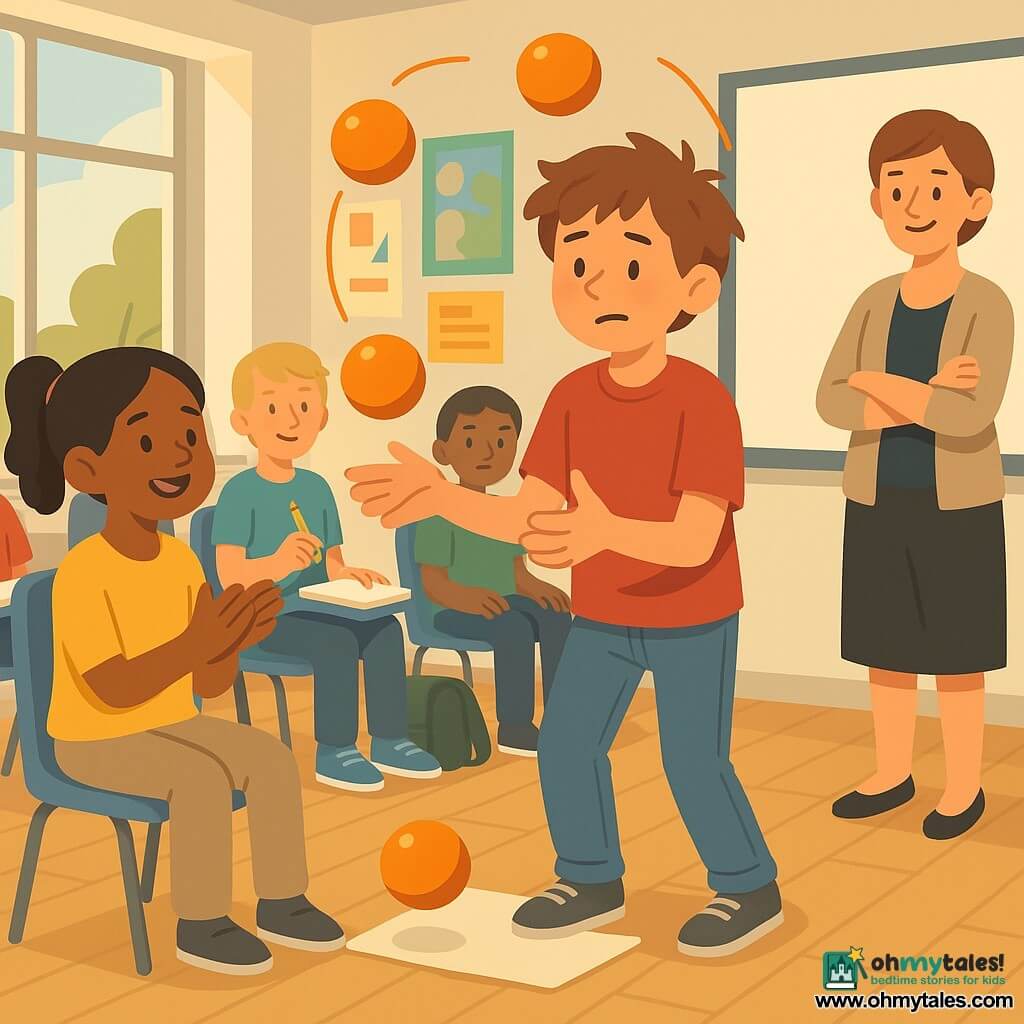
Leo faced the class. Twenty-something faces looked back at him. Some curious. Some sleepy. One kid chewing a pencil eraser like it was gum.
Ms. Patel smiled. “Take your time.”
Leo set his towel on the floor, a little square stage. He pulled out the three oranges and placed them on the towel.
A few kids leaned forward.
Leo cleared his throat. His voice came out smaller than he wanted. “Hi. I'm Leo. I'm going to teach you the basics of juggling. Like… very basic.”
A couple of students chuckled softly, not meanly. Leo felt his shoulders drop a fraction.
He held up one orange. “Step one is one object. You toss it from one hand to the other. Not too high. About… eye level.”
He demonstrated. Toss. Catch. Toss. Catch.
“Step two is two objects,” he continued. “You don't throw them at the same time. You throw one, and when it reaches the top, you throw the other.”
He did two oranges. Right. Left. Catch. Catch.
He heard Maya whisper, “Yes!” under her breath.
Leo took a slow breath. The classroom smelled like dry-erase markers and someone's strawberry shampoo.
“Step three is three,” he said, and felt his heart bump against his ribs. “This is where it gets messy. And that's normal.”
He looked at the top of the toss, like his mom said. Like watching tiny rainbows.
He began: toss, toss, toss.
For a second, the oranges made a neat pattern. A small, bright loop in the air. Leo's hands moved without asking permission from his fear.
Then an orange clipped his thumb and dropped.
It landed on the towel with a soft thud and rolled to a stop.
The room went quiet for half a beat.
Leo's cheeks burned. The old panic tried to stand up.
Then he remembered the terrace. The breeze. The clicks of clothespins. Mr. Rahman's voice: five more than zero. His mom's voice: adjust.
Leo bent down, picked up the orange, and faced the class again.
“Well,” he said, and his voice steadied, “that was a planned demonstration of gravity.”
Laughter burst out—real laughter, surprised and friendly. Even Ms. Patel laughed, covering her mouth.
Leo smiled. He felt lighter. Humor wasn't an enemy. It was a door.
He continued, “So, when you drop one, you don't get mad at yourself. You just… pick it up and try again. That's kind of the whole lesson.”
He tried again. This time he managed six tosses before a drop. Then four. Then eight. Each run was different, but each run was his.
He stopped and held up his hands. “Also, your hands will feel weird at first. That's okay. Your brain is building a new map.”
Ms. Patel nodded. “Excellent explanation.”
A boy in the second row raised his hand. “How long did it take you to learn?”
Leo hesitated. He could pretend. He could exaggerate. But the story was about real life, not superhero skills.
“I started practicing a few days ago,” Leo said honestly. “On my terrace. I'm still learning.”
The boy's eyebrows rose. “Seriously? That's not bad then.”
Leo felt a warm spark in his chest. Not pride like shouting. Pride like a small lamp turning on.
Maya raised her hand. “What helped the most?”
Leo thought of the terrace again. The mint. The blue chairs. The patient breeze.
“Doing it in small steps,” he said. “And… having people who don't make you feel dumb when you mess up.”
Ms. Patel looked around the room. “That's our classroom goal too,” she said. “We learn with respect.”
Leo tried one last run. He focused. Toss. Toss. Toss. Catch. Catch. Catch.
Nine clean tosses.
The tenth orange wobbled, but he caught it.
He stopped on purpose, while he was ahead, and bowed a little.
The class clapped. Not thunderous, not fake. Just steady applause, like a friendly rain.
Leo exhaled. He hadn't been perfect. He hadn't needed to be.
He had been brave in a reasonable way.
Chapter 6: Terrace Evening and the Tiny Victory
That night, the terrace welcomed Leo back with its familiar smells and sounds. The sky was darker now, the city lights blinking on like slow fireflies.
Leo sat in one blue chair. His mom sat in the other. Between them, the mint plant swayed, still trying to escape.
“So?” his mom asked softly.
Leo leaned his head back and looked up. The air felt cooler. Calmer. Like the day had finally unclenched.
“I dropped an orange,” he said.
His mom raised an eyebrow. “Oh no.”
“And I made a joke,” Leo added.
“Oh no,” she repeated, deadpan. “A joke?”
Leo laughed. “People laughed with me. Not at me.”
His mom's face softened. “That matters.”
“And,” Leo said, drawing out the moment like he was unwrapping it, “I got nine tosses. Clean.”
His mom tapped her mug against his water glass. “A toast to nine.”
They clinked gently. The sound was small, but it rang in Leo's ears like a bell.
From the neighboring terrace, Mr. Rahman called, “Leo! How did it go?”
Leo stood and leaned on the railing. “I taught them the basics,” he shouted back. “And gravity won once.”
Mr. Rahman laughed. “Gravity always wins! But you keep playing.”
Leo nodded, even though Mr. Rahman couldn't see the nod clearly in the dim light. “I will.”
He sat back down. The terrace was quiet in a comforting way. No audience now. Just night air and mint and the soft hum of the building.
His mom said, “What do you think you learned?”
Leo thought carefully. He wanted to name it right.
“I learned that confidence doesn't show up first,” he said. “It comes after you start. And… after you keep going.”
His mom reached over and squeezed his hand. “That's a strong lesson.”
“And I learned,” Leo added, “that respecting other people makes it easier to respect yourself. Like… if you wouldn't call someone else stupid for dropping an orange, you shouldn't call yourself stupid either.”
His mom nodded slowly. “Exactly.”
Leo felt sleepiness begin to wrap around him, heavy and gentle. Tomorrow would have homework. Next week would have tests. Life would keep offering scary little stages.
But now he had proof. Real proof. Not perfect proof. Proof with orange juice on it.
He stood up and stretched. “I think I'm going to practice a bit more,” he said. “Just a few minutes.”
His mom smiled. “Small steps.”
Leo picked up the oranges and began again, quietly, under the night sky. Toss. Catch. Toss. Catch.
Sometimes one fell. Sometimes two. Sometimes he got a smooth little run.
Each time, he picked them up. No drama. No panic.
Just a boy on a terrace, learning, trying, and building confidence one small, steady step at a time.