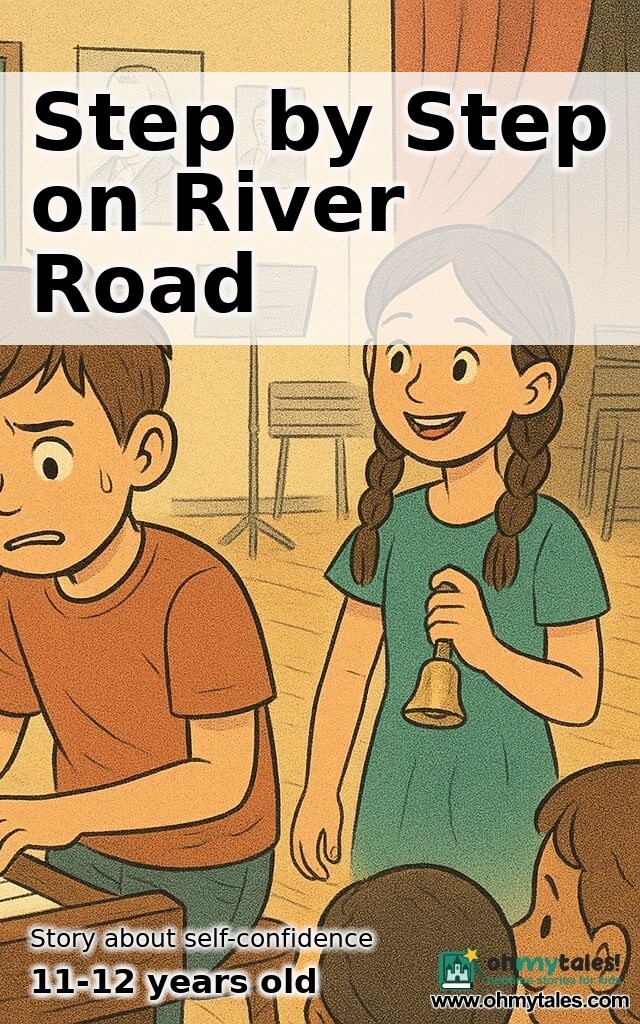
Chapter 1: The Quiet Note
Eli was eleven, almost twelve, and he carried his daydreams the way some kids carried backpacks—always on, always a little too full.
At school, his backpack held the usual: notebooks, a squashed granola bar, a pencil with bite marks. But in his head? In his head there was a whole concert hall, bright lights, and a piano that sounded like rain.
Real life was smaller.
Real life was the music room door with a peeling sticker that said PLEASE CLOSE GENTLY.
Eli stopped in front of it after lunch. He could hear muffled sounds inside: someone tapping a drum, someone laughing, a piano doing a slow scale like a person stretching.
His hands went sweaty around his schedule sheet.
“You going in?” asked Mara, sliding up beside him. She was in his class. She wore her hair in two braids and always looked like she had just thought of a good question.
Eli swallowed. “Maybe. I mean… I signed up for the after-school music club.”
Mara grinned. “Same. My mom says it's healthy to do something that makes your stomach feel like it's doing cartwheels.”
“That sounds… not healthy,” Eli said, and his voice squeaked at the end.
Mara laughed, not in a mean way. In a warm way, like a sweater. “Cartwheels are just your body practicing bravery.”
Eli stared at the door again. He imagined opening it and tripping and dropping his papers and everyone turning their heads, all at once, like owls.
He imagined the teacher saying, “Ah yes, the boy who cannot even walk properly. Wonderful.”
His imagination was dramatic. His imagination was always dramatic.
Mara nudged him with her elbow. “Come on. We can be awkward together.”
Eli took a slow breath. In. Out. The hallway smelled like floor cleaner and someone's orange.
“Okay,” he whispered, mostly to himself. “Small step.”
He pushed the door.
The music room was brighter than he expected. Sunlight fell in long strips across the floor. Posters of composers stared down like serious grandparents. Instruments rested in their corners: a row of xylophones, a drum kit behind a half-open screen, music stands like skinny metal trees.
And in the middle, a piano. Not a shiny grand one, but a school upright piano with scratches and a brave little lamp perched on top.
A few kids were already there. Some confident. Some hiding behind their cases. Mr. Bennett, the music teacher, stood by the whiteboard drawing a tiny stick-figure trumpet that looked more like a confused giraffe.
“Welcome,” Mr. Bennett said, clapping once. “Music club is not a contest. It's a workshop. We build things here. Sometimes the things we build fall over. That's normal.”
Eli's shoulders loosened a fraction. Not much. But a fraction was something.
Mara whispered, “See? Falling over is allowed.”
Eli nodded. He picked a chair near the piano, close enough to see, far enough to hide. His heart thumped a rhythm he did not choose.
Mr. Bennett held up a list. “This term, we'll prepare a small performance for the community open evening. Nothing huge. Just a few pieces. Group numbers, duets, solos if you want.”
Solo.
The word was a pebble dropped into Eli's stomach.
Mr. Bennett's eyes swept the room. “You don't have to decide today. But I want you to try something before you decide you can't.”
Eli stared at his hands. They looked ordinary. Fingers, nails. Nothing that screamed “future musician.”
Mara leaned closer. “Hey,” she murmured. “If you try and it sounds weird, we can blame the piano. It looks like it's been through wars.”
Eli's mouth twitched. A smile, small and shy.
He looked at the piano again, and the piano looked back in its quiet, wooden way, as if it was waiting patiently for someone to say hello.
Chapter 2: A Plan in Pencil
After music club, Eli walked home with Mara. The sky was pale blue, and the air had that after-school tiredness in it, like the whole neighborhood was exhaling.
“So,” Mara said, swinging her bag. “What do you play?”
Eli shrugged. “I… took piano lessons when I was seven. For a year.”
“Why'd you stop?”
Eli kicked a pebble along the sidewalk. “I wasn't good. I kept messing up. My teacher used to tap the stand with her pencil when I made mistakes. Tap. Tap. Tap. Like a tiny hammer.”
Mara made a face. “That would make me want to bite the piano.”
“I didn't bite it,” Eli said. “But I did start pretending I had stomachaches on lesson days.”
Mara's tone softened. “That sounds rough.”
Eli shrugged again, like he could shrug the memory off. But it stuck.
At home, his mom was chopping carrots. The kitchen smelled like cumin and something warm.
“How was music club?” she asked.
Eli hesitated. “Fine.”
His mom paused, knife hovering safely above the cutting board. “Fine like ‘I ate a plain cracker' or fine like ‘I saw a puppy'?”
Eli let out a tiny laugh. “Plain cracker.”
His mom nodded, as if that made sense. “Want to talk about it?”
Eli looked down at the table. There were crumbs from breakfast toast, still there like evidence.
“They want us to perform,” he said. “Later. Like, in front of people.”
His mom leaned against the counter. “Performing can feel big.”
“It feels… impossible,” Eli admitted. The word tasted heavy. He didn't like it.
His mom walked over and placed a hand on his shoulder. “Remember when you learned to ride your bike?”
Eli groaned. “Don't remind me. I fell into a bush.”
“And then you did it again,” she said gently. “And again. And then one day you didn't fall. You wobbled, but you didn't fall.”
Eli remembered the wobbles. The scary speed. His dad running behind him, puffing like an engine.
“I guess,” Eli said.
His mom's voice was calm, like slow music. “We can make a plan. A pencil plan. Not ink. We can erase and adjust.”
A pencil plan. Eli liked that.
Upstairs, Eli opened a notebook and wrote at the top: SMALL STEPS.
1) Touch the piano keys without dying.
2) Learn one simple piece.
3) Practice without panicking.
4) Decide about performing later.
He stared at step one and snorted softly. “Without dying” was dramatic. But it was honest.
He taped the list above his desk with a strip of blue tape.
The next day at school, Mara found it hilarious.
“Step one is my favorite,” she said. “If you survive, we should celebrate with cookies.”
Eli smirked. “Deal.”
At music club, Mr. Bennett handed out a simple arrangement of a folk tune called “River Road.” The notes looked like little black birds sitting on lines.
Eli's chest tightened. There were so many birds.
Mr. Bennett noticed Eli's stare. He crouched by his chair. “First time reading this kind of sheet in a while?”
Eli nodded. “It's… a lot.”
“It is,” Mr. Bennett agreed. “So don't read it all at once. Read one measure. Then the next. Music is a path. You don't jump the whole path. You step.”
Eli looked at the page again. One measure. One step.
Mara whispered, “One tiny toe at a time.”
Eli breathed in. Out.
He wasn't ready to be brave in public. But maybe he could be brave in private, in small pieces.
He wrote a new line on his list that night:
0) Ask for help when my brain gets loud.
It felt strange. It also felt… lighter.
Chapter 3: The Music Room After Hours
On Thursday, Mr. Bennett taped a sign to the music room: PRACTICE SLOT—THREE O'CLOCK—Eli M.
Eli's name looked official on paper. Like he belonged to something.
At three o'clock, the hallways were quieter. Lockers clicked shut. A custodian rolled a cart that squeaked like a timid mouse.
Eli stood outside the music room with his sheet music and a pencil. His heart was doing its cartwheel thing.
Mara appeared, right on time. “I brought moral support,” she announced, holding up a pack of gum. “Mint flavored courage.”
Eli laughed, and the laugh loosened the knot in his throat.
They went in together. The room smelled faintly of wood and brass polish. The piano waited, calm and patient.
Mr. Bennett was there too, sorting instruments. “Afternoon, Eli. Mara. You're welcome to sit in, Mara, if you keep the gum away from the timpani.”
“I would never gum a timpani,” Mara said solemnly.
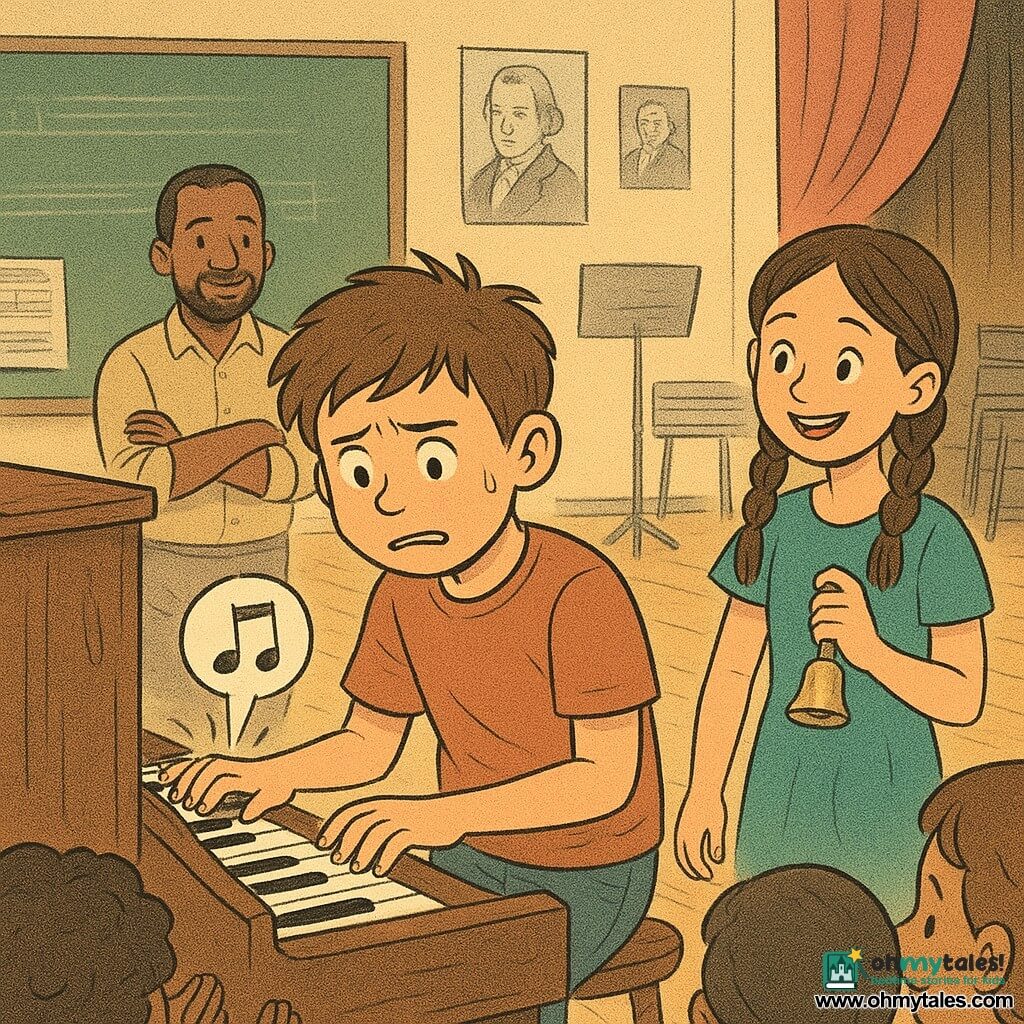
Eli sat at the piano bench. It was slightly too low, so he scooted forward. The keys were cool under his fingertips. White, smooth, a little chipped at the edges. The black keys rose like small stepping stones.
He placed his music on the stand. His hands hovered.
The first note of “River Road” was a simple C.
Eli pressed it.
The sound was soft, but it filled the room like a drop of water spreading.
He pressed the next note. Then the next.
By the fourth note, his left hand arrived, clumsy and uncertain, like a puppy trying stairs.
Clunk.
Eli flinched. “Sorry.”
“Don't apologize to the piano,” Mr. Bennett said. “It likes attention.”
Mara nodded seriously. “Pianos are dramatic.”
Eli tried again. This time he slowed down, counting quietly. “One and… two and…”
The notes came out in uneven steps, but they came out.
Halfway through the first line, he made a mistake. His fingers collided. The sound was a startled honk.
Eli froze. Heat climbed his neck.
Here it comes, he thought. The pencil tapping. The sigh. The disappointment.
But Mr. Bennett just said, “Good. Now you know where the tricky spot lives.”
Eli blinked. “Good?”
“Yes,” Mr. Bennett said. “Mistakes are information. They point. They say, ‘Look here.'”
Mara leaned in. “Your mistake is basically a helpful signpost.”
Eli stared at the messy measure. A signpost. Not a failure. Not a verdict.
He circled the tricky spot with his pencil.
“Let's shrink it,” Mr. Bennett suggested. “Don't play the whole line. Play just these four notes. Slow as a turtle in peanut butter.”
Mara giggled. “That is… extremely slow.”
Eli tried the four notes. Slowly. Carefully. One finger at a time.
Again.
And again.
The third time, they landed right. Not perfect, but right.
Eli felt a small spark in his chest, like a match being struck.
“That,” Mr. Bennett said softly, “is progress. It's quiet, but it's real.”
Eli played the four notes again, just because he could.
When the practice slot ended, Eli stood up and realized his shoulders didn't hurt. He hadn't been tensed like a wire the whole time.
Outside, Mara bumped him gently with her shoulder. “Look at you,” she said. “Alive. Step one completed.”
Eli smiled, bigger this time. “Yeah. Alive.”
As he walked home, the tune followed him. Not in a perfect performance way. In a “the road is still there” kind of way.
At dinner, he told his mom, “I played today. I messed up a lot.”
His mom passed him the bread. “And?”
“And it was… okay,” Eli said, surprised by his own words. “Mr. Bennett said mistakes are information.”
His mom smiled. “Smart teacher.”
Eli nodded. “I think I can do this. Not fast. But… step by step.”
The room felt warm. The day felt softer.
That night, Eli fell asleep imagining not a huge concert hall, but a small room with sunlight on the floor and a piano that didn't mind being learned.
Chapter 4: The Group Song Problem
Two weeks later, music club shifted into performance planning mode. Mr. Bennett wrote on the board:
OPEN EVENING SET LIST
1) Group rhythm piece
2) Small ensembles
3) Optional solos
The word “solo” was still there, like a spider Eli didn't want to look at. But it seemed smaller now. Not gone. Just… manageable from a distance.
Mr. Bennett clapped. “We need a group rhythm piece that includes everyone. Even beginners. Especially beginners.”
He handed out buckets, sticks, shakers, and one slightly dented cowbell that looked like it had feelings.
Eli got two drumsticks and a practice pad. Mara got the cowbell and lifted it like a trophy.
“I have been chosen,” she said. “The Bell Keeper.”
The plan was simple: a layered rhythm that built slowly. Tap-tap, pause. Tap-tap, pause. Then another part joined. Then another.
Simple on paper.
In real life, the first attempt sounded like a herd of shopping carts rolling downhill.
Kids stopped, laughed, restarted. Someone started too early. Someone forgot the pause. Mara rang the cowbell at a moment that was… not in the plan.
“Oops,” she said cheerfully. “My bell had a solo moment.”
Mr. Bennett raised an eyebrow. “Your bell is enthusiastic.”
Eli's stomach tightened. He could feel old thoughts waking up.
This is going to be embarrassing.
Everyone will notice if I mess up.
Better to stay quiet. Better to disappear.
He tapped his sticks lightly, trying to match the beat. But the room was loud, and his brain got louder.
Mara glanced at him. “You okay?”
Eli forced a nod.
Mr. Bennett stopped the group. “Hold on. We're doing too much at once. Let's cooperate with our own brains. We'll build it like a sandwich. One layer at a time.”
He pointed to Eli's side of the room. “Eli's group: you are the base layer. Just tap-tap, pause. Nothing else. Everyone else, listen.”
Eli's face warmed. Base layer? That sounded important. Also terrifying.
Mara whispered, “Base layer means you're the bread. Bread is powerful.”
Eli almost laughed. Almost.
Mr. Bennett counted them in. “One, two, ready—go.”
Eli tapped. Tap-tap. Pause.
It was quiet. Suddenly, it was very quiet. Eli could hear the air conditioner hum. He could hear someone's sneaker squeak.
Tap-tap. Pause.
His hands wanted to rush. But he remembered the turtle in peanut butter. Slow. Steady.
Tap-tap. Pause.
Across the room, a kid named Jaden nodded along, keeping time with his head. It helped. Eli watched Jaden's nod and let it guide his hands.
After eight measures, Mr. Bennett smiled. “Yes. That's it. Keep it going.”
Then Mr. Bennett added the next layer: soft shakers, like rain on leaves. Then the bucket drums came in, deep and steady.
Eli's part stayed the same. Simple. Strong.
And for the first time, Eli felt what cooperation really meant. Not just “working together,” but listening together. Making space. Holding a part so others could build on it.
When the group finished, the room was silent for a second.
Then Mara rang the cowbell once, perfectly on the final beat. “Ding,” she said, pleased. “Professional ending.”
Kids laughed. This time it felt good, like shared relief.
Mr. Bennett pointed at Eli. “Base layer did their job. Nice steadiness.”
Eli's chest filled with that match-spark again.
On the walk home, Mara nudged him. “See? You didn't disappear. You helped.”
Eli looked at the ground, then up at the sky. “It felt… kind of cool.”
“It was cool,” Mara said. “Also, your face when you concentrated looked like you were defusing a bomb.”
Eli snorted. “Thanks. That's comforting.”
“I'm a comforting person,” Mara said, and Eli laughed for real.
That night, Eli added another line to his list:
5) Being steady can be brave.
Chapter 5: The Almost-Solo
A week before open evening, Mr. Bennett asked for volunteers to play short solos between group pieces. Not required. Optional. Gentle.
Eli kept his eyes on his shoes.
He had learned “River Road.” Not perfectly. But enough that the tune sounded like a tune. His fingers knew the path now, even if they sometimes tripped on a pebble.
Mara raised her hand. “I can do a funny announcement,” she said. “Like, ‘Ladies and gentlemen, please clap politely or the cowbell will cry.'”
Mr. Bennett chuckled. “That is… a unique talent.”
Eli's hand did not raise itself. His courage stayed seated.
But later, when the club packed up, Mr. Bennett walked beside Eli as he put his music away.
“Eli,” Mr. Bennett said, “I'm not going to push you. But I want to ask you something.”
Eli's stomach tightened again. “Okay.”
“What would you do,” Mr. Bennett said, “if you weren't worried about being perfect?”
Eli's mouth opened. Closed. He stared at the piano. The scratched wood. The patient keys.
“If I wasn't worried,” Eli said slowly, “I'd play. Just… play. Even if my hands shake.”
Mr. Bennett nodded. “That sounds like an honest goal. Not perfection. Just playing.”
Eli swallowed. “I'm scared I'll mess up in front of everyone.”
“You probably will,” Mr. Bennett said calmly.
Eli blinked. That was not the comforting answer he expected.
Mr. Bennett continued, gentle as a metronome. “And you'll keep going anyway. That's the skill. That's confidence.”
Eli felt his throat tighten. “What if people laugh?”
Mr. Bennett's eyes were kind. “Then they're laughing at a human moment. Most people understand those. And if they don't, we'll handle it together.”
Together. The word landed softly.
Mara bounced over, holding her cowbell case. “Are we having a serious moment? I can leave and come back with snacks.”
Eli gave a weak smile. “It's serious.”
Mara lowered her voice dramatically. “I can do serious. My braids are serious.”
Mr. Bennett looked at Eli. “Would it help to have a buddy plan?”
Eli glanced at Mara. Mara's eyebrows lifted in a silent question: Want me?
Eli's chest warmed. “Yeah,” he said. “A buddy plan.”
Mara snapped her fingers. “Done. If you do a solo, I'll stand near the front and make a face that says, ‘We are calm. We are potatoes.'”
Eli blinked. “Potatoes?”
Mara nodded. “Potatoes don't panic.”
Eli laughed, and the fear loosened a notch.
That evening at home, Eli stared at his list. He added:
6) Maybe try a mini-solo. Not for perfect. For brave.
He practiced “River Road” slowly, then a little faster. He practiced the tricky measure until it felt less like a cliff and more like a small bump.
Sometimes he messed up and wanted to slam the keys. But he didn't. He stopped. He circled the problem again. He played it slower. He remembered: mistakes are information.
On the last practice run before bed, he reached the end and let the final note ring.
The sound hung in the air for a moment, then faded like a good thought.
Eli whispered to the quiet room, “Okay. I can do a small step in front of people.”
His voice shook. But it was there.
Chapter 6: Open Evening Lights
Open evening arrived with folding chairs and a table of cookies in the hallway. Parents drifted in holding coats. Younger siblings bounced like rubber balls.
Eli stood backstage—really just behind the curtain by the storage cabinets—holding his sheet music even though he had memorized most of it. Paper felt like a safety net.
Mara stood beside him in her “performance outfit,” which was basically her regular clothes plus a shiny hair clip shaped like a star.
“Remember,” she whispered, “potatoes.”
Eli took a slow breath. In. Out. He could smell the lemon cleaner on the floor and the buttery sugar smell of cookies.
Mr. Bennett gathered the club. “Whatever happens,” he said quietly, “you are already doing the brave thing. You showed up. You practiced. You worked together. That matters.”
The group rhythm piece went first. Eli held the base layer steady. Tap-tap, pause. Tap-tap, pause. He listened. He felt the room listening back.
When the last beat landed, applause filled the music room, warm and noisy. Eli's cheeks flushed.
Then came a couple of small ensembles. A clarinet duet. A trio with guitars. Each performance had tiny mistakes, tiny recoveries, and the audience clapped anyway. Eli noticed that. He tucked the fact into his pocket like a lucky coin.
Mr. Bennett nodded at Eli. The time had come.
Eli's legs felt like they belonged to someone else. Heavy. Uncertain.
Mara whispered, “I'm making the potato face.” She puffed her cheeks and widened her eyes in a ridiculous expression.
Eli almost burst out laughing. The laughter didn't erase his fear, but it poked a hole in it so he could breathe.
He walked to the piano. The bench felt familiar under him, like an old friend who didn't talk too much.
He placed his fingers on the keys.
For one second, the room was silent.
Eli thought of his list. Small steps. Pencil plan. Mistakes are information. Being steady can be brave.
He played the first note.
It sounded clear. It sounded real.
The melody of “River Road” flowed out, not like a perfect river, but like a real one—sometimes fast, sometimes slow, always moving forward.
At the tricky measure, Eli's left hand stumbled.
Clunk.
His heart jumped.
A few heads in the audience tilted, curious.
Eli felt the old panic rush up—hot, sharp, urgent.
Then he heard something else.
He heard Mara's cowbell, very softly, from where she stood, tapping the beat against her leg like a tiny guide.
Tap… tap…
Eli found the rhythm again. He didn't stop. He didn't apologize to the piano. He moved on.
And the music kept going.
When he reached the final note, he held it just long enough for it to glow. Then he lifted his hands.
For a heartbeat, there was silence.
Then applause rose, loud and generous. Not polite. Real.
Eli stood, bowing awkwardly, and his ears rang with claps and his own amazed thoughts.
I did it.
I messed up.
I kept going.
Backstage, Mara grabbed his sleeve. “You survived,” she hissed triumphantly. “Step one and step six. Double cookies tonight.”
Mr. Bennett came over, eyes shining. “That was courage, Eli. Not because it was flawless. Because it was honest.”
Eli swallowed hard. His eyes stung, but in a good way, like the feeling after a long run when you realize your legs carried you farther than you thought.
“Thank you,” Eli said to Mr. Bennett, and then, turning to Mara, “Thank you. For… the potato thing. And the beat.”
Mara shrugged, trying to act casual, but her smile was proud. “Anytime. I'm basically a professional support vegetable.”
Eli laughed, and this time the laugh sounded like it belonged in the room.
Chapter 7: The Imaginary Badge
Later, when the chairs were folded and the cookie crumbs were swept away, the music room returned to its quiet self. The posters watched. The piano rested.
Mr. Bennett asked Eli to help put away the music stands. Eli did, stacking them carefully, metal legs clicking together.
As they worked, Mr. Bennett said, “I have something for you.”
Eli's stomach fluttered. “Like… a grade?”
Mr. Bennett looked horrified. “No. This is music club. We don't grade bravery.”
He reached into a drawer and pulled out a small circle of cardboard. On it, he had drawn a badge in marker: a simple shield with a tiny piano key and a road curving across it.
At the top, in neat letters, it said: STEP-BY-STEP COURAGE.
“This is not an official school badge,” Mr. Bennett said, voice serious but eyes smiling. “It is an imaginary one. The best kind, because you can't lose it in the laundry.”
Eli took it carefully. The cardboard was warm from Mr. Bennett's hand.
Mara peeked over Eli's shoulder. “Wow,” she whispered. “That badge is powerful. I feel braver just looking at it.”
Mr. Bennett tapped the badge gently. “Eli, you earned this by trying. By cooperating. By letting others support you. By supporting the group with steadiness.”
Eli's throat tightened again, but he didn't try to swallow the feeling away. He let it be there. Soft and full.
He looked at Mr. Bennett. “Thank you,” he said, clearly this time. “For not making mistakes feel like… the end.”
Mr. Bennett nodded. “Mistakes are just the middle.”
Eli turned to Mara. “And thank you,” he added. “For being there. For making it funny when it felt heavy.”
Mara saluted with the cowbell case. “Always. Partners in bravery.”
On the walk home, Eli held the imaginary badge in his pocket. It wasn't real in a store-bought way. But it felt real in the way his chest felt when he remembered the applause, and the way his fingers had found the keys again after the clunk.
At his front door, Eli paused and looked up at the night sky. It was calm. The kind of calm that tells you the world will still be there tomorrow.
He thought of the road in “River Road.” Not a straight line. A path with turns.
Small steps, he reminded himself.
In his room, he taped the badge drawing above his list.
Then he added one last line beneath it, in pencil:
7) I can be scared and still move forward.
Eli turned off the light. The room went quiet. His thoughts drifted, not into a huge concert hall this time, but into something better: a real life where he could learn, try, stumble, laugh, and keep going—step by step, together.