Chapter 1: The Quiet Yes
Milo liked being the kind of person who could slip through a hallway without making the lockers echo. At school, he was the boy teachers trusted with passing out worksheets and collecting stray markers, because he never turned it into a performance.
On Monday afternoon, the library smelled like paper and pencil shavings. Milo sat with his two best friends at a table near the windows. Jay was tapping a ruler like it was a drumstick. Theo had a neat stack of colored sticky notes and the serious face he got when he was planning something.
Ms. Patel, the librarian, walked over holding a flyer. “I need three volunteers,” she said. “For a real job. Not just carrying boxes.”
Jay shot his hand up so fast his chair squeaked. “I volunteer my muscles and my brain.”
Theo raised his hand too, careful and polite. Milo didn't move right away.
Ms. Patel's eyes found him anyway, not pushy, just hopeful. “Milo?”
Milo's stomach fluttered, the way it did when someone called on him unexpectedly. He glanced at Jay and Theo. Their faces said, Please.
He nodded. “Okay.”
Ms. Patel smiled. “Thank you. The community center is hosting a small evening event next week. They asked our school to help make sure the place is accessible for everyone. We'll do an ‘access check'—a walk-through. You'll take notes and share suggestions.”
Jay leaned forward. “Like… spy work.”
“Like respect,” Ms. Patel corrected gently. Then she added, “Also a little like spy work. You'll meet someone from the event team. His name is Mr. Lewis.”
Theo's sticky notes rustled as he opened his notebook. “What do we check?”
“Entrances. Bathrooms. Seating. Signs. Anything that might make someone's night harder than it needs to be.”
Milo pictured doorways and stairs, the normal parts of buildings he never thought about. He didn't say much, but something inside him settled into place. A real job meant real help. And real help didn't need a loud voice.
Chapter 2: The Map and the Measures
Two days later, after school, the boys met at the community center. It was a brick building with a glass door and a poster taped inside that said: “Neighborhood Story Night: Everyone Welcome!”
Mr. Lewis waited by the entrance. He wore a baseball cap and carried a clipboard that looked like it had been through a few storms. Beside him stood his daughter, Nora, who was the boys' age and looked like she had more confidence in her ponytail than Jay had in his whole body.
Nora nodded at them. “You're the access squad?”
Jay saluted. “Agent Jay reporting.”
Theo did a small wave. Milo gave a quiet “Hi.”
Mr. Lewis chuckled. “All right, agents. Here's the plan. You walk the building like you're arriving for the first time. Imagine different needs. If something slows you down, blocks you, or confuses you, write it down.”
Nora added, “My friend Alina's coming. She uses a wheelchair. She said some places ‘welcome' her like a poster does—until there's a step.”
The boys followed them inside. The lobby had a shiny floor that reflected the ceiling lights. A table sat near the wall with a sign-in sheet.
Theo whispered, “Slippery?”
Jay stepped carefully, then exaggerated a tiny skid. “Wheee—” He stopped when he saw Milo's serious look. “Okay. Not funny. Sorry.”
Milo didn't scold. He just pointed at the floor and said, “Maybe a mat? Like a grippy one.”
Mr. Lewis wrote it down. “Good catch.”
They moved toward the main hall. A ramp ran along one side of three shallow steps.
Nora tried it, walking up. “This ramp's kind of steep.”
Theo pulled a measuring tape from his backpack. “I brought one. My dad uses it for shelves.” He knelt, measuring, his brow furrowed like a tiny engineer.
Jay whistled. “Theo, you're basically a human calculator.”
Theo shrugged. “Someone has to keep your math from hurting people.”
Milo smiled a little, the kind of smile that stayed mostly inside his cheeks. He watched the ramp. He hadn't noticed before how a few degrees could feel like an opinion: easy for some, exhausting for others.
They checked the doors. The main hall doors were heavy. Milo tried opening one with one hand, imagining carrying a bag or pushing wheels. The door fought him like it was stubborn.
He said quietly, “This is… tough.”
Mr. Lewis tried too and nodded. “You're right. We can adjust the closer. Maybe set it to stay open during the event.”
Nora pointed to a small button on the wall. “There's an automatic opener, but it's kind of hidden.”
Jay crouched like a detective. “I found the secret button!”
Theo tapped his notebook. “Maybe a sign. Like, ‘Press here for automatic door.' Big letters.”
Milo added, “And at a height people can reach.”
Mr. Lewis's pen scratched. “Excellent.”
By the time they reached the hallway to the bathrooms, Milo's notebook had a list that looked like it meant something. He still didn't talk much, but he didn't need to. His pen did the speaking, and his eyes did the noticing.
Chapter 3: The Bathroom Test and the Chair Trick
The bathroom hallway was narrow, with a trash can tucked near the corner like it had decided to live there forever.
Nora pushed an empty wheelchair forward. “We borrowed this from the office,” she said. “Just for testing.”
Jay's eyes widened. “We get to try it?”
“It's not a toy,” Nora said, but her voice wasn't mean. It was firm, like a seatbelt click.
Milo stood back at first. Theo looked unsure too.
Mr. Lewis nodded. “Try it, but respectfully. It's a tool. If it helps you understand, use it carefully.”
Theo took the handles and guided the chair toward the bathroom door. The trash can blocked part of the turn. He tried again, wheels squeaking softly, and bumped the can.
Jay grabbed the can and moved it. “Trash can, you are under arrest for blocking the hallway.”
Theo pushed the chair forward. The bathroom door opened inward and immediately stopped the chair from entering in a smooth line.
Milo stepped closer. “The door's… in the way.”
Nora said, “That's what Alina complains about in places. You have to do this weird spin.”
Theo attempted the “weird spin,” and it was awkward, like trying to fold a big box in a small closet.
Jay tried next, sweating dramatically. “This chair has better steering than my little brother, but the door is rude.”
Milo took a turn last. His hands on the wheels felt strange—more direct than walking, more careful. He tried the turn slowly. The chair bumped the wall, and the sound made him flinch, even though it was gentle.
He backed up and tried again. He pictured someone arriving tired, excited for story night, and then meeting this stubborn door.
He looked up. “If we prop it open? Or… change the swing?”
Mr. Lewis sighed. “Changing the door might be a big renovation. But propping it open during the event could help. We can also clear the hallway.”
Theo wrote: “Move trash can. Keep door open during event. Check accessible stall space.”
Inside, the accessible stall had a grab bar, but the handle was loose.
Jay wiggled it and made a face. “This is not confidence-inspiring.”
Mr. Lewis grimaced. “I'll get maintenance on that tomorrow.”
As they left, Milo noticed the bathroom sign: small letters on a shiny plate, same color as the wall. It was like the sign was playing hide-and-seek.
He pointed. “Hard to see.”
Nora grinned. “Milo the eagle.”
Milo's ears warmed. He wasn't used to being called anything out loud. He simply said, “Maybe bigger signs. And… picture symbols.”
Theo nodded. “So people who don't read English well can understand too.”
Jay puffed his chest. “We're making this place accessible to, like, the entire planet.”
Nora laughed. “Start with the neighborhood, Agent Jay.”
Milo wrote down “clear, high-contrast signs” and felt, for the first time that day, a lightness in his chest. Not because the problems were fun, but because problems could be solved with small, steady changes.
Chapter 4: The Stage That Needed a Bridge
They entered the main hall again. The stage sat at the front, raised about two feet, with stairs on the right. The microphone stand waited in the center like it was patient.
Nora walked to the edge and looked down. “Alina wants to read a short story. On the stage.”
Jay blinked. “But… stairs.”
Theo scanned the space. “No ramp.”
Milo imagined a wheelchair trying to climb air. He didn't like how quickly his mind saw the word “no.” It felt like a door shutting.
He crouched and studied the stage edge. The wood was scuffed, as if lots of feet had kicked it by accident. He noticed something else: on the left side of the stage, there was a wide gap between the stage and the wall—enough space for a temporary ramp to fit.
He pointed. “Could a portable ramp go there?”
Mr. Lewis looked where Milo pointed, then nodded slowly. “Yes. We have a storage room. There might be one.”
Jay rubbed his hands together. “Treasure hunt.”
They followed Mr. Lewis down a hallway to a door marked “Storage.” The air inside smelled like old paint and gym mats. Shelves held folding chairs, tangled cables, and boxes labeled in fading marker.
Theo shone his phone flashlight. “If we find a ramp, it might be heavy.”
Jay lifted a box and immediately put it down. “This box is full of… sadness.”
Nora rolled her eyes. “It's probably just extension cords.”
Milo moved quietly along the shelves, reading labels. He found one that said “ACCESS RAMP” in capital letters, half-covered by a dusty tarp.
He tapped it. “Here.”
Mr. Lewis's face brightened. “Milo, you legend.”
Jay gasped. “The quiet kid has superpowers.”
Milo's cheeks warmed again. He helped pull the tarp off. Under it was a folded metal ramp with ridges.
They carried it together. Jay tried to take the whole weight and almost toppled.
Theo said, “Agent Jay, you are not a forklift.”
Jay grunted. “I am… an emotional forklift.”
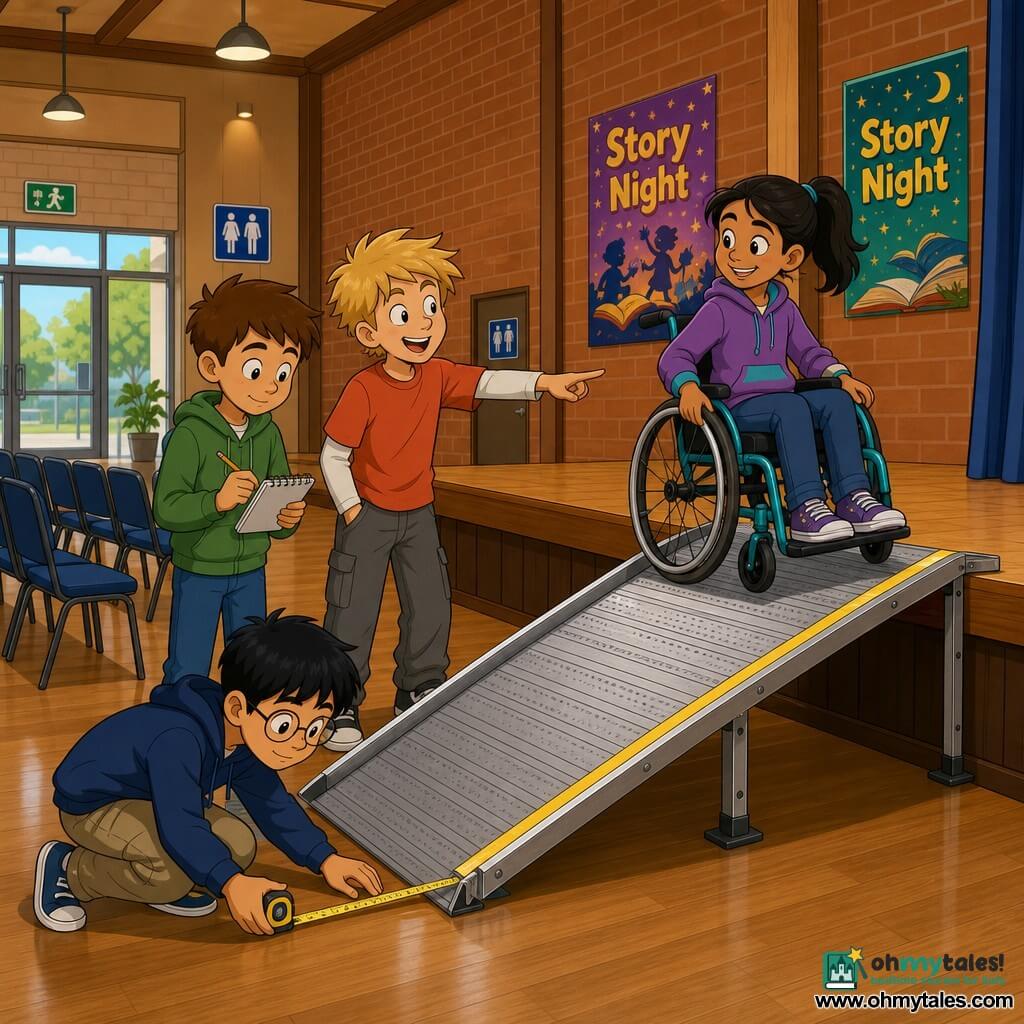
Back in the hall, they unfolded the ramp and tested it at the left side of the stage. It fit like it had been waiting to be remembered.
Nora pushed the empty wheelchair up it. “Not too steep. The ridges help.”
Milo watched the chair roll smoothly onto the stage, and something in his throat loosened. It wasn't dramatic. It was just… right. A simple bridge where there used to be a drop.
Mr. Lewis wrote on his clipboard. “Portable ramp will be set up before the event. We'll secure it, check the angle, and mark it clearly.”
Theo added, “And make sure nothing blocks it. Like cords.”
Jay pointed at the microphone cable on the floor. “Cords are sneaky.”
Milo looked at the stage again, now with a path. He thought about how often people assumed things were impossible because they hadn't looked for a stored solution, or because nobody asked the right question.
It made him want to keep asking.
Chapter 5: Signs, Seats, and a Small Joke
On the day of Neighborhood Story Night, Milo arrived early with Theo and Jay. They carried a roll of bright tape, a stack of printed signs, and Theo's measuring tape, which had become their unofficial badge of responsibility.
Mr. Lewis greeted them. “We made several changes. Come see.”
The entrance mat was down—dark blue and grippy. A big sign with an arrow pointed to the automatic door button: “PRESS HERE FOR EASY OPEN.”
Jay pressed it solemnly. The door swung open. He whispered, “The future is now.”
Theo checked the sign height. “Good. Not too high.”
Inside, the hallway trash can had been moved. The bathroom door was propped open with a heavy wedge during set-up, and the loose grab bar had been tightened.
Milo tested the bathroom sign. Now it was bold: white letters on a dark background, with a clear symbol. He felt proud in a quiet way, like a candle that didn't need to shout to be bright.
In the main hall, the portable ramp was secured to the stage, and a strip of bright tape marked its edges. Another sign read: “RAMP THIS WAY.”
Rows of chairs filled the room, but several spots were left open, not shoved in the back or crammed near the exit—open spaces woven into the middle.
Nora arrived carrying a folder of papers. “Alina's on her way.”
Jay looked around. “This is… actually nice.”
Theo adjusted a sign that had tilted. “Nice is the point.”
Milo noticed a table with snacks. Someone had placed the plates and cups at different heights: some on the table, some on a lower cart. There were straws and napkins easy to grab.
Mr. Lewis saw Milo looking. “You didn't write that on your list, but one of our volunteers suggested it after reading your notes. Turns out accessibility spreads.”
Jay nodded wisely, like a tiny philosopher. “Like glitter. But useful.”
Theo snorted. “Glitter is the opposite of useful.”
Milo's laugh came out small and surprised, like it had been hiding behind his teeth. Jay turned, delighted.
“There it is!” Jay said. “Milo laugh sighting!”
Milo shrugged, but he didn't mind. He looked around the room—ramps, signs, open spaces, little changes that felt like someone saying, We thought about you before you even arrived.
That kind of welcome was quieter than a poster and stronger than a speech.
Chapter 6: Alina's Story, Milo's Memory
The room filled with families and neighbors. The lights were warm. Someone's baby babbled, and an older man shushed him, then apologized to the baby like it was a tiny adult.
Milo sat with Jay and Theo in the third row. He liked being close enough to see faces but not so close he felt like everyone could see him thinking.
When Nora's friend arrived, Milo recognized her immediately because she moved like she belonged. Alina's wheelchair was bright teal, and she wore sneakers with yellow laces. She rolled in with her mom, scanned the room, and smiled when she saw the ramp.
Nora hurried over. “It's ready.”
Alina looked at the ramp, then at the stage, then at Nora. “Nice. No surprise stairs.”
Mr. Lewis came over, not making a big deal, just greeting her like any other reader. “Hi, Alina. Let me know if you want the microphone adjusted.”
“Thanks,” Alina said. “And whoever did the signs? I could actually find the bathroom without asking. That's like finding treasure.”
Jay whispered to Milo, “We are treasure makers.”
Milo didn't answer with words. He just felt a warm, steady glow.
When it was Alina's turn, she rolled up the ramp smoothly. The ridges hummed softly under her wheels. She reached the stage without anyone lifting, tugging, or rushing her. She parked near the microphone, adjusted her papers, and looked out.
“Hi,” she said. “My story is called ‘The Shortcut.' It's about a kid who thinks the fastest way is always the best way. Spoiler: he learns something.”
The audience chuckled.
As she read, Milo watched the room more than the stage. He saw heads tilt closer, eyes soften, hands pause above snack bowls. He saw the way people listened when someone spoke from their own life.
Alina's story wasn't about her chair. It was about getting lost, asking for help, and realizing that taking a longer path with a friend could be better than racing alone. At the end, the room clapped, and Alina's smile was real and tired and proud.
Afterward, people lined up to thank her. Milo hung back, as usual. But Theo nudged him gently. “Go say hi.”
Jay added, “Yeah, Agent Eagle.”
Milo walked up when the line thinned. His heart thumped like he was running, even though he wasn't. He stood a respectful distance away.
“Hi,” he said. “I'm Milo. We… did the access check.”
Alina looked at him like he mattered, not like he was background. “Thank you, Milo. Tonight was easy. That's a huge gift.”
Milo swallowed. “We just… noticed things.”
Alina tilted her head. “Noticing is not ‘just.' Most people don't.”
Milo didn't know what to do with that, so he held it carefully, like a warm mug. “Your story was good.”
“Thanks,” Alina said. “And hey—if you ever do this again, remember the little stuff. Like where people can sit with friends, not separated like luggage.”
Theo, standing behind Milo, nodded firmly. Jay whispered, “Not luggage,” like he was carving it into his brain.
Later, as the event ended and chairs folded and voices faded, Milo stepped outside. The night air was cool and smelled faintly of rain. Streetlights made pale circles on the sidewalk.
Theo and Jay walked beside him, and their shoes scuffed in a comfortable rhythm.
Jay said, “We should get badges.”
Theo said, “We should get sleep.”
Milo looked back through the glass door. He could still see the bright ramp tape, the clear signs, the open spaces between chairs. He pictured Alina rolling up, reading her story, laughing at the ending like everyone else.
In his mind, the memory settled gently, like a blanket pulled up to the chin: the simple moment when a place said welcome in a way that was true.
Milo didn't say much on the walk home. He didn't have to. Some memories don't need extra words to stay. They stay because they were made with care—and because they remind you that small changes can open big evenings for someone else.