Chapter 1: A New Seat at the Back Row
Mara liked the back row because it made everything feel calmer. From there, she could see the whole classroom—the whiteboard, the tall windows, the pencil cups lined up like tiny soldiers. She could also think without people bumping her elbow.
On Monday morning, she arrived early, the way she usually did. The hallway smelled like floor cleaner and toast from the cafeteria. She slid into her chair, took out her notebook, and wrote the date neatly.
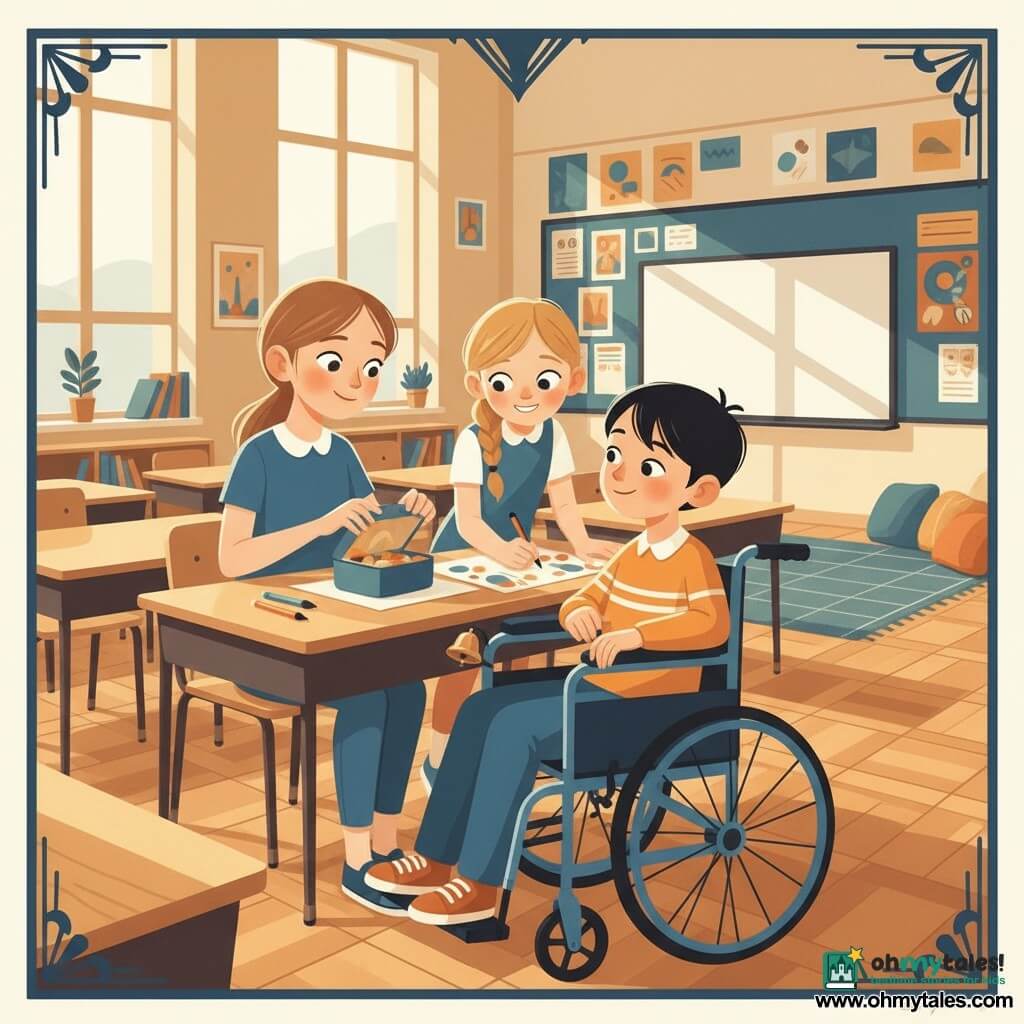
Then she noticed the desk beside hers had been moved. It was angled a little differently, with extra space around it, like someone had drawn a careful circle and said, “Here, this spot needs room.”
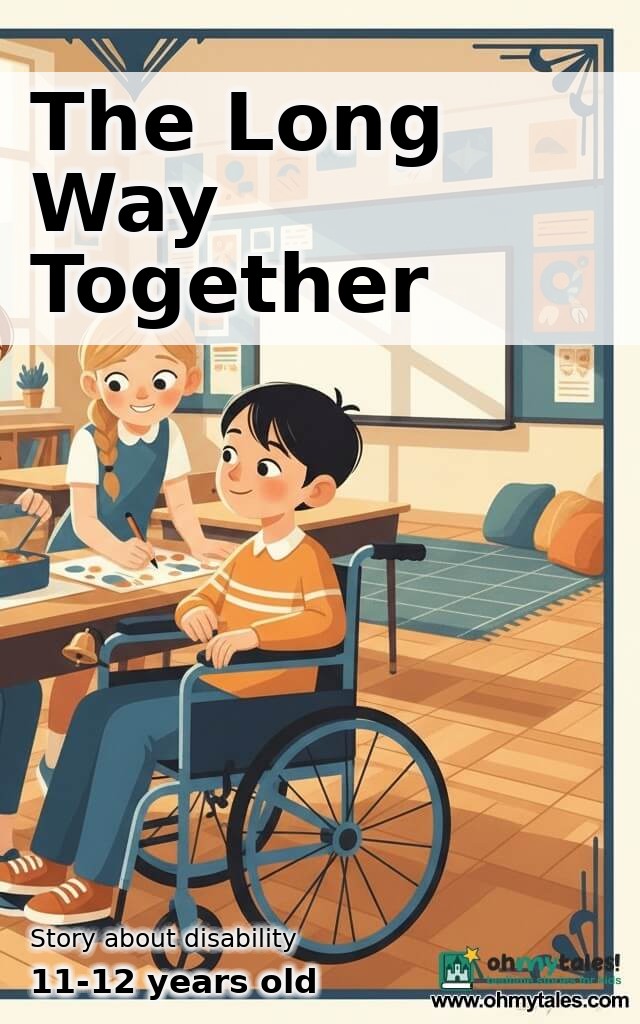
Footsteps came closer. A boy rolled in, not walked. His wheelchair was bright blue, with black wheels and a small silver bell clipped to the side.
“Hi,” he said, stopping with a soft squeak. “I'm Jay.”
Mara blinked once, then remembered to smile. “I'm Mara. You're… new.”
“Yeah. New school, new everything.” He lifted his backpack onto his lap like it was a well-trained pet. “Where do people put their lunches? I don't want mine to get squished.”
“In the cubbies,” Mara said, pointing. “I can show you.”
Jay looked at the narrow aisle between desks. “Is there a secret path that doesn't involve crashing into someone's chair?”
Mara's mouth twitched. “Not secret. Just… the long way.”
They took the long way together, looping around the reading corner and the science posters. Mara noticed how Jay didn't hurry. He moved with steady purpose, like a person who knew that rushing usually caused trouble.
When the bell rang, the noise burst through the room like popcorn. Jay reached up and flicked his little silver bell once.
“Why the bell?” Mara asked, curious.
“So people hear me coming,” he said lightly. “I'd rather ring than run into ankles. Ankles get offended.”
Mara laughed quietly. Jay grinned back, and the day felt a little less ordinary—in a good way.
Chapter 2: The Group Project Problem
By Wednesday, Ms. Patel announced the class project: create a “Neighborhood Guide” for families new to town. Each group would choose places to include—parks, libraries, corner stores, safe walking routes—and present it with a poster and a short talk.
Mara liked projects because they had steps. Steps meant you could solve things.
Ms. Patel read the groups out loud. “Mara, Jay, and Lila.”
Lila bounced in her seat as if springs lived in her shoes. “Yes! We can make it colorful. Like—neon!”
Jay raised an eyebrow. “Neon is a brave choice for a neighborhood guide.”
Mara opened her notebook and wrote: Tasks. “We need a plan,” she said. “First, pick places.”
Lila leaned forward. “The playground by Maple Street!”
Jay's smile faded just a little. “Is that the one with the big wooden climbing thing?”
“The pirate ship!” Lila said. “It's the best.”
Mara had been there a hundred times. She pictured the stairs up to the ship, the sand, the wobbly bridge. Then she pictured Jay. The sand would grab his wheels like sticky hands.
Jay cleared his throat. “I don't really go there.”
Lila's face crumpled in confusion, like she was trying to fold a paper that wouldn't cooperate. “Why not?”
Jay shrugged, but his shoulders looked heavier. “Because my chair doesn't love sand. It gets dramatic.”
Lila giggled, then paused, realizing it might not be funny. “Oh. Sorry.”
Mara tapped her pencil. She could feel a problem forming—a quiet one, the kind that didn't shout but still blocked the way. If their guide included places Jay couldn't use, it would be incomplete. Not just for him. For anyone.
“What if,” Mara said slowly, “our guide includes notes about accessibility? Like, which places have ramps, which paths are smooth, where the doors are easy.”
Lila brightened. “Like secret tips!”
Jay nodded. “Not secret. Just… helpful.”
Ms. Patel walked by and glanced at their table. “Good thinking, Mara,” she said. “A guide should work for different needs.”
Mara felt warm behind her ears. She wasn't trying to be impressive. She just didn't like leaving people out, even by accident.
After class, Jay rolled beside her. “Thanks,” he said quietly. “Some people act like I'm a problem to solve.”
Mara shook her head. “You're not. The playground is the problem.”
Jay laughed. “Tell that to the pirate ship.”
Chapter 3: The Field Trip Route
On Friday, the class went on a short walking field trip to the town library to research for the project. The sky was pale and bright, like it had been scrubbed clean. Everyone lined up outside, chattering.
Mara stood behind Jay, noticing the sidewalk crack that ran like a lightning bolt across the concrete. Ahead, the route included a steep curb near the bakery.
Mr. Lewis, their teacher aide, clapped his hands. “Stay together, everyone.”
They started walking. Jay rolled smoothly, his wheels humming. Mara stayed close, not too close. She didn't want to hover like a worried mosquito.
When they reached the bakery corner, the curb rose up, sharp and tall. The ramp was on the other side of the street.
Lila pointed. “We just hop up.”
Jay stared at the curb. “My chair doesn't hop.”
A few kids behind them sighed loudly. “Can't we just—” someone muttered.
Mara's stomach tightened. She knew that sound. The sound of people wishing the world would go faster, even if it left someone behind.
Mr. Lewis looked uncertain for a second, then said, “We'll cross to the ramp.”
“But that's longer,” a boy complained.
Jay's face stayed neutral, but his fingers tightened on the wheels.
Mara took a breath. She stepped forward and said, calm but clear, “If we take the ramp, we all get there together. It's not a race.”
The boy rolled his eyes. “Whatever.”
Jay glanced at Mara. “You always talk like you're reading from a wise fortune cookie.”
“I do not,” Mara said, offended. “Fortune cookies are much more dramatic. They'd say something like, ‘Patience brings library books.'”
Jay snorted. Lila giggled. Even Mr. Lewis smiled.
They crossed to the ramp. It wasn't a big detour—just a few extra steps. But Mara noticed how small changes could feel huge depending on where you stood.
At the library, the doors were heavy. Jay nudged them and they barely moved.
Mara held one door open, planting her sneakers firmly. Lila grabbed the other. Jay rolled through.
“Teamwork,” Jay said, ringing his bell once like a tiny victory sound.
Inside, the library was cool and quiet. The carpet muffled their footsteps. Mara liked the smell—paper and dust and something like old raincoats.
They found books about the town. Mara watched Jay scan the shelves. Some were high up.
“Want me to grab those?” Mara asked.
Jay nodded. “Yes, please. My arms are good, but they're not giraffes.”
Mara reached up and pulled down a book. She handed it over like it mattered, because it did.
In the reading nook later, Jay said, “You know, sometimes people help me without asking. Like they're afraid of doing nothing.”
Mara folded her hands. “I asked.”
“I noticed,” Jay said, softer. “That's what makes it feel… normal.”
Mara looked down at the library card in her pocket. Normal didn't mean identical. Maybe it meant being understood.
Chapter 4: The Quiet Confession
After dinner that night, Mara sat on her bed with her project notes spread out like a paper picnic. Her little brother, Theo, barged in holding a toy dinosaur.
“RAAAH,” Theo announced, because he believed dinosaurs communicated mainly by yelling.
“Indoor voice,” Mara said automatically, though her voice was gentle.
Theo plopped beside her. “Why are you writing so much?”
“It's for our neighborhood guide,” Mara said. “We're adding things like ramps and wide doors and smooth paths.”
Theo squinted. “Because of Jay's chair?”
“Yes,” Mara said. “But also for strollers. Or people with walkers. Or someone who broke their leg. Or… anyone.”
Theo made the dinosaur whisper dramatically. “Anyone can be secretly injured.”
Mara smiled, then her smile slipped away as she remembered the boy on the sidewalk sighing.
Later, she found her mom in the kitchen rinsing dishes. The water ran in a steady stream.
“Mom,” Mara said, “can I ask something?”
Her mom turned off the tap. “Of course.”
“Why do people get impatient when someone needs a different route?” Mara asked. “It's just… a route.”
Her mom dried her hands. “Sometimes people don't notice challenges until they're standing in them,” she said. “And sometimes they're carrying their own challenges, so they have less room for patience.”
Mara thought about that. “Like what challenges?”
Her mom smiled in a tired way. “Some people are worried about time, or they're embarrassed, or they don't like feeling unsure. Even adults.”
Mara nodded slowly. She had her own challenges too—she liked order, and surprises made her feel like her brain was a snow globe someone had shaken. She didn't always say it out loud, but it was real.
So maybe everyone had something. Some challenges were visible, like Jay's wheelchair. Others were hidden, like worry, or fear, or a mind that didn't like sudden changes.
Mara went back to her room and wrote in her notebook:
Everyone has challenges.
Some you can see.
Some you can't.
Be kind anyway.
She underlined the last part twice.
Chapter 5: The Rainy-Day Practice
On Monday, rain slapped the windows at school. The playground was closed, and everyone's energy bounced around the classroom like trapped ping-pong balls.
“Perfect day to rehearse,” Ms. Patel said, clapping. “Presentations are Thursday.”
Mara's group met in the corner with their poster. Lila had kept her promise about color, though thankfully not neon. Jay had drawn clean symbols: a ramp, an elevator, a wide door. Mara had written short notes in clear handwriting.
Lila pointed at a section labeled “Maple Street Playground.” “We should include it, but with a note,” she said. “Like, ‘Sand is tricky for wheels.'”
Jay nodded. “And maybe suggest the paved path near the pond instead. It's actually nice.”
Mara felt pleased. Their guide wasn't just listing places. It was offering choices.
They practiced speaking. Mara went first, voice steady. Lila added enthusiasm like sprinkles. Jay spoke last, calm and thoughtful.
Halfway through, a loud crash sounded near the supply shelf. Someone had knocked over a stack of plastic bins. A few kids laughed. Someone else groaned.
Mara flinched. The sudden noise made her heart jump.
Jay noticed. He paused, then said quietly, “You okay?”
Mara hesitated. She didn't like drawing attention to herself. But Jay had been honest with them. So she tried.
“I don't like sudden loud noises,” she admitted. “They make me… tense.”
Jay nodded like that was perfectly normal. “Makes sense. My chair doesn't like sudden drops. Different thing, same vibe.”
Lila blinked. “I don't like when people talk over each other,” she confessed. “My brain gets tangled.”
Mara looked at both of them. For a moment, the rain sounded like applause on the window.
“Okay,” Mara said, lighter. “So we're a group of people with very particular brains and wheels.”
Jay grinned. “A highly specialized team.”
They finished rehearsal, and when Ms. Patel walked by, she said, “Strong work. Clear, respectful, useful.”
Mara glanced at Jay and Lila. Their poster looked like more than paper now. It looked like care, taped together.
Chapter 6: The Guide and the Growing Friendship
Thursday arrived with sunshine, as if the sky wanted to make up for the rain. The classroom buzzed with nervous excitement. Posters leaned against desks. Someone's markers rolled off a table and clattered like tiny drums.
When it was Mara's group's turn, Mara stood with her notes. Jay positioned his chair beside the poster. Lila stood on the other side, hands clasped like she was holding in a song.
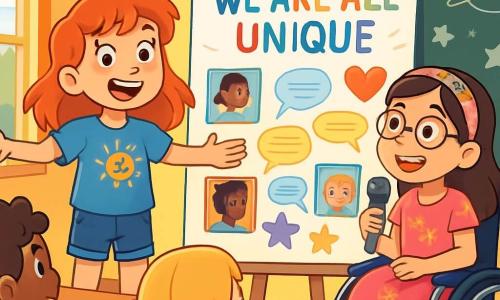
Mara began. “Our neighborhood guide is for anyone new to town,” she said. “And we wanted it to be useful for different people with different needs.”
She pointed to their symbols. “We marked places with ramps, elevators, and wide doors. We also included quieter spaces for people who get overwhelmed by noise.”
Lila chimed in, “Like the little garden behind the library. It's not crowded, and there are benches.”
Jay spoke last. “We also added notes for places that might be tricky,” he said, voice even. “Not to say ‘don't go,' but to say ‘here's what to expect,' and ‘here are other options.' Everyone deserves choices.”
The class listened. Even the kids who usually whispered during presentations were quiet. Ms. Patel nodded slowly, as if she was proud in a deep, adult way.
Afterward, a boy from another group raised his hand. “So… the ramp thing. That's not just for wheelchairs, right?”
Jay shook his head. “Nope. It helps lots of people.”
The boy nodded, thoughtful. “Cool.”
When presentations ended, Ms. Patel said, “These guides will be displayed in the front office. Families really do use them.”
Mara's chest felt warm again. Something they made would matter outside the classroom.
At dismissal, Jay rolled up beside Mara as she zipped her backpack. “You walking home?” he asked.
“Yeah,” Mara said. “Same route as always.”
Jay rang his bell lightly. “Mind if I roll with you? My mom's picking me up at the corner.”
Mara glanced at the hallway—busy, loud, full of swinging backpacks. “Sure,” she said. “But we'll take the long way. Less traffic.”
Jay's eyes crinkled. “I like the long way.”
They moved together through the quieter corridor near the art room. The walls were covered in paintings—storms, sunsets, silly cats. Mara noticed how Jay looked at them carefully, like he was collecting details.
Outside, the air smelled like warm pavement. They reached the corner where Jay's mom waited in a car with the window down.
Jay didn't leave right away. He looked at Mara. “Hey,” he said, a little awkward, “thanks for… being normal about things.”
Mara thought about it. “You mean, not pretending your chair isn't there, and not acting like it's the only thing about you?”
Jay smiled. “Exactly.”
Mara nodded. “And thanks for not acting like my quietness is weird.”
Jay lifted a hand. “Quiet people are the best. They notice stuff.”
Mara felt something steady settle between them, like a bridge built plank by plank. Not dramatic. Not perfect. Just real.
Jay's mom called, “Ready, Jay?”
He rolled back a little, then rang his bell once more. “See you tomorrow, Mara.”
“See you,” Mara said.
As she walked home, Mara noticed the sidewalk cracks, the curb cuts, the rhythm of her own steps. She thought about challenges—seen and unseen—and how taking the long way together didn't make life smaller.
It made it kinder.
And somehow, that felt like the best kind of adventure.