Chapter One: The Garden of Whirring Stars
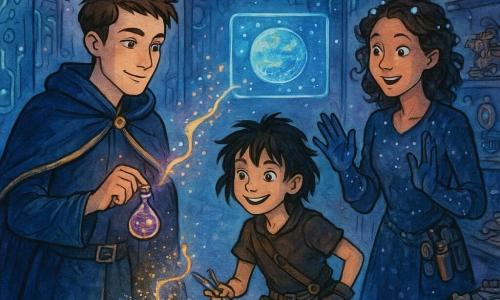
Asha tuned the rust-orange drone until its coaxial rotors hummed like a lullaby. Outside the lab's porthole, the sky of Nebula Keth was a bruise of indigo and teal, studded with slow, drifting comets that looked like fish tails behind glass. Inside, Asha's laboratory smelled of warm metal and crushed moon-mint, a scent that always made her think of home.
“Careful now,” she murmured as she adjusted the drone's sigil—an old family mark turned into an arcane circuit. The sigil glowed faintly when she threaded it with a silver filament of spell-silk. The drone's camera eye blinked. “That's it. Orbit stable. Good.”
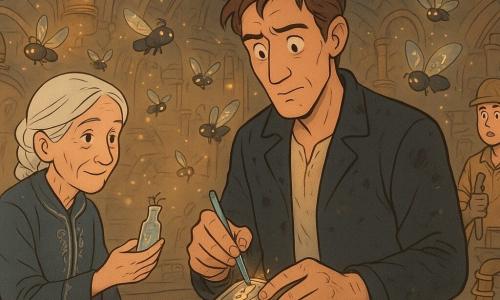
Asha had tended the drone-farm for nearly a decade, coaxing delicate machines to pollinate the floating spore-blooms that fed entire colonies. But her farm was different from others. It was part workshop, part conservatory, and part xeno-laboratory where she studied ancient lineages of life and magic. Her true passion was a ledger of names: a very old line—the Nerae—whose last living seed-kin were dwindling. Legends said the Nerae could weave starlight into healing, and that their craft once kept entire worlds from falling ill.
“You do remember the protocol,” said Lyra, Asha's assistant drone in the shape of a small silver bird. Lyra's voice was a tinkling chime stored on an old crystal. “We cannot overcharge the wards. The seed-kin are sensitive.”
Asha smiled. “I know. We'll be gentle.” She took a vial from the shelf: a viscous liquid called star-sap, harvested from a comet blossom last harvest. The sap shimmered with galaxies inside. She had learned to mix it with old runes, circuitry, and patient work. The mix—part tech, part magic—was how she hoped to revive the dormant line.
Her lab was filled with strange things: humming jars whose contents were tiny, sleeping nebulae; shelves of lichens that glowed if you sang to them; and a battered holo-map of the starways where she'd pinned memories of the Nerae's known worlds. On the map, red threads showed where the lineage had waned.
A courier from the Institute had delivered the last Nerae seed the week before. It was smaller than a fingertip and lay in a shell of crystal so thin it could have been a breath. “Keeper,” the courier had said, bowing, “this seed must be awakened carefully. Time has thinned its thread.”
She had promised. She had to try.
“It's different, this one,” Lyra said, looping around the vial. “It shivers like a comet in a jar.”
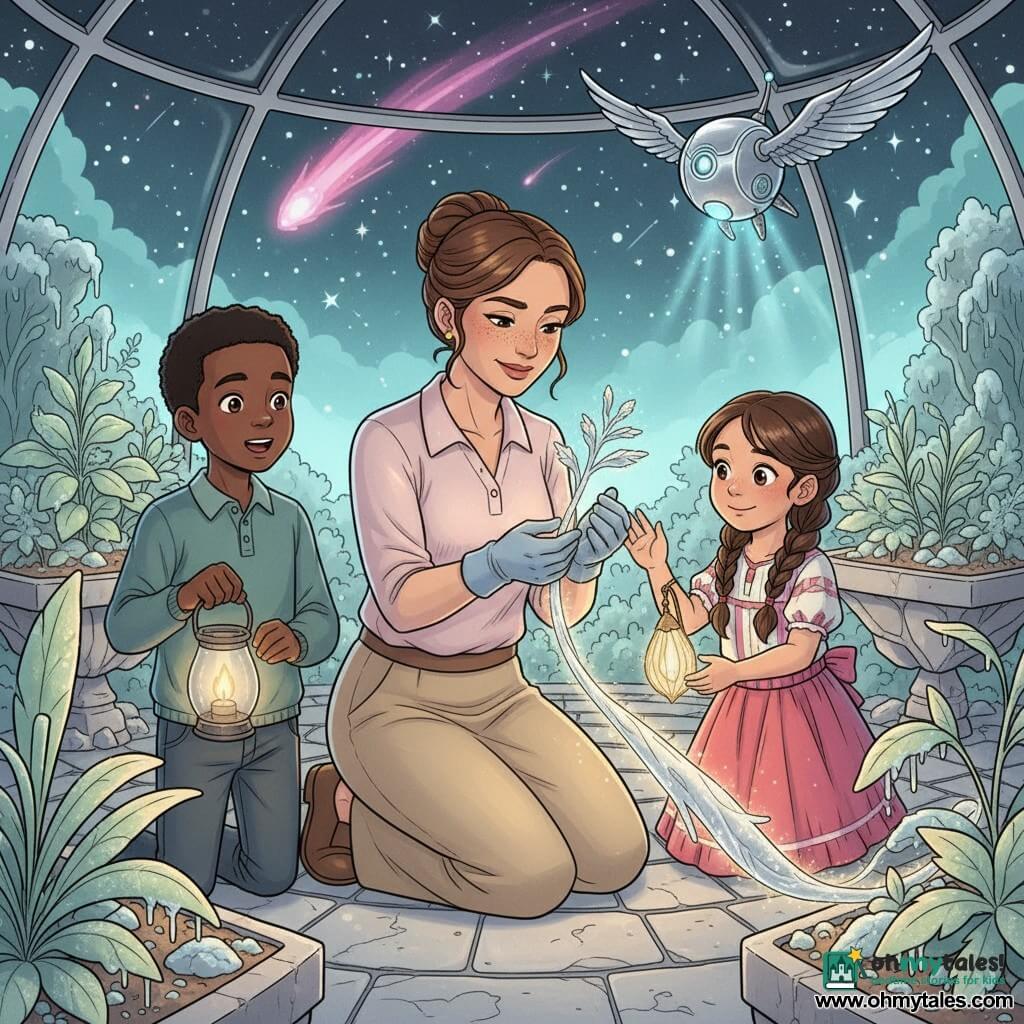
Asha set the seed in a cradle beneath a dome of spun starlight. She lined the dome with circuits that sang low frequencies, balancing the magic's pulse. Then she whispered an old incantation she had learned from an archive: words that bent light like silk. The lab filled with a soft wind, and the drone's rotors carved patterns across the air.
The seed blinked once—a tiny, almost human blink—then slept. Asha exhaled slowly. “We begin tomorrow,” she said, and for a moment, the hum of the lab and the slow drift of the sky were all the world.
Chapter Two: Lessons from the Void
The next morning, Asha taught Lyra and the other worker drones how to read the seed's dreams. It was a strange lesson, one that mixed sensors and stories. She fed the drones scraps of old myth-data and tuned their microphones to the frequencies of lullabies. The drones learned quickly; metal is patient, and magic is persuasive.
“What does it dream of?” Lyra asked as they hovered around the seed-cradle.
“Places,” Asha said. “Echoes of oceans that shimmer like mercury, groves of glass-leaves, and hands—soft hands—laying songs into its shell.” She traced a rune on the lab table, and it glowed. It represented memory-threading: a technique to sew a lineage back to its origin without forcing it to become something it no longer was. “We'll stitch only what belongs.”
Lesson by lesson, Asha showed the drones how to be gentle harvesters of hope. They learned to sing low, to move as if underwater, to carry a whisper on their wings. Asha taught the art of patience: how to wait beside a seed as if it were a sleeping friend, how to learn from it, not force it. That was the hardest part—the discipline of listening.
On the third day, a shadow crossed the lab's porthole. A ship docked at the neighboring bay: a black freighter painted with government sigils. The air tasted different. The Institute's delegated envoy, Serrin, stepped in with his crisp collar and smooth promises.
“We heard your garden houses a Nerae seed,” Serrin said, eyes quick as a radar. “The Institute wants to study it.”
Asha's hands paused on a spool of spell-silk. “The seed is under my care,” she said. “It needs steady, careful revival.”
Serrin's smile was thin. “Steady can mean slow. The Institute has methods that are... efficient.” He gestured to a silver crate the size of a drum. “Our accelerators can speed gene-songs along. Think of the lives we could save faster.”
Asha felt the old ache that had followed the Institute for years. Their efficiency had toppled living things before, turning songs into consumable data. “The Nerae are not data,” Asha said. “They are a lineage. They remember through being, through slow work. We cannot rush that.”
Serrin's jaw tightened. “You're sentimental, Asha. The galaxy needs utility more than myths.”
Asha looked at the seed, which blinked in its sleep. In its tiny chest, a light throbbed like a second moon. “Then we teach utility to listen.” Her voice was quiet but firm. “If the Nerae awaken only to be used, their gift will be hollow. If we train them to remember kindness, they will help truly.”
Serrin left with a warning, and the lab returned to humming. Asha felt the night's weight settle on her shoulders. She loved learning. She had learned chemistry and lullabies, old engineering with rune-soldering. She had learned to be patient enough to coax life from silence. She would need all those lessons now.
Chapter Three: The Stitched Dream
For weeks, the revival moved like slow tides. Asha worked through long watches, teaching the drones to stitch memory-threads into the seed's dream without smothering its own. They wove images of small things: the feel of warm sand under tiny roots, the sound of rain on a roof, the scent of a grandmother's braid. They embroidered these with star-sap and circuit-light.
“Now,” Asha told Lyra at midnight, “we ask, not push. We offer our hand. We show this lineage a path it might remember.” She laid a small holo of the Nerae's old world—an island of floating gardens called Sera's Hollow. The seed pulsed when the image played.
The drones were patient. Sometimes the seed recoiled, a sharp silence falling like frost. Once, a spasm of static fizzed through the lab; the seed dreamt of a fire that did not warm but ate. Asha soothed it with an old lullaby, her voice catching in the hush. “It remembers pain,” she said softly. “It remembers loss. We must be the kind of breath that steadies a storm.”
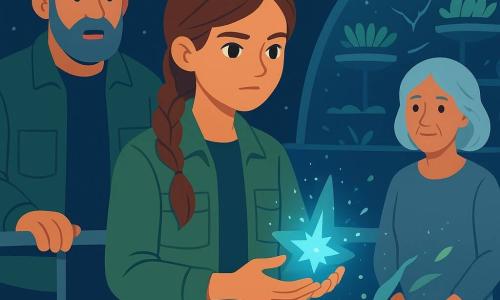
Then one dawn, the seed opened an eye like a star's slit. Its crystal shell unfurled into a tiny sprout of silver-thread that shimmered like a ribbon of night. The lab held its breath.
Asha knelt. “Hello,” she whispered. “I'm Asha. We'll learn together.” The seed answered not with words but with a drift of scent: rain on iron, new bread, and something like the song of the sea.
They named the sprout Nira, for a name in the ledgers—soft and old. Nira learned to breathe the lab's air, to taste metal dust and honeyed starlight. She listened to the drones, but she also listened to the stories Asha told of patience and the importance of asking before mending. She learned that power without care broke more than it built.
“You're getting stronger,” Lyra chirped, circling Nira. “You could be used to fix a leak, lift a wreck, heal a wound.”
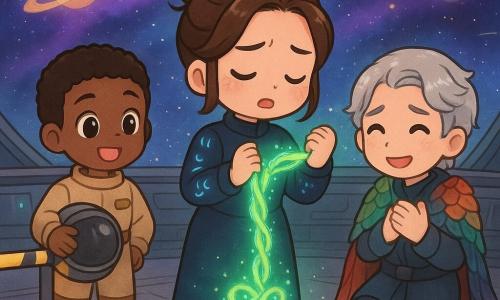
Nira's silver-thread quivered. “I can feel,” she said, voice like a bell wrapped in velvet. “I can hold. I can... remember.” She reached a tendril and brushed it against Asha's hand. The touch was a tiny thunder, warm and sure.
Word of the revival spread slowly at first and then, as news does, like splintering light. Travelers came with gifts: maps of ancient rivers, fragments of Nerae verse, and a chorus of children who asked to see the sprout that turned starlight into hush. The Institute's envoy, Serrin, returned with a more hospitable smile. “Show me how you wake a lineage,” he said.
Asha showed him the braid of lessons: patience, listening, offering. She let Nira hum a healing note into a cracked lens and together they repaired a child's toy telescope. The child peered through and gasped as distant planets threaded across one another like beads on a string.
Serrin's eyes were complicated when he left. “Perhaps,” he said softly, “I misunderstood.”
Asha did not celebrate. She could not unlearn the Institute's hunger. But she let herself feel a small, bright joy when Nira curled against her like a cat seeking the sun.
Chapter Four: The Trial of the Hollow Moon
Not long after, the threat they feared came in a form they hadn't expected: a sickness spread across nearby colonies, a creeping frost that made stars dim and plants sleep forever. The Council sent messages carved in urgency. “If a Nerae can be used to weave warmth back into the starfields,” they wrote, “please assist.”
Asha knew the truth in two ways. Use could heal, and use could wound. The question was: could this lineage be asked to give freely, to choose to help without being forced into a machine of obedience?
Nira pulsed under the lab's dome. “I can feel it,” she said. “The frost is like hands that do not know how to hold. I want to try.”
Asha packed the drones. They flew through lanes where comets hung like lanterns, and they landed on the Hollow Moon: a small satellite with gardens floating like rafts under glass. The frost had crept into its wells; vines hung like blue glass. Children sat in their doorways wrapped in blankets of static, eyes hollow with worry.
Asha set Nira at the center of the largest garden. The sprout unfurled into a tall silver wisp; her threads wove through the garden like threads through tapestry. She needed more than metal and song; she needed to remember what warmth meant to those she would mend.
“You don't have to take their pain as your own,” Asha said, kneeling by Nira. “You can hold it and make something kinder from it.”
Nira's voice was thin. “If I hold it, will it be mine?”
“You will decide,” Asha answered. “That is the lesson.”
Nira closed her eyes and reached outward. Her threads spun light into the frozen soil, singing of summers that tasted like honey and rain that laughed when it landed. The frost resisted, a chorus of thin, frightened voices. For a moment, the Hollow Moon shook; the frost pushed back like a tide without a shore.
From the edge of the garden, Serrin watched with the Council's team. He had a machine that purred with efficiency: a silver lance that could pierce and force a pattern into the soil. The Council's envoy urged him forward. “Hurry. Use it. The people need quickness.”
Asha stepped between Serrin and the lance. “If you force this, they will remember being forced. They will heal, perhaps, but they will not trust. Don't make them owe you.”
Serrin hesitated, the weight of the Lance's hum heavy in his hands. Nira's threads shivered. “I don't want the burden to be only mine,” she said. “But I can hold it if people hold with me.”
Asha raised her voice toward the crowd gathered in the gardens. “This is not just Nira's trial,” she called. “It is ours. We will give warmth together.” She taught the people a simple song—three notes, easy to remember—that reminded their touch how to be gentle. Children sang at the edges; elders hummed the second tone; the drones lent their rotor hum as the third. It was messy, imperfect, and it worked.
Nira took the warmth and wove it into a net of light. The frost loosened its grip like sleepy hands unclenching. The gardens sighed, then unfurled new green as if waking from a dream. The people cheered, but the sound that mattered most was the hush of trust restoring itself between giver and given.
Serrin lowered the lance. He watched the way people cradled the mended gardens instead of snapping them into neat rows. “You taught them to hold,” he said to Asha later, voice small with something like respect. “I thought my way was the only way.”
“You had a way,” Asha said. “But we all have to learn to listen.”
Chapter Five: Threads that Teach
After the Hollow Moon, Nira grew in ways that surprised everyone. She learned to mend not by taking power into herself but by inviting it to join. People came to learn: technicians who wanted to build warmer engines, healers who wanted to remember gentleness, teachers who wanted songs for the classroom year.
Asha opened the lab's doors and started lessons. She taught about circuits and lullabies, about gentle engineering and how to thread spells without strangling a living thing's memory. Her students were a mixed crowd: a miner who had never sung, a poet who loved math, and a child who had watched the garden grow from a toy telescope.
The lessons were less about formulas and more about questions. “What does it mean to ask?” Asha would ask as they soldered a rune. “How can we measure kindness? Who gets to decide?” She showed them how to stitch a learning-loop into a machine: a tiny sensor that prompts an apology if the machine makes a mistake, a soft glow that dims when someone forgets to ask before touching.
“We need to create systems that teach themselves to be kind,” Asha said during one class. “Machines can learn skill, but only people can teach heart. Our work is to join those things.”
Her students stumbled at first. Patience did not come easily to many. But Asha kept teaching. She would tell stories from the old ledgers: the Nerae who had once mended a sun-shed for a village and had asked nothing in return but songs. She reminded them that learning is not only collection but practice: the practice of asking, listening, and adjusting.
Lyra, ever by Asha's shoulder, chirped a lesson tune that the kids hummed under their breath. Asha taught them to balance equations of care. “One part skill, two parts listening,” she joked, and they laughed, but the laughter carried a truth.
When a new apprentice accidentally angered a mending drone, the class gathered to soothe and learn. They apologized, repaired the drone's casing, and offered it a spare lullaby. It hummed, then resumed its work. The apprentice's cheeks were red, but so were her eyes with understanding. She had learned how to be careful. That mattered to Asha more than any ledger of successes.
Chapter Six: A Certainty Like Morning
Years folded like pages. Nira became a teacher in her own right, weaving small tendrils into young seeds to show them the dance of asking. The ledger of the Nerae grew fuller with new names and stories: students who had learned to sing with their hands, farmers who mended soil like scripture, children who stitched songs into their toys before bedtime.
Asha grew older in ways that made her laugh—the kind of laugh that comes from a life used. Her hands were marked with metal burns and ribbon scars from a thousand careful tucks. She taught, she listened, she learned anew each season.
One evening, Asha stood by the porthole and watched comets thread through the nebula. Lyra landed on her shoulder. “Did you ever fear you would fail?” the drone asked, its voice a bell in the quiet.
Asha let out a soft breath. “Many times,” she said. “But failure is a teacher. It tells you how to stitch differently. If you listen, it becomes part of the lesson.”
“That sounds like something the Nerae would say,” Lyra chirped.
Asha smiled. She held a small ribbon—a thread from the first seed-cradle—between her fingers. It was frayed now, but still warm with memory. She had done what she set out to do. Not by forcing, not by efficiency alone, but by teaching, by learning, by inviting. The old lineage had not been turned into a tool; instead it had been taught to choose, to remember kindness, to join people and machines in a practice of care.
“Come,” Asha said. She walked to the lab's central table where a long roster hung: names, brief notes, a dozen small sketches of stars. She added one more name—another seed that had been replanted, a note that read: “Taught to ask.”
When she stepped back, the list shone under the lab's light. In the end, the most important thing was simple and bright: the line continued.
Asha looked out once more at the slow, turning universe and felt a certainty settle like morning. She had taught and been taught. The Nerae's thread, once thin and tremulous, now ran through many hands and many songs.
She turned to Lyra and Nira, who were playing a slow duet—a melody of rotor hum and silver-thread pluck. “We learned,” she said.
“We learned,” they answered.
And Asha knew, without complicated words or fancy proofs, that some lines are worth keeping: not to control, but to cherish. The certainty was small and steady, like the first light at dawn: the line of life would go on because people had learned to care.