Chapter 1: The Engine District That Sang
In the far city of Starwharf, where the sky was not a sky but a slow river of galaxies, there was a neighborhood that never truly slept.
People called it the Engine District.
It was built inside a hollowed asteroid, and its streets were tunnels of iron and glass. Pipes ran like shiny vines along the walls. Lanterns floated on gentle anti-gravity charms, bobbing above doorways. Every few steps, steam hissed from vents and smelled faintly of cinnamon-oil used to polish metal.
And everywhere—everywhere—were engines.
Not just ordinary engines. These were engraved engines, carved with tiny spirals and star-runes, their shells decorated with moons, comets, and little dragons that curled around bolt heads. When they turned, they didn't only make power. They made music: deep thrums, bright chiming clicks, and long notes that sounded like whales calling in space.
Arlo Venn walked through it all with a notebook in one hand and a tiny lens in the other.
Arlo was an adult man, tall and narrow-shouldered, with dark hair always sticking up as if it had argued with gravity and won. He was a xenobiologist—someone who studied living things from other worlds. He usually observed creatures with delicate patience, the way you might watch a shy cat peek from behind a chair.
Today, he was watching something much stranger than a cat.
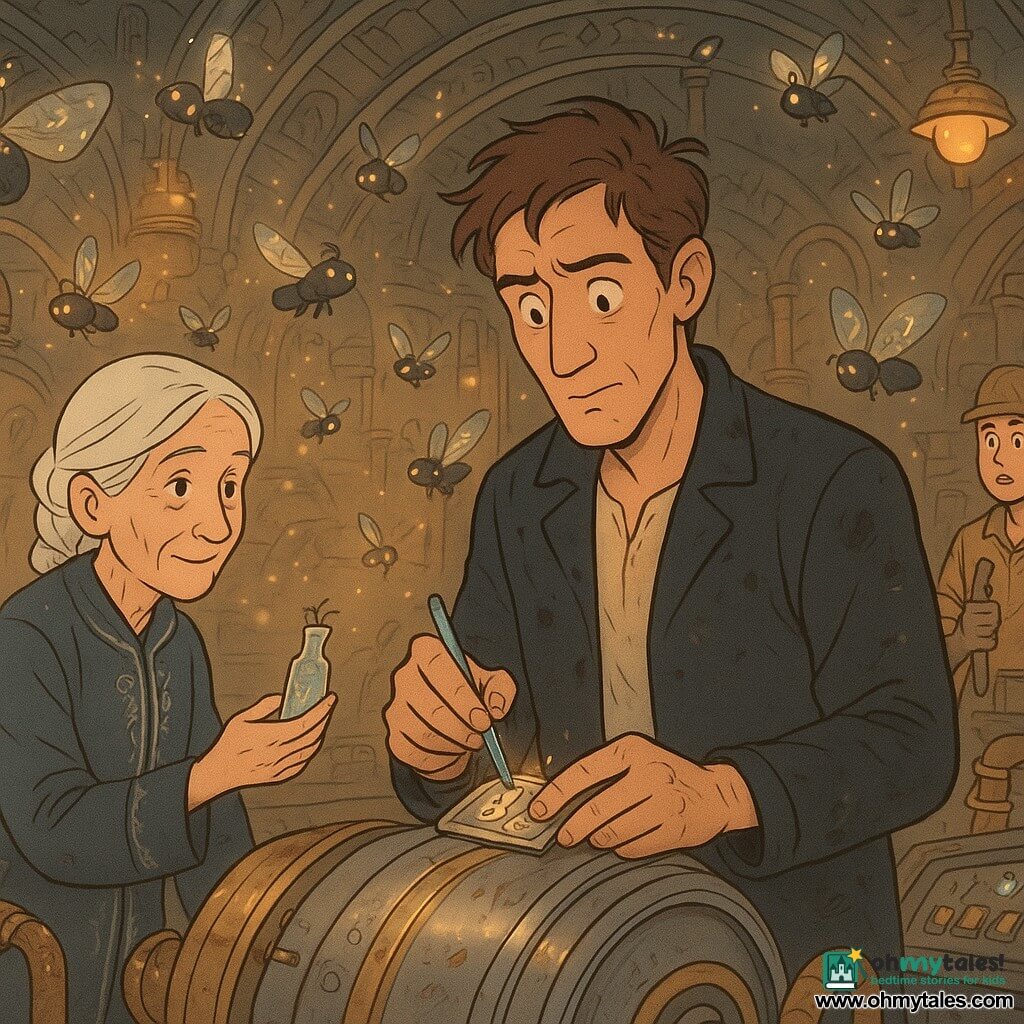
A small cluster of “sparkmoths” hovered near a warm engine vent, their wings glittering like bits of stained glass. They weren't insects exactly. Their bodies were made of soft, dark fuzz, but their wings carried tiny glowing numbers instead of patterns: 3s and 8s and 1s, flickering in gentle rhythms.
Arlo whispered as he wrote. “Wing-beat repeats every… seven pulses. Numbers shifting with temperature.”
A sparkmoth drifted closer, as if listening. On its wings the numbers changed: 2… 4… 6… 8… then back again.
“Even steps,” Arlo murmured. “Like a little dance.”
He smiled, because curiosity was his favorite kind of magic.
But beneath the music of engines, something else lurked—something slightly wrong. The district's song had a stumble in it. A skipped beat. A grinding note.
Arlo felt it in his boots.
He followed the sound to a huge workshop door marked with a copper plaque: ENGRAVING HALL 9.
Inside, the air shimmered with heat and spell-light. Rows of engine shells sat on racks like sleeping beasts. Engravers in thick gloves leaned over them, etching star-runes with tools that glowed blue at the tip.
In the center stood a foreman with soot on his cheek and worry in his eyes.
“Arlo Venn!” the foreman called. “If you're here to admire the art, now's a bad time.”
“I'm here because the engines sound… limping,” Arlo said gently. “What's happening?”
The foreman rubbed his neck. “The Great Array is losing harmony. Two engine-houses are out of sync. Our ships are stuttering at launch. Even the street-lights keep blinking like they can't decide whether it's day or night.”
Arlo listened. The engines' notes overlapped, but not neatly. It was like a choir where two singers were singing the right song at the wrong moment.
“Has anything changed?” Arlo asked.
“Nothing we can see,” said the foreman. “Nothing we can fix.”
Arlo looked down at his notebook. Then he looked back at the sparkmoths fluttering near the vents, their wing-numbers changing like a secret language.
“Maybe,” Arlo said, “something has changed that isn't meant to be seen… but counted.”
Chapter 2: The Librarian of Moving Numbers
Arlo's best place to think was the Counting Pier, a narrow balcony that hung over the Engine District's deepest power chamber. From there, you could hear the whole neighborhood at once—the hum of workshops, the clink of tools, the chorus of engraved engines.
And if you listened carefully, you could also hear the gap.
Arlo leaned on the rail, watching a swarm of sparkmoths drift like tiny living lanterns. Their number-wings glittered. As they moved, the numbers shifted in patterns that felt almost… polite, as if the moths were bowing to each other.
A voice behind him said, “They like you.”
Arlo turned. An old woman stood there, wearing a coat stitched with silver thread. Her hair was white and braided, and her eyes were sharp as star-points.
“I'm sorry,” Arlo said. “Do I know you?”
“You don't,” she replied, “but you've been watching instead of grabbing. That's rare. I'm Mira Quill, keeper of the Drift Archive.”
Arlo had heard of the Drift Archive. It was a hidden library where maps changed on their own and stories sometimes floated off the page if you didn't pay attention.
Mira pointed to the sparkmoths. “Those are Numeris sparkmoths. They feed on warmth and rhythm. When the rhythm is sick, they get restless.”
Arlo nodded slowly. “The engines are out of harmony.”
“Not only the engines,” Mira said. “The numbers inside the engravings. The counting has slipped.”
Arlo blinked. “Numbers inside engravings?”
Mira walked to the railing and tapped it twice. The metal rang. “Every engraved engine carries two things: power and order. The runes tell the engine how to behave. The numbers tell the runes when to sing.”
Arlo's mind felt like a door swinging open. “Timing.”
“Exactly,” said Mira. “Long ago, engineers and mages made a way to keep timing perfect. It was called the Dance of Numbers.”
Arlo couldn't help it—he laughed a little. “That sounds like something from a bedtime tale.”
Mira's serious face cracked into a tiny grin. “Most important things do.”
She reached into her coat and pulled out a thin strip of metal, no longer than Arlo's finger. It was engraved with tiny digits that seemed to shift when he blinked.
“This is a counting-slate,” Mira said. “If you learn the dance, you can hear where the rhythm breaks. Then you can guide it back.”
Arlo held it carefully. It felt warm, as if it had a heartbeat.
“I'm a xenobiologist,” he said. “I study living things, not… dancing numbers.”
Mira raised an eyebrow. “Then you are perfect. You already know how to observe. You already know how to try again when you don't understand. The dance is patience wearing fancy shoes.”
Arlo stared at the counting-slate. The numbers along it pulsed: 1… 1… 2… 3… 5… 8…
He frowned. “Those numbers… they're like steps that add up.”
Mira's eyes brightened. “You see it. Not everyone does.”
From below, an engine coughed—a deep metallic clunk that sent a shiver through the pier. The lights flickered, dimmed, and returned with a weak buzz.
Mira's voice lowered. “If the Great Array loses harmony, Starwharf's ships can't fly safely. Supplies won't arrive. People will panic. The Engine District will stop singing.”
Arlo's fingers tightened around the slate. He pictured the sparkmoths, fluttering in confusion. He pictured launch bays full of ships that couldn't trust their own hearts.
“Teach me,” he said.
Mira nodded once, as if she'd been waiting. “Then don't rush. The Dance of Numbers punishes impatience by simply… not working.”
Arlo took a deep breath.
He was ready to persist, even if the steps felt strange.
Chapter 3: Learning the Steps Between Stars
Mira didn't teach in a classroom. She taught in places where numbers lived.
They started in a humming alley where water pipes dripped in steady beats. Mira set three small pebbles on the ground and tapped them in a pattern: tap-tap… pause… tap… tap-tap-tap.
Arlo tried to copy her. His fingers were clumsy at first. Tap-tap… pause… tap… tap—
He rushed, and the pattern fell apart like a tower of cards.
Mira didn't scold him. She only said, “Again. Slower.”
They moved to a workshop where an engraver carved runes into an engine's shell. Mira pointed at the tool's glow. “Each flicker is a count. Listen with your eyes.”
Arlo watched. The glow brightened, dimmed, brightened—then hesitated.
“Did you see it?” Mira asked.
“I… think so,” Arlo said. “A missed beat.”
“Good,” Mira replied. “Now don't think. Feel.”
That was the hardest instruction Arlo had ever been given.
He liked facts. He liked notes and labels and clear answers. But the Dance of Numbers wasn't only logic. It was rhythm, like skipping stones across a pond. Too much force and the stone sank. Too little and it plopped into the first ripple.
They practiced with sparkmoths too. Mira held up the counting-slate, and the moths gathered as if it were a warm campfire.
“Watch their wings,” Mira said. “They mirror what the district is doing.”
Arlo watched the shifting digits. When the engines below thrummed smoothly, the sparkmoths' numbers lined up in gentle streams: 1-2-3-5-8, then looping back like a story with a favorite part.
But when an engine hiccupped, the wing-numbers scattered. Some jumped ahead. Some lagged behind. The swarm swirled like a confused flock of birds.
Arlo tried the dance.
Step with the count. Pause with the gap. Breathe where the pattern wanted breath.
At first, his steps were wrong. The slate stayed dull. The moths ignored him. An engine clanked loudly in the distance, as if laughing.
Arlo sighed. “I'm too slow.”
Mira pointed to a tiny sprout growing out of a crack in the metal floor—an audacious little green thing in a place of steel. “That plant is slow too. Yet here it is.”
Arlo looked at it, and something eased in his chest. He tried again.
This time he didn't force the numbers. He listened for them, the way he listened for shy creatures breathing in the dark.
He stepped: one, one, two, three, five—
The counting-slate warmed.
A sparkmoth landed on his sleeve. Its wings flashed 8, then 13, like a congratulation.
Mira nodded, pleased but not surprised. “Now you can sense the flow. Next, you must find where it breaks.”
Arlo swallowed. “How?”
Mira gestured toward the deepest tunnels of the Engine District, where the Great Array's main engines lived. “By going where the song is loudest.”
From far below came a rolling thrum, like thunder trapped in a drum.
Arlo looked down into the glowing mist of the power chamber and felt very small.
Then he remembered the sprout in the crack.
He straightened his shoulders. “Let's go.”
Chapter 4: The Stuttering Heart of the Great Array
The tunnels to the Great Array were lined with mirrors—not for vanity, but for safety. They reflected warning lights and rune-signals so workers could see trouble coming.
Arlo and Mira walked deeper, past pipes that pulsed with blue light, past doors that whispered passwords when opened. The air grew warmer. The engine-song grew louder.
At last they reached the Array Chamber.
It was enormous, a cathedral of metal. Two colossal engines faced each other across a gap like rival giants. Their engraved shells glowed with constellations. Between them floated a ring of crystal panels, spinning slowly, catching sound and turning it into light.
But the light was wrong.
One engine sang in a steady bass. The other answered a moment too late. Their voices collided, making the crystal panels tremble. The spinning ring wobbled, as if dizzy.
On a platform above, technicians argued and pulled levers. Sparks flew from a control console. A warning bell rang, not loudly, but often—an annoying ding-ding-ding that made everyone's nerves itch.
Mira handed Arlo the counting-slate. “Now. Dance.”
Arlo stepped onto a narrow walkway that stretched between the two great engines. Heat rose around him. The engraved runes shimmered, like tiny stars trying to blink in time.
He began with the pattern he had practiced: one, one, two, three, five—
The slate pulsed against his palm. It tugged, like a compass needle.
Arlo took another step, and the tug grew stronger toward the right engine.
He closed his eyes for half a second—just long enough to listen with his whole body. The right engine's rhythm didn't match its own carvings. Something inside it was counting wrong.
He walked closer. The technicians shouted at him to step back, but Mira lifted her hand and they hesitated, because there was something about her that made even loud people remember manners.
Arlo leaned near the engine's engraved shell. Among the star-runes, he spotted a small plate—the timing plate—etched with numbers so tiny they looked like a line of glitter.
But one section had been scratched.
Not deeply, not like an attack. More like an accident. A tool slip. A hurried worker.
The scratch crossed a single digit.
Arlo's stomach flipped. “One wrong number,” he whispered. “It throws the whole dance off.”
Mira's voice came softly behind him. “Small mistakes can make big storms.”
Arlo looked at the scratch again. Fixing it wasn't as easy as painting over it. The timing plate was part of the engine's magic. If he guessed, he could make it worse.
He lifted the slate. The numbers on it shimmered, offering a pattern—then fading when he tried to grab the answer too quickly.
Arlo shut his eyes, breathed, and remembered: don't rush.
He began to dance again, but this time he danced with the engine. He matched its bass thrum, then guided his steps toward the missing beat, like showing someone where to place their foot.
One, one, two, three, five… pause… eight… thirteen…
The slate grew hot. The sparkmoths, drawn by the warmth and rhythm, fluttered into the chamber in a shining swarm. They circled the scratched plate, their wing-numbers flashing in unison.
Arlo opened his eyes.
On the moth wings, the correct digit glowed again and again, as if written in light: 8.
He exhaled. “Eight. It should be eight.”
A technician shouted, “We can't re-engrave while it's running!”
Mira stepped forward. “You can, if you use living ink.”
She reached into her coat and produced a tiny vial. Inside, a silvery liquid swirled, sparkling like moonlight.
Arlo realized what it was: ink made from shed sparkmoth dust—harmless, but magically eager to settle into proper patterns.
The technician hesitated, then handed Arlo a fine engraving stylus.
Arlo's hand trembled. The engine's heat prickled his skin. The whole city's rhythm seemed to rest on the point of that stylus.
He dipped it into the vial. The ink clung like liquid starlight.
“Slow,” Mira reminded him.
Arlo nodded. He placed the stylus on the scratched digit and traced the missing shape carefully, guided by the Dance of Numbers still moving in his legs.
The moment the 8 was whole, the timing plate flashed.
The right engine's song snapped into place like a puzzle piece.
The crystal ring steadied. The warning bell stopped mid-ding, as if surprised by silence.
Then the two engines sang together—perfectly matched—filling the chamber with a harmony so smooth it felt like warm wind.
Arlo's knees went wobbly. He laughed, half from relief and half because it was impossible not to.
The technicians cheered. Even the grumpiest one looked like he might cry, though he tried to hide it by coughing loudly.
Mira smiled at Arlo. “You persevered.”
Arlo looked at the sparkmoths swirling overhead, their numbers now flowing like a bright river. “I almost rushed,” he admitted.
“Yes,” Mira said. “And you didn't.”
Chapter 5: A New Song in the Steel
The Engine District noticed immediately.
Street-lanterns stopped blinking and glowed steady and gold. Workshop tools hummed with happy energy. In the launch bays, ships that had been grounded lifted a few inches as if testing their legs again.
Word traveled fast through Starwharf. People waved to Arlo in tunnels where no one usually waved. Someone pressed a warm pocket-pie into his hands and ran away before he could refuse.
Arlo returned to the Counting Pier with Mira as the district's music rolled beneath them like a gentle ocean.
The sparkmoths gathered again, calmer now. Their wing-numbers shimmered in tidy patterns, and a few hovered near Arlo's head as if crowning him with math made of light.
Arlo took out his notebook. This time he didn't only write facts.
He drew.
He drew the engines like giant singing whales. He drew the crystal ring like a halo. He drew the tiny scratched digit that had almost become a disaster. And he drew himself, awkwardly mid-step, trying to dance without tripping over his own feet.
Mira watched. “So, xenobiologist,” she said, “what will you do with a dance that can mend engines?”
Arlo thought about it. He had come to Starwharf to observe alien life, and he still loved that work. The sparkmoths had taught him something important: living creatures and machines were not enemies here. They were neighbors.
“I'll keep studying,” Arlo said. “But I'll also teach what I learned. To engineers. To apprentices. To anyone who thinks they're too clumsy or too slow.”
Mira nodded, satisfied. “Good. Harmony is not something you fix once. It's something you practice.”
Below them, the Engine District sang on—engraved metal and drifting magic, warm lights and steady counts, technology and wonder woven together like a bright tapestry across the stars.
A sparkmoth landed on Arlo's finger. Its wings flashed a simple sequence: 1… 2… 3… then a neat little 4, as if saying, Keep going.
Arlo smiled. “I will,” he promised.
And in the great hollow of the asteroid-city, under the river of galaxies, harmony was found again—not by luck, not by speed, but by patient steps and the courage to try one more time.