Chapter 1 — The Moon's Quiet Workshop
There once was a man named Masato who kept a small house at the edge of a round, silver lake. He was careful with everything: he swept the moss, tied his sandals in tidy knots, and always folded the sleeves of his kimono just so. People in the village said Masato listened the way a pine tree listens to wind—slow and patient.
Every autumn, when the moon was full and orange like a persimmon, the village gathered for tsukimi. They sat on low benches, sipped barley tea, and thanked the moon for rice, for rain, for days that had been kind. Masato liked to sit a little apart, near the reeds, with his hands resting on his knees. He watched the moon as if it breathed softly into the lake.
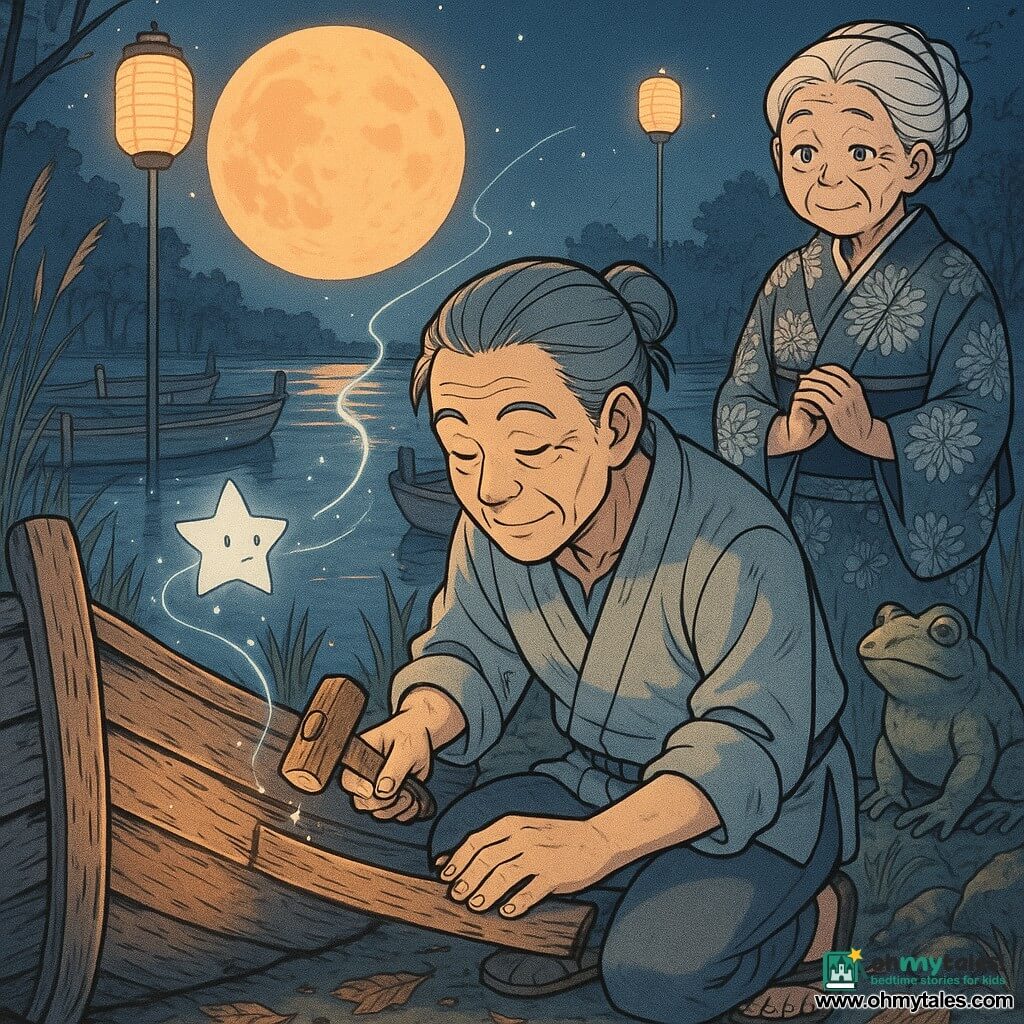
Near his house was a small harbor where messenger boats once skimmed across the water. Long ago, the boats carried notes and small gifts between the islands of the lake. The messengers were quick as dragonflies. But now the boats were quiet, their paint faded like morning mist. Masato kept an old hammer and thin strips of wood in a neat box and he had a secret dream: he wanted to fix the messenger's barque so it could sing over the water again.
“I would mend every crack and knot,” he told his neighbor, an old woman who grew chrysanthemums. “But the boat sleeps under years of leaves.”
“You listen so well to the wood,” she said, patting his shoulder. “Maybe the wood listens to you.”
At night, under the moon, Masato walked to the harbor and touched the boat's hull. He asked it softly, “What will you tell the lake if you could glide again?” The wood only creaked like a deep hush. Still, Masato listened. He could hear—tiny, almost like a breath—the song of the lake asking for help.
Chapter 2 — A Rain of Stars
One evening in late summer, the sky grew very clear. The moon hung like a bright bowl, and the reeds shivered with a cool promise. As the village prepared sweet rice dumplings, a hush traveled across the houses. Then the air filled with a soft sound—like beads of light clicking together—followed by a shimmering shower: a rain of stars crossed the sky.
“It's the Star Rain,” children whispered, eyes wide. They ran to catch the falling lights in their hands, but the starlight slipped like warm water. Masato stood very, very still. He felt the falling lights as if they landed on his ears first, and then walked into his chest.
One tiny star settled on the rim of the old messenger's boat. It did not melt away. It blinked like a small lantern and then climbed, not into the sky, but into a knot in the wood. A slender voice, like a bell from far away, called out.
“Who listens?” it asked.
Masato kneeled. “I do,” he said. “I have been listening.”
The little star-wisp rose and took the shape of a small creature no taller than a rice bowl. It wore a coat of silver mist and had eyes bright as moonlight. It bowed with the dignity of an old spirit.
“You hear the wood speak,” said the star-wisp. “We are the lake's messengers of light. Our boats have rested too long. Our oath has grown thin. If one who listens mends the barque, we will help the lake remember how to carry words again.”
Masato's hands trembled. “I will mend it,” he whispered.
The star-wisp smiled like a tiny moon. “Then you must listen not only with your ears, but with your hands and your heart. Begin with questions, and let the wood answer.”
Chapter 3 — The Long Conversation
Masato set his tools on a cloth blessed by the old woman and began to work. First he cleaned the boat, sweeping away damp leaves and digging out tiny pebbles that slept between the planks. He listened. The boat's voice was not loud; it spoke through the cracks as if telling stories of long journeys.
“What are you afraid of?” Masato asked the boat softly.
“I fear being forgotten,” the boat sighed, sounding like wind through straw. “My ribs creak for names I carried once. The lake remembers, but I am weary.”
“And what would you remember if you could?” Masato continued.
“Names,” the boat whispered. “Names of islands, of foxes who grinned at moonlight, of little hands that once tied strings to letters. I remember the warmth of palms and the sound of gratitude.”
Masato patted the wood. “Then I will mend you for those names.”
He scraped the old paint with careful strokes and spoke to each plank as he fit new slivers into gaps. When he hammered, he listened for the sigh of relief from the nails. When he smoothed the beam, he asked which grain to follow. Sometimes the boat would tell him to go left, sometimes to go right, and sometimes it fell silent to remember a far-off bell.
All evening the star-wisps danced above the lake, weaving threads of light that hummed like a soft loom. They taught Masato to breathe with the tide—slow in, slow out—so that his hands would move as if learning an old song. When he faltered, a tiny wisp would touch his wrist and hum until his worry unknotted.
Near midnight the moon rolled its silver wheel across the sky. Masato paused and listened. A small voice came from the reeds: it was the spirit of the harbour, an old frog-shaped guardian who kept watch over boats.
“You listen to wood and to waves,” said the frog-guardian. “Do not hurry. Even the moon takes its time.”
“I am afraid my hands will not be enough,” Masato confessed.
“The lake will be with you,” said the frog-guardian. “And the sky. That is what listening does: it gathers help.”
So Masato listened harder. He listened to the pattern beneath the knots where moths had woven tiny curtains. He listened to the way the lake licked the hull at low tide. He listened to the memory of children laughing, and the old messages that smelled like plum and cedar. With each listen he learned how to place each nail, where to join the ribs, how to bind the oarlocks so they could sing again.
Chapter 4 — The Boat Remembers
At dawn the last star-wisp folded like paper and whispered into the boat's keel. Masato gave a final touch: a ribbon of paper dipped in tea for luck. He tied it to the prow and spoke to the boat like an old friend.
“Are you ready?” he asked.
The boat trembled, and from its wood rose a low, glad sound—half song, half wind through bamboo. It turned a little in the water, as if stretching after a long sleep.
“You have mended our voice,” said the star-wisp. “Now the boat must remember the words it will carry.”
The boat shivered and called to the lake in a tone like many shells. The lake answered with a ripple that sounded like laughter. The messengers—small lights—came out of the reeds and tied themselves to the boat's stern. They were like paper cranes made of moonbeams.
“Take us once,” they asked the boat, “and carry one small message.”
Masato slid into the seat with hands steady and a heart light as steamed rice. He did not steer with rough force but listened to the way the oars wanted to dip. The boat moved, first slowly, then like a thought that grows into a smile. It skimmed across the mirror of the lake and made small waves that tickled the fish.
They carried a message that smelled of plum and carried a child's drawing of a cat. When they reached a little island cradle of grass, a small hand appeared and took the note. The child laughed and waved a leaf. The boat hummed with pride, and the little stars fluttered like sewing needles closing a seam.
People from the village came down to the shore. Some wept quietly, some clapped soft hands. The old woman with chrysanthemums bowed low to Masato.
“You listened,” she said simply. “You listened and the lake spoke back.”
Masato smiled. “I only asked questions,” he said. “Then I let the answers come.”
Chapter 5 — The Listening That Grows
From that season on, the messenger's barque carried small things that mattered: a song, a recipe for a family soup, a promise to visit, a knitted mitten left for a lonely fox spirit. Masato would mend what needed mending and then sit with his hands folded while the lake told stories. Sometimes he closed his eyes and heard instead the rustle of the rice fields, or the chuckle of a fox spirit washing its paws in moonlight.
Children learned to sit quietly at his feet and ask gentle questions of the boat. They learned that listening can be like planting—first you give your care and later a thin green answer will push up. Even the fishermen mended their nets with more care, because they too had learned the way the lake liked to be spoken to.
One autumn night, another rain of stars came, and Masato walked to the harbor with a cup of tea. A star-wisp landed on his shoulder like a warm pebble.
“You taught them to listen,” it said.
“No,” Masato answered, looking at the silver water. “I taught them to ask. The lake taught us how to hear.”
The star-wisp hummed. “Listening is like a lantern,” it said. “It lightens what it looks upon.”
Masato nodded. He lifted his cup to the moon in the old way, a quiet thanks for the work of many small things—nails, hands, breath. He thought of the wood that had once feared being forgotten and now remembered names again.
“If you ever forget how to listen,” the frog-guardian croaked from the reeds, “stand by the water. The lake will teach you.”
So Masato kept listening all his life. He mended not only boats but also small silences between people. When someone felt alone, he would fold his sleeves and listen. And slowly, the village grew gentle, like paper warmed by the sun. The moon watched, pleased.
The whispering spirits of the lake stayed close, like long friends who visit with tea and rice cakes. Occasionally, on nights when the moon was especially round, a rain of stars would fall and a new little wisp would find a home in the boat's knots. Each wisp taught a new child the quiet art: to ask small questions, to wait without rushing, and to let the answers come like tides.
And when the wind sounded like an old lullaby, Masato would smile, close his eyes, and listen—because listening, he had learned, is the kindest way to help anything heal.