Chapter 1 — The Morning Light
In a small village folded between green hills and a silver river, Kenji woke before the sun. His house was the kind with a paper lantern at the gate and a tiny garden of moss and stones. He brewed tea quietly, watching steam make soft clouds that rose like small spirits. Kenji liked the slow start of mornings. He listened to the village waking: the click of a door, the distant laugh of children, the woodpecker tapping at an old maple.
Kenji worked with his hands. He mended sandals, stitched sleeves, fixed clocks that had stopped ticking. People said his hands knew stories. Once he touched a teapot, its chipped lip felt less lonely; once he oiled a bicycle chain, the bike sang again as if it remembered the wind.
One spring morning, a paper note arrived on Kenji's doorstep. It was folded like a little boat and smelled faintly of plum blossoms. The note read: "Day of Small Repairs — bring what is broken. Help others, mend what needs mending." The letters were neat and steady, as if the wind itself had written them.
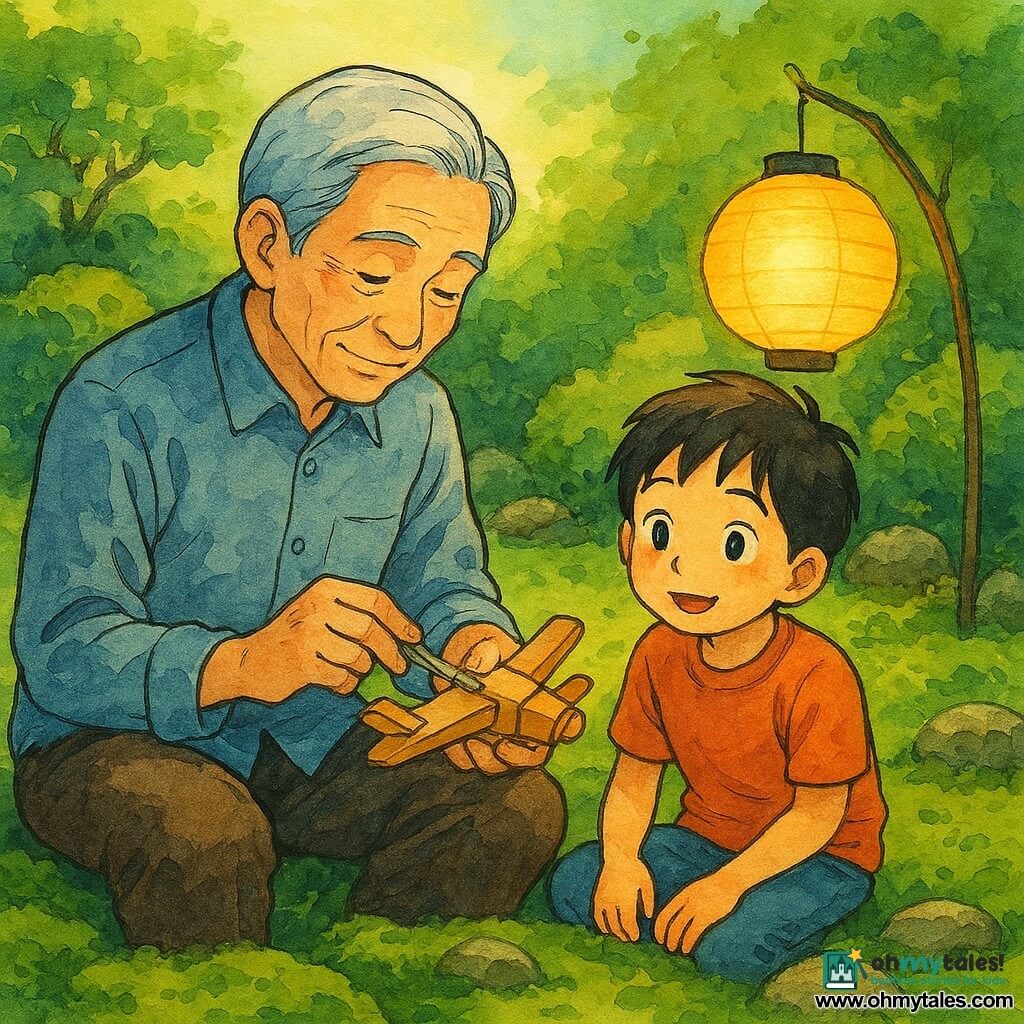
Kenji smiled. He decided to organize a Day of Repair in the village. Repair, he thought, was like listening to an old friend: each scratch and loose thread had a reason. By listening, by caring, small things could be whole again. He hung a bright lantern, Akari, outside his gate. Akari was not an ordinary lantern. It had a soft warm glow, and if you stood close and whispered, it would seem to nod, as if understanding.
"I will ask the village to repair together," Kenji told Akari, touching the warm glass. "We will listen to each thing."
Akari hummed, a tiny sound like a sleeping beetle, and the light pulsed kindly. The lantern seemed pleased.
Chapter 2 — What Needs Listening
On the morning of the Day of Repair, villagers arrived with baskets, boxes, and humble items wrapped in cloth. The path to Kenji's house became a river of colors: a faded kimono, a cracked wooden bowl, a small boat with a loose oar, a child's wooden bird whose paint had worn thin. Each object looked hopeful as if it knew it would be held and heard.
Kenji greeted everyone with tea and a soft bow. "Bring your things," he said. "We will listen first. Then we will mend."
A blue-haired woman named Miyo brought a broken teacup that had belonged to her grandmother. "It sounds tired," she said quietly. "It rattles when the kettle sings."
Kenji held the cup gently. He closed his eyes and let silence come in. He listened to the cup's small, inside song. Sometimes he hummed to match it, like two friends learning each other's names. He polished the rim, glued the small crack with careful hands, and then wrapped it in a cloth stitched with a bright thread.
"There," Kenji said, handing the cup back. "It needed time and a strong stitch. It will still keep stories."
Miyo smiled and touched her forehead lightly in thanks. In the corner, children drew paper cranes and folded little notes to hide in the cup for good luck.
A boy named Haru came with a kite; its paper wings had been torn by last autumn's rain. "It cries when it can't fly," Haru whispered.
Kenji and Haru laid the kite on a mat. Kenji showed Haru how to feel the tear, how to place new paper like a patch of sky. He tied the string with patient fingers. "Kites need space and a steady hand," he said. "They also like to be told that they are brave." Haru laughed softly and promised to let it fly at sunset.
Near the lantern, an old man with a walking stick and a shy smile placed a wooden box with a broken hinge. "It held my songs," he said. "Tonight, I want to tell new ones."
Kenji oiled the hinge, smoothed the splintered wood, and carved a small leaf as a symbol, placing it inside the lid. "Hinges like to feel wanted," he said. The old man's eyes gleamed like river stones.
Akari sat atop a low table, its light steady. Whenever someone placed an object beside it, the glow warmed, and the little lantern made a quiet chime like a bell. People began to say that Akari helped them remember how to care. "Listen to the thing but also listen to the person," Kenji would remind them. "Sometimes it's not the teacup that is broken. It is the story that needs mending."
Children chased their shadows and counted how many things became whole again. Each small repair was a kind of song, and the village hummed along, like a gentle chorus.
Chapter 3 — The Night of Small Repairs
As afternoon drifted toward evening, a soft breeze blew down from the hills. The river shone like a ribbon of glass. Kenji noticed a young mother arrive with a child asleep against her chest and a wooden toy horse missing a wheel. The child dreamed with little smiles. The mother's eyes were tired but kind.
"This horse used to run for him," she said softly. "He pushes it along and laughs. Lately, he pushes it and the wheel falls off. I don't know how to fix it."
Kenji took the toy horse. He whispered to the wheel and tapped the axle like a tiny drum. Then he reached inside a drawer and found a thin piece of bamboo. He sanded it with a small stone until it was smooth like a new sunbeam, and he shaped a new wheel. He pressed it into place and painted a small blue dot on its back, a dot like a single star.
"There," he said. "Now it will roll like the river."
The mother's eyes softened. The child stirred and tightened their sleep-fist around the horse. "Thank you," the mother breathed.
By twilight, the lantern Akari grew brighter, as if other small lights inside the village had joined it. People gathered under the maple tree and told stories about the repairs. A tea shop owner, whose kettle had been fixed, offered cups of warm tea sweetened with honey. Laughter mingled with the steam.
Kenji sat and watched. He felt like a gardener who had planted seeds of care and now watched tiny shoots appear. He noticed that fixing things had not only made objects useful again. It had opened doors between neighbors. Old grudges seemed lighter. A boy who had once pushed another on the river bank helped to mend the other's toy boat. A woman who had always kept to herself brought ginger cookies for everyone and, with a small smile, stayed to talk.
"Why do you do this, Kenji?" asked a young craftsman, wiping his hands on his apron. "Why mend when we could simply buy new?"
Kenji looked up at the fluttering leaves and answered softly, "Because every thing remembers the hands that made it. To fix is to remember. To care is to weave a thread between people. New can be bright, but mended things carry time, like rings of a tree. They tell us where we have been."
Akari chimed again, and from its light a small breath of warmth seemed to blow. The villagers listened as if the lantern had spoken with a voice only they could understand. In the hush, an old woman came forward with a photo frame whose glass was clouded and cracked. Inside stood a picture of her as a young woman, smiling at a festival, hands dusted with rice flour.
"My husband took this," she said. "He is gone now. This frame... I keep it on the shelf, but the light makes the photo sad."
Kenji cleaned the glass and smoothed the frame. He painted a tiny golden torii—a small gate—on the corner as a sign of safe passing. "This frame carries love," he said. "It is a small shrine of a memory. Let it shine."
The old woman pressed the frame to her chest. Her shoulders eased. Around her, people quieted, as if tending to a hidden fire.
When night settled like a soft blanket, lanterns glowed along the street, and Akari's light seemed to spill like gentle moonlight. Kenji looked at the village and felt a warm hush in his chest. He had not just fixed things; he had listened to many small needs and helped people find the courage to ask for help.
Chapter 4 — A Promise of Seeds
The next morning, birds sang as if they had learned a new tune. Some villagers returned items they had borrowed and brought treats to share. Haru ran up to Kenji, holding the kite high. "It flew!" he cried. "It flew above the rice fields!"
Kenji laughed. "It listened to the wind," he said. "And you listened to it."
The villagers decided to make the Day of Small Repairs a yearly event. They made a little board outside the shrine where people could write what they needed mending. A group of children drew pictures of the things they wanted to fix when they grew older: bicycles, houses, the village bell. Each picture had a tiny note: "We will help."
Akari stayed on Kenji's gate, its light always warm. People began to leave small offerings of dried persimmons and tiny folded paper cranes near it. The lantern seemed to keep the village's heart bright. Kenji found that he had learned things too. He learned to slow his breath when a thing was quiet, to trust that listening could be a kind of magic.
One evening, as autumn colored the leaves like scattered coins, Kenji walked along the river and met the old man whose wooden box had been mended. The man handed Kenji a small packet of seeds wrapped in cloth. "Plant these," he said. "They are mending seeds."
Kenji took the seeds. They sparkled faintly in his palm like tiny glass beads. He could not tell their name. He placed them gently in his pocket and felt their warmth.
That night, he planted them in his little garden by the house. He cleared a small patch of moss, made a shallow bowl with his hands, and tucked each seed into the soil. He thought of the village: of mended teacups, of laughter, of kites flying like prayer flags. He covered the seeds with soft earth and whispered, "Grow quietly. Watch over us."
Akari lit the corner of the garden, and for a moment Kenji swore he saw tiny lights, like little beings, breathing beneath the soil. He smiled and guessed that some magic is simply patience and a steady hand.
Seasons turned. Winter came with white breath and calm. People kept on repairing, in small ways, in ordinary ways: a boy learned to stitch his mother's sleeve; an old woman learned to fix a small crack in a pot. The village felt softer, like fabric that had been lovingly darned.
In spring, Kenji's garden sprouted slender green shoots. They were not ordinary plants. Their leaves were shaped like tiny hands. Children came to see and touched the leaves and giggled. "They will help us remember," Kenji said. "They will remind us to listen."
Soon the plants grew into small guardians along the path, their leaves whispering at night like a chorus that kept watch. People called them the Listening Greens, or sometimes the Repairing Herbs. Their scent made worries kind and small.
Years later, people still spoke of the Day of Small Repairs as a gentle turning point. Something small had changed the way they cared for each other. Kenji grew older, his hair silver like the river at dawn, but his hands stayed patient and true. He sat by Akari and watched children learned the slow art of mending. He taught them to listen with more than ears — with eyes and fingers and warmth.
One evening, under a sky full of lanterns, a child asked Kenji, "Will the seeds always make plants that remember?"
Kenji smiled and touched the child's hair. "As long as hands remember to mend and hearts remember to care, the seeds will always bloom," he answered. "We are the makers of light, like Akari. We can be small, but we can be steady."
Akari hummed in agreement. It had been a lantern that began the day, but its glow had become a village rhythm, a promise that small acts can make big light.
The moral of the story moved gently through the village: when we listen carefully and tend to small things, we mend more than objects. We mend stories, friendship, memory, and hope. Repair is a kind of song we sing together, one soft stitch at a time, and each stitch is a small kindness that keeps the world whole.