Chapter 1: The Missing Flour
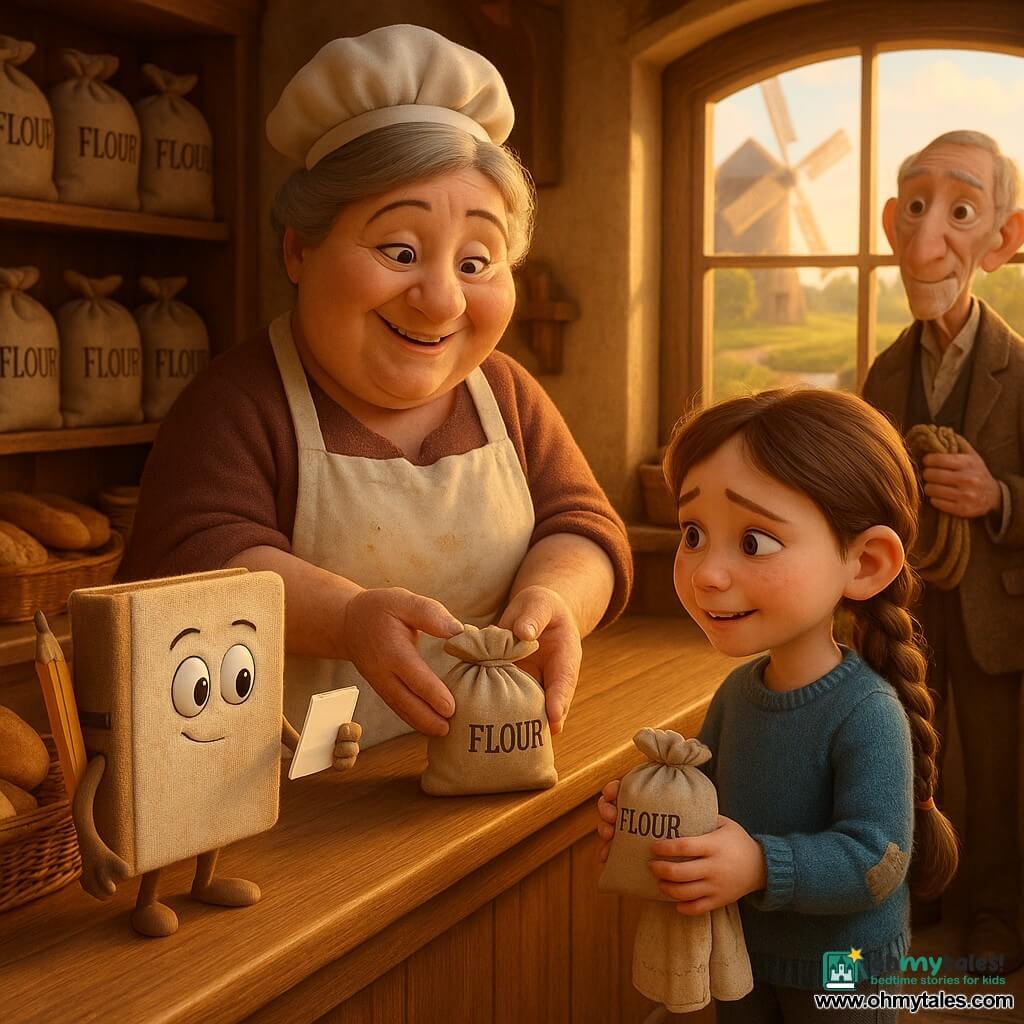
I live on a small shelf by the window of Maple Lane. My cover is soft, and my pages hold neat lines. I keep thoughts, lists, and secrets safe. People call me Nora. I am a young detective. I am clear-headed and curious.
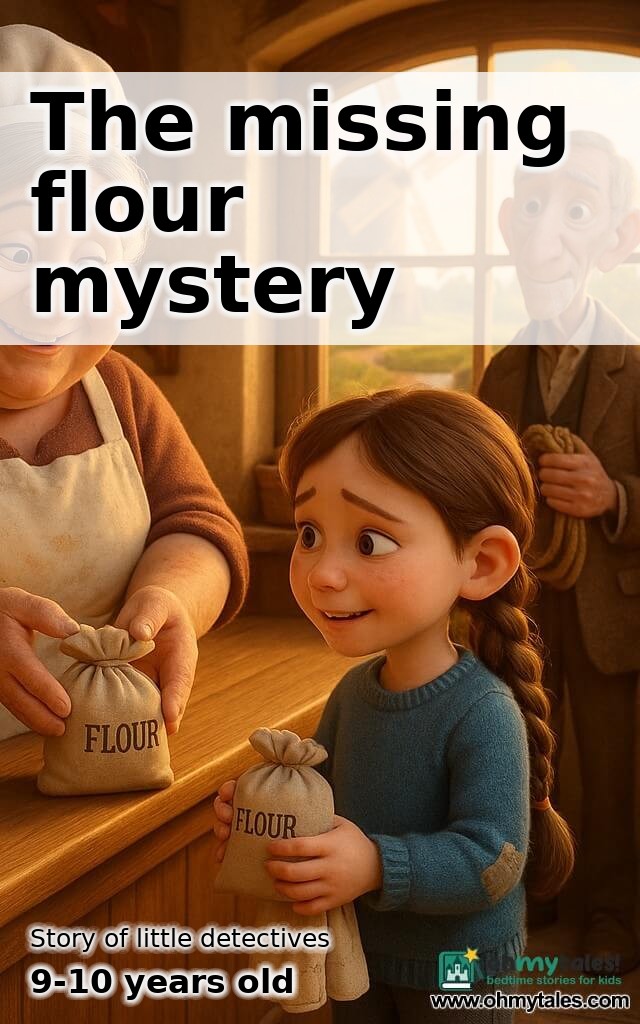
One sunny morning, I heard shouting down the lane. Mrs. Berry, who runs the bakery, was at the gate. Her face was like a crumpled recipe. "My flour is gone!" she cried. "All of it! The sack is empty."
I hopped off my shelf—careful, of course—and rolled under my strap. I like to move quietly. I arrived at the bakery with my pencil tucked behind my spine. I ask good questions. That is how I solve things.
"Who saw anything?" I asked, in a small, steady voice.
Mrs. Berry wiped her hands on her apron. "I only saw two people near the old mill last night," she said. "Tom the postman and little Jory. They both say they left early."
A mill? The old windmill at the edge of town. I had always wanted to visit. My pages fluttered with excitement. "I will help," I said. Readers, will you help me look for clues?
We began at the bakery. My notebook fingers turned a page and I drew a list: footprints, spills, schedules, suspects. Simple things first. I counted the sacks. Five sacks, all neat. One sack had a small smear of gray on the bottom. Not flour. Mud? I poked at the smear with my pencil. The mark smelled faintly of river water and a whisper of oil.
"River near the mill," I said. Mrs. Berry nodded. "The mill has a little creek. Sometimes the millstone spits out grit."
I asked about times. Tom the postman had left a round of letters at 6 p.m. He claimed he passed the mill at 6:15. Jory said she went to feed her kitten at 6:30. Two stories, two times. They both sounded steady. I wrote each account in two columns on my page. Comparing helps me see what fits and what might wobble.
Chapter 2: Wind, Wheels, and Witnesses
The mill stood tall and lean against the sky. Its sails were still like folded hands. The wood creaked in a slow, secret language. Up close, the door was slightly open. A small feather lay in the crack. I picked it up with a corner of my page. It was white and soft. Not from a pigeon. From a dove? Or a scrap from a bag?
Inside, dust made patterns when light fell through the slats. I traced a slow line with my pencil. Someone had hurried through. Bits of flour clung to a bench. A few crumbs followed a trail to the inner room where the large stone wheel turned when a river pushes it. The wheel was cold and still now.
"Look," I said, touching a smudge on the floor. It was flour—fine and pale—but mixed with something else. Tiny blue threads were lodged in the flour trail. I held the threads to the light. The threads were from a sweater. Not from Tom. He wears brown wool. Maybe from Jory. She loves blue.
At the edge of the mill, a broken strap lay tangled on the beam. It looked like the strap of a sack. Someone had carried a sack and it had torn. I made a tiny sketch in the margin. Visual notes are like a map for thoughts.
We met Tom at the post office. He was sorting envelopes with calm hands. "I did pass by the mill," he said. "I heard a creak and a scuff. I got nervous and walked fast. I saw someone by the old gate. I thought it was a cat."
"Could you tell if it was tall or small?" I asked.
He frowned. "Small. Maybe a child. Dark clothes. They ran that way—toward the lane by the creek."
Two accounts: Tom saw someone by the gate at 6:15. Jory said she fed her kitten at 6:30 and did not see anyone leaving. The flour vanished sometime between 6:00 and 7:00. I wrote the times in the two columns and drew a line between them. My pages made the gap look like a little bridge. Crossing it would help.
Readers, what do you think? Is one story more likely? Or could both be true? Think about who was near the mill and who had blue threads.
Chapter 3: The Two Stories
I visited Jory at her small house. Her cheeks were sticky with jam. Her kitten, Whisk, purred like a soft engine. Jory wore a blue sweater with a patch near the sleeve. I saw the same blue threads on the patch. They matched the threads at the mill.
"I didn't take the flour," Jory said quickly. Her eyes were as round as coins. "I fed Whisk and then I practiced my skipping rope. I heard wind. I saw shadows. I was home by 7."
Her story was neat and quick. I asked for the sweater. She blushed but handed it over. The patch had a smear of pale dust near the wrist. Not full flour, but enough to make a mark. Jory explained: "I helped my gran with baking earlier. Maybe I was dusty."
Two stories now sat on my page. Tom's and Jory's. They agreed on some details: both saw shadows, both heard the wind. But Jory's sweater had dust. Tom had seen someone run by the mill gate. Which detail mattered most?
I thought about motives. Why would someone take flour? To bake late at night? To help a hungry friend? Or by mistake, thinking the mill was giving out free flour? I circled the word "help" in my notebook. Sometimes people take things because they think they must.
Then Mrs. Berry gave me a new note. "I found a small card under my counter," she said. The card read: "Borrowed for bread. Will return. Sorry." The handwriting was shaky and kind. A note! That changed the puzzle.
"A note," I whispered. "Someone felt sorry."
The note matched Jory's handwriting a little. Not exactly, but if someone had written quickly, lines could wobble. I tipped the card in light and saw a smudge of blue ink on the corner. Blue again. My pencil tapped the top of the page as if nodding.
Readers, look at the two stories. Which details match? Blue threads, a note, a hurried step by the gate. Who might have written the note? Can you imagine why?
Chapter 4: The Answer and an Apology
The mill's keeper, old Mr. Harrow, sat on a bench like a storybook hero. He had a small notebook too—ironically—and a soft voice. "I've kept the mill long enough to know when a sack is torn," he said. "I heard scuffling last night. I saw a small figure by the wheel. They tried to lift a sack. It was heavier than they thought. The strap snapped."
I showed him the torn strap. He tapped it with a nail. "Ah. Fresh rope, not from the sacks we use. Someone used what they found."
"Maybe a borrow," I said.
He rubbed his chin. "There was a note on my door this morning," he added. "It said they'd be back. Said they'd fix the strap."
So many small pieces: the torn strap at the mill, blue threads on the floor, a smudged note at the bakery, someone seen running by the gate, and a patch of dust on Jory's sleeve. When I lined them up, they fit like puzzle pieces.
I turned to Jory gently. "Did you go to the mill?" I asked.
She sighed. "Yes," she admitted. "My gran was ill. We had no flour, and I wanted to make bread to cheer her. I wanted to take just a little, but the sack ripped. I left a note because I felt bad. I took a small bag and ran. I planned to return it when I could." Her voice trembled like a wet leaf.
Tom stepped forward. "I saw you run and thought you might be in trouble," he said. "I went to my rounds faster. I didn't tell because I thought you'd sort it. I was wrong."
Mrs. Berry's face softened. "You could have asked," she said. "We would have helped."
Jory looked at her sweater thread and then at Mrs. Berry. "I'm sorry," she said. Her apology was small but honest. She straightened. "I will return the rest and fix the strap."
I wrote down the solution in tidy strokes: Jory borrowed, strap broke, note left, Tom saw, she planned to return. The story matched both accounts. Tom had seen a small figure at the gate. Jory had the blue threads and the dust. Both were true. Two stories compared showed the full picture.
The town came together. Mr. Harrow helped mend the strap with new twine. Jory carried the bag back to the bakery and handed it over. She added a small apron she had sewn to show gratitude. Mrs. Berry decided to teach Jory how to bake bread properly. Tom brought extra envelopes of kindness, promising to watch out for neighbors. I closed my pages with a tiny satisfied tap.
Before I left, Jory wrote a new note on my page. "To Mrs. Berry and Mr. Harrow and Tom: I am sorry. I will return what I owe and help bake. Thank you for understanding." She signed it with a shaky heart.
Readers, did you help me solve it? You counted clues, compared stories, and followed the little bits of blue. You were brave and thoughtful. You practiced asking and listening. That is being independent and kind.
I slid back onto my shelf by the window, my cover warm from the sun. Outside, the mill's sails turned slowly again. The town smelled of baking and river air. Jory's apology sat on my page, neat and true. It sounded like a promise.
The mystery had a gentle ending. Someone had been in trouble and reached for a quick fix. They learned to ask. The town learned to listen. And I, Nora, tucked my pencil behind my spine, ready for the next small adventure.