Chapter 1: The Missing Lantern
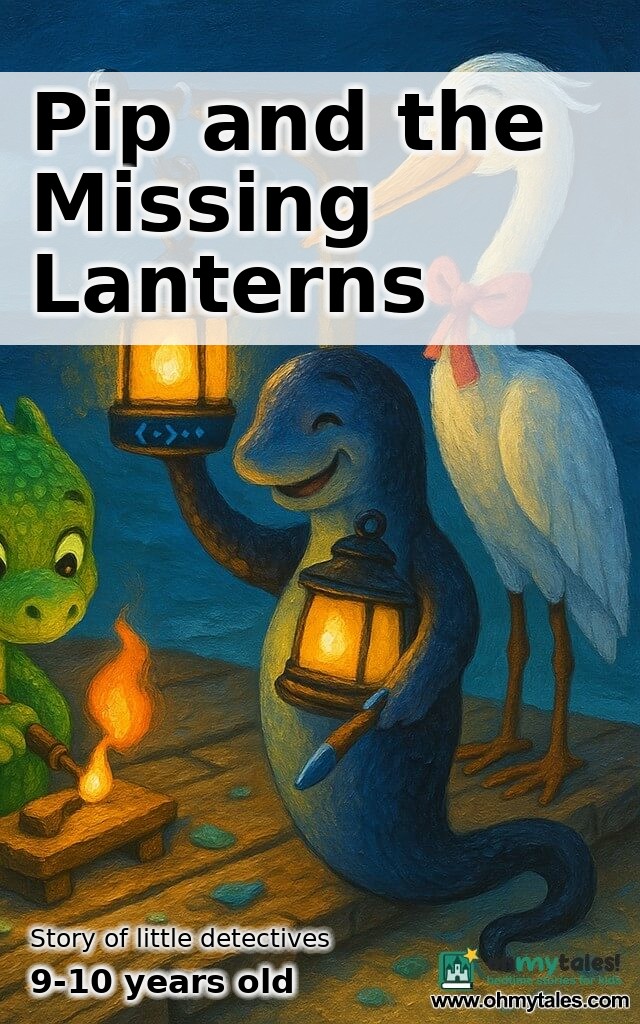
Pip the little dragon lived in a village of reeds by the salt marsh. Pip liked tidy things, quiet steps, and solving tiny puzzles. On this damp morning, he found his fishing friends fussing at the edge of the marsh.
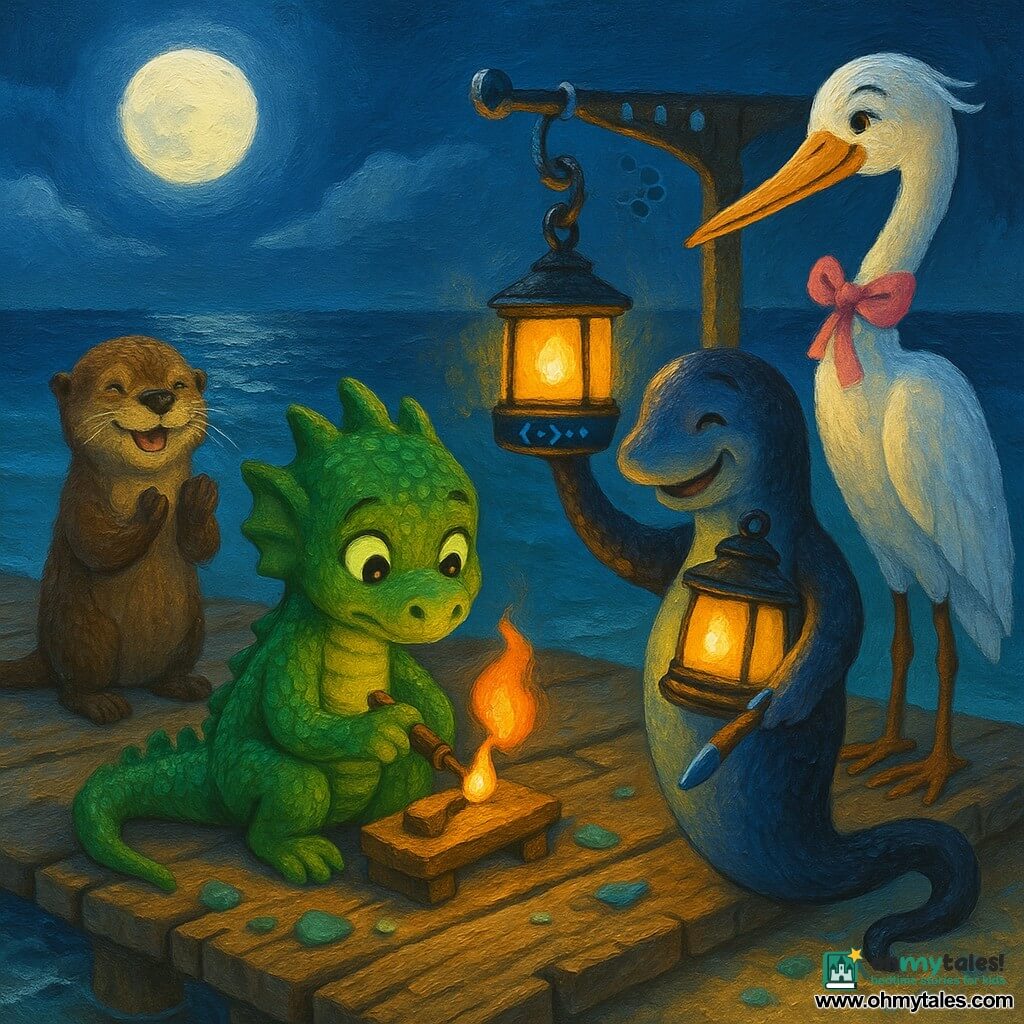
"The lanterns are gone!" cried Ollie the otter, flapping his paws. "They were on the jetty last night."
"They should glow all night," said Mrs. Heron, who always wore a ribbon on her long beak. "How will boats see the posts?"
Pip's nostrils twitched. He loved a clear job. He opened his notebook—a scrap of seaweed wrapped tight—and drew a little box for clues. "Let's look," he said. "Show me where they stood."
The animal-folk led him to the jetty: a creaky line of wooden posts reaching into the silver water. The sand beneath glittered with broken shells and sea glass. Where lanterns should hang, empty hooks dangled like fingers.
"Any footprints?" Pip asked, peering. He spotted three kinds: webbed prints, small paw pads, and a curl of tail that left a shimmer in the sand. He drew them down. He noticed something else: a pattern of tiny blue dots on each hook—three dots, then a dash, then two dots.
"A motif," Pip murmured. He had a habit of noticing patterns, even in puddles. "Who would leave that?"
Ollie spat water. "Nobody leaves markings by the jetty except the tide."
"But the tide can't paint dots," said Mrs. Heron. "And the lanterns are missing."
Pip set his jaw. He loved puzzles like this. "We'll solve it together," he promised. "Let's ask around."
Chapter 2: Questions on the Docks
Pip visited the market by noon. Fish were traded in neat piles, and shells chimed as buyers shuffled. He asked everyone: the crab who mended nets, the gull who told tall tales, even the old turtle who sold maps.
"Three dots, a dash, two dots?" repeated the crab, clicking his claws. "It sounds like the pattern on the seal of the lighthouse keeper."
"The lighthouse keeper?" Ollie echoed.
"Yes," the crab said. "A shell with blue paint. He visits the jetty each midnight to check the lamps."
Pip's eyes brightened. He scribbled the clue. A motif led him to a person... or a keeper. He imagined a shell with blue paint. He wanted to check the lighthouse immediately, but the keeper wasn't home. A gull pointed to the west.
"He went to the pier," the gull muttered. "Saw him with a sack."
"Pier or jetty?" Pip asked, thinking of the words. The gull shrugged. The pier was a longer boardwalk where boats moored. It creaked and smelled of seaweed tea.
Pip trotted off with Ollie and Mrs. Heron. He hummed quietly to help him think. The village watched them go—their small team, determined and gentle.
At the pier, fishermen were mending nets. Pip asked the same question. A crab pointed down to the water. "Saw lights. Saw a small boat in the night," a fisherman said. "No one else near. Only ripples."
Pip noticed a smudge of blue paint on the pier's post. He tapped it. The three-dot pattern repeated, battered by salt. He had his motif again. It pointed like an arrow.
"Follow signs," Pip told his friends. "Patterns tell stories."
Chapter 3: Moon at the Pier
That night Pip hid near the pier. He wrapped himself in a damp kelp blanket and took out his notebook. The moon was a pale coin. He watched the water. He counted breaths.
At midnight, a small boat slid to the pier. Pip's heart did a quiet flip. A figure stepped out: a slim animal in a cloak, with webbed feet and a lantern under their arm. Pip's nose twitched; the cloak smelled of salt and old tea.
Pip tiptoed closer. He could see the lanterns—stacked in the boat like sleeping beetles. The figure set them gently on the pier and began to hang them on the hooks. Pip watched the motion. The person hummed and tapped the hook each time, then painted three dots, a dash, two dots on the metal with a little brush.
"Why mark them?" Pip whispered. He thought of codes and maps. He peered at the person's collar. A small charm hung there—a tiny oyster shell painted blue. It matched the motif.
Pip stepped out. "Hello," he said, voice firm but soft. "Why take the lanterns and hide them?"
The cloaked figure froze. Then the hood fell back. It was Mira—the eel who kept the lighthouse. Her skin glimmered like wet ink. Her eyes looked tired.
Mira blinked. "I didn't hide them," she said. "I took them to repair them. The lamps were cracked. They sputtered and scared the night fish. I paint the hooks so I can find which ones I fixed." She smiled sadly. "I didn't mean to worry anyone."
Pip peered at the lanterns. A few were indeed cracked, their glass misted with tiny stars of salt. Mira showed him a cracked bulb and a little tool. "I couldn't fix them in the lighthouse. I work best with the pier's light."
Ollie stepped forward. "Why not tell us?"
Mira's eyes shone. "I didn't want folks to worry and stop the boats. I thought I'd fix them overnight."
Pip thought. The pattern told a story but not the whole story. He looked at the tiny blue dots on the posts. They matched the charm Mira wore. Mira had used the motif to mark her work.
"So you took them to repair, not to hide," Pip said. "Did you leave the posts empty because you were finishing the last ones?"
Mira nodded. "I have one to finish, and then I'll return them. I didn't mean to make trouble."
Pip had to make a decision. He liked to be careful and fair. He also felt the fishermen's worry about boat lights. He needed to check the lanterns and hear more.
Chapter 4: A Surprise at Low Tide
Pip asked Mira to show the finished lanterns. They walked together along the jetty. The tide was low, and the water retreated like a shy dog, revealing a strip of wet sand and sea grass.
"I'll help," Pip said. "We can finish them together. Two pairs of paws are better than one."
They worked under the moon. Pip passed tools, held tiny screws, and shone his small flame to warm the glass without scorching it. Mira hummed, and her glimmer made the work look like magic. As they worked, Pip noticed a tiny footprint near the boat—a print with three toes and a nibble mark.
"That print is new," Pip said, pointing. "Someone else came last night."
Mira frowned. "Who would nibble at my lanterns?" she wondered.
They followed the prints toward the piles of seaweed and found a small stash: shells with blue paint flecks, a half-eaten sea biscuit, and a little scrap of cloth tied into a knot. The cloth had a pattern—three dots, a dash, two dots. The motif again, but smaller, woven into the knot.
Pip's mind clicked. "This was not a taking to steal. Someone else has been copying your marks," he said. "Maybe someone thinks the lanterns belong to them."
Mira's face softened. "Perhaps a young one saw the pattern and thought it was a game," she sighed.
At dawn, they finished the repairs. Mira hung the lanterns back on the hooks and painted the motif anew, clean and bright. The lanterns glowed like small moons. Boats passing the jetty would now see the light.
Chapter 5: Gratitude and a Little Lesson
The village woke to glowing lanterns. The fishermen cheered. Mrs. Heron fluttered by and kissed Mira's beak with her ribbon. "Thank you," she said.
Pip smiled. He had watched, asked, and used the little blueprint of dots and dashes to follow truth rather than rumor. He had also learned to ask before judging.
Mira gathered everyone at the jetty. "I owe you an apology for worrying you," she said. "And I owe thanks to Pip for helping and for his careful eyes."
Pip felt shy but proud. He handed Mira a little token he had made from sea-glass—a tiny blue bead threaded onto a reed. "Keep it," he said. "So the motif isn't only painted. It's shared." His paws trembled a bit. He had never given a gift before.
Mira's eyes glowed. She tied the bead to her charm and hugged Pip in a way that set his scales tingling with warmth.
"To remind me of helping hands," she said. "And of asking first."
That afternoon, as the sun warmed the marsh, Pip sat by the jetty and wrote in his notebook. He drew the three dots, the dash, and the two dots, and then drew them joined by a tiny heart. He had solved the mystery, but more important, he had learned the value of clear eyes and kind questions.
Before he left, the animals gathered. Ollie produced a small picnic; Mrs. Heron sang a silly tune. Mira brought sea tea. As the last sip was drunk, she reached into her pocket and handed Pip a small lantern—one of the repaired ones, shining faintly.
"For when you search at night," she said.
Pip's chest filled with a warm glow. He looked at his friends, at the lit lanterns swinging gently above the water, and felt grateful. He had followed a motif and found more than answers; he found trust.
"Thank you," he said simply.
"And thank you," the village replied.
Pip tucked the lantern under his wing. He walked home along the jetty, eyes open, ready for the next small mystery. The marsh hummed softly with light, and Pip's notebook waited for more dots to connect.