Chapter 1: The Sticky Note Plan
Leo was ten, and he had a secret problem: his efforts felt invisible, like writing with a pencil so light it barely showed.
On Monday morning, he lined his pencils by color. He sharpened them until they looked like tiny wooden rockets. He even wiped his desk so it shone.
“Nice desk,” said Mila as she walked past.
“Thanks,” Leo said, hoping she'd add, You're the most organized kid in class.
But she only shrugged and whispered, “I spilled yogurt on mine again.”
In math, Leo raised his hand fast. In spelling, he wrote as neatly as a printer. Still, Ms. Patel mostly said things like, “Good job, everyone,” which sounded warm… but also wide, like a blanket that covered the whole class.
At recess, Leo sat on the low wall by the playground and sighed.
“What's with the big-guy sigh?” asked Jordan, flopping down beside him.
“I just… I'm trying really hard,” Leo admitted. “But nobody really notices.”
Jordan nodded like he understood. “You could wear a sign. ‘NOTICE ME, I DID MY HOMEWORK.'”
Leo snorted. “That would be embarrassing.”
Jordan grinned. “Or funny.”
Leo didn't want embarrassing. He wanted real.
Back in class, Ms. Patel announced, “Tomorrow we'll visit the library. We'll practice reading aloud in small groups. You'll choose a short passage and share it.”
Leo's stomach did a slow flip. Reading aloud meant voices, mistakes, and everyone's eyes. But it also meant a chance—maybe people would finally hear how hard he tried.
That night, he slipped a sticky note into his backpack anyway. On it he wrote, in careful block letters: TRYING MY BEST.
Chapter 2: The Library and the Computer Corner
The next day, the class walked to the library in a wiggly line. The library smelled like paper and lemon cleaner, and the carpet was so soft it felt like walking on quiet clouds.
Ms. Brooks, the librarian, waved from behind the desk. “Welcome, readers! Today we'll use the computer corner to help you pick a passage.”
The computer corner sat by the windows. There were six computers, headphones hanging like sleepy bats, and a printer that always looked a little nervous.
Leo sat at a computer and clicked through a reading site. Animated book covers popped up like colorful doors. He picked one about a kid who built a birdhouse and accidentally made it too fancy.
“Too fancy,” Jordan whispered from the next computer. “Like you and your color-coded pencils.”
“They're not fancy,” Leo muttered, though he smiled.
Across the table, a boy named Amir was tapping the keyboard carefully, like it might bite.
Mila leaned over and said, “Amir, want help finding the ‘search' box?”
Amir's cheeks turned pink. “Yes, please. English websites are… fast.”
Leo paused. He'd heard some kids whisper that Amir “talked weird,” but Leo had noticed something else: Amir listened like he was collecting every word, saving them like coins.
Leo cleared his throat. “It's okay. The search box is kind of sneaky.”
Amir looked up, surprised. “Sneaky?”
“Yeah,” Leo said. “It hides at the top. Like it's playing tag.”
Amir laughed, small and bright. Together, they found a story with short paragraphs and simple sentences.
Ms. Brooks walked by and said, “Nice teamwork.”
Leo's ears warmed. Someone noticed—just a little.
Then Ms. Patel clapped softly. “Pick a passage you can read aloud in about one minute. Practice quietly first.”
Leo chose the birdhouse story. He read the first lines under his breath. The words felt like stepping-stones, some steady, some wobbly.
When he reached a long word—“magnificent”—his mouth got stuck.
Mag… mag-nif…
He glanced at Amir. Amir was whisper-reading too, tracing the words with his finger. He stumbled, then tried again without giving up.
Leo took a breath. “Mag… nif… i… cent. Magnificent.”
He had done it. Quietly, but done.
Still, the thought of reading aloud to others made his stomach do another flip.
Chapter 3: The One-Minute Read
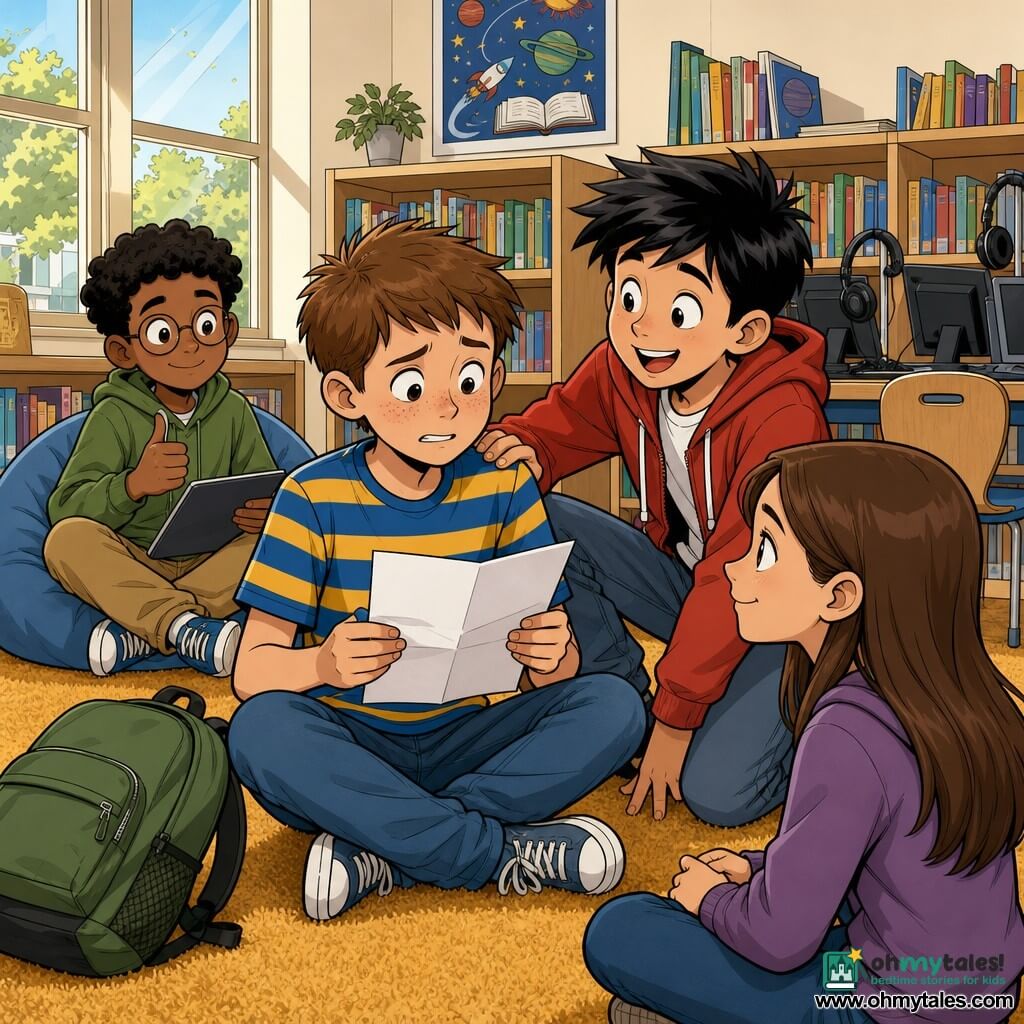
Back in the reading area, Ms. Patel arranged them into small groups on the carpet. Leo ended up with Jordan, Mila, and Amir.
“Okay,” Ms. Patel said, “one at a time. Remember: we listen kindly. No laughing at mistakes. Everyone's learning.”
Jordan went first. He read with big dramatic pauses, like an actor. When he reached a silly part, he wiggled his eyebrows, and Mila giggled.
“My turn,” Mila said, reading smoothly, like her voice had wheels.
Then Amir read. His accent made some words sound different, but his voice was steady. When he got stuck, he tried again, and nobody rushed him.
Leo's turn arrived like a slow-moving bus he couldn't dodge.
He held his paper. His hands felt damp. The letters looked darker than before, like they knew they were about to be tested.
Jordan whispered, “You've got this.”
Leo started. “Sam hammered the wood and—”
His voice shook. He heard it. Everyone heard it.
He kept going anyway.
When he reached “magnificent,” he hesitated. The old stuck feeling returned. He pictured the word like a ladder.
“Mag… nif… i… cent,” he said, then said it again faster: “Magnificent.”
Mila nodded, smiling.
Amir gave Leo a small thumbs-up.
Leo read the last line and stopped. Silence, then gentle claps from his group—soft, like rain on the window.
Ms. Patel leaned down. “Leo, your pacing was thoughtful. And I liked how you didn't quit on that tricky word.”
The sticky note in his backpack suddenly felt silly. His effort had been heard without any sign at all.
As they walked back to class, Jordan bumped Leo's shoulder. “See? Not embarrassing. Just… magnificent.”
Leo groaned. “Please don't use that word all day.”
Jordan grinned. “No promises.”
Chapter 4: The Question That Wouldn't Sit Still
In the afternoon, Ms. Patel handed out a worksheet about choosing books and sharing recommendations.
At the bottom, there was a question: What makes a story good to read aloud?
Leo wrote: “Good rhythm. Clear sentences. Funny parts.” He paused, pencil hovering. He wanted to add something more, something true.
He had noticed how different voices sounded. Jordan's dramatic voice. Mila's smooth voice. Amir's careful voice. And his own voice—shaky at first, then stronger.
He wrote: “Different voices make stories interesting.”
Then he frowned. He wasn't sure if that was the right answer. He also wasn't sure what “right” even meant.
A question began to bounce inside his head like a rubber ball: Is it okay if my voice sounds nervous? What if I mess up again?
Leo looked at Ms. Patel, who was helping someone with a stapler that had decided not to believe in staples anymore.
He could keep quiet. Quiet was easier. Quiet didn't make your cheeks hot.
But Leo remembered Amir trying again. And Ms. Patel saying, “We listen kindly.”
Leo lifted his hand.
It felt like lifting a weight, but his arm stayed up.
Ms. Patel looked over. “Yes, Leo?”
His throat tightened, but he pushed the words out anyway. “When we read aloud… if our voice sounds nervous, is that… bad? Or is it normal?”
For a moment, Leo worried he'd asked the most ridiculous question in school history.
Ms. Patel's face softened. “That's a brave question. It's completely normal. Even adults get nervous. Reading aloud is like sharing a piece of yourself, and that can feel big.”
Jordan whispered, “Told you,” as if he were announcing a weather report.
Ms. Patel continued, “What matters is that we keep going, and we respect each other. Some people are learning English. Some people are shy. Some people speak fast or slow. Our classroom is for all of those voices.”
Amir nodded. Mila smiled. Leo felt something unclench in his chest.
After class, Amir came up to Leo by the cubbies. “Thank you for asking,” Amir said. “I feel nervous too.”
Leo shrugged, trying not to look too proud, but failing a little. “Yeah. Me too.”
Amir held up his library paper. “Maybe tomorrow we can practice again. In the computer corner? It helps me.”
Leo thought of the soft carpet, the sneaky search box, and the word “magnificent” turning from enemy into friend.
“Deal,” Leo said.
That night, he found the sticky note in his backpack. TRYING MY BEST.
He didn't throw it away. He stuck it inside his journal instead, like a bookmark.
Because now he knew something important: effort didn't always need a sign.
Sometimes it needed a voice.
And sometimes, it needed one brave question.