Chapter 1
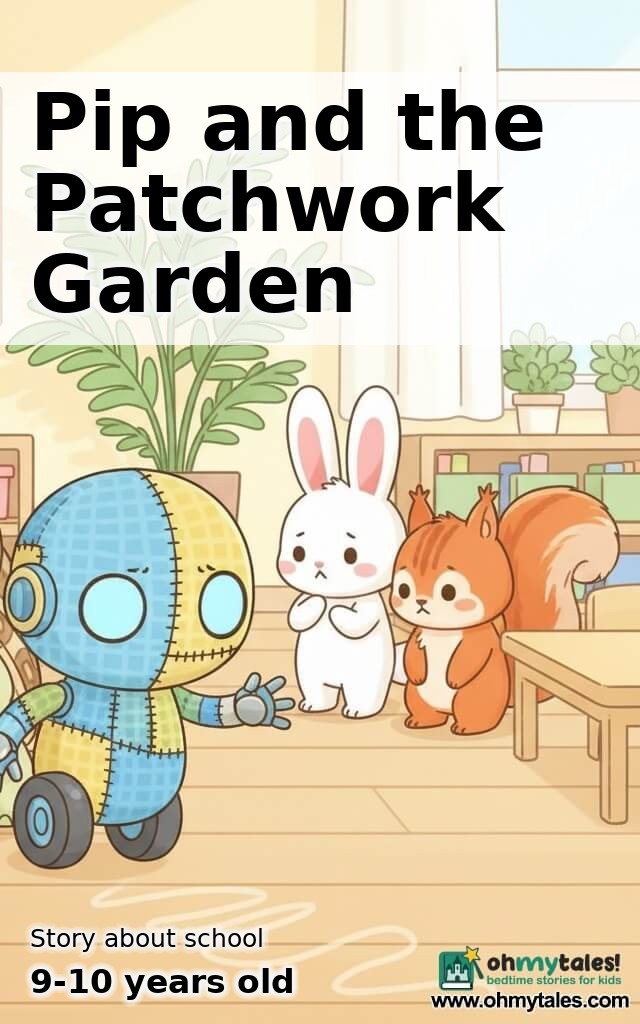
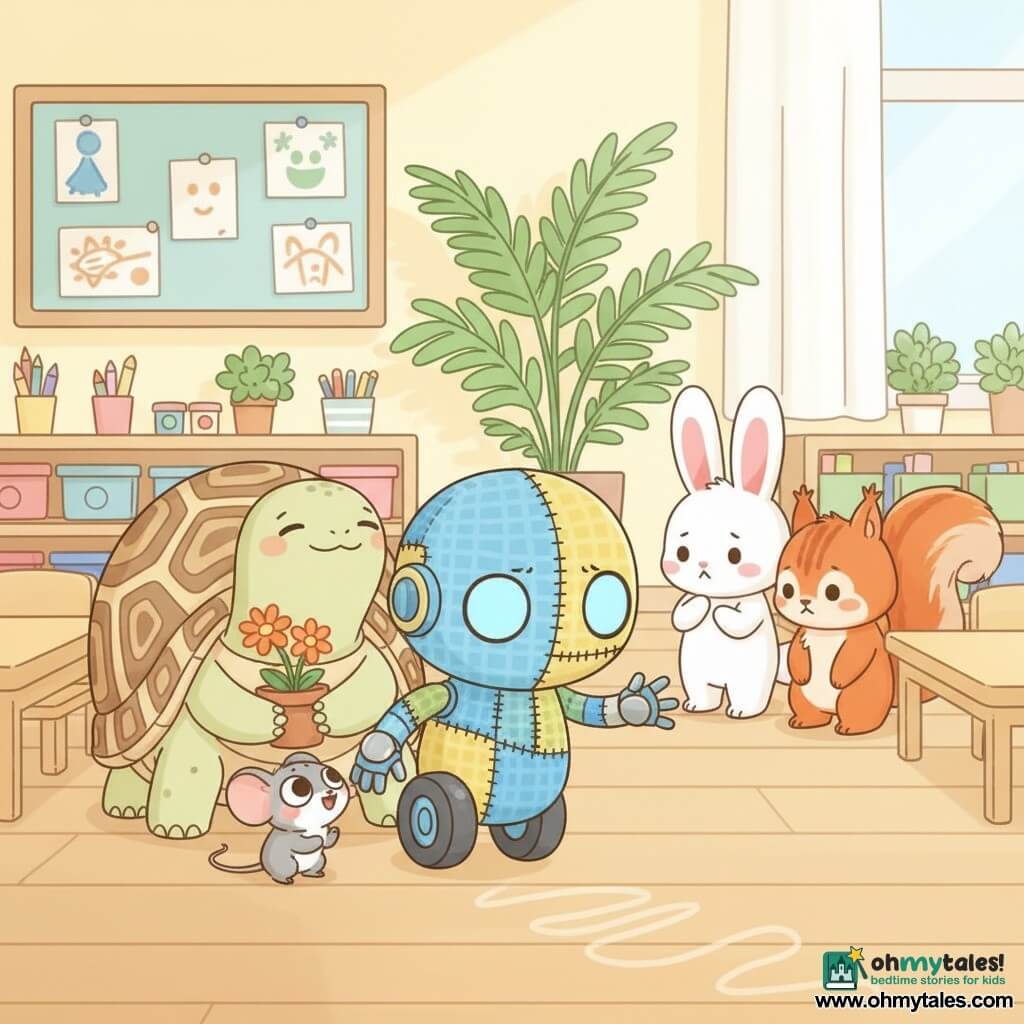
Pip was a small patchwork robot with one shining blue eye and a squeaky wheel that made a tiny wheelie sound whenever he hurried. He lived in a bright classroom at Willow Tree School, where crayons smelled like rain and the clock ticked like a slow drum. Pip loved school—especially the science corner with magnets and shiny springs—but he worried a lot. He thought everyone watched him and judged every beep and wobble.
“Don't be silly, Pip,” whispered Mimi the mouse from beneath her reading mat. “They're just doing math.”
“But what if they're thinking my wheel is silly?” Pip said, spinning a little to show Mimi. “Or that my voice squeaks too loud? What if I don't fit?”
Mimi piped a soft laugh. “You fit fine. Come on, it's time for art.”
Pip rolled to his seat feeling his metal tummy flip-flop. He liked art because glue was forgiving and paint did not care about perfect wheels. Still, when Ruby the rabbit and Sam the squirrel whispered while glancing at him, his blue eye blinked faster.
“Did you hear Pip's wheel?” Ruby giggled. “It sounds like a tiny train.”
“He can be helpful,” Sam said, kinder than he meant to. But Pip heard only the giggle. He imagined the whole class judging him, drawing tick marks on an invisible list labeled “Not Quite.”
At recess, Pip tried to play hopscotch, but his wheel kept skidding on the chalk. He fell gently into a pile of leaves, which made the other animals laugh—not mean, but light and surprised. Pip felt small and pushed himself into a quiet corner under the big fern, where his thoughts spun like gears.
Chapter 2
The next morning, a new student arrived: a large, spotted tortoise named Tessa. She moved slowly and hummed to herself like a low, happy tune. The class buzzed with curiosity. “She carries her house!” whispered Pepper the parrot. “That must be heavy.”
Pip felt odd. He wanted to say hello, but his squeaky voice felt too loud. He watched Tessa slowly set up at the front of the room. She placed tiny potted plants around her shell and arranged a little sign: “Tessa's Slow Garden.”
During show-and-tell, Tessa explained how she grew marigolds by whispering to them and taking her time. “Slow helps me notice small things,” she said in a calm, warm voice. “Like a beetle's footprints or a tiny seed sprouting.”
The class listened, and Pip's worries did something strange: they shuffled. A tiny seed of curiosity poked through. “How do you move with a garden?” Pip asked before he could stop himself.
Tessa smiled. “Carefully,” she said. “Everyone moves in their own way. Your wheel lets you zip to the art table. That's a kind of magic.”
Pip felt a feather-light pride. His eye blinked, not so fast now. That afternoon, Mimi nudged him. “See? Not everyone is judging. Some are discovering.”
But later, while Pip was helping to hang Tessa's paper flowers, some classmates teased Tessa for being slow. Pip's wheel froze. He remembered how it felt when people laughed at him. “Stop,” he said, and surprised himself with the firmness in his voice.
“Why?” asked Ruby, bouncing like a soap bubble. “It's just a joke.”
“It's not funny to make someone feel small,” Pip said. His wheel rolled a little louder now. He didn't mean to be brave, but the thought of Tessa's gentle smile made courage bloom like one of her marigolds.
Ruby blinked, then shuffled her feet. “Oh. Sorry.”
Tessa's slow smile widened. “Thank you, Pip. I like your wheel. It sounds like the sea.”
Pip smiled back. A warmth like sunlight spread through him. Maybe the class wasn't a list of judges after all. Maybe it was a patchwork of different things, like him.
Chapter 3
A week later, there was a misunderstanding at lunch. A sandwich went missing, and sniffles turned into whispers. Someone blamed Pip because his wheel had been near the lunch table earlier. The blame felt heavy, and soon the teacher, Ms. Linden, had to ask Pip to come to the principal's office. Pip's gears clicked loud with worry. The principal was Mrs. Finch, a tall owl with gentle eyes who wore round glasses like moons.
“Sit,” she cooed, pointing to a velvet cushion. “Tell me what happened.”
Pip spilled his story in staccato beeps. “I was by the table for a second. I help set chairs sometimes. I didn't take the sandwich. I would never—”
Mrs. Finch listened, head tilting. “Thank you for telling me. It is hard to be suspected. Do you know why it might have seemed like you did it?”
Pip's blue eye dimmed. “Because I'm different,” he whispered. “My wheel sounds funny. My voice squeaks. People look.”
Mrs. Finch fluttered closer, her feathers like soft notes. “Sometimes we think others are judging us, and that makes us feel small. But we must look for truth, not just footprints. Would you like help finding out what really happened?”
Pip nodded. Mrs. Finch asked gentle questions and suggested they speak to classmates calmly. With Mimi and Tessa's patient support, they went back to the classroom, where Pip and Mrs. Finch asked everyone to think about the sandwich. Slowly, Sam the squirrel raised his hand. “I saw Pepper the parrot drop some crumbs, and then the wind blew a napkin, and I took the sandwich to keep it safe. I forgot to tell anyone,” he admitted, cheeks puffing.
Pepper squawked and apologized, fluttering his colorful wings. The class laughed together, not mean but relieved. Mrs. Finch smiled at Pip. “See? When we ask and listen, we find answers. And we make room for everyone.”
Pip felt like a weight had rolled off his shoulder. He had been afraid of being judged, but instead he found a process: patience, questions, listening. And friends who helped him.
Chapter 4
After that day, Pip practiced being kinder to himself. He still worried sometimes—old habits are like sticky glue—but he learned to breathe and count to five little ticks. He also learned to notice others. He helped Tessa carry a tiny watering can, and she taught him how to be still and listen to the soil. He taught Ruby how to fix a torn crayon, and Ruby discovered that Pip's wheel was excellent at rolling crayons into neat piles.
One afternoon, the class planned a “Diversity Day” art wall. Each student painted something that showed how they saw themselves. Pip painted a bright patchwork robot with a garden on his back and small animals smiling around him. Tessa painted a slow, sunlit path lined with marigolds. The wall filled with different colors—not better or worse, simply different.
On the day the wall went up, Mrs. Finch stood by and said, “This is what a class looks like when we encourage each other. Differences make our picture stronger.”
Pip beamed until his blue eye nearly glowed. He rolled a small wheelie of pride. He realized that being afraid of judgment had kept him quiet, but noticing differences and encouraging them made school feel like a warm quilt.
That evening, as the classroom lights dimmed and the moon traced a silver smile across the window, Pip settled under his reading mat. Mimi curled beside him. “Are you still worried?” she asked softly.
“Sometimes,” Pip admitted. “But I know now: people aren't always judging. They're learning, just like me. And if there's trouble, we can talk, and listen, and fix it together.”
Mimi yawned. “That sounds like a very grown-up robot.”
Pip let out a happy squeak. “Maybe I'm growing up a bit.”
Outside, Willow Tree School hummed gently. Inside, the patchwork robot dreamed of marigolds and slow paths, of friends who listened, and of a classroom where differences were like colors on a wall—each one bright, each one needed. He slept knowing conflicts could be mended with words, kindness, and patience. The world felt kinder, and his wheel rolled a quiet, contented tune into the night.