Chapter One: A Soft Morning
The school smelled like warm playdough and fresh crayons. Sunlight tucked itself into the corners of the classroom, making the carpet look like a patchwork quilt. Miss Rosa, with her soft voice and cardigans the color of tea, folded her hands on the small desk and watched her class wake up.
"Good morning, stars," she said, and the children blinked like tiny moons. Some waved their hands high; a few curled their fingers on their laps. There was one child, Emmy, who kept both hands folded and her chin near her elbow. Emmy's smile came out slowly, like a shy snail.
"Today," Miss Rosa said, "we will tell tiny stories about our pets." She placed a basket of paper and colored pencils on the table. "If you feel shy, you can whisper to me first."
Emmy's pencil stayed still. "I don't like talking," she finally said, in a voice that needed a blanket.
Miss Rosa sat on a small blue stool and looked at Emmy the way the sun looks at a sleepy flower. "That's okay," she said. "Words can be small and brave. Would you like to write a sentence first?"
Emmy nodded. Her sentence was short and plain: I have a cat.
Miss Rosa smiled. "That's a happy start. Can we make it sparkle a little? Not by changing your thought—only by adding pieces that show the cat better. Like a painter adds light."
Emmy watched Miss Rosa as if the teacher were a magician. "How?"
"First," Miss Rosa said, "tell me one thing about your cat." She waited like a pond waiting for a pebble. "Does your cat purr? Does it like naps? What color is its fur?"
"She purrs," Emmy whispered. "And she is small. She is grey."
Miss Rosa tapped a finger gently on the sentence. "We can gently tuck those things in. Try: I have a small grey cat who purrs like a tiny engine." Emmy's eyes widened. The sentence sounded like a song now. Emmy wrote it down with a careful hand.
Miss Rosa clapped quietly. "Wonderful. Sometimes, a sentence just needs a little nudge to come alive. You can always keep your thought the same and add small details."
Across the room, other children were making their sentences bloom too. Miss Rosa moved between desks like a gardener, watering small seedlings of ideas with her words.
Chapter Two: The Brave Little Sentence
At circle time, Miss Rosa asked for volunteers to share. A few hands shot up like cheerful rockets. Emmy's hand stayed down, but her eyes followed every word.
When it was time for reading, Miss Rosa chose a book about a fox who learned to sing. "Listening helps us learn how stories wear their clothes," she said, and the children giggled because the fox did wear a tiny hat in the pictures.
After the story, Miss Rosa laid out a small game. She wrote a simple sentence on the board: The dog ran. "We will make this sentence kinder, prettier, or more curious," she said. "We will choose one small change at a time. If it feels too much, we can stop."
Tommy, who loved running more than anything, shouted, "It ran fast!" Miss Rosa nodded. "Try saying how it ran. Fast like the wind? Fast like a racecar?"
Tommy grinned. "Like a racecar!" He changed it: The dog ran like a racecar on a sunny street.
"Good," Miss Rosa said. "We added a comparison. We gave an image."
Then Miss Rosa wrote another version: The dog ran to his blue ball. "This time we showed why. Reasons help sentences stand up straight."
Emmy watched as Miss Rosa and the class nudged the sentence gently. Each change felt like a soft pat.
"Now," Miss Rosa whispered, "we will practice making a kind change, not a loud one. We will be gentle editors. We don't replace someone else's words—we help them shine."
Emmy's neighbor, Lila, read her line: I am scared. Her voice shook like leaves.
Miss Rosa put a hand over Lila's and said, "Thank you for sharing. Do you want to try adding one small thing about why, or what might help?"
Lila thought. "I am scared of math."
Miss Rosa smiled. "We can make that sentence specific and helpful. Like: I am nervous about math, but I like when I solve one problem at a time." Lila's eyes opened like doors. "That way, your sentence tells how you feel and what might help you."
"That's a good trick," whispered Emmy.
Miss Rosa's eyes met Emmy's. "Would you like to practice that trick with your cat sentence?"
Emmy blinked and nodded. She said, "Maybe I will. But later."
Miss Rosa nodded. "Whenever you're ready."
Chapter Three: The Whisper Workshop
The room turned cozy as the afternoon light stretched. Miss Rosa arranged the desks into a small circle and set out colorful stickers. "Now we will try something called the Whisper Workshop," she announced. "Two friends will sit together and help each other add one tiny detail to a sentence. Keep it kind. Keep it gentle."
Pairs formed like little islands. Emmy sat beside a boy named Sam, who liked dinosaurs and had a giggle that sounded like a tiny bell.
Sam read Emmy's sentence: I have a small grey cat who purrs like a tiny engine.
"That's nice," he said, as if tasting a sweet. "Maybe she likes something special, like yarn or jumping in boxes."
Emmy's cheeks warmed a little. "She likes sleeping in a basket," she whispered.
Sam suggested, "We can say: I have a small grey cat who purrs like a tiny engine and loves sleeping in a sunny basket." Emmy's pencil trembled with excitement as she added the words.
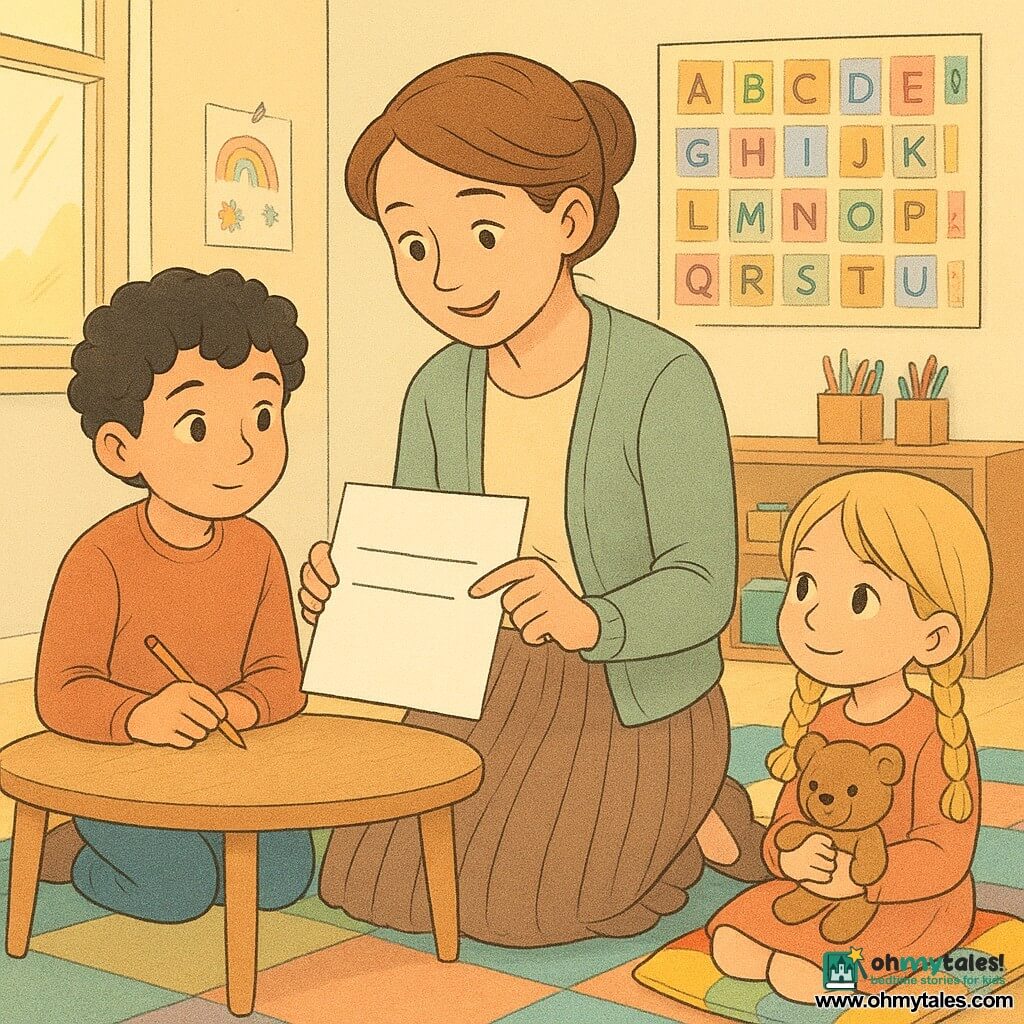
Miss Rosa came by, kneeling so her eyes were level with their page. "That sounds so cozy," she said in a voice full of honey. "Do you want to try making one more small change?"
Emmy thought. The idea of "small changes" felt safe, like stepping stones across a pond. "Maybe say when she purrs," she offered. "She purrs when she hears my voice."
Miss Rosa clapped softly. "Perfect. That tells us how your cat and you are friends."
So the sentence grew again: I have a small grey cat who purrs like a tiny engine when she hears my voice and loves sleeping in a sunny basket.
Emmy read it to Sam, and her voice was firmer, like a string pulling a kite into the sky. Sam beamed. "Your sentence tells a whole little story!"
Around the circle, children helped each other the same way. They added feelings, places, times, and tiny sounds. Miss Rosa walked around, offering quiet praise and a helpful question: "What does it look like? What does it sound like? What happens next?"
When Lucy, a girl who rarely talked, whispered, "My bird sings," Miss Rosa asked, "When does it sing?" Lucy thought for a long breath and said, "In the morning with the window open." Miss Rosa suggested a small change: "My bird sings in the morning when the window is open." Lucy's hand went to her heart. Her sentence felt like a warm pancake, fresh and soft.
Miss Rosa sometimes used little metaphors as she helped. "A sentence is like a sandwich," she would say. "You can add a filling to make it tastier. We don't throw away the bread; we just make it yummier."
Every time a child made a change, Miss Rosa asked, "Do you like it?" If they didn't, they could change it back. No one corrected anyone harshly. They practiced being patient editors, kind and steady.
Chapter Four: A Lantern of Words
By the end of the day, the classroom felt like a tiny town glowing with sentences. Miss Rosa gathered everyone on the carpet and dimmed the lights. "Let's share our favorite sentences," she said. "Tell the class the sentence you loved making."
One by one, children stood like small candles and read. The room was full of little stories—A frog who wore a proud leaf hat; A boy who practiced drawing every day; A cloud that looked like a giant cotton candy. Each sentence had been warmed by the class's gentle help.
When it was Emmy's turn, her legs felt like jelly, but she stood. She held her paper as if it were a little lantern. Her voice at first was a thread, then it grew. "I have a small grey cat who purrs like a tiny engine when she hears my voice and loves sleeping in a sunny basket," she read.
There was a quiet clap, just like rain on a tin roof—soft and steady. Miss Rosa smiled with her whole face. "That is beautiful," she said. "Your sentence shows how your cat and you belong together."
Emmy's cheeks turned the color of pink chalk. "Thank you," she whispered. She tugged at her sleeve and added, "I was scared to say it."
Miss Rosa put a hand gently on her shoulder. "You were brave," she said. "Brave isn't always loud. Sometimes brave is whispering your story into the world."
Then Miss Rosa did something she did every day. She asked a question that felt like a little key: "What helped you make your sentence better?"
Emmy thought of Sam's bell-laugh and Lucy's morning bird. She thought of Miss Rosa's calm voice. "When you asked small questions," Emmy answered, "it helped me think of small answers. Small things made my sentence bigger in my heart."
Miss Rosa nodded. "Perseverance is like planting bulbs. You can't see the flower at first, but you keep the soil soft and water it a little each day. Then one spring, the flower appears."
At home time, children packed their drawings and folded words into their pockets like secret maps. Parents arrived, and Emmy ran to her mother. "I told my sentence," she said, breathless. "I felt scared at first, but I did it!"
Her mother hugged her. "Tell me," she said, and Emmy told the sentence again. It felt like sharing a treasure.
That night, Emmy tucked the paper under her pillow and dreamed of grey fur and warm baskets. In the morning, she buzzed into school as if she had swallowed a tiny sun.
A few days later, at the playground, Emmy found her friend Zara sitting alone, not talking.
"Hi," Emmy said. She remembered the way Miss Rosa had leaned in and whispered. "Do you want to hear my sentence?"
Zara shrugged, eyes on the ground. "I don't like talking to lots of kids."
Emmy sat beside her and showed her the paper. "I have a small grey cat who purrs like a tiny engine when she hears my voice and loves sleeping in a sunny basket."
Zara's face changed—like someone opening a window. "She likes baskets? My dog sleeps on a pillow," Zara said.
Emmy's fingers felt like little wings. She thought of Miss Rosa's patient questions. "Do you want to try making a sentence about your dog? We can add one small thing."
Zara blinked. "Like what?"
"Maybe when your dog is happiest," Emmy suggested. "Or where he sleeps. Or a sound he makes."
Zara smiled a tiny smile. "He snores when he's tired." They both giggled.
They made the sentence together: My dog snores softly when he dreams of running in the park. When they finished, Zara's answer sounded proud. "We did it," she said.
Emmy felt a warm glow, like the moment she first read her lantern of words aloud. She thought of Miss Rosa's voice, of the Whisper Workshop, of all the small steps. "Perseverance," she said to Zara, "is when you try little things and keep trying."
Zara nodded. "Like a ladder made of tiny sticks."
They ran back to the swings, voices bright and easy.
That night, Emmy could not help but tell her best friend Mia the whole story over and over. She told how Miss Rosa helped, how Sam suggested the sunny basket, and how saying the sentence made her less scared.
Mia listened with wide eyes. "Can you tell me tomorrow?" she asked.
Emmy hugged her like a present. "Yes," she said. "And I want to tell Miss Rosa too."
A week later, Miss Rosa found a note in her mailbox. It read: Dear Miss Rosa, thank you for teaching us to make sentences like gardens. Love, Emmy.
Miss Rosa folded the note like a seed and kept it in her pocket. She thought of all the quiet bravery that swelled in her classroom like a soft tide.
That evening, Miss Rosa tucked her own small notebook under her arm and wrote down a sentence she had heard that day: A girl who was once very quiet now tells her stories to friends.
She smiled and added one small detail she had learned from Emmy: the sentences that grow are the ones tended with patience and kindness. Then she closed the notebook and looked out the window at the schoolyard where shadows made soft shapes.
Emmy, miles away at home, could not wait to tell her friend Mia again the thing that had changed her. "Words can be small and brave," she told Mia, "and a little detail can make a whole new picture."
Mia hugged her back. "Let's promise to help each other," she said.
They promised, and their promise was like two bright seeds.
Miss Rosa slept, dreaming of tomorrow's circle time, where more quiet seeds would find gentle hands. She knew patience and small questions were like lanterns. Little by little, the children's sentences would glow, and they would learn that saying something once is the start of a long, kind story.
And somewhere, the sentence that began as I have a cat kept growing in Emmy's pocket, in her voice, and by the time she reached the playground, she wanted to tell everyone the story of how she learned to be brave with her words.