Chapter One: The Lightning Kid
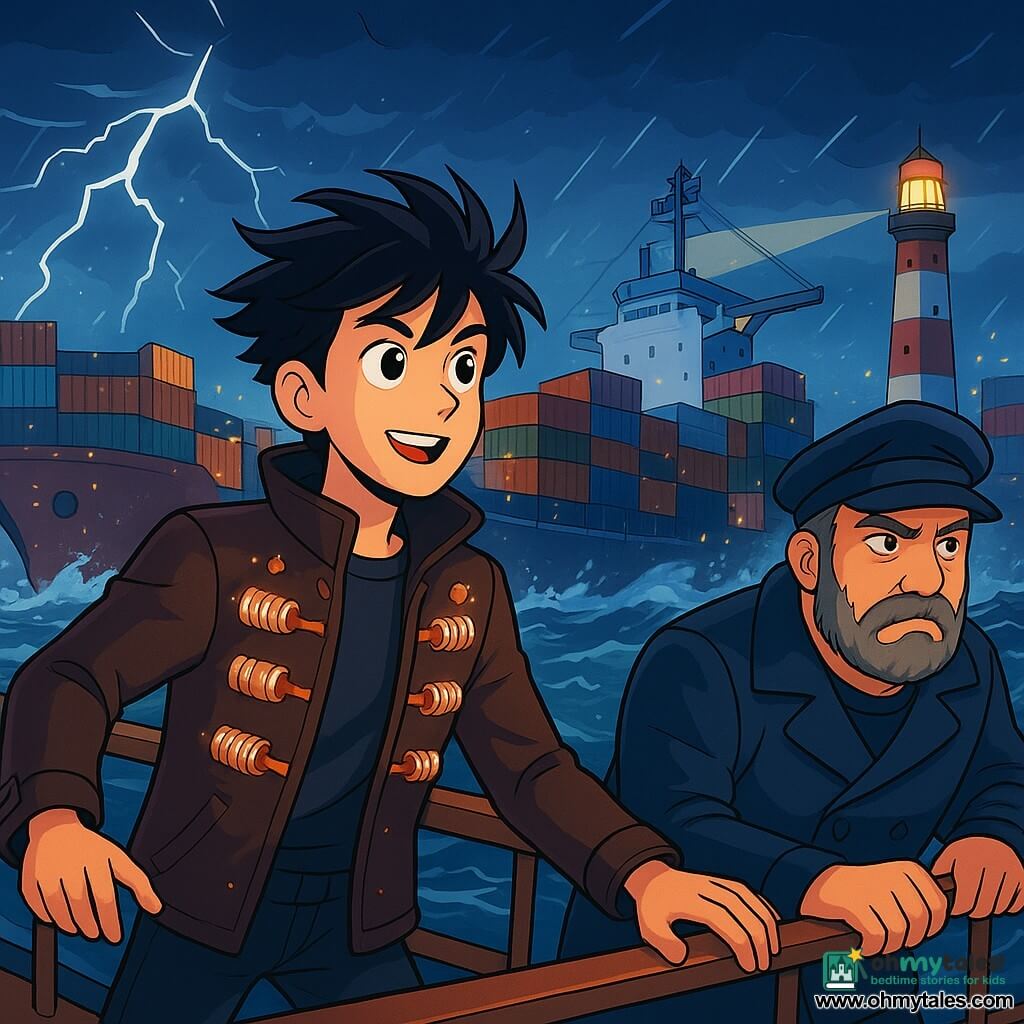
Keaton Voss was not the sort of boy to sit still. He had a shock of black hair that always smelled faintly of salt and ozone, and eyes that glittered like broken glass under a streetlight. At seventeen he was still young, but he carried himself like someone who had practiced bravery in mirrors a thousand times. He wore a jacket patched with tiny copper coils—his own invention—and boots with a squeaky, determined tread. People in his neighborhood called him the Lightning Kid because wherever he ran, a faint hum seemed to follow, like a soft thunder that only kids and cats could hear.
Keaton lived above a noodle shop in a coastal megacity called Tidal Reach, where skyscrapers leaned over the sea like attentive giants and ferries hummed like whales. The city was a jumble of glass, seawalls, and murals that told stories of lives intertwined with storms and sunshine. Keaton's room looked out over the harbor, and on clear nights he would balance on the windowsill and listen. He listened to the wind, to the waves, and mostly to people. He believed listening was a kind of superpower—one you sharpened by paying attention.
That belief had led him into many small rescues: a rooftop cat, a lost toddler, a heartbroken old woman who needed a neighbor to talk to. He had also learned, the hard way, that being brave sometimes meant stepping back and letting others speak. It was a lesson he kept like a map in his pocket.
One humid evening, while the city lights blinked like distant constellations, Keaton's coil jacket vibrated. A tiny holographic badge projected above his wrist—Emergency: Civic Dispute, Pier Eleven. He grabbed his satchel, tightened his boots, and jogged into the night, humming with nervous excitement.
Chapter Two: The Clash at Pier Eleven
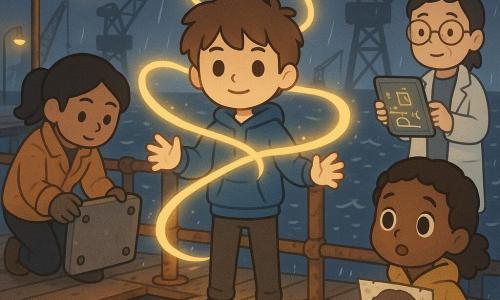
Pier Eleven was a place of sharp contrasts. Shipping containers stood like colorful blocks, cranes loomed like curious dinosaurs, and fish markets gave off a smell that made Keaton grin. Tonight, the pier was lit by conflict—two groups of workers and drone pilots faced each other across stacked crates. Voices rose in jagged peaks: accusations, insults, fear. A fleet of trading drones sat grounded, engines idling; their operators argued for control.
Keaton arrived under the last streetlamp, cape-less and bright-eyed. He didn't announce himself. He remembered his listen-first rule. He stepped between the groups and folded his arms, the copper coils on his jacket glowing faint blue.
“Hey,” he said. “I'm Keaton. What's going on?”
Silence. Then a woman named Mara, who ran the pier's logistics, spat, “These pilots want the night routes. They say the dockers are blocking new lanes. If nothing changes, shipments stop. People lose jobs.”
A young drone pilot, slim and furious, thrust a tablet: “We tested safer flight paths. They refuse to trust automation!”
Keaton listened. He asked questions that were small but sharp, like pebble throws: Who loses tonight? Who can wait? What do the children in the housing blocks need in the morning? Voices softened as he asked. People began to explain—landlords who'd promised repairs, a storm coming in two days, families who needed paychecks.
He could feel anger like static in the air, but instead of trying to roar louder, Keaton used his voice like a tuning fork. He suggested a shared schedule: pilots could have certain lanes during low tide, dockers would keep specified platforms free, and a joint safety team would test the new routes together. It wasn't a grand solution, but it was practical and made space for everyone's needs.
The leaders hesitated. Then Mara muttered, “Safety team?” The pilot glanced at Keaton. “And who's to watch the safety team?”
Keaton smiled, showing a flash of teeth like sunlight. “Us. Together.”
So they agreed—tentatively, like a tightrope walker testing the wire. Keaton felt the weight of their trust settle warm and strange in his chest. As they shook hands and exchanged grudging nods, a distant boom rolled across the water. A shipping freighter had lost power near the breakwater, and a coil of black smoke rose like an accusation into the sky.
Chapter Three: Storm Over Tidal Reach
The freighter's alarm lights blinked frantically. Tugboats in the distance sputtered, and a current threatened to push the giant into the old lighthouse foundation. Keaton looked at the newly-formed team—dockers, pilots, and a couple of volunteers—and felt his heartbeat dip into a drumroll. This was where listening met action.
He ran, faster than anyone expected, boots slapping metal, coils sparking. His jacket gathered the city's static; he felt lighter, like he could ride gusts of wind. The freighter was listing. Crew members clung to railings, faces pale in the crimson warning lights. The megacity's skyline watched from afar: glass towers, neon ads, and the Great Arch that marked the harbor's mouth.
Keaton climbed the freighter's gangway and greeted the captain, a broad man named Hideo with a voice like gravel. “You've got to cut the rigging,” Hideo barked. “We're pinned to the breakwater.”
Keaton looked at the ropes whipping like angry snakes. He could have used force—jerk cables, snap lines—but he remembered the captain's trembling hands and the crew's fear. He took a breath and listened to the ship's sighs: the strain in the metal, the thump of an engine dying. He spoke softly, guiding Hideo and two deckhands through releasing winches in a precise sequence. The pilots and tug crews coordinated from the pier under Keaton's direction, their drones sweeping ahead to chart safe currents.
A wave slammed into the hull, and for a breathless moment everything hung like a painting: Keaton braced, ropes snarled, and a scream rose up. Then the crew worked as he asked. Cables unlinked, tugboats shoved, and the freighter slowly turned its bulk away from the breakwater. It drifted, giant and stubborn, back toward open water where the harbor's mouth awaited like relief.
When the freighter steadied, the crew cheered with a sound like thunder breaking into laughter. The city lights reflected in the captain's wet cheeks. Keaton realized his jacket had absorbed a tremor of static so bright his hair stood up like a halo. He was panting, soaked by spray and triumph. People clapped—pilots, dockers, volunteers—all looking at one another with astonished kindness.
Hideo gripped Keaton's shoulder. “You've got guts, kid,” he said. “And ears.”
Keaton grinned. “And some spiky hair.”
They laughed. The immediate danger eased, but in the distance, clouds had gathered heavy and determined. A storm was approaching, and it would test them all in ways listening alone could not answer.
Chapter Four: Calm After the Clash
The storm hit Tidal Reach at dawn, a slow, ocean-fed roar. Streets became rivers, and the megacity's faces looked smaller and braver. Keaton moved through the city like a bright pulse—helping with sandbags, guiding rescuers, and plugging leaks with clever, makeshift seals. He felt both small and enormous, a single thread tied to thousands of others.
During the worst hour, Keaton heard a different argument—this time at a community center where evacuees argued over scarce dry floors. Old resentments bubbled up: who had priority, who had been helped before, who had a roof at all. Keaton paused, feeling weary in his bones. He had spent the night acting like wind and wrench; now he remembered his softest skill.
He sat in the center of the arguing circle and asked everyone, “Tell me what you need, and tell me what scares you most.” He listened like he was reading a slow, complicated map. People told stories of grandparents, medication, lost pets, and promises broken by storms. As people spoke, hands unclenched. A girl offered her blanket to a neighbor. A man with a gruff voice said he could share his generator's fuel.
Keaton proposed a system of rotating care: one group would manage food, another would keep watch for leaks, a third would ensure medicine was delivered. Each person's worry had been heard and turned into a plan. The center's mood changed from tight fear to tired determination. Keaton could see how listening had knitted strangers into a team.
When the storm finally passed, Tidal Reach looked like a city that had been cleaned and then redecorated by nature—streets bright with puddles, murals glittering with rain, and boats bobbing like sleepy dogs. The pier was intact, the freighter had sailed on, and the conflict at Pier Eleven had become a story of cooperation. Leaders who had argued now walked home together, sharing coffee in paper cups.
That night, standing on his windowsill, Keaton watched the moon dip low and silver over the harbor. His jacket was patched and smelling of salt. He felt the city's heartbeat in his chest—steady, stubborn, hopeful.
He heard a soft knock at his door. It was Mara and a couple of pilots, holding a small, battered trophy someone had found in the cargo hold of the freighter—a brass compass, dulled by sea air. “For listening,” Mara said, smiling. “And for leading.”
Keaton accepted it, feeling the weight of the compass like a promise.
He slept, but not for long. Morning brought new lists: repairs, trainings, and a network to maintain. He knew that being a hero wasn't a single shine but a long, patient polish.
Before he left the rooftop for another day of small and large rescues, Keaton turned to the city. “I'll train,” he said softly to the harbor and to the compass. “I'll get stronger. I'll teach others to listen.” He promised to train so he could better protect Tidal Reach—not with force alone, but with skill, patience, and the habit of hearing every voice.
People in the city would wake to find solutions and to remember that their greatest strength was in working together. Keaton Voss tucked the compass into his jacket, adjusted the copper coils, and sprinted into the morning light—ready to learn, ready to teach, and ready to listen.