Chapter One: The Night the Sky Hummed
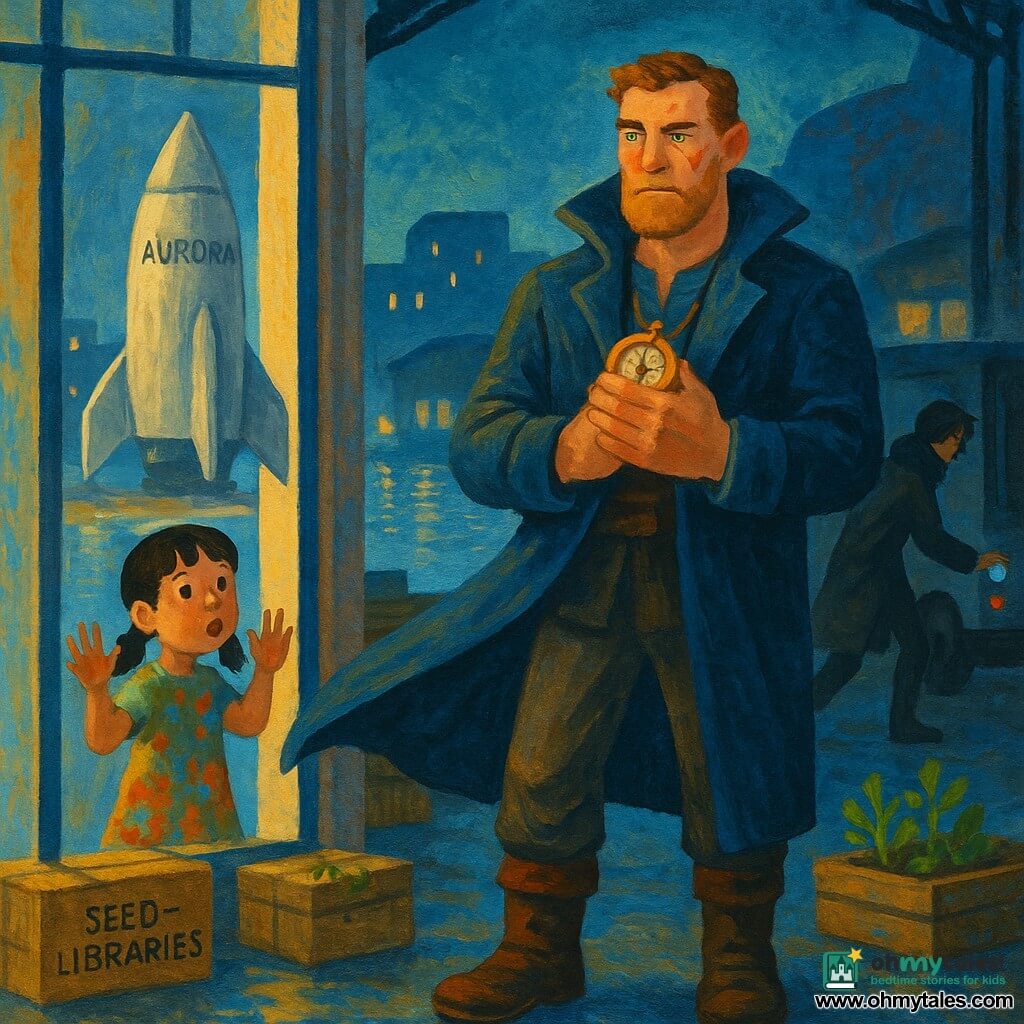
The city of Asterport slept under a quilt of sodium lights and trailing clouds. On the waterfront, the shuttle Aurora sat like a silver promise, wrapped in a hangar's blue glow. It carried more than fuel and instruments—inside, small gardens and a crate of seed-libraries destined for schools that had once only known concrete. Tonight it waited to lift hope beyond the horizon.
From a rooftop across the bay, the Sentinel strode into view. He was an adult man with a name that sounded like a myth and a calendar: Captain Meridian. He stood tall, shoulders like anchored piers, and his coat caught the wind like a sail. His face had a scar that looked like a lightning stitch—proof of a rescue years ago—and his eyes were a steady, bright green that scanned the city like searchlights. He wore boots that had crossed deserts and climbed apartment vents; his gloves were marked with smudges of every tool he'd used. Around his neck hung a tiny brass compass, scratched but faithful. He looked every inch the protector of Asterport.
The air hummed. Meridian felt it in his teeth. The shuttle's cooling fans did a slow, nervous whisper. "Something's out of tune," he said to himself, and leapt from the rooftop. Wind rushed past, carrying the smell of sea salt and solder. He landed on the promenade with a soft thump that startled a couple pushing a stroller. They waved. He waved back, always careful not to make children worry.
Meridian's radio chirped. "Aurora launch window in T-minus twenty," said Control, a bright voice from the space center. "All secure."
He smiled, but the smile didn't reach his shoulders. Heroes learn to read small silences. A shadow slid across the hangar lights—a drone the size of a hawk, its belly glowing ink-black. Meridian's hand went to the compass. Justice has small rituals.
Chapter Two: The Shimmering Heist
Under the hangar, the crew checked the shuttle: braided hoses, polished thrusters, a mural painted by kids—planets, paper rockets, stick-figure astronauts. A little girl called Mina had painted a smiling moon. The crew joked, voices warm like soup. Meridian loved these moments; they were the city's quiet armor.
The drone dove. It wasn't after the fuel. It hummed toward the seeds—small boxes stamped with school names. A thin, silver wire snaked from its belly and latched onto a crate. Meridian sprinted, coat flaring like a banner. He moved in a rhythm that had been honed through years of rescuing cats from church steeples and stopping runaway trams.
"Hey!" he roared. The drone reacted, flaring a ring of lights and a shriek that felt like nails on glass. Meridian threw a gloved fist. He didn't punch metal; he threw a net made of light—an invention of his own design that trapped circuits without frying them. The net closed. The drone hissed, then stuttered to a halt.
From the darkness stepped a figure wrapped in a coat that swallowed light. Their voice was velvet with calculating edges. "Captain Meridian," they purred. "Protecting toys for tomorrow?"
Meridian rooted like a lighthouse in a storm. "You can't steal what belongs to everyone."
"Belonging," the stranger said, "is always a matter of who controls the gate." They gestured toward a shadowed van where a strange device thrummed—an Aethersmith, capable of bending the shuttle's guidance to anywhere the buyer wished.
Meridian's jaw flexed. He knew Aethersmith tech: clever, illegal, and often used to reroute hope into pockets of greed. He thought of Mina's moon. "Not tonight," he said.
A flash. The stranger threw a smoke orb that smelled faintly of lemons and static. In the fog, the stranger darted toward the van. Meridian lunged after them, the light-net stinging out like a spiderweb. Someone behind him shouted, "Radio interference!" The hangar's consoles blinked and fell silent.
Chapter Three: Promenade Run
The smoke cleared enough for Meridian to see the stranger running toward the promenade where families walked and lights reflected silver on wet pavement. He followed, boots slapping tile. The promenade was alive with the city's heartbeat: dog walkers, late joggers, lovers leaning on the rail and watching ferries like drifting lamps.
Meridian intercepted on the boardwalk near a painted bench of constellations. The stranger moved with nimble, practiced steps, weaving between pedestrians with a thief's grace. Meridian kept his distance; the last thing he wanted was to cause a panic. He reached into his coat and pulled out a small device—a Justice Beacon—that sent a calm tone through nearby radios and slowed pulses. It was meant to soothe, not to snuff out courage.
"Stop," Meridian said, voice steady but not loud. "Whatever you're planning will hurt people."
"People make choices," the stranger said. Their coat opened enough for Meridian to see a glint of circuitry at their wrist, exactly the kind that could rewire the Aurora mid-flight. "Sometimes you must choose for them."
Meridian pictured the children in classrooms planting seeds from Aurora, the feel of dirt under small nails, the wide curious eyes when sprouts poked through soil. He thought of fairness, of towns where choices are not whispered but shared. He stepped closer, gently, and offered his hand—not as a cuff but as an answer.
"Choices are better when everyone gets a say," he said. "Justice means people get to rise together, not be lifted by a few."
The stranger hesitated, surprise flickering across their features. Meridian's kindness was not weakness; it was a tool. It made people remember who they were.
A sudden shout—Control was back online, its voice a hopeful thread. "Aurora prepping for launch in five!"
The stranger's eyes widened. They had wanted to redirect the shuttle to sell its cargo. Instead, Meridian's words made something like doubt blossom. For a heartbeat, the city held its breath.
Chapter Four: Circuit of Choices
The stranger's coat drooped. "You really believe people can be trusted?" they asked, not a challenge so much as a question from someone who had been told to doubt.
"I believe they deserve it," Meridian replied.
They stepped back. Two city patrols arrived, lights gentle and calm—the city's new guardians trained not to shout but to guide. Meridian suggested a different path: custody of the device, oversight, and a plan to redistribute goods fairly. "We'll set up a council," he said. "Schools, families, engineers. You can be part of it, too."
The stranger looked at the patrols, at the families on the promenade, at Mina's painted moon peeking from the hangar. They thought of a life built by taking and a life rebuilt by sharing. Their fingers tightened around the Aethersmith module and then, in a small, stunned motion, they handed it to Meridian.
There was no grand speech, no dramatic collapse—just a quiet handoff that felt, in Meridian's chest, like sunlight breaking a cloud.
Control's technician rushed over, voice full of relief. "We can secure the shuttle now. Thank you, Captain."
Meridian winked at Mina's mother and held the module like an awkward gift. The patrols walked the stranger to a seat where a counselor awaited. Justice, Meridian knew, is not a gavel alone; it's repair, repair with kindness, and a listening ear.
Chapter Five: Lift-Off and Lights
Back at the hangar, teams checked the Aurora again, humming machines accepting new instructions with beeps like contented birds. The small gardens were reassured; the seeds would go where they belonged. The city gathered at the promenade, peppered with silent cheers.
Meridian stood beside the shuttle as days of work became the final countdown. Children pressed their hands to the hangar glass, faces lit like the moon they had painted. "For classrooms," they whispered.
"All set," came Control's voice, calm and bright. The engines sang a low, hopeful tune. Meridian adjusted his compass on his neck, a private ritual that steadied him.
Before the launch, he turned to the stranger who had caused the trouble. They stood a little apart, a coat wrapped around them like a question. Meridian offered a small, earnest smile. "There are better ways to change a city," he said.
The stranger's smile was tiny, maybe the beginning of something else. "Teach me," they muttered.
The Aurora lifted. It climbed like a story taking flight, until the city could only watch its silver belly vanish into the stars. The people on the promenade cheered—not for fireworks but for possibility. Meridian felt it ripple through his chest, like the return of a long-awaited tide.
In the weeks that followed, councils formed, seed-libraries were distributed under fair plans, and the stranger worked with engineers to turn their skills to fixing broken things instead of stealing them. Meridian walked the promenade often, speaking with children about the stars and telling them how choices could build bridges.
The city of Asterport tightened its guards not into walls but into networks of care: patrols that listened, plans that included voices, and heroes who remembered to be gentle. Captain Meridian kept watch, compass warm against his chest, always ready, always kind.
And at night, when the lights trimmed the water like stitches, people slept a little easier. The shuttle had carried seeds away, but it left something behind—a city more brave and more fair. Justice had worked not as thunder, but as a steady light, and Asterport glowed a little brighter for it.