Part One: Ink-Wash Morning
In a small village where the mountains wore mist like a soft scarf, a woman named Aiko lived beside a narrow river. The river ran like a silver brushstroke through the rice fields. When dawn arrived, it did not shout. It whispered, and the world answered in pale colors, like a sumi-e painting still drying.
Aiko made pictures with ink and water. She used a simple brush, but her lines could feel like wind, and her dots could feel like rain. On her paper, a pine tree was not just a tree. It was a patient old friend, standing still and listening.
People in the village liked Aiko's calm smile. They came to her for drawings of cranes, for lucky charms, for quiet words. Yet Aiko carried a secret wish in her heart like a warm pebble.
At night, when the lanterns blinked and the frogs sang their round, sleepy songs, a tanuki would sometimes appear near the storehouses. He was a trickster spirit, with bright eyes and paws quick as falling leaves. He would tap barrels to make silly echoes, swap sandals, and leave rice bags tied in strange knots. No one saw him clearly, but everyone blamed him loudly.
“Thief!” the villagers would shout. “Nuisance!”
Aiko did not shout. She listened.
One evening she found a single persimmon placed neatly on her doorstep, its skin glowing orange like a tiny sunset. Beside it lay a smooth stone shaped like a smiling face. Aiko bowed toward the darkness.
“Thank you,” she said softly, as if speaking to the wind.
Her secret dream was simple: to help the tanuki and the villagers stop being enemies. She believed kindness could be a bridge, even over a river of fear.
Part Two: The Lost Page
Spring slid into summer. The rice grew taller, and dragonflies stitched blue thread through the air. One afternoon, Aiko walked to the shrine at the edge of the cedar forest. The torii gate stood there like a quiet doorway to the unseen, and paper streamers fluttered like white butterflies.
Aiko swept fallen needles from the stone steps. She liked caring for the shrine. It felt like caring for the village's heartbeat.
Behind the offering box, something pale peeked out—paper, old and curled like a sleeping leaf. Aiko gently pulled it free. It was a torn page, stained by time, with ink drawings and careful writing. At the top was a sketch of a tanuki, not with sharp teeth, but with a round belly and kind eyes. Around him floated small symbols: a rice stalk, a lantern, a circle like the moon.
Aiko read the words slowly. They were from a very old tale, a mukashibanashi, written long ago:
“When the tanuki's jokes turn sour, do not chase him with stones. Invite him with a lantern and a bowl. Let him see his face in clean water. Speak his name with respect, and he may return respect in return.”
Aiko's heart beat softly, like a drum covered with cloth.
“A lantern and a bowl,” she whispered. “Clean water. Respect.”
That night, the village buzzed with angry talk. Someone's pickles had been scattered, and a fisherman's hat was missing.
“We must set traps!” said one man.
“We must scare him away!” said another.
Aiko stood up, her voice gentle but clear. “May I try something first?”
The villagers looked at her as if she had offered to hug a thunderstorm. But Aiko had helped them many times, and her calm was like shade on a hot day.
“What will you do?” asked the headwoman.
“I will invite him,” Aiko said. “Not to cause trouble—but to make peace.”
Some villagers frowned. Some scoffed. Still, the headwoman nodded slowly. “One night,” she said. “Only one.”
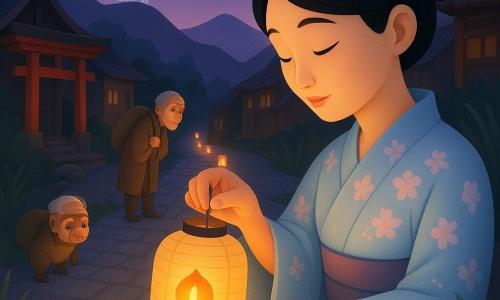
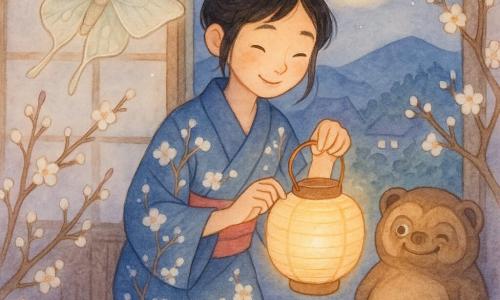
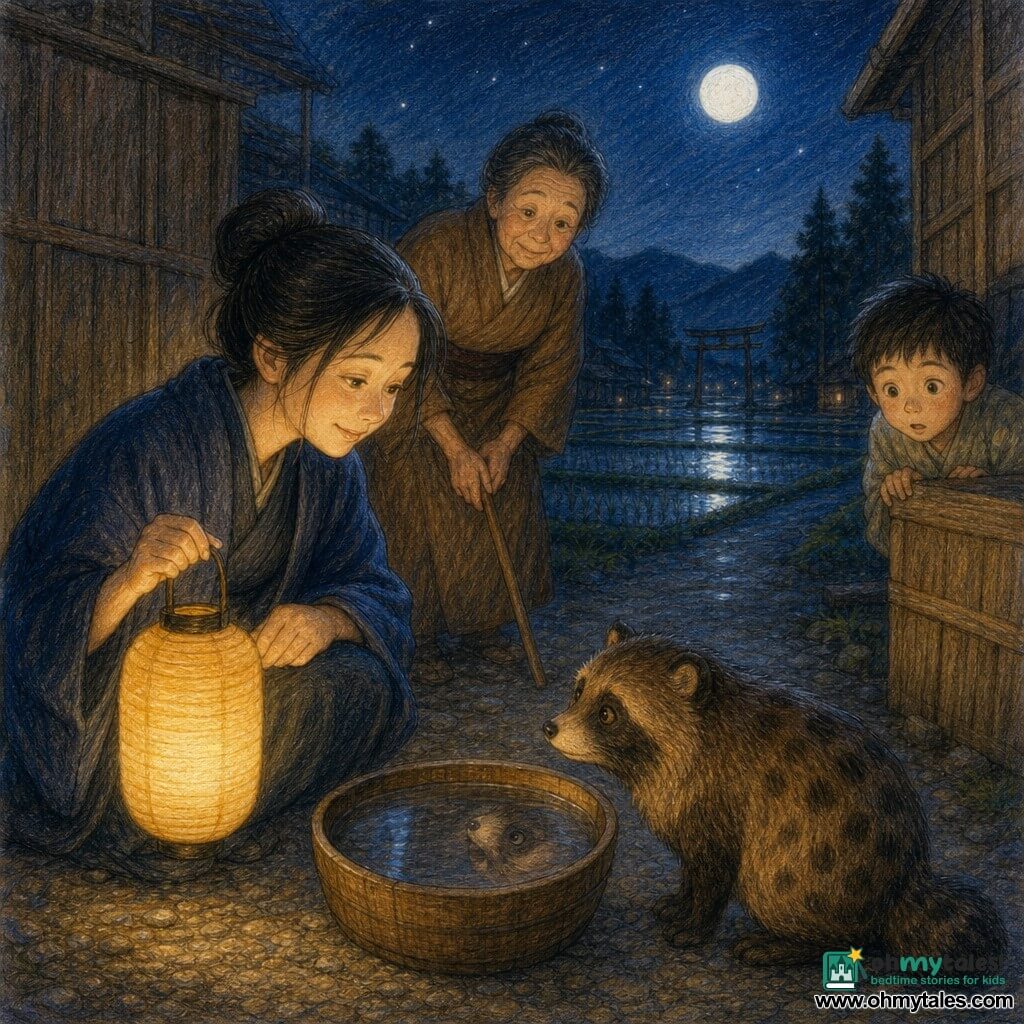
Aiko went home and prepared. She chose a small lantern with warm light, the color of honey. She found a shallow wooden bowl and filled it with clear river water. In the water she placed one floating camellia petal, pink as a shy smile.
Then she did something else. She took fresh paper and, with her brush, painted a tanuki in soft ink: rounded ears, gentle paws, eyes like two curious stars. Under it she wrote, in simple strokes: FRIEND.
She did not know if a tanuki could read. But she knew spirits understood the language of heart.
Part Three: The Trick and the Bridge
Moonlight arrived like a quiet guest. Aiko carried her lantern to the path between the storehouses and the riverbank. The village slept behind her, roofs dark as folded wings. The forest breathed in long, slow sighs.
Aiko placed the bowl of water on a flat stone. She set the lantern beside it. Then she laid her ink painting carefully on the ground, held down by a pebble.
She sat, hands in her lap, and waited. Waiting, she believed, was a kind of kindness. It said, “I have time for you.”
The night was full of small sounds: a moth tapping the lantern glass, a reed swaying, a distant owl counting the hours.
Then—tap-tap-tap—tiny footsteps.
Aiko did not turn fast. She turned like a page, slowly.
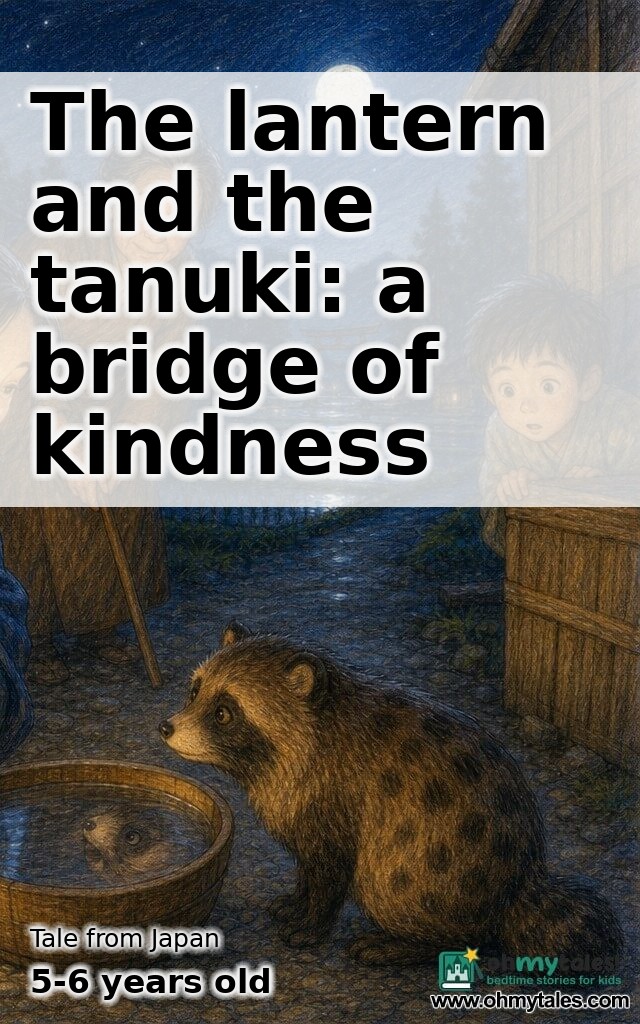
There, half-hidden in the shadow of a storehouse, was the tanuki. He was smaller than the villagers imagined, and his fur looked like autumn mixed with midnight. His eyes shone, but not with anger. With worry.
He stared at the lantern, and at the bowl. He crept closer, one paw at a time, ready to vanish like smoke.
Aiko bowed. “Good evening,” she said. “Tanuki-san.”
The tanuki froze. Hearing his name spoken kindly was like hearing a song he thought forgotten.
Aiko pointed to the bowl. “This water is for you,” she said. “To see yourself.”
The tanuki leaned over. In the bowl, his face trembled in the reflection, soft and round. Beside his whiskers floated the pink petal, like a tiny promise.
He looked up at Aiko, puzzled.
Aiko slid her paper closer. “And this is for you too.”
The tanuki sniffed the painting. Then he did something strange. He touched the word FRIEND with one paw, very gently, as if it might bite.
Aiko smiled. “The village is frightened,” she said. “When people are frightened, they make hard words and hard hands. But fear is only a cold wind. Kindness is a warm coat.”
The tanuki's ears drooped. He let out a small huff, like a child caught making faces.
Aiko continued, “Your jokes have made trouble. But I think you do not wish to be hated.”
The tanuki glanced toward the sleeping houses. His paws moved, and he pulled something from behind his back: a fisherman's hat. Then another thing: a string of pickles tied neatly in a leaf. He set them down with care.
Aiko's eyes widened. “You kept them safe.”
The tanuki made a small sound—half proud, half sorry.
Just then, a twig snapped. A few villagers had followed Aiko, unable to resist. They stood at the edge of the path, holding sticks. Their faces were tight knots.
The tanuki saw them and sprang back, ready to run.
Aiko lifted her lantern high. Its light spilled onto the path like a golden ribbon. “Please,” she said to the villagers, “do not chase him.”
The headwoman stepped forward. In the lantern glow, she saw the hat and the pickles placed neatly, not stolen away. She saw the tanuki's trembling paws. And she saw Aiko, calm as a pond.
Aiko bowed again, this time to both sides. “If we want harmony,” she said, “we must start with gentle hands.”
The headwoman's stick lowered. One by one, the others lowered theirs too. The air seemed to loosen, like a clenched fist opening.
The tanuki blinked. Slowly, he picked up the fisherman's hat and, with a careful little bow, set it on the stone. Then he waddled to the bowl and dipped his paws in the water, washing them as if washing away old mischief.
It was a small act, but it felt like a door turning on quiet hinges.
Part Four: Everyday Magic
After that night, things began to change, not all at once, but like dawn—thin light growing brighter.
Aiko asked the villagers to leave a small bowl of water by the shrine each evening, and a bit of rice on festival days. “Not as a prize for tricks,” she explained, “but as a greeting.”
The villagers agreed. Even the grumpiest man could not argue with the calm way the nights felt now.
The tanuki still played, but his play became helpful. One morning, a lost child followed a trail of little pebble arrows all the way home. Another day, someone found their missing sandals lined up neatly like polite guests. Sometimes, near the storehouses, people heard funny tapping—yet nothing was broken. It sounded like laughter learning to be careful.
In late summer, Aiko returned to the shrine and tucked the found page into a clean cloth, safe and honored. She added her own new page beside it. On it she painted a lantern, a bowl of water, and two figures—one human, one tanuki—standing under the same moon.
Underneath she wrote: KINDNESS MAKES ROOM.
On the night of the harvest moon, the village held a small festival. Paper lanterns swayed. The air smelled of sweet rice cakes. Aiko stood near the river, watching the moon's reflection tremble like a bright coin.
From the reeds came a soft rustle. The tanuki appeared, wearing—somehow—a tiny ribbon around his neck, as if he had tried to dress for the occasion.
Aiko giggled, covering her mouth. The tanuki puffed his chest, pleased.
The headwoman approached slowly and placed a little saucer of rice on the ground. “Tanuki-san,” she said, a bit stiffly, but trying. “Thank you… for returning what was lost.”
The tanuki blinked, then bowed so low his nose nearly touched the earth. He took one grain of rice and held it up as if it were a pearl. Then he set it down again, and pushed the saucer toward the village, sharing.
Aiko felt her secret dream unfold like a paper crane opening its wings.
In that moment, the village looked like a sumi-e scene come alive: dark roofs, pale moon, a few bright lanterns, and between them, a simple bridge made of kindness. No spells, no fireworks—just everyday magic, the kind that grows when hearts choose to be gentle.
And as the seasons continued to turn, the villagers learned something quiet and strong:
When you meet mischief with cruelty, it becomes sharper. But when you meet it with patience and respect, it can soften into friendship.
Aiko went home under the moon, her lantern swinging like a small, warm star. Behind her, the river kept flowing, brushing the world with silver, as if painting harmony one calm stroke at a time.