Part One: The Lantern Keeper
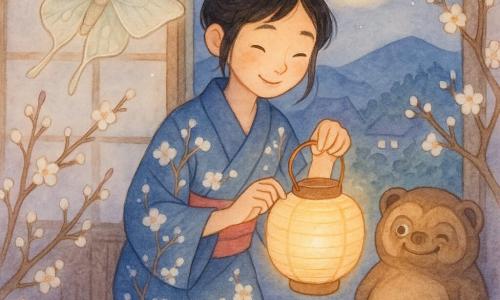
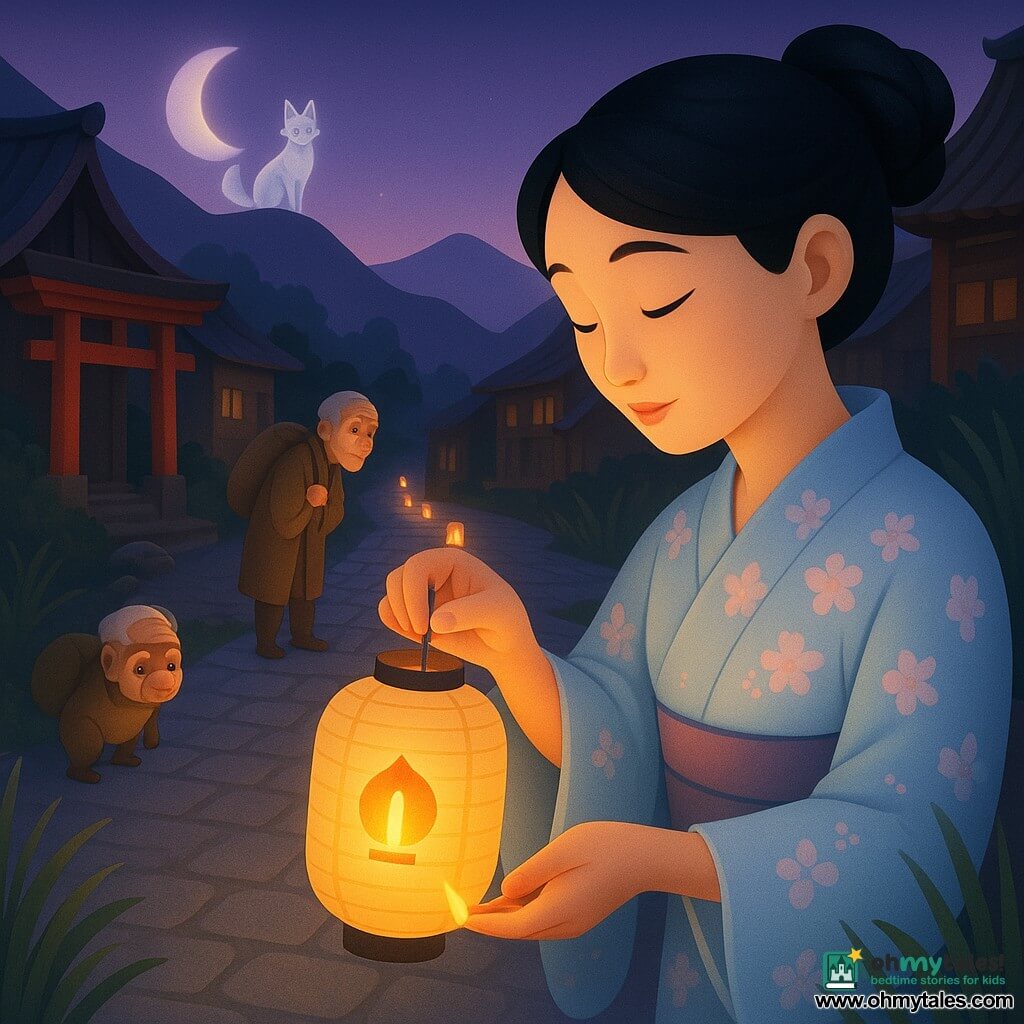
In a seaside town in Japan, where roofs curved like sleeping cats and bamboo sighed in the wind, lived an adult woman named Hana. She was careful in the way a teacup is careful—steady, gentle, never rushing. Each evening she walked the stone lanes and lit the town lanterns, one by one, until the streets looked like a necklace of warm amber beads.
Hana's lantern pole was smooth from years of use. She carried oil in a small tin, and her steps were quiet. Travelers came through the mountain pass after sunset, and Hana wanted them to find the town safely, as if her lights were friendly hands guiding them home.
The seasons moved around her like soft robes. In spring, cherry petals floated like pale snow. In summer, the air smelled of river water and green leaves. In autumn, the maples burned red, and in winter, the moon looked like a cold coin.
And always, near the old shrine at the edge of town, the tanuki watched.
Tanuki were playful spirits, round as dumplings and quick as secrets. They loved small tricks. Some nights they turned footprints the wrong way. Some nights they hid a sandal just to see someone hop. They were not cruel. Their mischief was like a gust of wind that flips a paper fan.
Hana knew their games. She did not chase them. She simply checked each lantern twice. “Light is for everyone,” she reminded herself. “Even for tricksters.”
One twilight, as she lit the last lantern near the shrine, she noticed something strange: the lantern's paper had been patched with a leaf, and the flame inside made the leaf glow green-gold, like a tiny forest caught in a jar. Hana's heart felt a small shiver of wonder, but she stayed calm. In a world with spirits, wonder often wore ordinary clothes.
She bowed to the shrine, as her mother had taught her. The wind replied with a hush, like a kind old voice.
Part Two: A Small Trick and a Fair Heart
The next evening, clouds covered the sky. The town grew dark early, and the mountain pass looked like a long black ribbon. Hana hurried, but she did not run. Carefulness was her lantern too.
Halfway through her route, she found three lanterns unlit. Their wicks were dry, as if they had been waiting too long. Hana frowned. She had filled them yesterday.
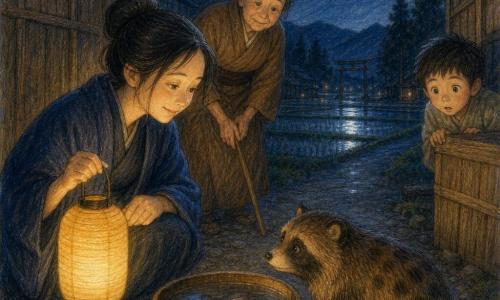
She looked down and saw tiny paw prints in the dust—round, soft, and smug. Tanuki prints.
Farther on, she heard a faint clink, then a giggle hidden behind a hedge. A lantern hook swung empty. Another lantern was gone.
Hana's first feeling was anger, hot as pepper. Travelers would come. They might slip. They might get lost. Mischief was one thing, but danger was another.
She followed the paw prints to a clump of reeds near the river. There, under a flat stone, she found the missing lanterns. They were not broken. They were only hidden, as if someone had played a game and forgotten the rules.
Hana lifted them and set them back on their hooks. She lit them with steady hands. The flames rose like tiny sunrises.
Then she did something the tanuki did not expect. She placed a small bowl of rice by the reeds, and beside it a slip of paper with one simple drawing: a lantern shining over a path.
Hana did not scold the night. She did not shout at the unseen. She only made her meaning clear, like a clean bell sound.
That night, a traveler did come: an old man with a bundle on his back. He moved slowly, and the wind pulled at his sleeves. When he reached the town gate, he bowed toward the lanterns as if they were people. Hana watched from a distance, her heart easing.
But when she returned home, sleep did not come quickly. The darkness outside felt thick, like ink in a deep bowl. Hana lay still, listening to the hush of the shrine trees.
At last, her eyelids closed, and she stepped into a dream.
In her dream, the lanterns were not lanterns. They were fireflies the size of peaches, drifting above the road. The town was farther away, as if it had slid down the hill. And on the path stood a fox.
The fox was tall and silver, and its eyes were calm, like two quiet stars. It did not speak with words. It spoke with the way it moved—slow, certain, and careful, like Hana.
The fox turned its head toward the mountain pass. In the dream, the pass was split in two: one path was bright and safe, and the other was dark and twisting. On the dark path, Hana saw shadowy figures—travelers who looked tired, uncertain, and small.
The fox lifted its tail. From its fur, pale light fell like moon-dust. The dust did not chase the darkness away by force. It simply revealed what was true: some lanterns stood where they should not, turned the wrong way, pointing travelers toward the twisting path.
Hana's chest tightened. Someone had moved the lanterns—no longer just hiding them, but changing the road itself.
The fox looked at Hana, and in its gaze she felt a simple lesson: justice is a straight path. It is not loud. It is clear.
Hana bowed in the dream. The fox bowed back. Then the dream folded like paper, and morning arrived.
Part Three: The Night of Right Light
Hana woke with the taste of cold air in her mouth, as if the dream had been a real walk. She rose before dusk and visited the shrine with a small offering: rice, salt, and a sprig of pine. The shrine was quiet, but the quiet felt alive.
That evening, she began her lantern round earlier than usual. The sky was a soft purple, and the first star blinked awake. Hana checked every hook, every post, every rope. She placed a pebble mark by each lantern base, a tiny sign only she would notice.
Near the river reeds, she found the rice bowl empty. In the wet sand beside it, tanuki paw prints circled like a little dance. And there, set neatly on a stone, was a single chestnut—shiny and brown, like a small thank-you.
Hana smiled. “We understand each other,” she thought, and continued.
When she reached the mountain pass gate, she saw it: two lanterns had been moved. Not far—just enough to bend the path. The pebbles she had placed showed the truth. Hana's careful plan had worked.
She did not panic. She did not storm into the bushes. She simply lifted the lanterns and put them back where they belonged, so the road made sense again. She tied the rope tighter. She set the hooks higher. She made the path honest.
Then Hana did something brave and gentle at the same time. She placed a new lantern at the fork where the path began to twist. This lantern had a paper shade painted with a simple symbol: a straight line leading to a small house. It was not fancy. It was clear.
As the sun slipped away, travelers arrived—two sisters holding hands, a merchant with a creaking cart, a young mother with a sleeping child on her back. They followed the warm dots of light like ducks following a calm river.
In the shadows, the tanuki gathered. Hana could sense them: a rustle here, a sniff there, a giggle swallowed quickly. Their eyes shone like wet berries.
At first, one tanuki crept toward the new lantern, paws itching for trouble. But another tanuki tugged it back. The first tanuki froze, then sat down with a huff, as if remembering the drawing on the paper and the dream's quiet warning.
The wind rose. It carried a faint scent of fox—clean and cool, like snow on pine needles. Hana looked up, and for a moment she thought she saw a silver shape on the ridge, watching the pass with patient eyes. Then it was only moonlight and mist.
The night grew deeper. A sudden gust tried to shake the lantern flames into fear, but the lanterns held steady. Their light seemed to say, “This way. This is safe. You are not alone.”
Hana walked the street once more, counting each glow. Her heart felt like a warm stone in her chest.
She understood something simple and strong: justice is not a punishment. Justice is protection. It is putting things back where they belong, so others do not stumble. It is making sure the smallest traveler and the biggest trickster live under the same fair sky.
Before she went home, Hana bowed to the shrine and to the road. In the reeds, the tanuki left another chestnut, and this time a bright leaf too, as if they were learning to give light back.
That night, the town shone like a little boat on a dark sea, and the lanterns guided everyone—careful woman, playful tanuki, and wandering strangers—toward warmth, home, and peace.