Part 1: The Dry Marsh and the Quiet Hands
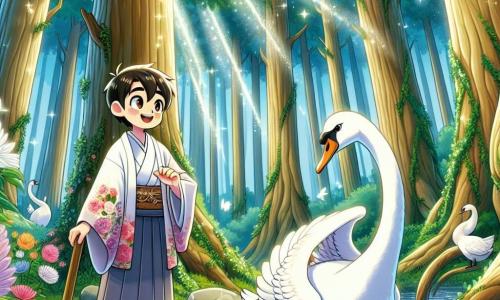
Long ago, in a village where roofs curved like sleepy cats, a young man named Haru lived beside a marsh.
People used to call it Firefly Marsh. In summer it had glittered, as if the stars had slipped down for a drink. Children would cup their hands and whisper, “A tiny lantern, a tiny wish.”
But now the marsh lay dry.
The reeds were thin as old brushes. The mud had cracked into little squares, like a tired puzzle. Even the frogs sounded shy, as if their songs had lost their way.
Haru was gentle and generous. When an elder carried a heavy basket, Haru was there. When a neighbor dropped rice, Haru helped gather each grain like it was a pearl. And when he saw the dry marsh, something in him ached the way a drum aches before it is played.
“I will bring the fireflies back,” he promised the marsh, softly, as if speaking to a sleeping child.
Haru learned ikebana from his grandmother. She taught him that flowers were not just pretty. They were a way to listen.
“Do not force the branches,” she would say. “Find the balance. Let the empty space speak. Nature has a breath. Respect it.”
So Haru began with respect. Each morning he walked to the marsh with a small bowl of water and poured it slowly into the deepest crack. It was not much, but it was a kind act, like offering tea to a lonely guest.
He also cleaned the old stone path that led to the marsh. He picked up fallen twigs and bits of broken pottery. He bowed once to the water that used to be there, and once to the wind that still was.
One evening, as the sun folded itself behind the hills, Haru arranged an ikebana offering near the edge: a green reed, a wild white flower, and a curved branch like a moon in winter.
He sat and watched.
The air turned cool. The sky turned purple, like a plum. And then, from the reeds, came a sound—soft as a fingertip on paper.
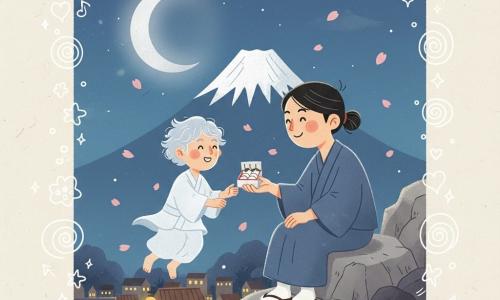
A small spirit appeared.
It looked like a pale child made of mist and moonlight. Its eyes were dark and kind. It did not speak with a mouth. It spoke with the rustle of leaves.
“The marsh remembers,” the spirit's whisper seemed to say. “But remembering is not the same as returning.”
Haru held his hands together. “Please,” he said aloud. “What can I do?”
The spirit drifted close to Haru's ikebana and circled it, as if smelling the balance.
“Three things,” the whisper said, like wind through bamboo. “Water, patience, and a light that does not chase.”
Then the spirit faded, leaving only the quiet, and the smell of earth waiting.
Haru did not feel scared. He felt guided, the way a boat feels when a calm river takes it.
He stood, bowed to the darkening marsh, and went home to think.
Part 2: The Lantern That Floated Like a Promise
At home, Haru found an old paper lantern in a wooden chest. It had been his grandfather's. The paper was yellowed, like autumn leaves, but the frame was strong.
Haru fixed it carefully. He patched the paper with thin rice paper, smooth as a moth's wing. He tied a new string. He placed a small candle inside, and the light glowed warm and round.
As he worked, he remembered the spirit's words: “A light that does not chase.”
Fireflies were shy. They did not like loud hands or running feet. They liked stillness. They liked kindness. They liked a place where the water held their reflections like gentle mirrors.
Haru asked the villagers for help.
Some brought buckets of water from the stream. Some brought stones to make small channels. Some brought reeds from a wetter pond to plant near the marsh.
It was hard work. The sun was hot. The ground was stubborn.
A boy complained, “It will never be like before.”
A woman sighed, “The marsh is too tired.”
Haru wiped his brow and smiled. “Even tired things can heal,” he said. “We will try, one small step at a time.”
Day by day, the marsh began to change. Not quickly, not with a great splash, but with tiny signs.
A thin ribbon of water began to curl through the cracks. The mud softened. New green shoots rose like little brushes painting the world again.
Still, no fireflies came.
Summer nights arrived, warm and sweet, but the air stayed dark and empty. Haru sat by the marsh, listening to the frogs, watching the sky.
His heart felt like a lantern with no flame.
Then came the night of the mini-storm.
Clouds hurried in like gray travelers. Wind shook the reeds. A sudden rain fell—fast, loud, and then gone.
When the rain ended, the moon slid out, bright as a silver coin. The marsh held more water than it had in a long time, and it shivered with moonlight.
Haru's lantern was beside him.
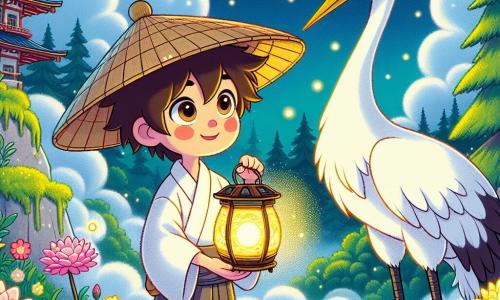
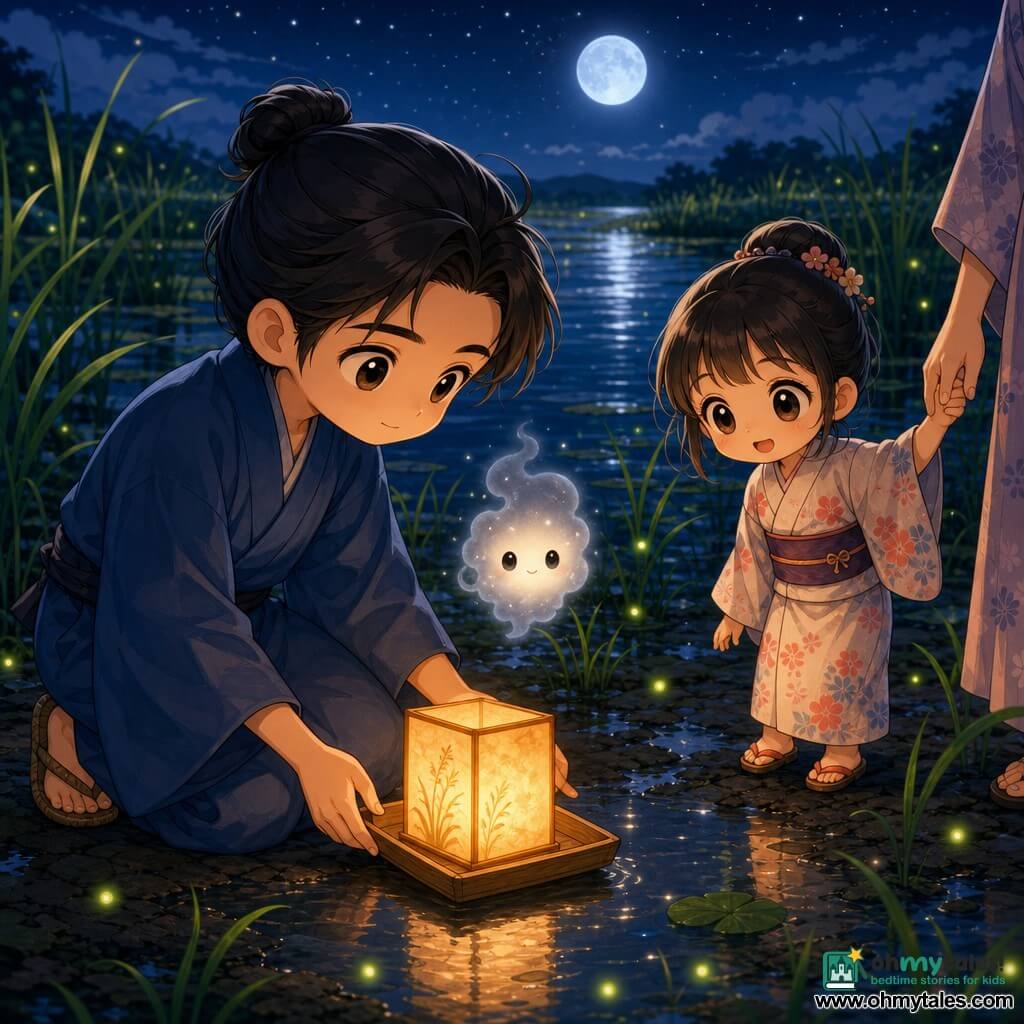
He lit the candle, and the lantern glowed like a small, patient sun. He placed it on a flat wooden tray and carried it to the water's edge.
The spirit's words returned to him, soft as a lullaby: “A light that does not chase.”
So Haru did not wave the lantern. He did not run with it. He set it gently on the water.
The lantern floated.
It drifted slowly, like a paper boat carrying a secret. Its warm circle of light stretched across the water and rested on the reeds. The flame inside bowed with the breeze, but it did not go out.
Haru watched, holding his breath.
Then—oh!—the lantern bumped a reed. The tray tipped. The lantern leaned.
For a moment it looked as if the light would drown.
Haru's feet wanted to jump forward.
But he remembered balance. He remembered space. He remembered patience.
He stayed still, ready, but not rushing.
The lantern righted itself. It floated on.
And in that quiet, something else moved.
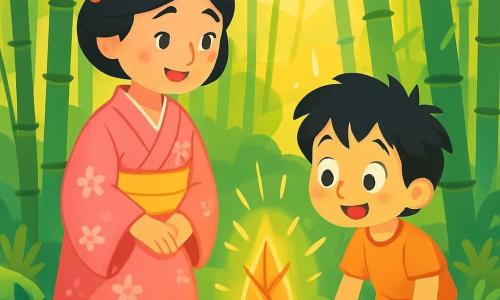
A tiny spark blinked near the water.
Then another.
Then three more.
They were not from the lantern. They were not candle sparks.
They were fireflies.
Part 3: The Marsh Breathes Again
At first, only a few fireflies came, shy as whispers.
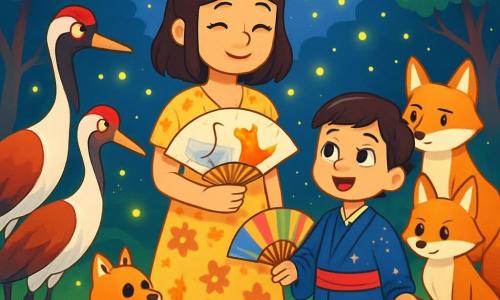
They hovered near the lantern's glow, as if greeting an old friend. They did not crash into it. They danced around it, making little loops and commas in the air.
Haru's eyes filled with happy tears. He did not clap. He did not shout. He simply bowed, very low, to the marsh and to the night.
The next evening, he returned with the lantern again. He set it on the water, just as gently.
More fireflies appeared.
They rose from the reeds like tiny prayers. Their lights blinked on and off, as if the marsh itself was breathing: in… out… in… out.
The villagers came, too, but Haru taught them how to watch.
“Soft steps,” he said. “Quiet voices. Let the fireflies lead.”
The children held hands. The adults smiled. Even the grumpy old dog sat down and looked peaceful.
On the third night, the mist-child spirit returned, floating near the lantern. In the lantern's glow, the spirit looked like a white petal drifting on dark water.
“You did not chase,” the whisper said. “You invited.”
Haru spoke softly. “I was afraid the lantern would fall.”
“It did,” the whisper replied. “A little. And you did not break the night by panicking. You stayed steady. That is how a marsh heals. That is how a heart heals.”
Haru looked at the water. He saw the lantern, and the fireflies around it, and the moon above it. Three lights, different and together. Like a family of stars.
He remembered the hard days, the hot work, the doubts that tried to nibble at his hope like mice on rice paper. He remembered how he kept going anyway.
Resilience, he realized, was like planting reeds. You push them into the mud again and again, even when the wind laughs. You trust that roots will grip.
The spirit drifted closer to Haru's ikebana offering, which he had brought again: one reed, one flower, one moon-branch.
“Balance,” the spirit whispered. “Respect. And the courage to try again.”
Then, as quietly as a falling leaf, the spirit disappeared.
The fireflies stayed.
All summer, Firefly Marsh shone again, not as bright as a festival, but as gentle as bedtime. The marsh was no longer a cracked puzzle. It was a mirror, a home, a soft bowl of water holding the sky.
And Haru, the young man with the steady hands, learned something he would carry like a warm lantern inside his chest:
When things dry up, when dreams look cracked, you do not have to be loud or fast. You can be patient. You can be kind. You can try again, one careful step at a time.
Even the smallest light, set gently on the water, can help the world remember how to glow.