Chapter One: The Garden of Clear Stones
There was a small garden at the edge of the village. The garden kept its rules like a kind friend. Paths were neat. Trees bowed politely. Stones lay in clear lines so you could always find your way back.
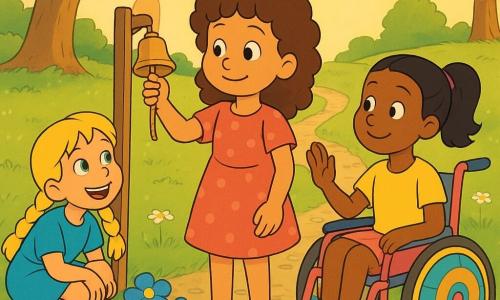
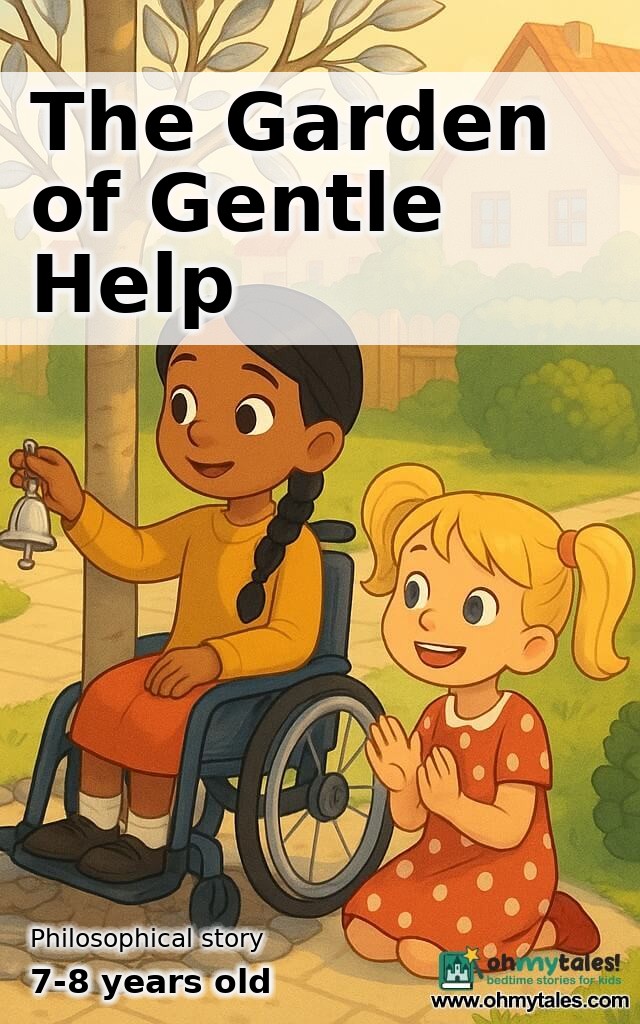
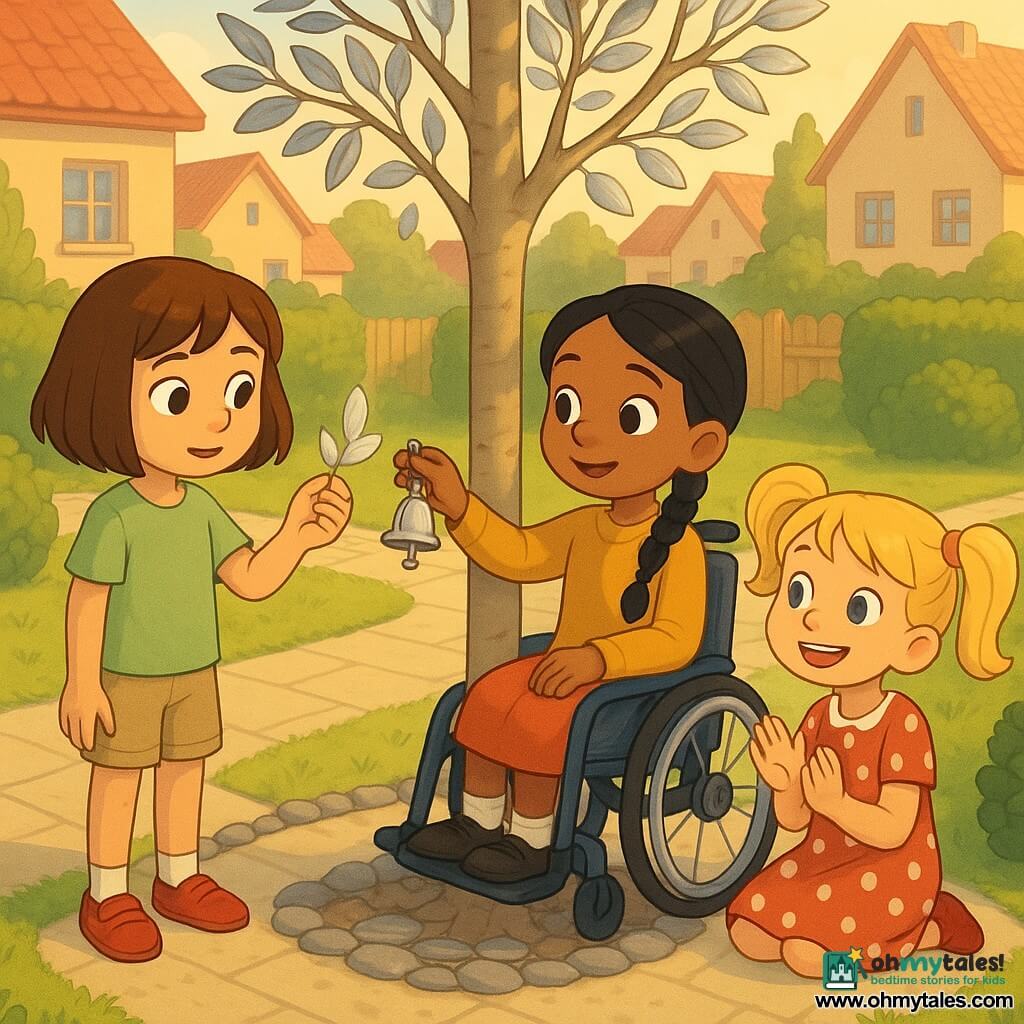
Three girls came every afternoon. They were all seven. Mira had quick eyes. Sara laughed like bells. June moved with calm steps and sat in a bright wheelchair that had stickers of stars. The girls liked the garden because it listened. It did not hurry them or push them. It gave gentle limits, like a warm hand on the shoulder.
One sunny day, they found a new patch of stones. These were smooth and flat, like pages of a book. In the middle of the patch stood a tiny, leaning tree. Its trunk was thin as a pencil, but its leaves shimmered like a thousand small mirrors. The tree looked like it had a secret.
"Maybe it speaks," Mira said with a serious face.
"It probably sings," said Sara, and she clapped a little. Her laugh made the leaves twitch.
June rolled closer and touched the trunk. It felt warm. "I think it waits," she said.
They sat around the tree. The garden listened. A soft wind moved the leaves, and the girls felt as if the tree asked a gentle question: Who decides when to call for help? The question moved like a bird through the branches and landed on their knees.
"Can a question be shy?" asked Sara.
"Maybe," said Mira. "It hides until someone asks it nice."
June smiled. "Then let's ask it nice."
They spoke to the tree with quiet voices. Each voice was a pebble dropped in a still pond, making small, bright ripples.
"What does it mean to ask for help?" Mira asked.
"Is it brave or small?" Sara wondered.
"Can I decide when I need a hand?" June asked, looking at her own palms.
The tree did not answer with words. It answered with a small silver leaf that drifted down and landed in June's lap. The leaf was thin as a thought. It shone like a coin and carried no hurry.
"Keep it," the garden said in a voice the girls only understood by feeling. "It will grow when you learn."
They kept the leaf. They agreed to meet the next day. Each went home holding a small silence that felt like a warm blanket.
Chapter Two: The Map of Quiet Rules
The next day, the garden gave them a map. Not a paper map, but a map made of light on the ground. Lines of sun made streets. Little lanterns marked places: The Corner of Small Tasks, The Bridge of Shared Laughter, The Hill of Choices.
"Look," said Mira. "The map shows limits. They are friendly limits, like fences for picnic blankets."
"They are not walls," June said. "They are guides."
They followed the lines. At the Corner of Small Tasks they found an old watering can. Mira tried to lift it. It was heavier than she expected. Her arms shook a bit.
"Do you want help?" Sara asked, already reaching.
Mira paused. She felt a flutter in her belly. She liked being able to do things by herself. She also liked Sara's hands. She looked at the silver leaf in her pocket. It felt soft.
"I can try a little more," Mira said. She bent her knees and breathed slow. She carried the can a few steps and then, with a laugh, handed it to Sara. "Okay, your turn," she said.
Sara took it and poured water over the little seedlings. They all clapped like a small storm of joy. The garden nodded.
On the Bridge of Shared Laughter, June wanted to cross without anyone pushing. The bridge was tiny and wobbled like a giggle. June felt the bridge move under her wheels. She felt like a captain steering a small boat.
"If it tips, I will call," she said, her voice calm. "But I'll try first."
"Call then," Mira said softly. "And we'll come."
June crossed, slow and steady. Halfway, a pebble slid, and the wheelchair shivered. June smiled. "Hello, pebble," she said. "You are curious."
She reached out and touched the rail. The girls reached when she asked, quick as a kite in the wind. They steadied the chair like a pair of hands catching a falling feather.
"That felt good," June said, hugging the rail and the friends who had come like two little boats steadying hers.
They moved to the Hill of Choices. Up high, the world looked like a folded paper map. Houses were small stamps. People were tiny dots. The garden hummed soft and steady, like a heart.
"Who decides when to call for help?" Sara asked again, letting the question float like a paper plane.
They sat and thought. Wisdom, they felt, was a slow bird. It did not rush. It landed when you prepared a branch for it.
"We decide," June said after a while. "And sometimes we ask the world to remind us."
"But how do we know?" Mira asked.
"You listen," June said. "To your hands, your belly, your voice. Ask yourself if the task is a storm or a cloud. If it's a cloud you can wait. If it's a storm, ask sooner."
"That sounds like making good rules," Sara said. "Rules that are kind."
The garden shone a little brighter, like someone who had been told a joke and appreciated it.
Chapter Three: The Clock That Listened
At the center of the garden, there was an old clock. It did not say hours and minutes like most clocks. Instead, its face had tiny pictures: a cup for rest, a shoe for walking, a hand for help, and a star for dreaming. The hands of the clock moved softly when people showed them choice.
"You can wind it," the garden said. "Winding keeps it honest."
Mira wound the clock. The hand pointed to a small drawing of a hand. The girls laughed. "How clever!" Sara said.
A ladybug walked across the clock as if crossing a bridge. It stopped at the hand. "Help," the ladybug seemed to say with tiny antennae. The clock ticked. It gave the girls a small bell, like a promise you keep in your pocket.
"Use it when the wind is strong," the garden whispered. "The bell calls a circle of friends."
They kept the bell. It sounded like a tiny yes.
Days passed like soft pages turning. The girls practiced listening. They tried things alone and together. They learned when their own breath felt like a drum and when it felt like a lullaby. When it felt like a drum, they pushed a little. When it felt like a lullaby, they asked.
One afternoon, a new question arrived. "Is asking for help the same as giving up?" Sara asked, chewing her lower lip.
June took the silver leaf from her pocket and held it up. It winked. "No," she said. "Asking for help is like asking for a taller ladder or tools when a wall is high. You are still building."
Mira tapped the bell. It made a small sound like a bell of dew. "Help is a beam for your house of trying," she added.
They all smiled. Wisdom was simple and stubborn. It liked to hide in small things.
Chapter Four: The Night of Bright Quiet and a Wish for Tomorrow
One evening, the sky turned the color of a sleeping whale. Stars pricked it like tiny stitches. The garden wrapped itself in quiet. The three girls sat beneath the little leaning tree. The silver leaf lay between them. The bell was in June's palm.
"Do you know what I dream?" Mira asked.
"Tell us," said Sara.
"I dream that one day I will know exactly when to ask. That I will feel it like a warm light that says, 'Now.'" Her eyes made a small shine.
June looked at the stars. "I have a secret dream too," she said. "I wish I could choose when to ask for help, like a button I press, and it would ring only when I want."
Sara pretended to press an invisible button. "And I wish," she said with a grin, "that help would bring cookies sometimes. That would be very wise help."
They all laughed. The garden laughed too, making leaves clap softly.
"Maybe the secret is this," June said quietly. "We can practice choosing. We can learn the sound in our bodies that says, 'Now I will ask.' And we can trust that asking is part of being brave."
"That makes sense," Mira said. "It's like learning to ride a bike. At first you wobble. Then you know when to call for a lower hill or a friend. You don't stop being brave."
Sara looked at the silver leaf and then at her friends. "So tomorrow we practice," she declared. "We play at deciding. We make a game where we ask at the right moments and keep trying when we can."
They agreed. They held hands in a small circle. June rang the bell once. It made a sound like a soft promise.
"One wish for tomorrow?" Mira asked, looking at the sky.
"One wish," Sara said, "and make it kind."
June closed her eyes. She pictured the leaning tree, the map, the clock, the bell, and the silver leaf. She pictured the small garden with its friendly rules. Her wish was a tiny, bright thing that fit in the palm of a hand.
"I wish," she said, "that tomorrow we wake with the quiet to listen, the courage to try, and the wisdom to ask—just when we need it. And that when someone asks us, we come like a gentle wind."
They whispered the wish together. It fluttered up into the leaves and became part of the garden's hush. The night held them like a soft cup. The stars stitched a small story above their heads.
They left the garden with pockets full of small noises: a bell, a leaf, a plan. Each step home was like a sentence in a book that loved endings and also liked the idea of another page.
As they walked, June pressed the bell into Mira's hand. "Keep it tonight," she said. "So you remember the wish."
Mira put the bell by her bedside. Before sleep, she tapped it once, just a soft sound, and thought of the tree that asked questions without scaring anyone. In her mind, the silver leaf glowed like a little moon.
And she made one last wish for the dark: May tomorrow's listening be gentle. May the asking be brave. May help come like a warm blanket and a friendly ladder.