Chapter One: The Quiet Meadow
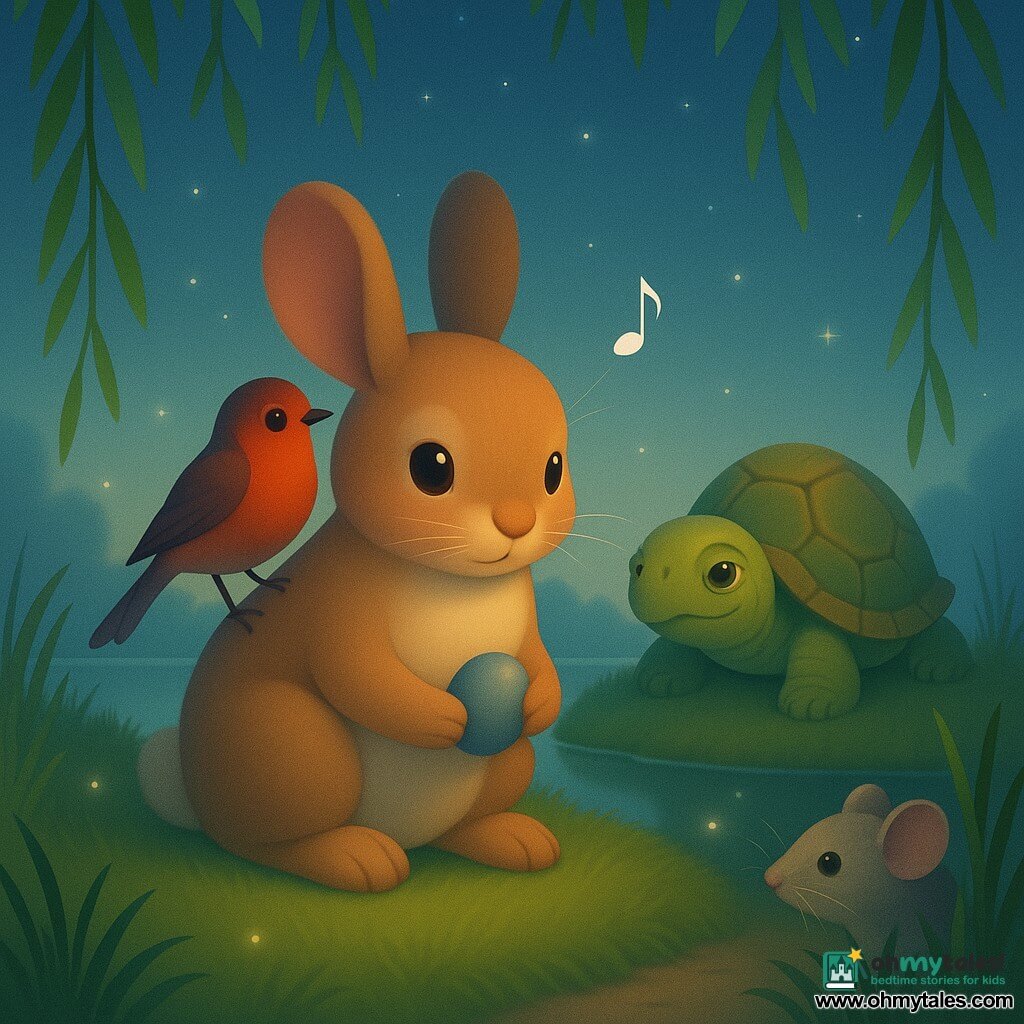
In a meadow that breathed like a sleeping song, there lived a small rabbit named Lute. His fur was the color of warm bread and his ears were soft flags that listened to the world. Lute liked simple things: the taste of clover after rain, the gentle curve of the river, and the way the sky kept its promises of stars.
Every morning Lute hopped along a narrow path of flattened grass. He knew the stones by their names—Round, Tall, and Clever. He knew the sound of wind in the tall grass and the way the sun painted the leaves gold. Lute did not ask for much. He liked to keep his pockets light and his days slower than clock-hands.
One day, as he nibbled a quiet patch of clover, Lute looked up. The clouds were like folded letters. He asked the air, in the softest way, "What is the best way to live?" The wind replied with a leaf and a laugh. Lute sat very still. He liked to think of questions like seeds. He believed seeds should be planted gently.
"Why ask?" said a voice like a pebble rolling. A tortoise, slow as a thought, came from a burrow. "We have always eaten, slept, and warmed our shells."
"But is living more than that?" Lute wondered aloud. "Is it kind to others? Is it brave to be small?" The tortoise smiled with eyes like slow moons. "You will find answers on the way," he said, "but the way will also learn from you."
Lute felt his little heart open like a flower. He decided to walk. He would not run. He wanted the world to keep its gentle shape around him. He asked the meadow for one companion. The meadow brought him a friend, not loud but steady—a robin with a single feather darker than the rest. The robin's name was Maro. Maro sang short songs that smelled of bread and rain.
"Come," Maro chirped. "I will help you ask." Lute smiled and they set off, two small questions walking in the same direction.
Chapter Two: The Pond of Gentle Proofs
They reached a pond whose surface was a mirror that liked to tell true things. Around it, the frogs kept their thoughts like shells. Lute and Maro sat at the edge. Lute touched the water with his paw. The pond remembered the touch and gave it back as a ripple.
"How can I know a thing is good?" Lute asked the pond. The frog on the lily pad cleared his throat and croaked slowly. "Watch," he said. "If a stone makes a wave that helps another stone, it is helpful. If a wave pushes all the little plants away, maybe it is not."
"That sounds like proof," whispered Maro. "A proof can be small. A proof can be quiet. A proof shows what happens when you do something."
Lute thought of the tiny bridge he had once chewed to keep a mouse from needing to swim. He remembered the mouse's eyes, warm and full of thanks. That could be a proof: kindness makes the world easier.
"Can proof be a feeling?" Lute asked. The pond smiled with a ripple. "Yes. Feelings are gentle evidence when they return truthfully, like your bridge returned a smile." The frog nodded. "But remember, feelings can sometimes wear a mask. We look for returns. Does the kind thing make more peace than noise?"
They watched a dragonfly draw a line over the water. It was bright and careful. Lute felt a little courage. He practiced saying his ideas out loud. "I think living well is quiet," he told Maro. "Like a warm blanket that asks nothing in return."
Maro tilted his head. "But the world has loud storms. Sometimes we must be a voice, too." He sang a short, sparkling note. "Both are true. We are small and we are needed."
A heron, dressed in white like a tall question, stepped softly. "When you test a thought, ask for small things first," she advised. "Find a way to try the idea. Do not throw the world at it all at once. If your small experiment brings peace, it may be right to do more."
Lute felt the pond's lessons settle like a soft stone in his pocket. He and Maro promised to keep their experiments gentle. They would prove things like kindness by trying tiny acts and seeing the return.
Chapter Three: The Orchard of Gentle Arguments
Beyond the pond lay an orchard where trees spoke in riddles. Each tree offered a different view. The apple tree said, "Work is honor." The willow whispered, "Quiet keeps truth safe." The walnut tree thumped softly, "Stories are the maps of the heart."
Lute sat beneath a low bough. He liked the orchard because arguments there were like fruits: you could touch them, smell them, and see if they were sweet. He wanted to learn modesty—the art of being small enough to listen.
"Why be modest?" asked Lute aloud. A squirrel, quick as a thought, darted along a branch and dropped a nut at Lute's feet. "You will not carry every nut," she laughed. "Modesty is like a pocket with limits. It keeps you from stuffing your pockets until you can no longer hop."
"Modesty?" Lute tried the word. It felt like a gentle coat. "Is it hiding what you know?"
"No," said a beetle that had been near the roots. "Modesty is the choice to show only what helps. It is to share the light that warms others, not to shine until others are blind."
Maro chirped a tiny song. "So modesty is honest. It puts others first when it can. It keeps pride small so kindness is free."
The orchard was full of small arguments that did not fight. A pear said, "Sometimes speaking is helpful." A fig added, "And sometimes listening is enough." Lute learned that an argument could be quiet proof and tender reason. He practiced saying "I do not know" and found the phrase like a warm loaf, shared between friends.
A fox came by, not sly but gentle, and asked, "If you are modest, will others believe you?" Lute thought of his bridge and the mouse's smile. He answered, "I hope so. But if they do not, I will still be simple. My goal is to live in peace, not to be loud or to be first."
The fox nodded. "There is courage in that modesty." He brushed his tail like a calm wave.
They left the orchard with their pockets lighter and their steps softer. Lute felt the world around him full of small truths. He did not need to carry them all. He would try one at a time. He would let each truth come back like a bird after a seed.
Chapter Four: The Evening of Small Names
Night came like a slow page turning. The sky stitched stars into a blanket. Lute and Maro curled beneath a willow, where shadows were friendly. Lute thought of his questions as a trail of breadcrumbs. He placed them one by one to find his way home.
"I am not sure about everything," he said, touching his chest. "Sometimes I feel doubt, like a small cloud."
Maro hummed and fluttered closer. "Doubt is not a thunderstorm," he said. "It is a little fog. It helps you be careful."
Just then, a tiny mouse whose whiskers tickled the earth squeaked from the grass. She had been watching Lute for days, keeping his bridge company. "Doubt is smaller than you think," she whispered. "It is a name for a softer idea. Give it a little name so it does not become a giant."
Lute liked the thought. He wanted to be gentle with his doubt. He thought of all the small things that had helped him: a returned smile, a pond that answered, the soft nod of a tortoise. He reached into his heart like finding a lost marble.
"What shall I call it?" he asked out loud.
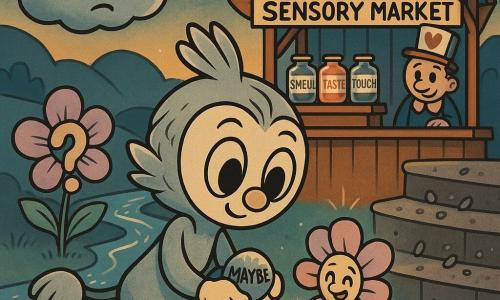
Maro sang three short notes. The robin suggested, "Call it 'Perhaps'." The mouse shook her head and suggested "A Pebble." The tortoise blinked slowly and offered "Maybe." The fox brushed a whisker and proposed "A Quiet."
Lute considered the names. He felt the names like different breads. He wanted one small enough to hold between his paws, a name that would not grow bigger than a rabbit.
He chose a name that sounded like a bell under water. "I will call my doubt 'Perhaps'," he said softly. He liked the gentle jingle of the word. Perhaps could sit on his lap and be warm. It could be a friend who reminded him to test his kind acts without roaring.
"Perhaps," said the mouse in a tiny voice, "is helpful. It keeps your heart open. It asks, 'What if?' but it does not push you over the edge."
Lute put Perhaps in his pocket and felt less alone. He realized doubt did not mean he failed. Doubt was a small companion who asked good questions. It made him careful, and that care kept his quiet world whole.
They walked home slowly under the stars. They met a family of frogs practicing a slow song. They greeted each other with small bows. Lute felt his steps match the rhythm of the night, steady and kind. He had learned that living in peace meant listening more than speaking, trying small proofs, and keeping his pride like a coat hung up at the door.
At the edge of the meadow, Lute paused. He looked at the river, the pond, the orchard, and the willow. He thought of the bridge and the mouse's smile. He thought of the tortoise, the robin, the fox, and the squirrels' quick laughter. Each had given him a small answer. None demanded to be the final one. The world was a circle of small truths that fit together like pieces of a slow puzzle.
Maro hopped onto Lute's shoulder and whispered, "The best way to live is to be kind and curious, and to be small enough to change."
Lute agreed. He tucked his modesty like a blanket around his shoulders. He held Perhaps gently and laid his head down on a pillow of grass. As the stars blinked slow goodnights, he felt a warmth like a lesson he could keep: modesty is not being small in the way that hides you. It is being small in the way that makes space for others.
Before sleep, Lute breathed a soft question into the night. "Will I always know?" he asked the sky.
The sky, large and patient, answered with a single star that did not claim to be the brightest. "No," it seemed to say, "but that is all right."
Lute smiled like a rabbit who knows a secret. He held Perhaps like a small lantern that would help on mornings when roads looked unsure. He closed his eyes and trusted the gentle proof of the day: that kindness returned kindness, that listening was its own kind of answer, and that modesty kept the heart open like a window.
And when the morning came, Lute woke ready to be small and brave again. He would continue to plant his questions like seeds, gather the soft returns, and leave room for Perhaps to sit quietly beside him. He had learned a simple thing: to live in peace with others, you need a heart that asks and a pocket that remembers the size of what it holds.