Chapter 1: The Neon Passages
In Lumenward City, the covered passages never ended.
They folded into each other like shiny ribbons—glass roofs sweating rain, tiled floors reflecting a thousand signs, and neon humming overhead as if the streets themselves were singing. You could walk for hours without seeing the open sky. There were cafés wedged between hat shops and phone-repair stalls, tram stops hidden behind curtains of ivy, and old fountains that nobody remembered building.
Milo Reed knew the shortcuts.
He was twelve, quick on his feet, and stubborn in the way of kids who've decided the world is a puzzle and they're going to solve it even if it sulks. His backpack was full of the useful junk grown-ups called “clutter”: string, chalk, a marker that wrote on glass, a tiny screwdriver set, and a notebook where he sketched maps of passages that did not officially exist.
Beside him strode Jace Kwon—also twelve, taller, with a careful way of looking at things, like he was always checking if reality had any loose screws. His hair was always falling into his eyes, and he pushed it back with the same motion he used to push away worries.
And then there was Rafi Alvarez, who could turn any problem into a joke, usually at the exact moment it stopped being funny. He had a grin that made adults suspicious and other kids brave.
They moved together through Passage Nine, where the ceiling lights flickered like a nervous heartbeat.
“Tell me again why we're doing this,” Jace said, adjusting his glasses with one finger.
“Because,” Milo said, “someone stole my talisman.”
Rafi whistled. “Not just any talisman. The talisman that keeps your aunt's teapot from singing opera at midnight.”
“That was one time,” Milo muttered. “And it wasn't my aunt's. It was mine. Sort of.”
The truth was, the talisman belonged to the Reed family. It was a small bronze coin with a hole in the middle, worn smooth, threaded on a black cord. It didn't shoot lightning or summon dragons. It did something quieter.
It helped Milo find what was hidden.
Lost keys. Missing cats. The last slice of pizza someone swore they hadn't eaten. Forgotten doors tucked between shops. Things like that.
And now the talisman itself was missing, stolen two nights ago from Milo's drawer, as if someone had known exactly how to lift it without waking the floorboards.
They reached a square where the passages widened, opening into a bright, indoor plaza—Place Serein. It should have felt cheerful: a carousel of painted metal horses stood in the center, surrounded by benches and food stalls, and a fountain made a soft, watery music.
But Place Serein felt wrong.
The neon above it didn't flicker the way neon should. It shone too steadily, a perfect, cold line of blue. The fountain's water fell in smooth sheets like glass, not a splash anywhere. Even the air seemed quieter, as if the plaza was holding its breath.
A woman at a pretzel stand stared straight ahead, blinking slowly, like she was watching a dream she couldn't wake from.
Milo slowed. “That's a spell.”
Rafi leaned in. “A bad one?”
“Bad,” Jace agreed, voice low. “Look at the carousel.”
The carousel horses moved, but not in a circle. They bobbed in place, rising and falling like they were stuck in invisible mud. Their painted eyes seemed dull.
Place Serein had been cursed. Not in a dramatic, thunder-and-screams way. In a way that smothered.
Milo's fingers curled around the empty cord he still wore around his neck. It felt like missing a tooth with your tongue—impossible to ignore.
“We help the plaza,” Milo said.
Rafi made a face. “We help the plaza… and also find your coin?”
“Same job,” Milo said. “Whoever did this knows passage magic. That kind of person would want the talisman.”
Jace nodded, already watching the edges of the square. “Then the curse is a clue.”
They stepped into Place Serein.
The neon buzz softened, as if the plaza noticed them and didn't approve.
Chapter 2: The Map That Wasn't There
At the fountain's edge sat an old man with a suitcase and a bouquet of paper flowers. He wore a coat that looked too heavy for the season and a hat with a ribbon the color of streetlight.
He was folding a new flower with hands that moved slowly, like he was practicing patience.
Milo approached, careful. “Excuse me. Is… is Place Serein okay?”
The old man looked up. His eyes were clear, but tired, like someone who had watched a lot of days repeat themselves. “Depends on what you mean by okay,” he said. “It's still here. That's something.”
Rafi pointed at the water. “It's doing the glass thing.”
“It always did the splash thing yesterday,” the man said. “And tomorrow, who knows? Today, it behaves like it's afraid of making noise.”
Jace crouched near the fountain, dipping a finger into the water. He pulled it out quickly. “It's cold.”
“Curses are often cold,” Milo said, more to himself than anyone else. He glanced at the bouquet. “Those are… nice.”
The old man smiled faintly. “Paper flowers don't wilt. Very practical in a city that forgets seasons.”
Milo took out his notebook. He flipped to a page full of passage lines and arrows. “Do you know who cast it?”
The old man's gaze slid past Milo, to the carousel. “A person doesn't always cast a spell,” he said. “Sometimes a place makes one by accident. Sometimes a place gets hurt and tries to protect itself the wrong way.”
Rafi crossed his arms. “So Place Serein stubbed its toe and now it's freezing everyone's vibes?”
The old man's mouth twitched. “Something like that.”
Milo leaned closer. “We think a talisman was stolen. A bronze coin on a cord. Whoever took it might be tied to this.”
The old man finally looked properly interested. “A Finder's Coin.”
Jace's eyebrows rose. “You know it?”
“I know of it,” the old man said. “Those who steal such things are either foolish or very sure of themselves. Perhaps both. The curse here… it has a shape.” He tapped his temple. “Not a good shape.”
Milo's heart gave a small jump. “Can you tell us where to look?”
The old man opened his suitcase. Inside were dozens of flat paper squares, each folded into different shapes: cranes, boats, little houses, even a folded paper tram.
He took out a square and smoothed it on his knee. Then he began to fold.
His fingers worked quickly now, crisp and certain. The paper bent into a long rectangle, then into a thin strip, then into something that looked like a narrow bridge.
When he unfolded it, there were lines on it.
Not drawn lines—creases that formed a map. A map of the passages around Place Serein, and one passage that wasn't on Milo's notebook.
“There,” the old man said, tapping a crease. “An old service corridor behind the carousel maintenance door. It used to lead to a storeroom. Now it leads to a market that sells things you don't want to buy.”
Rafi squinted. “What kind of things?”
“Promises,” the old man said. “Second chances. Names. Sometimes voices.”
Jace swallowed. “Why would anyone go there?”
“Because they think they can bargain better than the city,” the old man replied. “Or because someone is waiting for them.”
Milo stared at the folded map. “What's your name?”
The old man hesitated, as if his name was something he hadn't worn in a while. “Call me Orin.”
Rafi lifted a paper flower. “Do these do magic too?”
Orin's smile warmed a little. “Only the kind that reminds you you're alive.”
Milo carefully tucked the folded map into his notebook. “Thank you.”
Orin's eyes sharpened. “If you go, don't trade what makes you you. A city will take anything you offer. It's polite like that.”
Rafi tried to grin, but it came out crooked. “We'll keep our ‘us-ness.' Promise.”
Orin looked at Place Serein, at the still neon and the glassy water. “And if you find the coin,” he added softly, “listen to the plaza. It's trying to say something, even under the spell.”
Milo nodded. The air tasted like rain trapped behind windows.
The boys headed for the carousel, where a small door marked MAINTENANCE sat half-hidden by a poster for a concert that had happened three months ago and was somehow still advertised in bright letters.
Jace pressed his ear against the door. “I hear… humming.”
Rafi leaned in too. “I hear my stomach.”
Milo pushed the door open.
Cold air spilled out like a sigh.
Chapter 3: The Market Under the Glass
The corridor behind the carousel was narrow and lined with pipes that gleamed faintly under emergency lights. Their footsteps sounded too loud, as if the hallway wanted to repeat them.
At the end was another door, unmarked, painted the same color as the wall. Milo wouldn't have noticed it without Orin's crease-map.
He knocked, because his mom had raised him with manners and because sometimes magic liked manners more than people did.
Nothing answered.
Rafi shrugged and tried the handle. The door swung inward without a sound.
On the other side was not a storeroom.
It was a market.
Not the kind with fruit and fake designer shoes. This market was built under a ceiling of glass bricks, each brick glowing with trapped neon. Stalls were made from old tram seats and bent street signs. Lanterns hung from wires like captured stars.
People moved between the stalls—some human, some not quite. A woman with a barcode tattooed across her throat. A boy with moth wings folded under his hoodie. A tall figure in a suit that looked too crisp, whose shadow didn't match his feet.
Rafi whispered, “Okay. That's… new.”
Jace whispered back, “Don't stare.”
Milo tried not to, but the place tugged at his attention like a magnet. Everything here felt like the city's forgotten pocket.
At a stall made of stacked TVs, a vendor sold jars full of tiny sounds: laughter, thunder, a baby's hiccup. Another vendor displayed keychains shaped like doors, each labeled with a street name that Milo was sure didn't exist.
A small sign hung above the nearest aisle:
NO CASH. NO CRYING. TRADES ONLY.
Rafi squinted. “No crying? That's rude.”
“It's practical,” Milo murmured. “Tears are valuable.”
A voice behind them said, “Especially the first ones.”
They turned.
A girl about their age stood there, chewing gum with loud confidence. Her hair was shaved on one side, and the other side fell in curls dyed a soft electric green. She wore a jacket patched with subway tokens.
“You're lost,” she said.
“We're… looking,” Milo corrected.
“For what?” she asked, eyes sharp.
Jace replied carefully, “Something stolen.”
The girl's gaze flicked to Milo's empty cord. “Finder's Coin,” she said. “Bold to wear the necklace without it. Like carrying a sword's scabbard and hoping nobody notices the sword's gone.”
Rafi bristled. “Do you know where it is?”
“Maybe,” she said. “Maybe not. Depends how interesting you are.”
Milo held her gaze. “Place Serein is cursed. It's hurting people. We're trying to fix it.”
The girl's expression softened for half a second, then snapped back into coolness. “Everyone's always trying to fix something. Usually themselves.”
“What's your name?” Milo asked.
She blew a bubble, popped it. “Nina.”
Jace said, “Are you… with the market?”
Nina snorted. “Nobody's with the market. You're in it, and it's in you. Like chewing gum on a shoe.”
Rafi pointed at a stall where a man was selling tiny bottles labeled COURAGE, USED. “Who cursed Place Serein?”
Nina tilted her head toward the center of the market, where a circle of light pulsed faintly. “Talk to the Broker,” she said. “If you've got the stomach.”
They walked, weaving between strangers and almost-strangers. Milo felt eyes follow them. In a modern city, you could disappear in a crowd. Here, the crowd noticed you like a tongue notices a sore tooth.
In the center stood a kiosk made from a ticket booth, its windows covered in sticky notes written in dozens of handwriting styles. Behind the glass sat someone in a dark hoodie, face hidden by a visor that mirrored neon.
A sign on the booth read:
THE BROKER OF SMALL NECESSITIES
Milo stepped forward. “We need a talisman back. A bronze coin.”
The Broker's voice came through a speaker, warped as if spoken underwater. “Everything comes back eventually. Even regrets.”
Jace leaned in. “Someone used a curse on Place Serein.”
The Broker's visor tilted. “Place Serein used a curse on itself.”
Rafi frowned. “How does a plaza do that?”
“Pain,” said the Broker. “A place can be hurt. A place can be robbed. When it loses what anchors it, it panics. It locks itself down. It becomes… smooth. Quiet. Safe. Dead.”
Milo's stomach tightened. “What was stolen from it?”
The Broker's visor reflected Milo's face in broken pieces of light. “A talisman passed through there. A Finder's Coin. It was taken from you, child, and used as a key. It opened a lock the plaza didn't want opened.”
Milo's throat went dry. “So my coin caused this.”
“Not caused,” Nina said from behind them. “Enabled. Like leaving your bike unlocked and then blaming the bike.”
Rafi shot her a look. “Hey.”
Milo ignored them. “Who took it?”
The Broker's voice lowered. “A magician with a taste for shortcuts. He calls himself Mr. Vant.”
Jace stiffened. “Vant… like advantage.”
The Broker continued. “He wants what the coin can find. He wants the city's hidden seams. He wants to tug until something rips.”
Milo gripped the strap of his backpack. “Where is he?”
The Broker's speaker crackled with something like laughter. “Questions are cheap. Answers are trades.”
Rafi said, “We can trade—uh—this coupon for free fries?”
Nina snorted again, but Milo saw her watching, curious.
Milo opened his notebook and tore out a page—one of his best maps, full of careful details and the secret routes he'd discovered. He held it up.
“I trade this,” Milo said. “A map of the passages that aren't on any official plan.”
Jace's eyes widened. “Milo—”
“It's a copy,” Milo lied quickly, then added in a whisper, “It's not a copy.”
The Broker's visor gleamed. “A creative offering,” the Broker said. “A piece of your seeing.”
Milo's fingers hesitated. The map felt like part of his brain on paper. But Place Serein's stillness pressed at him, and the empty cord around his neck felt like a dare.
He slid the page into a slot in the booth.
The booth swallowed it.
“Mr. Vant waits,” the Broker said, “in the Mirror Service Station. Find the door with the sign that doesn't reflect.”
Rafi blinked. “A sign that doesn't reflect. That's… very specific.”
“Everything is specific,” Nina murmured. “That's how traps work.”
Milo turned to her. “Are you coming?”
Nina's gum stopped chewing. “Why would I?”
“Because,” Milo said, “you knew about my coin. And you care, a little, even if you pretend you don't.”
Nina rolled her eyes so hard they nearly clicked. “Fine,” she said. “I'll get you to the door. After that, you're on your own. Boys with quests tend to step on things.”
Rafi grinned. “We'll try to step on only the villain.”
They left the kiosk, the market's neon-glass ceiling glowing like a trapped sunrise. Milo felt lighter and heavier at the same time.
He'd traded a piece of his creativity for a direction.
Now he had to use what he had left.
Chapter 4: The Door That Wouldn't Shine
Nina led them through a series of side alleys that weren't really alleys—more like seams between streets. The city above felt close, like a ceiling just out of reach. The neon here was dimmer, older, as if it had been switched on a long time ago and nobody remembered where the switch was.
They passed a wall of mirrors covered in graffiti. Rafi paused to fix his hair, then remembered he didn't trust reflections down here and stopped mid-swipe.
Jace whispered to Milo, “Are we sure about her?”
Milo whispered back, “No. But she's sure about the door.”
Nina heard them anyway. “I'm not going to eat your faces,” she said. “Not today.”
“Comforting,” Rafi said.
They arrived at a corridor lined with old vending machines. Their screens showed ads from years ago: smiling people holding phones that looked like bricks, glittery drinks no one sold anymore.
At the end stood a metal door with a sign above it that read MIRROR SERVICE STATION.
Except the sign didn't glow.
Every other sign in Lumenward had some kind of light, some kind of hum. This one sat dull and matte, swallowing neon instead of reflecting it. Even the polished metal of the door looked strangely tired.
Milo's skin prickled. “That's it.”
Nina stopped a few steps back. “I told you I'd get you here,” she said, and her voice tried to sound casual but failed at the edges. “Mr. Vant doesn't like witnesses.”
Jace nodded. “Thanks.”
Rafi asked, “Why help us at all?”
Nina's mouth tightened. “Because I used to hang out in Place Serein,” she said. “Before it got… like that. Before my little brother stopped laughing at the fountain because the fountain stopped being funny.”
Milo's chest warmed with something fierce. “We'll fix it,” he said.
Nina looked at him. “Don't say it like a slogan,” she snapped. “Say it like you mean it.”
Milo took a breath. “I mean it.”
Nina gave a small, sharp nod and turned away, vanishing into the dim corridor like a thought you almost remember.
The three boys faced the door.
Jace took out a small flashlight. The beam looked weak here, like the darkness had weight.
Milo placed his hand on the handle. It was cold enough to bite.
He pulled.
The door opened into a room that smelled of ozone and rainwater. It was a station, maybe once used for city maintenance, with rails on the floor and a ceiling crisscrossed with cables. Mirrors hung along the walls—tall, arched, framed in tarnished brass.
And in the center, standing like he belonged, was Mr. Vant.
He looked normal at first: a man in a sleek coat, hair neatly combed, shoes too clean for underground corridors. But his smile didn't reach his eyes, and his eyes… his eyes had the flat shine of a screen.
“So,” Mr. Vant said pleasantly, “the children come to play hero.”
Rafi muttered, “We prefer ‘problem-solvers.' Less cape.”
Mr. Vant chuckled. “Creative. I like that.” He held up something that made Milo's heart clench.
The Finder's Coin, dangling from its cord, swung gently from Mr. Vant's finger like a pendulum.
“There you are,” Milo breathed.
Mr. Vant watched Milo's reaction as if tasting it. “A lovely little tool,” he said. “It finds what is hidden. It found a door I wanted. It found the weak spot in Place Serein.”
Jace stepped forward, voice tight. “Why curse it?”
“I didn't curse it,” Mr. Vant said. “I merely… removed its anchor. The plaza did the rest. Places are so emotional.”
Milo said, “Give it back.”
Mr. Vant's smile widened. “Or what? You'll tell on me? Call the Passage Police?”
Rafi raised his fists half-heartedly. “We could… punch you, maybe.”
Mr. Vant lifted a brow. “Adorable.”
Milo's mind raced. The coin helped him find things. But Mr. Vant had it. So Milo had to find something else—something hidden in this room.
He scanned the station. Mirrors. Rails. Cables. A maintenance console with dead screens. And something odd: one mirror at the far wall had a crack running through it like a lightning bolt.
Mr. Vant followed Milo's gaze. “Ah,” he said. “You noticed the Exit Mirror.”
Jace frowned. “Exit to where?”
Mr. Vant tapped the coin against his palm. “To the place behind Place Serein. The heart-room. The anchor that keeps it alive.” His voice softened, almost affectionate. “Imagine what you can do with a city's anchor.”
Milo's stomach dropped. “You'll hurt it.”
“I'll improve it,” Mr. Vant corrected. “No more messy spontaneity. No more unpredictable joy. Everything smooth. Efficient. Safe.”
Rafi snorted. “That sounds like a dentist's waiting room.”
Mr. Vant's eyes narrowed. “Enough.”
He flicked his wrist, and the mirrors along the walls shimmered. Milo saw himself multiplied—dozens of Milos, each looking slightly different: one with a braver chin, one with tired eyes, one who looked like he'd already lost.
The air thickened, buzzing like a phone about to ring.
“Choose a mirror,” Mr. Vant said softly. “Step through. I'll even make it fair. If you find the right one, you can have the coin back.”
Jace whispered, “It's a trick.”
“Everything's a trick,” Rafi whispered back. “But sometimes you can trick the trick.”
Milo stared at the mirrors. Reflections swayed. Some smiled when he didn't. Some blinked late.
He didn't have the coin, but he still had his notebook, his chalk, his marker—the tools of someone who made maps out of confusion.
Creativity, Orin had implied, was its own magic.
Milo pulled out his glass-marker and walked to the nearest mirror.
Mr. Vant watched with amused curiosity.
Milo drew a small star on the mirror's surface, right over his reflection's heart.
Then he drew another on the next mirror. And another. Fast, simple, bright marks—tiny anchors of his own making.
Rafi caught on and began drawing too, making silly lightning bolts and arrows. Jace, precise, drew numbers.
Mr. Vant's smile faltered. “What are you doing?”
“Making a map,” Milo said, voice steady. “Of what's real.”
Mr. Vant's eyes sharpened. “Reality is what I say it is.”
Milo shook his head. “Reality is what we agree to notice.”
He turned to the cracked mirror—the Exit Mirror. Unlike the others, it didn't show Milo's face clearly. It showed Place Serein's carousel, stuck and silent, reflected as if the mirror remembered it.
Milo felt it like a tug in his chest. Not the coin's tug.
The plaza's.
“That one,” Milo said.
Mr. Vant's grin returned, too quick. “Then step.”
Milo did.
The mirror's surface went cold and soft, like pushing through jelly made of winter.
Behind him, Jace swore under his breath, and Rafi said, “Well, guess we're doing this,” and followed.
The Mirror Service Station vanished.
Chapter 5: The Heart-Room of the Plaza
They landed on tiled ground, knees bending automatically. The air here smelled like old coins and wet stone.
Above them was a ceiling of glass, but not the market's neon-glass. This was thicker, older, like the underside of a frozen pond. Light filtered through in pale bands.
They were beneath Place Serein.
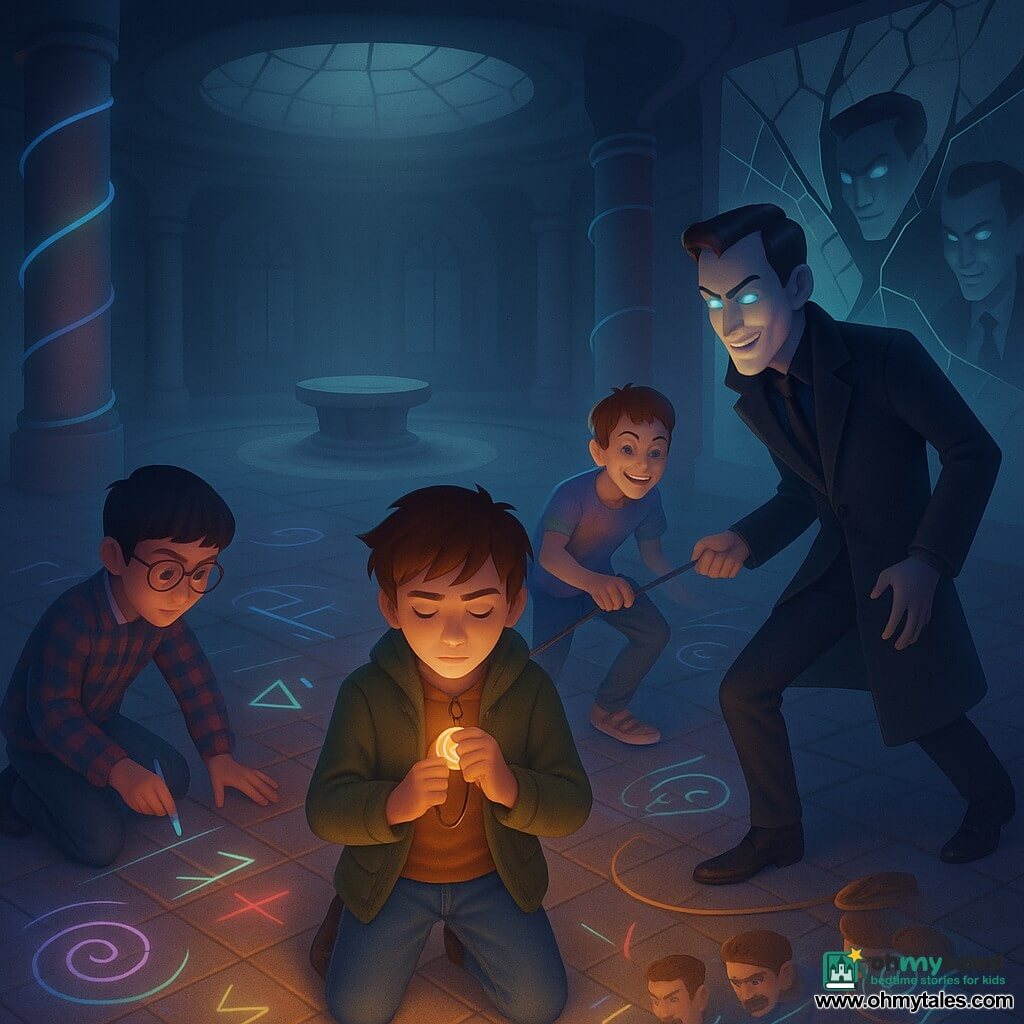
A hidden room spread out, circular, with pillars wrapped in cables that pulsed faintly like sleeping snakes. In the center stood a pedestal, empty, with a ring of dust around it—the mark of something that used to sit there.
An anchor.
Jace stood slowly. “This is… under the fountain.”
Rafi rubbed his arms. “It's like the plaza's basement. Except the basement is haunted by architecture.”
Milo walked to the pedestal. His footsteps echoed in a way that made the room feel lonely.
A sound came from behind them.
Clap. Clap. Clap.
Mr. Vant stepped out of the cracked mirror as smoothly as if he'd been born in it. The Finder's Coin swung from his finger like a hypnotist's charm.
“Excellent choice,” he said. “You brought yourselves right where I needed you.”
Rafi groaned. “Knew it. Knew it knew it knew it.”
Mr. Vant ignored him, eyes on the pedestal. “Look at it,” he murmured, almost tender. “A city's soft spot.”
Milo faced him. “Why do you need us?”
Mr. Vant sighed, as if explaining to slow adults. “The anchor won't respond to just anyone. It listens for a certain… kind of mind. A finder's mind. A child's mind, flexible enough to imagine doors where there are walls.”
Jace said, “So you stole the coin to get in, and you brought Milo to make the anchor work.”
Mr. Vant tilted his head. “Precisely.”
Milo's pulse hammered. He thought of Place Serein above, of people blinking slowly like they were underwater. He thought of Nina's brother.
He thought of Orin's warning: don't trade what makes you you.
Mr. Vant stepped toward the pedestal. “Now,” he said, “we'll take the anchor, reshape the plaza, and I'll return your little trinket. You can go home feeling heroic.”
Milo lifted his chin. “No.”
Mr. Vant's pleasant mask slipped. “You don't have a choice.”
Milo pulled out his chalk and snapped it in half. White dust coated his fingers like moonlight.
He began drawing on the tiles around the pedestal—quick circles, lines, symbols that weren't ancient runes so much as kid-logic: arrows for direction, spirals for focus, little boxes for doors. A map of ideas.
Jace joined in, sketching a grid, grounding Milo's wild lines into structure. Rafi added goofy faces in the corners, then, seeing Mr. Vant's confusion, turned the faces into watchful eyes.
Mr. Vant stared. “What is that nonsense?”
“It's a new anchor,” Milo said, voice shaking but determined. “Not a thing you can steal. A pattern you can't pocket.”
“You can't replace an anchor with doodles.”
Milo's hands moved faster. “Why not? Cities are made of plans. Plans are drawings. Drawings are choices.”
Jace looked up, eyes bright behind his glasses. “An anchor is something a place agrees to hold onto,” he said. “So we're giving it something to hold.”
Rafi added, “Something with personality. You're welcome, Place Serein.”
Mr. Vant's face tightened. “Stop.”
He flicked his wrist. The Finder's Coin glowed faintly, and the chalk lines trembled as if a wind tried to erase them.
Milo pressed his palm to the tiles, smearing chalk, making the lines messier but thicker. “Creativity isn't neat,” he said through clenched teeth. “It sticks.”
The cables on the pillars pulsed brighter. The room seemed to listen.
For a moment, Milo felt something vast and tired shift its attention toward them—toward the chalk, the arrows, the eyes, the spirals. The place itself, waking up.
Mr. Vant stepped forward, anger sharp now. “I will take what I came for.”
He reached toward the pedestal—
—and the chalk pattern flared.
Not with fire. With light like sunrise caught in a puddle. The tiles glowed under Milo's hand. The air warmed. The stale smell lifted.
Mr. Vant recoiled. “What—”
The pedestal hummed. The ring of dust swirled upward like a tiny storm and formed, briefly, a shape: the suggestion of a small stone or metal object that was no longer there. The old anchor's memory.
Then the glow poured into the chalk drawings, as if Place Serein accepted them, messy and human.
Above, faintly, Milo heard the fountain—finally—splatter.
Rafi let out a shaky laugh. “Yes! Splashing! Take that, glass water!”
Mr. Vant's eyes widened, and for the first time he looked unsure. “You're binding it to— to—”
“To us?” Jace guessed.
Milo shook his head. “To choice,” he said. “To change. To the fact that nothing has to stay stuck.”
Mr. Vant's mouth twisted. “Stupid children.”
He lunged, snatching at Milo's neck.
Milo ducked. Rafi grabbed Mr. Vant's sleeve. Jace, thinking fast, yanked a loose cable from a pillar and looped it around Mr. Vant's wrist like a lasso.
Mr. Vant hissed and flung his arm—Rafi stumbled—but the Finder's Coin slipped from Mr. Vant's finger.
It fell.
Milo caught it.
The bronze was warm, like it had missed him too.
The moment the cord touched Milo's skin, the room sharpened into focus. Milo felt the hidden seams of the station, the way back to the mirror, the thin crack in Mr. Vant's confidence.
He also felt something else: Place Serein above, loosening its grip, letting sound back in.
Mr. Vant snarled. “Give it—”
Milo didn't run. He held the coin up, and for the first time he understood: it didn't just find lost things. It found openings.
He looked at the cracked mirror behind Mr. Vant.
“Jace!” Milo shouted. “The exit!”
Jace nodded, already pulling Rafi toward the mirror. “Move!”
Mr. Vant surged after them.
Milo made a choice that felt like stepping off a curb without looking, trusting the streetlight to hold the world back.
He swung the coin like a pendulum and whispered, “Find.”
The word wasn't a spell he'd learned. It was a demand, a hope, a bright stubborn idea.
The coin tugged—not toward the mirror—but toward Mr. Vant's coat pocket.
Milo reached in and grabbed something hard and cold: a small, smooth stone carved with the same too-steady blue light that had hung over Place Serein.
A curse-stone.
Milo yanked it free.
The room exhaled.
Mr. Vant froze, eyes wide, as if someone had switched off his power source.
Milo tossed the curse-stone onto the chalk pattern.
It shattered like sugar.
And the neon-blue steadiness vanished from the air, replaced by the city's usual messy glow.
Mr. Vant screamed—not in pain, but in frustration—and the mirror behind him rippled, pulling at him like a strong tide.
The station wanted him gone.
Mr. Vant clawed at the tiles, but the chalk eyes seemed to watch him, and the arrows pointed one way.
Out.
With a final snarl, he was sucked backward through the cracked mirror, vanishing into whatever pocket of the city he'd crawled out of.
Silence settled.
Then, above, the distant sound of laughter drifted down—real laughter, surprised laughter, like someone had just remembered how.
Rafi sank to the floor. “I am never going to complain about boring malls again.”
Jace exhaled, shaky. “We did it.”
Milo slid the cord over his head properly. The Finder's Coin lay against his chest, steady as a heartbeat.
“We need to go back,” Milo said. “Place Serein will still be… healing.”
Rafi looked at the glowing chalk. “Are we leaving our masterpiece?”
Milo smiled faintly. “It's not ours anymore.”
They stepped toward the mirror.
This time, it felt warm.
Chapter 6: The Plaza Learns to Breathe
They emerged behind the carousel, back in the maintenance corridor. The air here no longer bit. It felt like ordinary city air: full of dust, popcorn, and a thousand lives bumping shoulders.
They hurried into Place Serein.
The change was immediate.
The neon above the plaza flickered again—imperfect, lively, human. The fountain splashed properly, droplets catching light and throwing it into tiny rainbows. The carousel horses moved in a circle, creaking and cheerful, their painted eyes bright.
The woman at the pretzel stand blinked fast, then shook her head like waking from a nap. “Oh! Sorry, dears,” she said, suddenly bustling. “Pretzels? Half price, I suppose. I feel like I missed something.”
Rafi whispered, “We literally rewired reality and got a discount.”
Milo laughed, a short sound that surprised him.
At the edge of the plaza, Nina stood with her hands in her jacket pockets. Her green curls were damp from the fountain mist. She watched the water splash as if she didn't trust it yet.
Then a smaller boy ran up to her—maybe eight or nine—and grabbed her hand. He pointed at the fountain, giggling.
Nina's face softened fully this time.
She saw Milo and the others and walked over, trying to look unimpressed and failing.
“You're alive,” she said.
“So are you,” Rafi replied. “Nice job not getting murdered while we did the dramatic part.”
Nina rolled her eyes, but the corner of her mouth lifted. “Did you get it?”
Milo touched the coin on his chest. “Yeah.”
Jace said, “Place Serein is back.”
Nina glanced around. “It feels… louder. In a good way.”
Milo looked at the carousel, at the messy joy of it. “It was trying to protect itself,” he said. “But it didn't know how.”
Nina nodded slowly. “So you taught it?”
“We reminded it,” Milo said. “That being alive is noisy.”
They sat on the fountain's edge, shoes inches from splashing water. The city's passageways stretched away in every direction, lit by neon and evening advertisements, by shop windows and street magic that hid in plain sight.
Orin appeared on a bench nearby as if he'd been there all along, folding a new paper flower. He didn't interrupt. He just watched the plaza breathe.
After a while, he stood and approached, offering Milo a paper flower the color of sunrise.
Milo took it carefully. “Thank you,” he said. “For the map.”
Orin's eyes twinkled. “You made a better one.”
Rafi held up his hands, still dusted with chalk. “We're basically artists now.”
Jace adjusted his glasses. “Or accidental urban engineers.”
Nina snorted. “Don't let it go to your heads.”
Milo looked down at his notebook. The page he'd traded was gone. It stung a little, like losing a secret.
But he also thought of the chalk pattern under the plaza—still there, glowing faintly, a shared sketch holding a place steady.
Creativity, he realized, wasn't a thing you stored safely in a drawer. It was a thing you used. Sometimes you spent it. Sometimes it came back as something bigger.
He opened his notebook to a blank page.
Rafi leaned over. “New map?”
Milo nodded and began to draw. Not just lines and arrows, but the fountain's splash, the carousel's circle, the way Nina's brother laughed, the way neon reflected in puddles like spilled galaxies.
Jace added careful notes. Nina, after pretending not to care, leaned in and suggested a shortcut between two passages. Rafi drew a heroic pretzel in the corner “for morale.”
Place Serein glittered around them, no longer trapped in stillness. The city hummed its endless, bright song.
And Milo's Finder's Coin rested against his chest, warm and steady, as if it approved of being found again—not by force, but by imagination.