The Day the City Sneezed
Glimmerbridge was a city that liked small surprises. The tram whistles played jazzy tunes at rush hour, the lampposts blinked polite little winks at pedestrians, and the pigeons wore tiny scarfs knitted by somebody's grandma. On mornings like this, the city usually woke up with a yawn and a single neat sigh. But today it began with a sneeze the size of a parade float.
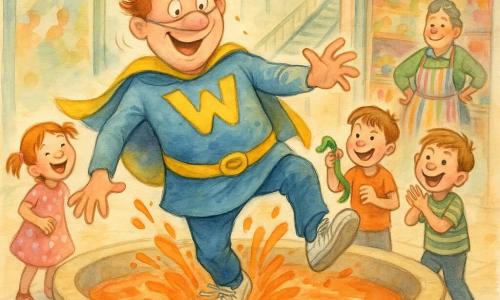
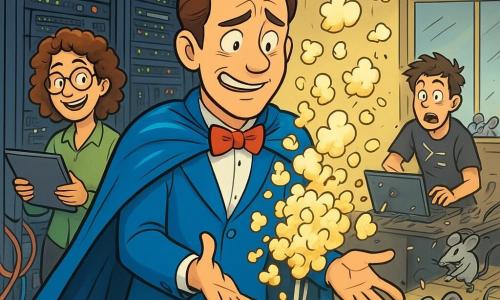
Felix Fizzlebop had a morning routine that matched his name. He whistled into his cereal, tied one shoelace with a knot that looked suspiciously like a bow, and checked his Super-Pocket Mirror (handy for a quick eyebrow adjustment when a cape is involved). He was an ordinary man until the city called him extraordinary: when things went unexpectedly silly, Felix donned his wooly cape and Glove of Glee and became Fizz—Glimmerbridge's cheerful, slightly clumsy superhero.
The first sneeze came from the traffic lights at the corner of Tangle Street and Marmalade Avenue. One by one, the lights hiccuped and jolted. Red honked at amber, amber tried to do a little dance, and green stretched, stuck out its tongue, and blew out a tiny puff of glitter. The result was a traffic jam that included a dancing scooter, a taxi that politely refused to honk, and a bus that tried to turn itself into a hat.
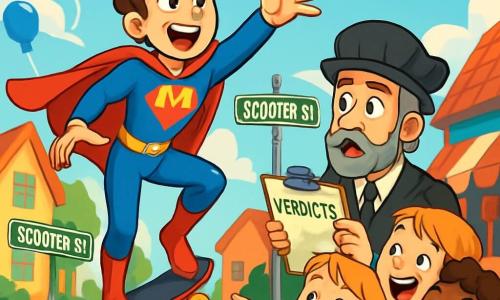
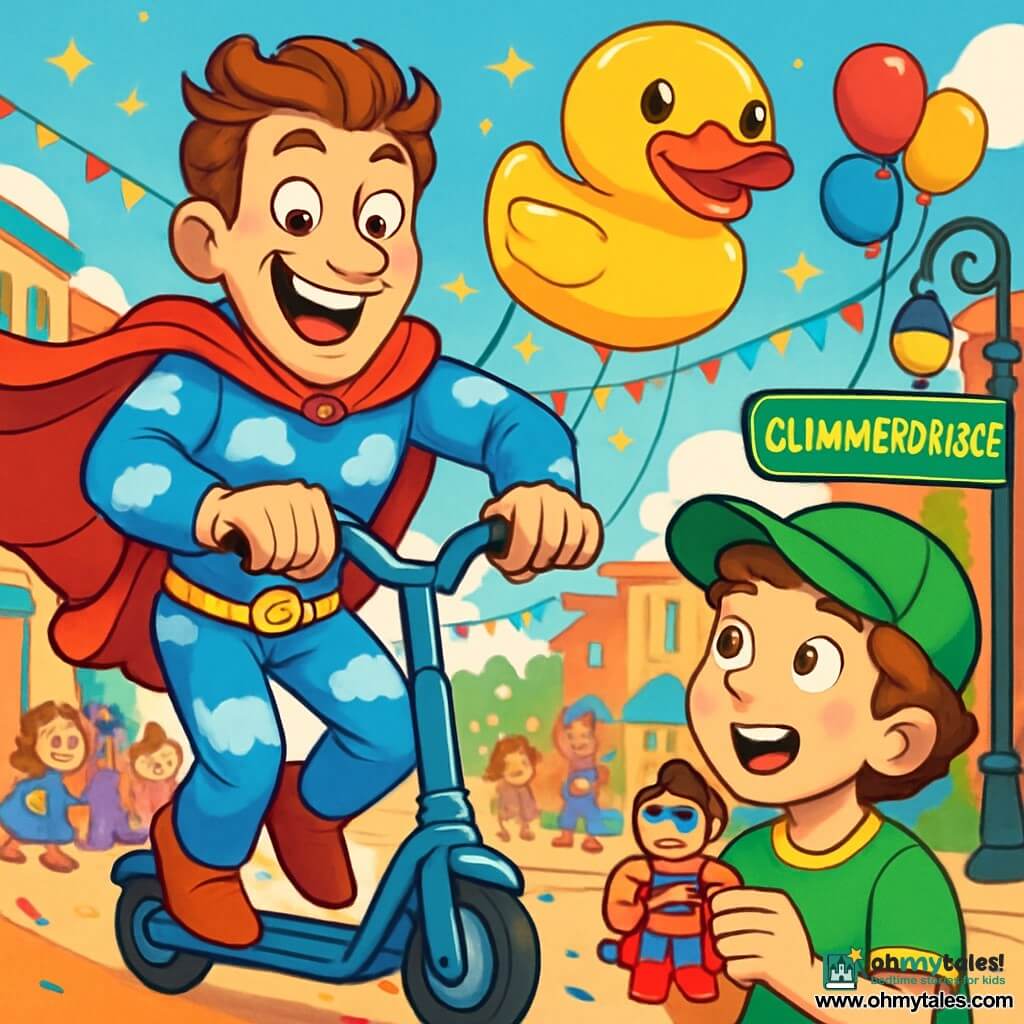
Fizz arrived on his scooter (it had a bell that rang “ta-da”) to find a crowd gathered. Mrs. Pottle from the bakery held a tray of pastries that were twitching. A small dog had found a traffic cone and declared it a throne. Mayor Tinsley, all knees and official ribbons, looked like a man unsure whether to clap or to run.
“I thought it was my alarm,” said a man with a briefcase, whose briefcase had started whispering grocery lists to anyone who leaned close. “But then my sandwich winked at me.”
Fizz took a deep breath. He owned a degree in "Lighthearted Problem Solving" from a very respectable online course. He also had his Glove of Glee, which could nudge objects into behaving differently—usually for the better. He aimed his glove at a trembling lamppost, gave it the gentlest tickle he could manage, and hummed a happy tune.
Instead of calming, the lamp sprouted a mustache and began reciting poetry about clouds. The crowd giggled. The coughing traffic lights hiccuped again and this time burst into a chorus: "Achoo! A-choo! We like to blink in time to you!" The chorus was catchy and the crowd, unable to resist, started clapping along to the beat.
Fizz scratched his head. The Glove of Glee had never turned things into musicians before. He tried to think like a problem, which he had been told helped. He sang a little song back to the lights—a silly melody about socks that never find their mates. To his surprise, the lights composed the next verse and added a trumpet solo performed by a taxi horn.
An important rule for being a superhero, which Fizz had learned from the manual titled Things You Might Not Need But Are Glad You Have (it was small and sticky), is: never let the city get bored. If it sneezes, you catch it. If it hums, you hum louder. So Fizz danced between the cars, sang with the lights, and tried to steady the bus that was doing its best impression of a jellyfish.
By the end of the morning, the traffic managed to part politely for pedestrians, the bakery pastries had calmed and were being given out as peace offerings, and Fizz had earned a high-five from a tiny boy whose shoelace had tied itself into a perfect bow. The city had stopped sneezing—mostly—and the people of Glimmerbridge thought they had seen enough excitement for a Tuesday.
But on the top of the City Hall, behind a curtain of bunting that fluttered like a million tiny flags, something else was brewing: a plan that promised to sprinkle a little more unpredictability into the day. Fizz, wiping a smear of jam from his cape, looked toward the bunting and frowned. He liked jam on toast, but he did not like bunting conspiracies. He tucked his Glove of Glee into his pocket, adjusted his bow-tied shoelace, and pedaled toward the next small commotion with a pocketful of curiosity and a heart ready for giggles.
The Case of the Singing Street Signs
Fizz had hardly finished a second bowl of cereal when the screech of a violin (or at least something pretending to be a violin) drifted from the east side of Glimmerbridge. By the time he arrived, the street signs on Lollipop Lane were holding a full opera. "Stop," one sign cried dramatically. "Give way," replied another in a soprano wail. "No Parking" was deep basso with such gravitas that a nearby truck asked for the sign's autograph.
Children gathered on the curb, enthralled. Seniors bobbed their heads. Even the pigeons were quiet, unless you count the one that coughed out a little tune. Mr. Greeble, who ran the corner newsstand, was selling instant popcorn to an eager crowd and looked unusually pleased with life.
Fizz tapped his glove and tried to listen. The street signs were singing not because they wanted to, but because something was tickling the bolts that held them up. Somewhere beneath the blocks and cobbles of Lollipop Lane, tiny giggle-wind was trying to escape. Giggle-wind, Fizz knew, was a rare kind of air that loved to make things behave in slightly ridiculous ways. It was mostly harmless, very chatty, and offended by silence.
Inventors sometimes trapped giggle-wind on purpose to make jokes springier, but whoever had loose giggle-wind in Glimmerbridge today had done so without permission. The air above the signs shimmered like marshmallows in heat. Fizz tucked a scarf into his glove (a little thing he did when he felt nervous) and began to sing alongside the signs. The Glove of Glee hummed back; it liked harmonies.
He followed the music underground, into a service hatch that smelled like old comics and lemon custard. There, in the soft glow of a faulty light bulb, he found a small machine with an enormous grin: the Giggle-Catcher 3000. It was a gadget full of springs, tubes, and a little brass bell that peeped when tickled. Beside it was a note: "For a better city—P. Jinkerton." The handwriting looped like a rollercoaster.
Fizz recognized the name. Percy Jinkerton was an inventor who lived on Cupcake Crescent. He sometimes made miniature weather for his parrot, and once he built a teapot that whistled jokes. He was forever promising to "improve daily life," and forever forgetting to pack an instruction manual.
Fizz pulled on the lowest lever of the Giggle-Catcher 3000. Nothing happened. He pulled another lever. The machine hiccuped, spat out a tiny rubber duck, and grew a second mustache. A satisfying clang echoed through Lollipop Lane as the singing signs broke into applause. Fizz wasn't sure whether to be impressed or alarmed.
He chose both. He climbed atop a manhole cover and called out to Percy. Within minutes, a man in a smudged lab coat and slippers popped out of a nearby sewer access with a bag of spare chuckles and the wildest look on his face. Percy explained, in a voice that seemed to have been warmed by too much lemon tea, that he had only meant to make the city cheerier. "Just a little laugh here and there," he said, sheepish, "but everything went tickle-wibbly instead."
Together, Fizz and Percy tried to coax the Giggle-Catcher into calm. Fizz suggested a lullaby. Percy suggested a cup of tea. The machine suggested a full Broadway musical. The situation became so musical that a local choir turned up, attracted by the strong notes, and the choir sang so well that the machine began to giggle politely and then slowly, ever so slowly, unspooled the giggle-wind until the singing signs returned to their normal, helpful fonts.
The lesson from Lollipop Lane was clear: inventions with a sense of humor were delightful, but they needed rules—like not tickling the bolts after breakfast. Percy promised to be more careful. Fizz promised to teach Percy how to tie his shoelaces properly. The city hummed back into ordinary song, but the day was not over. The bunting above City Hall still trembled in the breeze, as if it had saved the best surprise for last.
The Parade That Wouldn't Stay Put
Glimmerbridge loved a parade. Once a year, everyone came out with hats shaped like fruit, with flags that smelled faintly of lemon, and with shoes polished until they reflected the sky. This year's parade promised the biggest balloon anyone had seen: a towering, smiling Goose-Honker, so big it could have tickled the moon.
The Goose-Honker, however, had other ideas. At the very moment Mayor Tinsley pulled the string to begin the festivities, a gust of something—perhaps leftover giggle-wind, perhaps a particularly excitable breeze—lifted the balloon and leapt into the sky. The ropes, trained handlers, and pontoons tried their best, but the Goose-Honker rose like a sleepy giant who had remembered breakfast. It tugged a float, which tugged a brass band, which tugged a row of dancing umbrellas, and before long the entire front of the parade was airborne and floating over Glimmerbridge like a circus of socks.
Fizz was ready. He leapt from his scooter and grabbed a net from his emergency closet (it was always good to carry a net; it had saved him from at least three runaway croissants). He waved it at the Goose-Honker with the confidence of a man who had practiced dramatic hand gestures in front of a mirror. The net turned into a patchwork quilt. The quilt turned into a trampoline. The trampoline turned into a very polite octopus who introduced herself as Matilda and offered tea.
Matilda had the best intentions. She wrapped a tentacle around a balloon rope and bounced a brass trombone into a new melody. Instead of catching the Goose-Honker, the parade became a float festival that performed a graceful ballet over Glimmerbridge's rooftops. Stalls in the park organized themselves into a flying marketplace; hotdog stands floated down Main Street, offering condiments with excellent aerial service.
Children squealed with delight. Tourists forgot to be shocked and instead began to applaud. Fizz, though, could see the Goose-Honker was getting tired; it had never meant to fly all day. Its beak drooped, and it gave a forlorn honk. Fizz knew that a balloon with a sad honk could cause trouble: deflated morale, soggy confetti, and possibly a shower of rogue cupcakes.
He needed a plan that was clever, kind, and slightly ridiculous. He asked for help from the floats, the umbrellas, the band, and Matilda the octopus. He asked polite questions, which is a superhero skill he practiced like other people practiced push-ups. He suggested a lullaby that sounded suspiciously like a potato being mashed, and everyone joined in. Matilda bounced rhythmically, the umbrellas fanned like applause, and the Goose-Honker gradually eased downward until its ropes could be reattached.
It was when they tried to tie the Goose-Honker back down that things really got silly. The knot they tied turned into a skipping rope for a troupe of acrobatic squirrels. Two of the squirrels performed a double somersault in between the ropes and, cheered on by the band, insisted on a curtain call. The mayor, embarrassed but happy, awarded each squirrel a tiny medal and promised to add acrobatics to the next parade permit.
By evening the balloons were back on the ground, if a little ruffled. The band played an encore. The Goose-Honker bowed like an expert stage actor. Fizz, sunburned only on one ear, accepted a trophy that was actually a very shiny teapot. The city had floated a parade and landed it with style. People would talk about the flying day for years—and so would pigeons, who had never been so impressed with umbrellas.
The Inventor with a Pocket Full of Whoops
All these oddities had a common thread that day, like crumbs leading to a secret picnic. Fizz noticed that each escape—sneezing lights, singing signs, flying balloons—began at places owned or visited by one person: Percy Jinkerton. He had an alibi that sounded sincere: "I only wanted a bit of cheer. I swear I didn't mean for the Goose-Honker to go airborne." But Percy's bag of spare chuckles, his Giant Giggle-Catcher, and his tendency to leave doorways open suggested a pattern.
Felix found Percy in his workshop, which smelled of burnt toast and brilliance. The room was a charming disaster: gears on the floor arranged into cautious smiley faces, a kettle that told time, and a parrot that complimented Felix's cape. Percy explained, hands waving, that he had been testing his new invention, the Unpredictatron. It was designed to make everyday life more fun by introducing little surprises. A vase might sprout polka dots. A bench might play a friendly riddle. He meant the Unpredictatron to be gentle. He did not mean it to make pigeons reenact famous dances.
Fizz sat on a stool and listened. He could see Percy's earnest eyes under his goggles. He could also see an Unpredictatron that had turned itself into what Percy called "a proto-chaos swirl." Tiny banners popped out of it saying "Whoopee!" in cheerful fonts. The machine sneezed confetti when nobody was nearby and chewed on a sock that insisted on telling jokes.
Instead of scolding, Fizz asked Percy to show him what the machine did on a small scale. Percy obliged. He flicked a switch and the toaster on the bench began to perform a strict but friendly ballet. A pile of screws performed a tap dance. Felix laughed until his sides hurt. The Unpredictatron had charm. It also had an allergy to being told it was wrong. It responded to Felix's laughter with a trill, and then—without warning—started to grow.
Percy panicked. The machine, deciding that the city needed a grand finale, aimed its top spout at the sky and started producing a harmless but persistent shower of tiny, bouncing ideas. Streetlamps found new hats, crosswalks decided to hum lullabies, and even the mayor's ribbon learned to juggle. The city filled with harmless, enthusiastic chaos.
Fizz could have played the stern superhero, but he didn't. He remembered the day's earlier moments—people smiling at singing signs, children watching the aerial parade. A city that could surprise itself was a city that would never be bored. But surprises needed boundaries. Fizz suggested they set the Unpredictatron to "Gentle" and teach it the word "Please."
Working together, Felix and Percy adjusted knobs, tightened a few screws, and had the Unpredictatron repeat polite phrases until it filled the workshop with a new type of noise: the sound of machines learning manners. The machine beeped "Sorry" when it accidentally made a lamppost juggle, and "Thank you" when a toaster bowed. Percy promised to register his inventions and to keep guidelines in his pocket (which, as an inventor, he called "reminders and widgets").
To celebrate the success, Percy invited the whole neighborhood to tea. The parrot explained how to make a perfect crumpet. The kettle timed the toast to a tic-tac rhythm. Felix sat back with a cup of something warm and thought how nice it was to fix things with kindness and laughter.
The Big Tidy-Up and the Best Kind of Surprise
When all was calm, Felix had a final job: to return the city to its everyday kind of unusual. The goose had returned to its place in the park, the signs had their voices back in limited edition, and the lamps had shed their extra mustaches. Percy promised to write up a very thorough manual, and the Unpredictatron had been enrolled in a class on "Social Skills for Sentient Gadgets."
Fizz walked home as evening slid across Glimmerbridge like a velvet blanket stitched with tiny lights. The people of the city were out, laughing about their floating umbrellas, trading stories of a lamppost that had once recited a sonnet, and polishing medals given to acrobatic squirrels. Fizz passed the bakery where Mrs. Pottle presented him with a pastry shaped like a tiny cape. He accepted it with gratitude and a small, knightly bow.
At the park, the Goose-Honker stood quietly, its smile softer than before. Children were making up adventures for it, and the mayor was allowing a new rule: once a year, a little bit of organized chaos was permitted during the parade. It would be called Festival of the Unexpected, and it would include very strict safety procedures and a dedicated committee of friendly octopuses.
Felix sat on a bench and thought about the day. He had fixed sneezing lights with a song, helped a machine learn to say “please,” and convinced an octopus that tea etiquette was essential. More than that, he realized that people liked surprises when they were safe, kind, and shared. He liked surprises too, especially ones that made him snort-laugh in public, which was a nice change from private snorts.
Just as Felix zipped up his coat, a small voice beside him said, "Are you a superhero?" It belonged to the boy with the shoelace from earlier, now proud in his newly flawless bow. Felix looked at the boy and thought about the Glove of Glee tucked away, about his scooter with the "ta-da" bell, and about a cape that smelled faintly of jam.
He replied, quietly, "Sometimes." The boy nodded as if this answered everything. Around them, Glimmerbridge hummed in gentle contentment. People waved to each other across fences and fed the pigeons, who had, for reasons no one could explain, learned to whistle in three-part harmony.
Percy came by with a box of new inventions all tagged "For Borrowing." He promised to keep them in his pocket of responsibility. The mayor announced a picnic to celebrate the festival and appointed Felix an honorary Marshmallow Marshal, a title that involved holding a stick and ensuring treats did not escape fires.
As stars winked awake, Fizz took a last look at his city. It was a place of steady surprises and safe silliness, where a balloon might float away if it meant a thousand people got to clap together for a moment. He thought about the Glove of Glee, about Percy's Unpredictatron now set to "Chuckle, Not Chaos," and about how a city that could laugh could also look after its citizens.
Fizz stood, pocketed his Glove, and walked home. He had never been one to shout his own name from the rooftops. Instead, he preferred to leave a little sparkle of kindness in his wake—like a secret ingredient in a cake that made everyone smile but didn't tell them why.
And in Glimmerbridge, where the unexpected sometimes became an adventure, people slept with gentle smiles. The pigeons snoozed with tiny scarves wrapped neatly. The traffic lights, content, blinked a polite goodnight. As for Felix Fizzlebop, he dreamed of a tomorrow where the city might surprise him with a breakfast that sang or a lamppost that told jokes. He would be ready—with a scarf, a net, and a glove—and he would be happy to laugh alongside it all.