Chapter 1: A Moonwave and a Sneeze
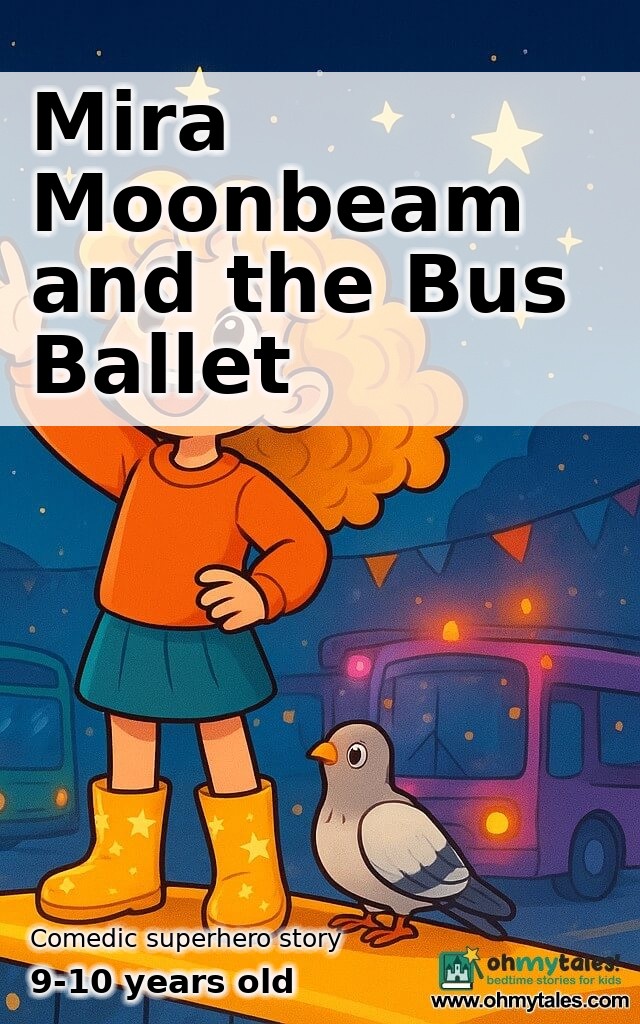
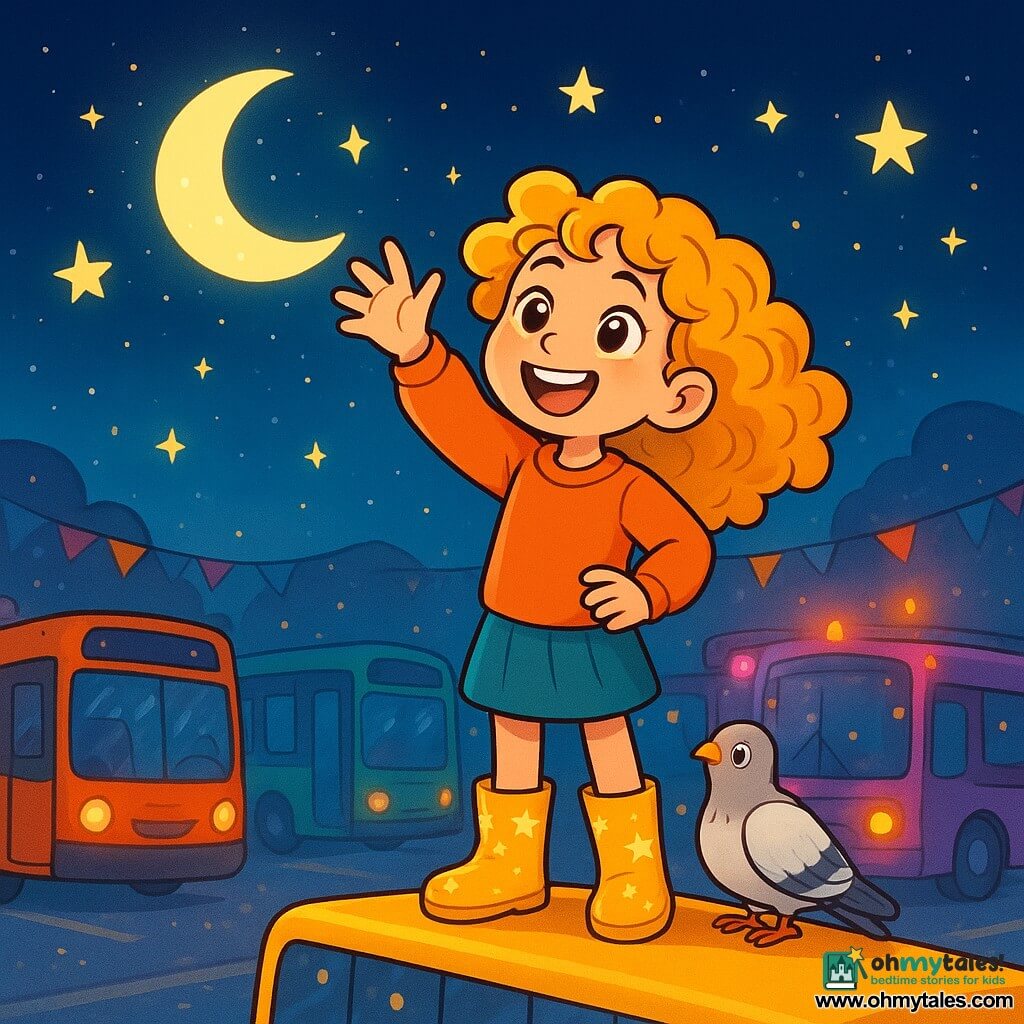
Mira Moonbeam was not your ordinary superhero. For one thing, she wore bright yellow rain boots with stars on them, even when it wasn't raining. For another, her superpower involved fingers, a wink, and a great big comical WHOOSH that sounded like "Pzzzzt!" when she waved at the moon.
One evening, while the city buzzed below like a jar full of giggling lightning bugs, Mira climbed up a lamppost—because why not?—and gave the moon a knowing little wave.
"Pzzzzt!" she said, and the moon blinked, like someone had nudged a sleepy cat.
"Hi, Moon," Mira whispered theatrically. "Nice night for capers, isn't it?"
From the lamppost below, a pigeon wearing a tiny backpack looked up and cooed. Mira laughed and waved again, and this time the wave sent a ripple of glittering moonbeams straight down toward the city. The ripple did not only sparkle; it made a nearby trash can sprout a hat. "Boop!" went the hat as it settled on the can.
"Oops," Mira said, tucking a stray curl behind her ear. She liked to play little tricks, harmless ones that made people grin. Her powers were peculiar: when she waved at the moon, unexpected things happened. Sometimes cupcakes rained politely into open hands. Sometimes streetlights hummed a jazz tune. Mostly, it was all good fun.
But that night, the moonwave bounced off the clouds and ricocheted into a place Mira hardly ever visited—the Great Gleam Bus Depot, a rectangular maze of buses that looked like a fleet of sleeping whales. The bus depot was quiet, with a soft glow from a single lamp. Mira, feeling particularly adventurous, decided to investigate. She leapt from the lamppost, somersaulted over a recycling bin (SPLAT!—just kidding; she stuck the landing), and tiptoed through a low fence like a mischievous cat.
As she pushed open the depot gate, a small breeze, smelling faintly of bubblegum, rush-whistled through. "Hee-hee!" Mira said, because this was the exact type of scene she loved—silent, suspenseful, and sunnily suspicious.
Inside, rows of buses snored softly. One bus coughed a little puff of steam that smelled like cinnamon. Mira waved at the moon again, because she couldn't help it—habit, curiosity, and the irresistible urge to see what would happen. "Pzzzzt!"
This time, a single bus blinked its headlights awake. It blinked twice, as if checking if it had dreamed the hat earlier. Then, with the sound of a trumpet trying to clear its throat—TOOT-choo!—the bus rolled a little forward and sighed. Mira giggled and hopped aboard for the fun of it. She had no idea the evening was about to get even more ridiculous.
Chapter 2: The Depot's Secret Song
Inside the bus, the seats smelled like old books and sweet gumdrops. Mira walked down the aisle and found a radio tucked under the driver's panel. It was shaped like a tiny, surprised dog. The radio had no station; instead, it hummed in a language of clicks and tiny bells.
"Hello?" Mira said to the radio. "Can you tell me a joke?"
The radio answered not with words but with a sequence of beep-boops and a little twinkling melody. The melody made her toes tap. Mira's fingers itched for another wave at the moon, but she remembered—she was in a depot—and she might wake the sleeping bus whales.
She pressed a button on the radio, which made it blink like an expectant penguin. "Let's find out," she murmured. But the radio needed power. A tiny screen flashed a sad battery icon.
"Aha," Mira said. Being a superhero sometimes meant fixing things other superheroes broke accidentally. Besides, she liked radios. She took out her talkie—little, square, and sticky with sticker ghosts—and tapped it three times. The talkie was dim. "Low power," it whispered, in words only she could hear.
Mira thought of the moon again. She popped out of the bus, tiptoed behind a row of sleeping grey whales, and decided to find something that could jumpstart her talkie. She tried plugging it into a lamppost (sparks! "ZAP!"—not a good idea), and then into a vending machine that sold pickles and glow-in-the-dark yo-yos (the machine shuddered and gave her a yo-yo anyway). As she rummaged, she accidentally flicked a switch on the back of a maintenance cart. The cart's headlights flashed with a delighted "Honk-honk!" and the cart began to buzz-scoot in tight circles.
"Whoa!" Mira exclaimed, and grabbed the cart like it was a runaway popsicle. The act struck a match of inspiration: the depot's buses were powered by a big old charging hub. But to charge her talkie, she needed a special socket—one that fit talkies, toasters, and tiny robots who lived under beds.
She climbed onto the roof of the nearest bus. The roof had a pattern of stars that twinkled underfoot—leftover from another moonwave, no doubt. From up there, she could see a large shed marked "CHARGING HUB" in friendly orange letters. The shed door was padlocked, and the padlock was shaped suspiciously like a sandwich.
"Hmm," Mira said. She loved sandwiches and also disliked padlocks. She zipped down the aisle and found a key stuck in a driver's locker. The key was labeled "Do Not Touch," which, for Mira, was a big flashing invitation. She pocketed the key.
Just as she reached the hub door, a guard robot appeared. The robot was a bright blue cylinder with a smile painted on. It wore a cap that said "Depot Safety." It spoke in a voice that sounded like a bubble wrap harp.
"State your business," it said.
Mira puffed out her chest and adopted her bravest voice. "I am Mira Moonbeam, official moon-waver and casual problem-solver. I need a charge for a talkie. Important—very important. For, uh, heroic reasons."
The robot's painted smile stayed fixed. "Heroic reasons must be verified."
Mira, thinking fast, pulled out a glittering moon-flake from her pocket. "This?" she said. The robot's eyes pinged like sonar. "Authorized moon-flake? Very well."
The padlock clicked. Inside, rows of charging sockets hummed like contented bees. Mira found a socket labeled "Talkies & Tiny Things" and plugged in her talkie. The screen lit up with a cheerful chime. "Charging commenced," it declared in a chirpy electronic voice.
"Yay!" Mira cheered. "One step closer to adventure!"
She sat on a crate, listening to her talkie rev up. Meanwhile, outside, the depot stirred. A bus cleared its throat and coughed a soft cloud shaped like a cat. The sound made Mira giggle, and she waved at the moon again—because good habits are hard to break. "Pzzzzt!"
This wave set off a chain of giggles through the depot: the vending machine started to dance, the maintenance cart did a perfect pirouette, and the guard robot performed a tiny conga line with two parking cones. The depot was becoming a midnight carnival.
Chapter 3: The Great Bus Ballet
As the talkie's little battery icon inched up, the buses began to yawn awake. It was as if Mira's moonwave had sent a waking song through the metal ribs of the depot. One by one, buses stretched their doors like sleepy mouths and began to shuffle into an orderly line. Mira, fascinated, clambered onto the roof of a bus to get a better view.
From above, the depot looked like a slow-moving orchestra. Buses synchronized their bumpers in clap-like rhythms: CLAP-CLAP! Mirrors flashed like winking conductors. The radio in Mira's bus, now charged from the hub's secret hum, burst into a jaunty polka. "Tsk-tika-boom! Tsk-tika-boom!" it played, and the depot answered in echo.
"Is this... a bus ballet?" Mira asked aloud, to the sky, to the moon, and to the pigeon with the backpack, who had now become an enthusiastic fan.
"Bravo!" a seat cushion seemed to cheer (or maybe that was just the polka). The buses rolled forward and backward in a choreographed shuffle that would have made ballet teachers proud and traffic planners extremely puzzled. One bus twirled its side mirror and dislodged a small, glittery feather that floated down and landed on Mira's nose. She sneezed a polite, sparkly sneeze: "Achoo—KA-POOF!"
The sneeze sprayed tiny stars across the depot, which made a nearby bus honk a flurry of notes that sounded suspiciously like "Happy Birthday." A cat-shaped cloud drifted through the air, meowed, and disappeared. Mira clapped. "This is splendid."
But then—CLANK!—a groan came from the far end of the depot. Big Yellow Number 42, the granddaddy of buses, seemed stuck on a raised platform. Its wheels spun with a frustrated "Whee-whee-whee" and then stopped.
Mira slid down and ran to the front of Big Yellow 42. Its hood was trembling like a bowl of jelly. "What's the trouble?" she asked.
Big Yellow 42 coughed out a puff of steam that smelled like old pennies and sunshine. "I can't reach the charging rail," it groaned. "My reach is too—too—short! I need help… but I'm heavy."
Mira looked around. The charging rails were raised like the arms of a giant orchestra conductor. If only the rails could lean down, Big Yellow could get a boost. She darted to the guard robot, who was now doing handstands with two parking cones.
"Can you help? We need to lower the charging rail," Mira asked.
The robot pondered, then clanked forward with a dramatic flourish. "The rails can be adjusted by the maintenance lever," it sang in a bubble-wrap harp voice. "But the lever is guarded by a sleepy maintenance cat."
"A cat?" Mira said, eyebrows performing an entire conversation on their own. She loved cats. She also did not like guilded rules that blocked a bus in need. Off she sped.
In a dim corner of the depot lay an enormous fluff-mat, and atop it snoozed a giant tabby with stripes like piano keys. The cat dreamed of cream and conducted a soft snore-symphony. Mira tiptoed closer and offered a gentle tickle under the chin. The cat's whiskers twitched. She whispered, "Excuse me, Mr. Cat. Would you mind a tiny stretch?"
The cat unpeeled an eye, stared at Mira, and then, with all the dignity of a king waking for tea, stretched. A lever popped out from beneath the fluff-mat—SQUEEEAK!—and the trains of machinery obliged by leaning the charging rail gently toward Big Yellow.
Big Yellow 42 hummed like a purring whale and rolled forward. The rail clicked into place, and the bus nudged its charging port until it fit—like a key into a gleaming lock. "Charging commenced," chimed the depot, and Big Yellow sighed relief.
The whole depot exhaled in a ripple of applause. The polka swelled, and even the pigeon with the backpack did a tiny loop in the air. Mira bowed, because when the world is filled with joy, one must always take a bow.
Her talkie's battery reached a cheerful green bar. A triumphant chime chimed. "Battery at eighty percent. Talkie optimized for heroic transmissions."
Mira's eyes twinkled. "Perfect," she said. "Now, for the final step!"
Chapter 4: The Talkie that Saved the Night
Mira climbed up the closest bus for another good vantage point. The depot sparkled with moon-given quirks: vending machines were politely offering free chocolate to passing pigeons, a parking cone was juggling tiny oranges, and the guard robot was teaching two assembly-line mice how to bow. Everything felt balanced in that sort of silly, wonderful way that makes the world feel safe and hilarious at the same time.
She took out her talkie and clicked it on. The screen now glowed like a friendly firefly. "Test, test," she said into it, and her voice came out like a crisp bell.
"Hello, Mira. This is Central. Please confirm status," answered a voice over the talkie—not the hub, not the radio, but Central itself. It sounded like a radio host with a warm sweater.
"All systems fun, battery charged to eighty," Mira chatted. "Buses operational. Depot dancing. One cat snoozing. A pigeon is currently wearing a hat. Moon approves."
"Excellent," Central replied. "We have reports of a glittery trail leading from the depot to the city center. Confirm whether trail is safe and not likely to cause mass giggles."
Mira wagged a finger at the moon, as if negotiating with a celestial partner. "Trail is safe," she said into the talkie, because it was true. The glittery trail made people smile, which was about the safest thing there was.
As she spoke, a small group of people emerged from the depot's side door. They were night-shift bus drivers, yawning but curious, carrying thermoses and sandwiches shaped like dinosaurs. One driver stepped forward and bowed to Mira. "Miss Moonbeam," he said with a grin. "Thank you. That was… the most elegant restart of a bus fleet I've ever witnessed."
Mira felt her cheeks turn the color of toasted marshmallows. "All in a night's work," she said, modest but proud. She turned to the talkie again. "Central, I'm sending you a live report. Also, do you mind if I file a request for a dance tutorial for buses? They're naturals."
Central chuckled through the talkie. "Permission granted. Also, Mira? Your talkie battery just reached full."
"Full? Already?" Mira beamed. The talkie gave a little celebratory beep-beep: BEEP-BEEP! The depot answered with one last grand flourish: all buses flashed their headlights in a cascade that spelled out "THANK YOU" in jittery Morse-code sparkle.
Mira climbed down and walked through the depot, saying goodbye to the guard robot and the vending machine and the cat. The pigeon offered her a piece of its backpack as a souvenir. "No, thank you," she said politely, but took a selfie with the pigeon because memories are important.
Outside the depot, the city welcomed her like a party with open doors. The glitter trail led towards the town square where a group of children, who had been watching the sky for clues, gasped in delight as the moon shimmered above them. Mira stood on the curb, silhouetted by the moon, and listened to Central say, "Status: Optimistic."
"Optimistic," Mira echoed, tasting the word like candy. It felt sweet and empowering. She waved at the moon one last time for good measure, and the moon winked like an old friend. "Pzzzzt!"
Her talkie buzzed, and Central's voice came in soft and satisfied. "Mission complete. Battery full. City smiling. Talkie charged."
Mira laughed, a bright, bubbling sound. "Mission accomplished," she answered, pockets full of moon-flakes and sneakers full of dust. She tucked the talkie safely into its holster. It felt warm and ready, humming gently like a contented insect.
The night had been full of small surprises: a hat on a trash can, a bus ballet, a dancing vending machine, and a robust-yet-refined guard robot who loved to conga. But most of all, it had been full of smiles. Mira knew that being a hero didn't always mean saving the world from dire doom. Sometimes it meant making a depot pirouette until its buses felt better. Sometimes it meant charging a tiny talkie so someone far away could hear that everything was okay.
She took a last look at the depot and the moon sparkling above the city, then snuck a piece of dinosaur-shaped sandwich into her pocket. "For later," she murmured. The talkie gave a tiny approving chirp.
As Mira walked away, humming the radio's polka, the talkie buzzed one more time—soft, friendly, and charged. It said, in a language that sounded suspiciously like a promise: "Ready when you are."
Mira grinned and flashed her signature moonwave—Pzzzzt!—toward the sky, the depot, and the whole wide city full of possibility. Tonight had been a silly ballet of moonbeams and buses, and she felt, more than ever, that optimism was like a superpower itself: small, bright, and capable of making everything a little bit better.
And so the night settled, full of giggles, gentle honks, and a fully charged talkie that would be ready for the next, not-so-serious adventure.