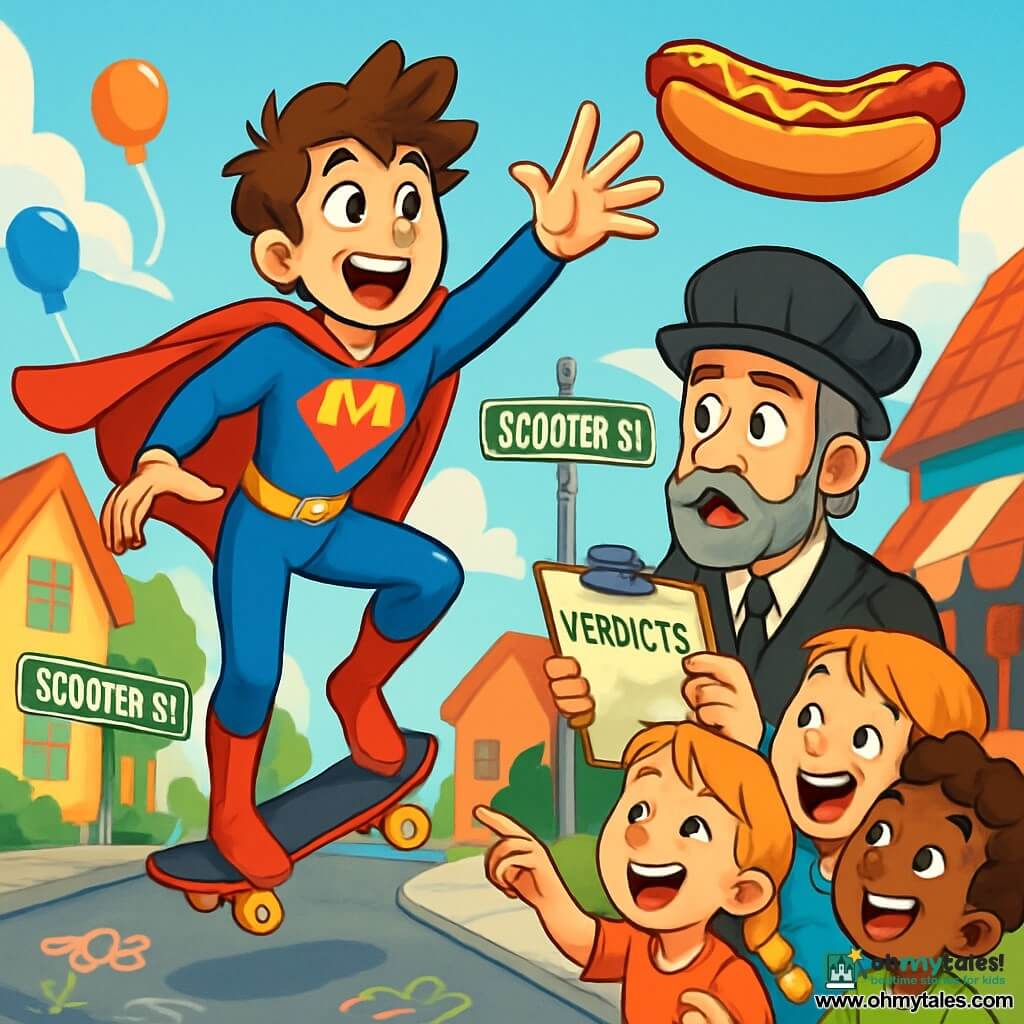
Chapter One: The Sticky Situation on Scooter Street
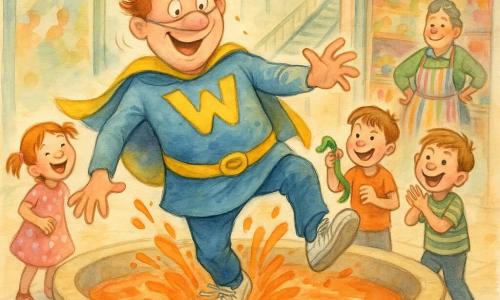
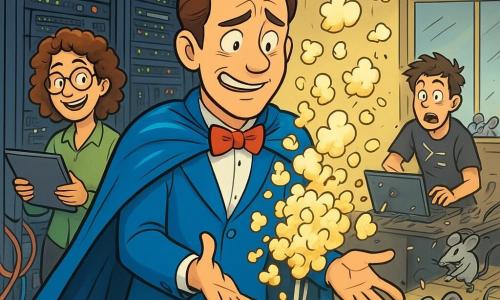
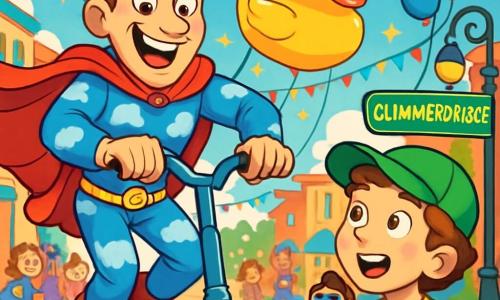
Milo Marvel liked to solve problems. He liked to rescue cats from trees, help old Mrs. Pritchard find her missing spectacles, and hand out free cookies at the park on rainy Thursdays. What made Milo different from other helpers was his superhero suit and one very odd superpower: he could swap how something felt for a short while. A heavy ball could feel as light as a feather. A squeaky chair might become soft as a marshmallow. A puddle could feel like a trampoline if he wiggled his fingers just so. He called it his Swizzle-Swap. He never meant to be dramatic about it. He just liked solving problems with a sprinkle of surprise.
On a bright Saturday, the city of Brightbridge hummed with its usual buzz. People rode bikes, shopkeepers hawked cheese toasties, and children traded marbles on the corner. Milo was walking down Scooter Street, whistling a tune and trying not to step on the sidewalk chalk that had blossomed into a rainbow maze. Suddenly, a shout sliced through the air.
"Hot dog cart!" someone yelled. "It's rolling downhill!"
Milo looked up. A shiny red hot dog cart had broken free from old Mr. Tully, who was waving his arms like a windmill. The cart picked up speed, sausages rolling in their little glass window as if preparing to fly. The cart was headed straight for the fountain with the statue of Sir Splasherton, and there were children playing on the rim.
Without thinking too much (because thinking too much was not Milo's style), he zipped across the pavement. His cape flapped like a flag and his sneakers made a heroic squeak-squeak. Milo wiggled his fingers, said the secret word he only used in emergencies—"Boing!"—and flicked his wrist.
For three whole seconds, the hot dog cart felt as light as a pillow to Milo. He could lift it as if it were made of cotton candy. He shoved it sideways, trying to steer it away from the fountain. But his swaps were tricky. When he swapped the cart to feel featherlike, it also became unusually bouncy. The cart launched like a small rocket, ricocheting off the lamppost and popping like a balloon in the most dramatic way. Sausages flew into the air like little hot dog fireworks.
Children cheered. Mr. Tully's hat flew off and spun around like a top. Milo, balancing awkwardly on a skateboard he hadn't meant to grab, skidded backward and landed in a puddle with a tiny, surprised splash.
The bouncy cart did a final boing and stuck itself to the fountain with a big, squelchy thunk. It had landed nose-first, sausages pointing at the statue, and the crowd burst into laughter. No one was hurt. Mr. Tully held Milo's arm as if Milo had balanced an entire circus on his shoulders.
"You're a bit... peculiar," Mr. Tully panted. "But thanks!"
Milo grinned, cheeks rosy. He had saved the day, thanks to a rather wobble-prone swap and a lucky skateboard. The city applauded. Milo blushed. He loved the applause, though he loved the cookies more.
As Milo dusted off his knees and handed a flying sausage back to a giggling child, he didn't notice a small man in a grey coat watching from across the square. The man's hat was dull, his shoes were dull, and his expression was the dullest color of all. He rubbed his hands together slowly, like someone warming up a very boring pie.
"Interesting," the man muttered. "Interesting and... noisy."
He walked away, the hem of his coat whispering secrets to the cobbles. Milo waved at the crowd, pocketed a cookie Mr. Tully pressed into his hand, and set off down the street. Roller skates. A lost balloon. A dog wearing sunglasses. The city kept offering him surprises, and Milo kept swapping feelings to make them better.
At the edge of the square, the small grey man stopped to tie his shoe. He pulled out a tiny machine that looked like a radio crossed with a paintbrush. He pressed a button and a soft, grey mist puffed out. It fizzled over a bench and the bench went from comfy to "meh" in a blink.
The man smiled the smile of someone who liked plain porridge. "Perfect," he said. "It's time Brightbridge learned how to be serious."
Milo munched his cookie, humming, unaware that a new kind of problem was beginning to stir. It would be the kind of problem that didn't need rescuing from a fountain or a runaway cart, but the kind that needed a laugh, a trick, and a very brave person willing to turn the boring into the brilliant. Milo popped the last of his cookie into his mouth and blinked at the dullening sky, which had suddenly become just a little too ordinary for his liking. He laughed and felt a tiny tickle in his wrist, like the promise of another swap.
He didn't know yet that Brightbridge was about to be on the edge of its seat, waiting for someone to make it giggle again.
Chapter Two: The Great Cake Catastrophe
Brightbridge loved parties. There was always something to celebrate: the librarian's hundredth book returned on time, the annual pillow-jumping contest, or the day the traffic lights learned to blink politely. This week, the Brightbridge Annual Bake-Off stacked its tents on the town green, offering mountains of frosting, towers of tarts, and more sprinkles than a unicorn could dream of.
Milo loved the Bake-Off. He loved the sticky fingers, the chance to sample custard, and the idea that you could turn a bad day into a delicious one with proper sprinkles and a brave spoon. He also liked to keep his ears open for trouble. Trouble often arrived at bake-offs as a spilled pie or a rival baker slipping into a very embarrassing soufflé.
The Bake-Off committee had called a meeting at the tent labeled EXTRA-RISÉ (very fancy letters). Milo stood under the striped awning, his cape inside-out because he had accidentally tripped on it while reaching for a jam tart. He chatted with Mrs. Fenn, who ran the jelly donuts, while keeping an eye on a spectacular lemon meringue the size of a small moon.
"Mr. Marvel!" cried a panicked voice. It was Benny, the Bake-Off judge, who was usually calm enough to hold teacups on his beard. "It's the Gigantor Cake! It's wobbling!"
Milo spun around. The Gigantor Cake was a showstopper, taller than a telephone pole, layered with clouds of cream and frosting doves that looked like they might fly at any moment. It quivered. Not like a gentle tremble, but like a giant standing on a trampoline. The sound it made was a low, groany "whoooonngh" that made the bunting ripple.
"It usually stays put," Benny explained, wide-eyed. "But somebody bumped the stand and now it's—"
Before he could finish, a small child sneezed near the cake, and the Gigantor answered with a wobble so loud it sent teaspoons rattling. Milo's Swizzle-Swap fingers tingled. He stepped forward, thinking to make the cake feel steady as a rock. But thoughts and fingers did a funny dance in Milo's head.
He flicked his wrist and yelled "Steady!" for good measure. For three whole seconds, the cake felt feather-soft. Milo thought feather-soft would be safe. Feather-soft turned out to be springy. The giant cake seized its chance and became a colossal trampoline. It launched icing birds into the air like snowy rockets. Muffins somersaulted. A judge somersaulted, and his monocle described a perfect arc before joining a family of doughnuts.
The crowd gasped. Then the crowd laughed. The cake leap sent a polite wave of frosting that slapped against the mayor's hat, turning his hat into a tiny cream-topped masterpiece. Children bounced. A marching band accidentally began to play "Boing Boing Boing" in perfect rhythm, and the mayor, with frosting on his nose, declared it the best unintended show in Bake-Off history.
"Do it again!" someone shouted. "Do it again!" Faces glowed with the kind of delight that belongs to people who understand the pure joy of an unexpected bounce.
Milo, however, was beginning to sweat. He was good at swapping, but not always good at predicting what would happen when he did. The Gigantor Cake now had enough bounce to catapult a full-grown sheep, if Brightbridge kept turning sheep into dessert. He needed a plan.
He took a deep breath. Then he remembered the little grey man from the square, the man who seemed to like dull things. Milo had a hunch—call it a gut-hunch or a frosting-hunch—that the man's tiny machine might be somewhere nearby. If the man wanted to make the city serious, maybe he would try to dull the Bake-Off first. And nothing made you more serious than stabilizing a trampoline-cake.
Milo squeezed through a crowd of flour-dusted bakers, dodged a pirouetting pastry chef, and crawled under a ribbon swing. His cape was now slightly sticky. He found a trail of grey fluff leading toward the judge's tent. It looked suspiciously like the same grey mist he'd seen earlier, fizzled into a puddle that felt like someone had left the radio on to play elevator music.
Milo sniffed. It smelled faintly of old socks and a forgotten lecture. He wrinkled his nose. He needed to turn this "meh" back into "marvelous." He slotted a coin into his pocket for luck, found a spoon (for heroic stirring), and crept toward the giant cake.
At the base of the Gigantor, he saw a small, metal puck that hummed like a sleepy fridge. It was spraying more grey mist, trying to make the cake lose its bounce and become a sensible, sensible loaf of bread. Milo knew he had to act quickly. He couldn't let a machine turn giggly cakes into serious loaves. Bake-Offs are at their best when someone can catapult a blueberry without regret.
He performed a trick he had practiced in his bathtub: the Reverse Boing. Milo sashayed his fingers, whispered "Boing back!" and pressed the puck. For a heart-thumping moment, nothing happened. Then the puck hiccupped, coughed, and turned bright as a lollipop. Instead of producing dull mist, it spritzed rainbow sprinkles all over. The Gigantor Cake shivered and settled into a majestic dome, no longer trampoline but still glorious and very sparkly.
The crowd cheered like a wave. Milo emerged, hands glittery, face streaked with cream. He had swapped a dreary device into something deliciously ridiculous. The small grey man peered from behind a tent, scowling at the confetti of color. He tipped his hat and disappeared in a trail of dull fog.
Milo laughed, the kind of laugh that tickled your toes. The Bake-Off went on with extra bounce and just enough sticky fingers to make it worth remembering. But the grey man's unhappy frown stayed in Milo's mind like a stubborn spot on a favorite shirt. Whoever liked dull things might return, and this time, he might bring a device even sneakier than a confetti-spewing puck.
For now, Brightbridge danced between frosting and laughter. Milo ate three cupcakes and promised himself he would keep an extra spoon in his utility belt, just in case.
Chapter Three: The Bland Baron's Plan
Brightbridge did not like being bored. The city painted murals with giggling colors and planted trees that hugged benches. Even the pigeons had a talent for awkward dancing. So when buildings began to look "less bright" and the playground slides adopted a polite, unexciting sheen, people noticed. Colors looked like they had been neatly folded and put away in a drawer. Jokes landed politely and then clapped politely back.
At the center of the change was a man who called himself the Bland Baron. He lived in a grey house at the end of a grey lane and adored beige music. The Baron had brought with him a machine that sucked out sparkles and replaced them with sensible tones. It hummed, it sputtered, and it made even the most stubbornly cheerful paint become "one shade less remarkable."
Milo noticed the change during one of his routine round-ups. He was helping at a playground when a slide stopped squeaking. Instead of the pew-pew sound it usually made, the slide only whispered "acceptable glide." Children looked confused. One small boy tried to make his toy robot dance and the robot politely declined. Even the ice-cream truck played a lullaby instead of its usual jingly tune. Something was wrong.
Milo's Swizzle-Swap tingled in a worried way. He followed the trail of polite yawns and neatly folded jokes to a grey van parked behind a row of hedges. The van had a logo: a smiling loaf of bread wearing a top hat. Very polite bread.
He crept closer and peered in. Inside was the Bland Baron, hair in a neat part, eyes like dull buttons. He worked a contraption that looked like a weather machine married to an old washing machine. A screen showed Brightbridge's color saturation slowly dimming, like a picture losing its crayons.
"It's almost done," the Baron whispered to himself. "A place where socks match and jokes resolve before the punchline. Perfect."
Milo did not like the sound of perfect. He thought perfection was boring and that surprises were the salt of life. He had to stop the Baron.
He stepped out from behind a bush, his cape crooked and a smear of raspberry jam on his cheek. "Hey!" he called, trying to sound very heroic.
The Baron looked up, eyebrow arched as if Milo were a mildly dull bird. "Ah. The peculiar fellow," he said. "You must be one of Brightbridge's entertainers."
"I'm a superhero," Milo announced, puffing his chest a little. "Name's Milo Marvel. What's your problem with sparkles?"
The Bland Baron smiled a smile that was all button and no grin. "Sparkles are messy," he said. "They splatter. They stick. People should be tidy about their feelings."
Milo blinked. "Feelings aren't meant to be tidy," he said. "They're meant to tickle and tumble and sometimes get jam on your sleeve."
The Baron tutted and waved a gloved hand. A beam hissed from the machine and washed over Milo. For a second, Milo felt his giggle turn into a polite chuckle. Worst of all, his cape turned an exciting shade into something suspiciously beige.
Milo's fingers buzzed; his Swizzle-Swap was being slowly unmade, or so it felt. He wrestled with his laugh, pinching it gently until it wriggled free like a small, grateful fish. He needed help. He needed a plan that involved everything the Baron thought was messy: loud noises, color explosions, and an old kazoo.
He dashed out and gathered friends: Benny the judge for his decisive nods; Mrs. Fenn, who had a talent for confectionary distraction; a troop of skateboarders who could make a blur of daring; and, most importantly, a small girl named Lila who believed in the power of absurd hats. Together, they met in the alley behind the van, plotting like a cheerful council.
Milo's idea was simple and joyful. If the Baron was trying to take the city's sparkle away, they would overwhelm his machine with more sparkle than it had ever seen. They would make so much oddness that the machine would have to either explode into confetti or start laughing.
They practiced their plan. Benny would deliver a verdict so full of emphasis it would wobble the Baron's machine. Mrs. Fenn would bake a pie that smelled of lemons and lemons alone—mysterious enough to distract even the most polite of villains. The skateboarders would make a rolling rainbow with banners and tin cans. Lila would wear three hats at once: a beret, a sombrero, and a bright foam crown. Milo would do the swap trick that would make the machine feel less like a machine and more like a jumpy puppy.
On the day of the plan, they crept to the Baron's van. Milo shuffled forward and flicked his fingers. He tried to swap the machine's feeling from "efficient appliance" to "ticklish hamster." For a blink, it seemed to work. The machine shivered and hummed. Then the Baron pressed a red button and the machine retaliated by exactly correcting Milo's swap, drawing a polite grey blanket over their colors.
Milo's heart did a small stutter. The machine was stronger than he thought. He needed something the machine couldn't fix: surprise. Lila tossed her hat into the air. It boinged twice, landed on a patrol dog who immediately started to twirl. The skateboarders zipped in a spiral, creating a centrifugal burst of confetti from a hidden keg Mrs. Fenn had carefully disguised as a rolling lemon.
The confetti wasn't normal confetti. It was made with leftover sprinkles and the gum from festival banners—practically indestructible sparkle. It slapped the machine and stuck to it, and the machine coughed in a way that sounded suspiciously like a giggle.
The Baron scowled. "Incredible stubbornness," he muttered. He revved the machine, turning its dials up to "proper" and his face to "very unamused."
Milo, thinking fast, used his Swizzle-Swap again. He reached for the machine and swapped its "dry rationality" for "uncontrollable tickle." The machine convulsed and produced a sound that was halfway between a polite cough and a hiccuping laugh. It started to shrink as if it were embarrassed to be so serious.
The Baron attempted to stomp on the shrinking machine, but his shoes, being quite polite, slid on a puddle of frosting Benny had slipped under his foot for dramatic effect. He lost his balance and ended up sitting on a bench, where Lila stuck three hats on him at once. He sputtered, red as a tomato that had witnessed a joke.
For a moment, everything held its breath. The machine, now ticklish and small, made a final wheeze and, with a pop like a bubble that chose the wrong hat, burst into rainbows and tiny rubber ducks. The entire alley smelled faintly of lemon and victory.
The Bland Baron sat among the ducks, blinking at a foam crown on his head. His face, which had been used to controlling everything, looked surprised. He had not expected the city to fight back with silliness.
Milo stepped forward, heart pounding with the hero's drumbeat. "You don't have to make things dull," he said gently. "People like sparkle. Sometimes they need to be careful, sure, but they also deserve to laugh. You could try a little color. Maybe a joke now and then."
The Baron stared. Then, slowly, he pulled off the hats and, after a great deal of thought, he tried a tiny smile, the size of a pinhead. It looked uncertain, but it was a smile all the same. The Baron sighed, and it was not a sigh of defeat but of someone who had just tasted lemon pie and remembered it wasn't terrible.
Brightbridge's colors slid back into place, like crayons nestling in a box. Children resumed playing with slides that made funny noises. Even the pigeons stepped up their dancing.
Milo, glowing with the warm aftertaste of victory, knew the Baron might try to be boring again — old habits are hard to break — but he also knew people could change. Sometimes they needed a little nudge, a pie with attitude, or a hat tossed in the right direction.
They left the Baron with a small rubber duck and an invitation to the next Bake-Off, just in case he wanted to see how fun lemon meringue could be. The city sighed happily, like a cat settling into a sunny spot, and Milo felt the kind of joy that comes from knowing you did the right, silly thing.
Chapter Four: The Parade of Peculiarities
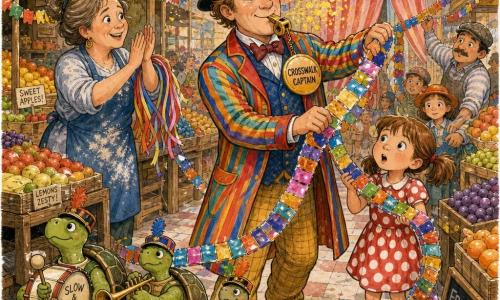
Word travels quickly in a town that likes to sing to stoplights. Within a week of the Baron's defeat, Brightbridge planned a Parade of Peculiarities — a celebration of everything the Baron had tried to take away. There would be floats shaped like giant cupcakes, bands that played xylophones with spoons, and a special category called "Most Dramatic Hat." The whole city buzzed with plans.
Milo was asked to lead the parade. He was thrilled and slightly terrified. Leading a parade meant holding a tiny baton and making sure no one accidentally turned a float into a spaceship. He practiced his parade face in the mirror, which helped slightly and squeaked a little. He also put a new pocket in his utility belt, just big enough for a small jar of giggle dust — a batter of clever confetti Mrs. Fenn had perfected.
On the morning of the parade, Brightbridge woke with an extra skip in its step. Banners fluttered like excited birds and the mayor slapped a sticker on his chest that said BRIGHT ON. The Baron, who had been invited and agreed to come (on the condition that there be a box of quiet crackers), watched from the sidelines with an expression that was a mixture of curiosity and a man trying a new salad.
Floats passed by: a lemon meringue that blasted zest-scented bubbles; a marching band that played a song entirely in honks and whistles; a group of grandmas on scooters doing synchronized pirouettes. Milo rode in a small float shaped like a smiling cloud, tossing candy sprinkles that burst into tiny musical notes when they landed.
All went wonderfully until the parade reached the bridge that connected Brightbridge to the opposite bank. Midway across, the bridge started to wobble like a jellybean. People clutched their hats. The bells in the tower began to play the wrong tune. Milo peered down and saw that the river below had begun to move in a line, like a river doing an orderly queue. Something very odd was happening; it was the sort of odd that made your socks think twice.
Milo leaped down from his cloud float, his cape acting like a small flag as he ran. He ran to the bridge's middle where the Marleyboro statue stood — a statue famous for tipping its hat at noon and for occasionally winking during festivals. The statue had its hand outstretched as if to say, "Please be dramatic," but instead, its hand was politely fixed, and people were wobbling like puppets with knitting needles.
At the edge of the bridge, the Bland Baron stood, surrounded by a new gadget that hummed with smugness. It had a small dial labeled "Enthusiasm: Mild," and a tiny fan that blew perfectly measured gusts of not-too-exciting wind. The Baron was trying again.
"Really?" Milo said, in the tone you use when someone waters a flower with lukewarm tea. "You again?"
The Baron shrugged. "I thought I might try moderation," he said. "A town can use a day of calm. Think of the benefits: no sticky bunters, no overzealous confetti."
Milo felt his fingers itch for a Swizzle-Swap, but he had learned not to leap in without a plan. He looked around. There were floats, drums, a woman juggling pies, and, worst of all for the Baron, a group of kindergartners holding up cardboard shields painted as giant smiles.
Milo called for a temporary ceasefire between the Baron and the parade. He explained that the city would rather lose a day of calm for a lifetime of laughter. He tried appealing to the Baron's curiosity. "Come on," Milo said, "just walk through the parade and tell me you don't feel a little brighter at the end."
The Baron hesitated, then nodded. He stepped between the floats, trying not to step on anyone's tap shoes. The parade participants did not play it safe; they played it spectacular. A group of unicyclists knit a scarf as they went; a choir sang the alphabet in reverse with great gusto; Benny rode a giant cupcake and gave a verdict on the pie's moral character.
The Baron smiled in a way that suggested something might be loosening. He nearly laughed when a marching doughnut performed a triple somersault and landed on a pile of whipped cream. He blinked as fireworks popped like sudden ideas overhead. People clapped, cheered, and, most importantly, looked delighted.
At the parade's end, the Baron had a sticky bun on his lap and a foam crown askew. He looked around at faces glowing with the kind of warmth you get from shared silliness. Something shifted in him — not a turnaround as big as a circus, but a tiny, important tilt.
Milo, standing on his cloud float, watched the Baron with a grin. He was proud, not because he had ushered the Baron into the fold, but because the city had shown that bright things can be shared without stealing anyone's peace. The Baron stood, dabbed his fingers, and announced, in a voice that sounded astonished, "I suppose...that was rather enjoyable."
The crowd cheered. Milo tossed confetti into the air and felt it fall like happy snow. He realized that sometimes the best heroics were not about fighting or roaring but about inviting and sharing. He had led the parade, but the parade had led the Baron, and the city had led them all into a better day.
When the sun dipped and the moon popped out like a curious spectator, Milo sat on the bridge with the Baron and shared a slice of lemon.
"You ever consider starting a club?" Milo asked.
The Baron considered this for a long moment. Then, with a slightly greener cravat and a moderately excited heart, he agreed to try one. The club would meet every Thursday to taste new pies and, once a month, to attend a puppet show that told slightly ridiculous stories.
Brightbridge returned to its usual level of unexpected joy, with a new member who sometimes asked for a second jam tart. Milo walked home, humming a marching tune and feeling like the city had become a little more tightly knitted together, like a sweater that had learned to tell jokes.
Chapter Five: The Confetti Covenant
Life in Brightbridge went on with a soft, happy buzz. The Bland Baron visited the bake-off and only occasionally frowned at glitter. The statue of Sir Splasherton resumed its dramatic midday wink. Milo kept his Swizzle-Swap well-practiced, storing small tricks in his pockets like candy for a rainy day.
One morning, a letter arrived, tied to a drone with a golden ribbon. It was addressed to "Milo Marvel, Keeper of the Giggles." Inside was an invitation to a gathering at the town hall: the Confetti Covenant. It was an official promise, signed by the mayor, the library cat, and a cluster of very opinionated pigeons. The city wanted to make a pact to protect laughter and surprises. Milo felt honored and touched. He accepted with a bow that made a little kid clap nearby.
On the day of the covenant, Brightbridge gathered in the square. Folks brought kites, shimmering umbrellas, and a folding chair orchestra that performed triangular music. The Bland Baron arrived with a small box of crackers that made polite popping sounds. He carried the crackers over gently and placed them on the table with a smile that was slowly becoming familiar.
The mayor stood on a soapbox and read the covenant aloud: "We, of Brightbridge, vow to guard our glitter, celebrate our spills, and protect our pies from unnecessary bureaucracy." Applause followed, loud enough to make a nearby tree lean forward with interest.
Milo was appointed Honorary Guardian of Sudden Delight. It was a title he wore with a grin and a badge the size of a pancake. He promised to use his Swizzle-Swap only for good, to help those in sticky situations and to keep laughter loud and kind.
As the crowd dispersed, the Baron lingered. He handed Milo a small envelope. "Thank you," he said. "For the pie, and for the parade. It was...refreshing."
Milo opened the envelope. Inside was a coupon for one free cup of calm tea, and a note: "For when you're feeling too much." Milo laughed and tucked the coupon into his pocket.
Days turned into weeks. Brightbridge thrummed with songs and soft chaos. Children learned that a dropped scoop of ice cream could be a lesson in bravery and sharing. People danced in crosswalks and apologized later with muffins. Milo continued to help, to swap, and to eat too many cookies. But he never forgot to invite people to be silly responsibly.
One afternoon, while Milo was helping a painter whose ladder had gone on a small adventure, he saw something he liked: the Bland Baron teaching a small group how to fold paper animals that hopped. The Baron's voice was no longer dull as a dishcloth; it had edges of laughter now and then. Milo realized something important: people could change if given the right kind of company.
Brightbridge had become a place where surprises were safe. It was a town that welcomed the unexpected like an old friend who brought good snacks. Milo walked through the square, watching children make brave leaps and adults try hula hoops without worrying about looking silly. He felt a warmth like a pocket full of sunlight.
That night, as Milo hung his cape to dry and arranged his tools (a spoon, a spare kazoo, and a jar of giggle dust), he thought about the future. He would always be ready for runaway carts, bouncing cakes, or villains with dusty machines. But he also knew that being a hero sometimes meant baking a pie with a new recipe and offering it to someone who needed to be cheered.
He placed a small, shiny rubber duck on his windowsill. It had been a gift from the Baron, left behind after that first clash. Milo smiled at it, the rubber duck reflecting the moon like a tiny, approving mirror.
As Brightbridge slept, dreaming of confetti and polite pigeons, Milo closed his eyes. He felt content. He had swapped, twitched, and occasionally made mistakes, but he had helped a city keep its sparkle.
In the morning, the city would wake and find that a lamppost had been painted mauve by a very enthusiastic group of painters. Someone would invent a new flavor of ice cream involving two flavors arguing for the spotlight. There would be laughter, mild chaos, and a few sticky sleeves. Milo would eat a cookie for breakfast and walk out the door, cape catching the breeze, ready for the next small, bright adventure.
And if the Bland Baron ever felt the old urge to make things bland again, Milo knew just where to find him: at the bakery, where he would be trying a lemon tart with more excitement than he thought possible, and probably wearing a ridiculous hat. Milo would smile, offer a spoon, and swap the moment into something perfectly, wonderfully silly.
The city of Brightbridge kept its confetti, its music, and its knack for ridiculous hats. Milo kept his Swizzle-Swap and his promise, and the people kept their laughter, folding it into their days like a treasured map to every small adventure.
The world outside may have needed weighty heroes for stormy nights, but Brightbridge had Milo — a man who made the ordinary extraordinary, one swap, one pie, and one joyful gag at a time.