Chapter 1: The Quiet Watch
Maya Laurent liked the station most when it was almost silent.
Not “nobody is here” silent—more like “everything is ready” silent.
The fire engine sat in the bay like a giant red beetle, polished and patient. Helmets lined up on the rack like sleepy knights. Boots waited underneath each pair of trousers, folded so you could step in and pull them up in one smooth move.
Maya walked slowly, her clipboard tucked under one arm. She was the shift's observer today, which meant she wasn't the one charging first into action. Her job was to watch, to take notes, to learn, and to help the team stay sharp. She loved it. Observation felt like listening with your whole body.
“Still doing your detective thing?” called Jo from the kitchen doorway. Jo was the driver, and she could parallel park a fire engine like it was a bicycle.
Maya grinned. “I prefer ‘professional observer.' Sounds fancier.”
“You're fancy like a hose nozzle,” teased Malik, carrying a crate of bottled water.
Maya clicked her pen. “Noted: team believes I am a piece of equipment.”
“High praise,” Malik said. “The hose nozzle is the hero of the day.”
From the common room, Captain Rivera's voice floated out warm and calm. “All right, crew. Gear check in ten. Then drills.”
Maya glanced at the wall clock. The second hand swept around in steady circles, like it was practicing laps.
She walked along the engine, naming what she saw in a whisper, as if the tools liked being introduced.
“Halligan bar. Axe. Thermal imaging camera. Breathing apparatus. Medical kit.”
She paused by the oxygen cylinders and tapped one lightly. “You are not decorations,” she murmured. “You are people's breaths, stored in metal.”
Maya wasn't just brave; she was curious. She wanted to understand the job from the inside out—not only flames and sirens, but planning, teamwork, and the quiet choices that saved time later.
When the gear check began, Captain Rivera's eyes were sharp but kind.
“Mask seals?” the captain asked.
“Good,” said Jo, pressing the edge of her mask and inhaling gently to test the suction.
“Radio batteries?”
“Charged,” Malik replied, patting his chest pocket.
Maya watched and wrote quick notes. She liked how everyone had a role, like parts of a well-built machine—except machines didn't crack jokes about hose nozzles.
Captain Rivera nodded. “Maya, since you're observing, tell me what you notice.”
Maya looked at the team. Their gear fit snugly. Their faces were calm. Hands moved confidently.
“They check each other,” she said. “Not just their own straps. They look like… like they're making sure nobody has a loose shoelace before a race.”
Captain Rivera's mouth tilted into a small smile. “Exactly. We do the job together. We also come back together.”
Maya wrote that down too.
Outside, the sky was turning purple with evening. It was the kind of peaceful shift that made you want to believe the whole town was tucked safely into bedtime already.
Then the alarm bell rang.
It didn't sound angry. It sounded urgent, like a friend calling your name when you're about to step into a puddle.
Maya's pen froze mid-air.
Captain Rivera's voice snapped into action mode. “Turnout!”
Chapter 2: The Red Beetle Wakes Up
In less than a minute, the station changed from cozy to electric.
Boots thumped. Straps clicked. Radios chirped. The fire engine's lights flickered like it was blinking awake.
Maya pulled on her own turnout jacket and helmet. As an observer, she'd stay close but safe, backing the team up and taking notes—not getting in the way, not becoming an extra problem.
Jo jumped into the driver's seat. Malik slid in beside her. Captain Rivera climbed up, already listening to the dispatcher.
“Reported smoke in the old bakery on Birch Street,” the radio crackled. “Possibly from the back storage room. Occupants evacuating.”
“Old bakery?” Malik said. “The one that always smells like cinnamon even when it's closed?”
“Nothing says emergency like surprise cinnamon,” Jo replied, steering out of the bay with smooth precision.
The siren began—loud, yes, but also oddly musical in a serious way. Maya watched the town go by through the window: closed shops, streetlamps, a cat perched on a fence like a judge.
Captain Rivera turned slightly. “Maya. Observer rule.”
Maya answered automatically. “See, think, communicate.”
“Good. Your eyes are helpful. Your brain is helpful. Your voice is helpful,” the captain said. “But you do not rush.”
Maya nodded, the helmet padding soft against her forehead. “I won't rush.”
As they approached Birch Street, Maya spotted a thin ribbon of gray rising into the twilight.
“That's real smoke,” she said quietly.
Jo parked at a safe distance, angled so the engine could leave quickly if needed. Malik hopped out and began pulling hose lines with quick, practiced movements.
Maya stepped down and immediately felt the night air change. It tasted slightly bitter, like burnt toast.
People stood on the sidewalk in pajamas and slippers, pointing and talking at once.
A woman with flour on her cheek ran toward Captain Rivera. “We're all out! Everyone's out! But the back door's stuck, and I think the vent fan is still running!”
Captain Rivera lifted a hand, steady as a stop sign. “You did the right thing getting out. Stay here. Don't go back in.”
Maya watched how the captain's voice stayed calm. It didn't steal anyone's fear; it just made room for breathing.
Malik set the first hose line. Jo moved to the hydrant, opening it carefully and checking for pressure.
Maya noticed Captain Rivera looking at the building, not just the smoke.
The captain's eyes traced the roofline. The windows. The wind direction.
Maya wrote: “Firefighting is reading a building like a story—where it began, where it wants to go.”
“Maya,” Malik called, holding up a small device. “Can you note the initial thermal scan once we're inside? From the doorway only.”
“Got it,” Maya said. Her stomach fluttered, but her hands stayed steady.
The team moved as one, each person knowing their place.
And the red beetle—the engine—kept humming, ready to feed them water and light.
They were about to step into the bakery's dark mouth.
Maya took one more breath of cool air.
Then they went in.
Chapter 3: Smoke, Sensors, and Cinnamon Ghosts
Inside, the bakery looked like a memory.
Daylight was gone, and the power had tripped. Emergency lights glowed faintly, making flour on the floor sparkle like pale sand.
The smell of cinnamon was still there, but now it wrestled with the sharp scent of smoke.
Jo and Malik wore breathing apparatus. Captain Rivera did too. Maya stayed just behind the threshold in her mask, her role clear: observe from the safest position, record, communicate.
Captain Rivera pointed. “Malik, hose line to the back. Jo, fan control—check that vent fan. We don't want it feeding oxygen to a fire.”
Jo nodded. “Copy.”
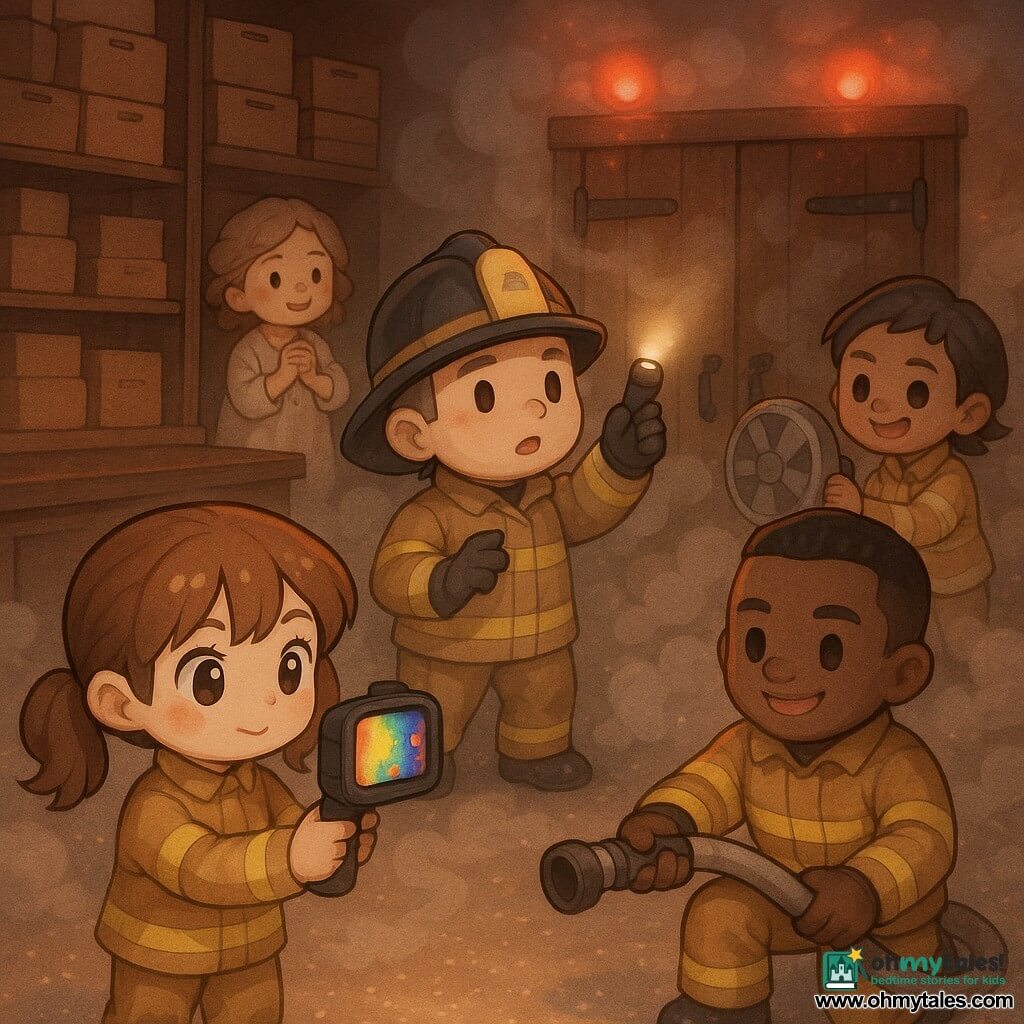
Maya lifted the thermal imaging camera Malik handed her. The screen showed the room in ghostly colors—cool blues and greens, warmer yellows, and the hottest areas bright white.
Maya swept it slowly, like she was painting with light.
Near the back storage room door, the camera flared. A bright patch pulsed behind the wood.
“Hot spot behind the storage door,” Maya called. “High heat. Concentrated.”
Captain Rivera's voice came back through the masks, muffled but clear. “Good. Malik, prepare to open. Maya, stay where you are.”
The door was swollen from heat. Malik used a Halligan bar, wedging it carefully.
Maya watched his feet—wide stance, balanced. She'd learned that firefighters didn't fight fire with strength alone. They used technique, like athletes. Like carpenters. Like people who respected physics.
“On three,” Captain Rivera said.
Malik pried. The door groaned.
A puff of smoke rolled out, thick and gray, crawling low along the floor like a sleepy monster.
Maya's heart thumped.
Captain Rivera's flashlight beam sliced through it. “Stay low. Malik, short bursts.”
The hose hissed. Water sprayed in controlled pulses, not a wild flood—just enough to cool the burning materials without sending smoke and steam everywhere.
Maya wrote quickly, the pen scratching on paper. “Use short, controlled sprays. Cooling reduces heat and prevents fire spread. Aim at base and hot spots.”
Jo returned from deeper inside. “Vent fan is OFF. It was still running. Good catch from the flour-face lady.”
Captain Rivera nodded. “Good work.”
Even in the dark, even with smoke, Maya could feel teamwork like a rope linking them. No one yanked. No one let go. They moved together.
The thermal camera showed the bright patch fading from white to yellow, then to a calmer green.
“Heat dropping,” Maya reported. “The hot spot is shrinking.”
Malik's voice sounded cheerful through his mask. “Take that, cinnamon ghosts.”
Maya almost laughed, but it came out as a tiny cough.
Captain Rivera gave a quick glance back toward Maya. “You okay?”
Maya nodded. “Yes. Just… the smell is weirdly hungry.”
“That's normal,” Jo said. “Smoke makes your brain think odd thoughts. Like, ‘I could eat a chair.'”
“I do not want to eat a chair,” Maya said.
“Give it time,” Malik replied. “We all have chair-eating phases.”
Maya laughed quietly this time. Humor, she realized, was another tool—like a flashlight. It didn't erase danger, but it helped you see.
The fire in the storage room was nearly out, but Captain Rivera didn't relax yet.
“Overhaul,” the captain said. “We check for hidden embers.”
Maya watched Malik pull aside charred cardboard boxes, poking carefully. Jo used the thermal camera now, scanning for any lingering heat in walls or corners.
“Fire is sneaky,” Captain Rivera said, as if reading Maya's mind. “It hides. We don't leave until we're sure it can't return.”
Maya wrote: “After flames, there's searching. Firefighters are careful, not just brave.”
At last, Jo lowered the camera. “All cool.”
Captain Rivera exhaled. “Good. Let's ventilate and clear.”
They stepped outside.
The night air felt like fresh water.
Across the street, the pajama crowd sighed with relief. The woman with flour on her cheek clasped her hands like she was holding a thank-you too big to say.
Maya looked back at the bakery. The smoke was thinning now, drifting away like a bad dream.
And still, the team stayed calm. They rolled hoses neatly, checked gear, and spoke in steady voices.
The emergency looked dramatic from far away, but up close it was made of many small, thoughtful actions.
Maya wrote one last note before closing her clipboard:
“Courage is planning plus teamwork.”
Chapter 4: The Notebook Line
Back at the station, the world felt softer.
The engine was parked and quiet again. Gear hung to dry. Someone started a kettle, and the scent of tea replaced the bitter smoke.
Maya sat at the table with her notebook open, the pages smudged slightly from her glove. She liked those smudges. They were proof that learning wasn't always tidy.
Captain Rivera sat across from her, sipping water. Jo and Malik argued gently about whether a chair would taste better with ketchup or mustard.
“I heard you two,” Maya said, deadpan. “No eating furniture on duty.”
Malik held up his hands. “Not even a small stool?”
“Not even a tiny footrest,” Maya said.
Captain Rivera's eyes warmed. “Maya, your reports are solid. Tell me what stood out tonight.”
Maya thought of the flour-cheeked woman, the swollen door, the heat pattern on the thermal camera, the way Malik's hose bursts were short and careful.
“It wasn't like the movies,” Maya said. “It was… quieter. Like solving a puzzle under pressure.”
“That's a good way to put it,” Captain Rivera said. “Most of the job is decisions. We train so those decisions come faster.”
Maya flipped to a fresh page. She wanted to capture something deeper than facts.
She wrote slowly, choosing words that felt true:
“I don't fight fire alone—my team is my courage.”
She underlined it twice.
Jo leaned over to peek. “Aw. That's actually nice.”
Malik pointed dramatically. “Look at Maya, writing poetry about hose nozzles.”
Maya closed the notebook with a soft thump. “It's not poetry. It's a reminder.”
Captain Rivera nodded. “Good reminders keep you steady. Especially when things get loud.”
Maya leaned back and listened to the station sounds: distant traffic, the kettle whispering, the dryer hum. The world outside was still out there, unpredictable as ever, but inside the station everything had a rhythm.
She pictured the bakery again, safe now. She pictured how the team had checked each other's straps before leaving, how they'd spoken calmly to the frightened people outside.
Teamwork wasn't just working together. It was trusting, communicating, and caring enough to double-check.
Maya yawned—an unexpected, wide yawn that made her eyes water.
Jo noticed. “Observer is sleepy.”
Maya blinked. “Observer is… recharging.”
Captain Rivera stood. “All right. It's late. We'll finish the paperwork in the morning. Maya, you did well.”
Maya felt warmth spread in her chest—pride, but also something gentler. Gratitude.
She picked up her notebook and headed toward the bunk room.
Behind her, Malik called, “Goodnight, Fancy Hose Nozzle!”
Maya called back, “Goodnight, Chair Eater!”
Their laughter followed her down the hall like a friendly flashlight beam.
Chapter 5: The Warmth Under the Blanket
The bunk room was dim, lit by a small lamp that made the corners look sleepy.
Maya changed into soft clothes and climbed into her bed. The blanket was thick and comforting, heavy in a good way—like the station itself was tucking her in.
She placed her notebook on the nightstand, the underlined sentence facing up.
“I don't fight fire alone—my team is my courage.”
Maya read it once, then again, letting it settle into her thoughts.
From down the hall, she heard the muted clink of mugs, Jo's low voice, Malik's quieter laugh. Captain Rivera's footsteps, unhurried.
No sirens now. No urgent bells. Just the gentle, ordinary sounds of people who had done their job and come back safe.
Maya imagined the bakery owner going home, washing the flour from her cheek, breathing easier. She imagined the storage room, cooled and checked, no secret embers hiding.
She let herself picture tomorrow's drills: practicing ladder raises, radio calls, first aid refreshers. She'd learned that firefighters trained constantly—not because they expected disaster, but because they respected it.
Maya shifted under the blanket, and warmth wrapped around her like a calm promise.
Her eyelids grew heavy.
In the soft dark, she whispered to herself, “See, think, communicate.”
Then she added, “And trust your team.”
The station settled further, like a big safe house exhaling.
Maya's last thought was simple and bright: courage wasn't a roar. Sometimes it was a quiet voice saying, “I've got you.”
She sank deeper under the covers, cozy and warm, as if the blanket were the gentlest kind of shield.
And she fell asleep with the steady comfort of teamwork glowing in her chest.