Chapter 1: The Pager That Hummed Like a Bee
Mara Quinn's volunteer firefighter pager didn't just beep. It buzzed like an impatient bumblebee that had learned Morse code.
She was in her kitchen, labeling containers with the kind of serious focus other people reserved for rocket launches: RICE, PASTA, OATS, and, for some reason, “MYSTERY COOKIES (ASK LATER).”
BZZZT-BZZZT!
Mara clipped the pager onto her belt and called toward the hallway. “Leo! Shoes. Hoodie. Water bottle.”
Leo, her neighbor's son and today's official “station helper,” skidded into view. He was eleven and moved as if the floor might disappear if he slowed down.
“Why do we need water? We're not—” he began.
Mara raised one eyebrow. It was a calm eyebrow, but it could stop a stampede. “We're always drinking water. Fires, drills, cleaning the truck, carrying hoses, thinking hard… all of it uses energy. Hydrated firefighters make better decisions. Also, thirsty firefighters get grumpy.”
Leo grinned. “Do you get grumpy?”
“I become a very reasonable dragon,” Mara said, grabbing her jacket. “Let's go.”
Outside, the evening air smelled like cut grass and faraway rain. The volunteer station was only a few streets away, and Mara's footsteps were quick and steady, like she was following a rhythm only she could hear.
When they arrived, the garage doors were open, and the fire engine waited like a red giant taking a nap—shiny, solid, and slightly smug. Inside, a few volunteers were already pulling on gear.
Captain Rojas looked up. “Mara! We've got a smoke alarm call—apartment building on Juniper Street. No flames reported.”
“Copy,” Mara said, already slipping into her boots. She spoke fast, but her hands were careful. She checked her helmet strap, her gloves, her radio. Rigorous, like every buckle and button mattered—because they did.
Leo hovered near the bench. “What do I do?”
“You do what you're already doing,” Mara said. “Stay calm, stay back, and listen. That's a superpower.”
Leo puffed up a little, as if he'd been given an invisible cape.
Before they climbed into the engine, Mara pointed to the station's water cooler. “One more thing—drink.”
A firefighter named Jessa groaned dramatically. “Mara, you're going to start a hydration club.”
“Excellent,” Mara said. “The first rule of Hydration Club is: you talk about Hydration Club.”
Jessa laughed and took a long drink anyway.
The engine rolled out into the blue-soft evening, siren wailing—loud, but not scary when you knew it meant help was coming. Mara sat steady, eyes alert, breathing slow. She glanced back at Leo, who was buckled in and holding his water bottle like it might contain bravery.
“It's normal to feel nervous,” Mara told him over the engine noise. “Just remember—training plus teamwork equals safety.”
Leo nodded. “Training plus teamwork,” he repeated, as if tasting the words.
Juniper Street slid into view, and the apartment building rose like a stack of shoeboxes. People stood outside in pajama pants and slippers, pointing and talking over each other.
Mara's voice stayed calm. “Okay. Let's do our job.”
Chapter 2: Smoke That Wasn't a Monster
The first thing Mara did wasn't charge inside like a movie hero.
She looked. She listened. She smelled the air.
“Smoke alarm on the third floor,” Captain Rojas said, scanning the windows. “No visible smoke from outside.”
Mara nodded. “Could be burned food, could be a real fire starting. Either way, we treat it like it matters.”
They walked briskly to the entrance, where an older woman in a fluffy robe wrung her hands. “It's screaming up there! My neighbor's alarm. I knocked, but nobody answered. And I—oh dear—I panicked and forgot my glasses!”
Mara's voice turned even gentler. “You did the right thing by calling. Alarms are like loud reminders that safety exists.”
The woman blinked. “That's… strangely comforting.”
Mara's radio crackled. “Engine 3 entering building.”
Inside, the hallway smelled faintly like toast. Not a “run for your life” smell—more like “someone forgot they owned a toaster” smell. Still, Mara stayed serious. Firefighters didn't guess. They checked.
She signaled to Jessa. “Stay with me. We'll go to the third floor. Let's bring the thermal camera.”
Leo stayed by the entrance with another volunteer, his eyes wide but steady. Mara caught his gaze for a second and gave him a small nod that said, You're doing fine.
Upstairs, the alarm shrieked behind a door labeled 3B. Mara knocked hard. “Fire department! If you're inside, call out!”
No answer.
Captain Rojas arrived behind them. “Force entry?”
Mara listened again. No movement. No voices. The alarm was relentless.
“Let's try the manager's key first,” Mara said. “Less damage if we can.”
A building manager sprinted up, jangling keys like tiny bells. “Here—here!”
The key turned, and the door swung open.
The apartment was filled with a thin haze. Not thick enough to hide the furniture, but enough to make the air feel like it was wearing a scratchy sweater.
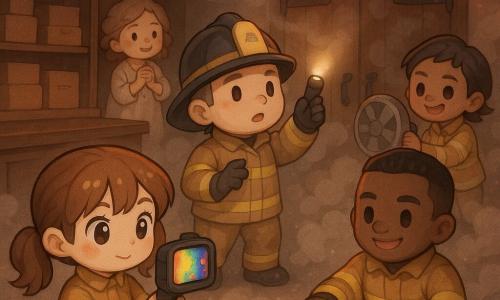
Mara lifted her thermal camera and swept it across the room. “No hot spots,” she said. “Kitchen?”
In the kitchen, a skillet sat on the stove with a blackened pancake that looked like it had been through a volcano.
Jessa leaned in. “That pancake is… emotionally burned.”
Mara turned off the burner. “This is why we never leave cooking unattended. A small mistake can grow fast.”
Captain Rojas checked the rooms. “No one inside?”
Mara opened the bedroom door and froze.
On the bed sat a parrot—bright green, feathers puffed, glaring like a tiny judge. Next to it was a handwritten note taped to the lamp:
GONE TO PHARMACY. BACK SOON. PLEASE DON'T PANIC. —MRS. HART
The parrot squawked, “DON'T PANIC!”
Jessa snorted. “Well, it's trying.”
Mara cracked a smile. “Smart bird.”
She opened a window to clear the smoke and set a small fan in the doorway to push fresh air through. “Even light smoke can irritate lungs,” she explained, half to the crew and half to herself—because saying it out loud reminded everyone why their steps mattered.
Back in the hall, the older woman in the robe appeared again, now wearing her glasses. “Is it terrible?”
“It's manageable,” Mara said. “The stove was left on. We turned it off, ventilated the apartment, and checked for heat. No fire spread.”
The woman exhaled so hard her robe fluttered. “Thank goodness.”
Mara glanced toward the stairs where Leo waited. “Also—everyone should drink some water. Stress dries you out, even if you're not running.”
The older woman looked startled. “Right now?”
“Right now,” Mara said, calmly stubborn.
Downstairs, Leo whispered, “That wasn't… that scary.”
“It could have been,” Mara said. “But we got there early. That's the point. We're not just putting out fires. We're stopping small problems from becoming big ones.”
Leo looked at the fire engine with new respect. “So you're like… a problem shrinker.”
Mara considered. “I'll accept that job title.”
As they packed up, the apartment door opened and a breathless woman rushed down the hall holding a paper bag. “Oh no! Was it my pancake?”
The parrot shouted from inside, “DON'T PANIC!”
Mara kept her voice kind. “Your smoke alarm did its job. Next time, stay with the stove. And maybe… retire the pancake earlier.”
Mrs. Hart groaned. “It was supposed to be a dinosaur pancake.”
Jessa said, “It became a meteor.”
Everyone laughed—softly, the way people laugh when they're relieved and a little embarrassed.
Mara's pager was quiet again, but her eyes stayed alert. Nights could change quickly.
Chapter 3: The Practice That Saves Your Sleep
Back at the station, the crew didn't collapse into chairs like exhausted movie characters. They moved with a routine that felt like a dance—cleaning, checking, resetting.
Mara wiped down the thermal camera. “We always put equipment back ready to go,” she explained to Leo. “Emergencies don't wait while we look for missing tools.”
Leo watched Jessa roll a hose with impressive speed. “That's like… giant spaghetti.”
“Very dangerous spaghetti,” Jessa replied. “It bites if you trip on it.”
Mara walked Leo over to the engine's side compartments. “Want to see what we carry?”
“Yes,” Leo said, then added quickly, “Please.”
Mara opened a compartment. Inside were neatly arranged tools: a halligan bar, an axe, wedges, a flashlight, spare gloves.
“This,” Mara said, tapping the halligan, “helps us pry doors. We use it carefully, only when we must. And we always think about what's behind the door—people, pets, smoke.”
She opened another compartment. “Medical bag. Because we often help with injuries or breathing issues, not just fires.”
Leo pointed to a set of air tanks. “Are those the oxygen things?”
“Air tanks,” Mara corrected gently. “We don't bring oxygen into a fire because oxygen feeds fire. These provide clean air for us to breathe in smoke. That's why firefighters look bulky—our gear is like portable safety.”
Leo nodded slowly, absorbing it. “So it's not just bravery. It's… science.”
“Exactly,” Mara said. “Bravery is important, but it's not enough. We learn how fire behaves. Heat rises. Smoke spreads. Different materials burn differently. We use that knowledge to keep people safe.”
She led him to a whiteboard where someone had drawn a cartoon flame wearing sunglasses. Under it, in neat writing, were the words: REST. WATER. CHECK YOUR PARTNER.
Mara tapped the words. “This matters. On calls, people forget basic needs. If you're tired or dehydrated, you make mistakes.”
Leo lifted his bottle. “Hydration Club.”
Mara smiled. “Welcome, founding member.”
Captain Rojas came in holding a clipboard. “Since we're awake and rolling, let's do a quick drill. Ladder practice.”
Groans rose like a chorus, but they were playful, not angry.
Outside, the night was cool and calm. The ladder leaned against the training tower. Mara tightened her gloves and looked at Leo. “You can watch from the safe line. No crossing it.”
Leo planted his feet behind a painted stripe. “I am a statue.”
Mara climbed first, moving steadily. “Three points of contact,” she called down. “Two hands and a foot, or two feet and a hand. Always.”
Jessa followed, muttering, “My arms are filing a complaint.”
“Tell them to drink water,” Mara called back.
“Hydration Club is everywhere!” Jessa groaned, but she was laughing.
When Mara reached the platform, she paused, breathing slow. The town lights below looked like scattered coins. She thought of all the quiet homes where people were getting ready for bed, trusting that if something went wrong, someone would answer.
That trust mattered.
She climbed down, and Captain Rojas nodded. “Good work. Everyone, take five. Drink water. Then we'll check the engine.”
Leo watched Mara's face as she took a sip. She didn't look like a superhero. She looked like a real person who had decided, over and over, to be ready.
“Do you ever doubt yourself?” Leo asked quietly.
Mara screwed the cap back on. “Sometimes. Doubt is like a little alarm in your brain. It reminds you to check your plan.”
“So… doubt isn't bad?”
“Not if you use it well,” Mara said. “I tell myself: I trained for this. I'm not alone. And I can take one step at a time.”
Leo looked down at his shoes, then back up. “One step at a time,” he repeated, as if placing the words carefully on a shelf.
The station's bay lights glowed warm. The engine sat ready again, compartments latched, hoses rolled, tools in place—calm preparation for whatever the night might bring.
Chapter 4: The Wind, the Shed, and the Very Dramatic Cat
Mara's pager buzzed again just as the clock ticked past nine.
“Report of smoke near Maple Lane,” Captain Rojas read from the dispatch. “Possible shed fire behind a house.”
Mara's body shifted into action, but her voice stayed level. “Gear up. Leo, stay at the station with Mr. Han if you'd rather—”
“I want to come,” Leo said, then swallowed. “If that's okay.”
Mara studied him. “Only if you follow rules exactly.”
“I can do exactly,” Leo said solemnly. “I am… the Exactest.”
Jessa leaned close. “That's not a word.”
“It is tonight,” Mara said, and Leo's shoulders loosened.
They drove through neighborhoods where porch lights blinked like sleepy eyes. Wind brushed the trees, making the leaves whisper secrets.
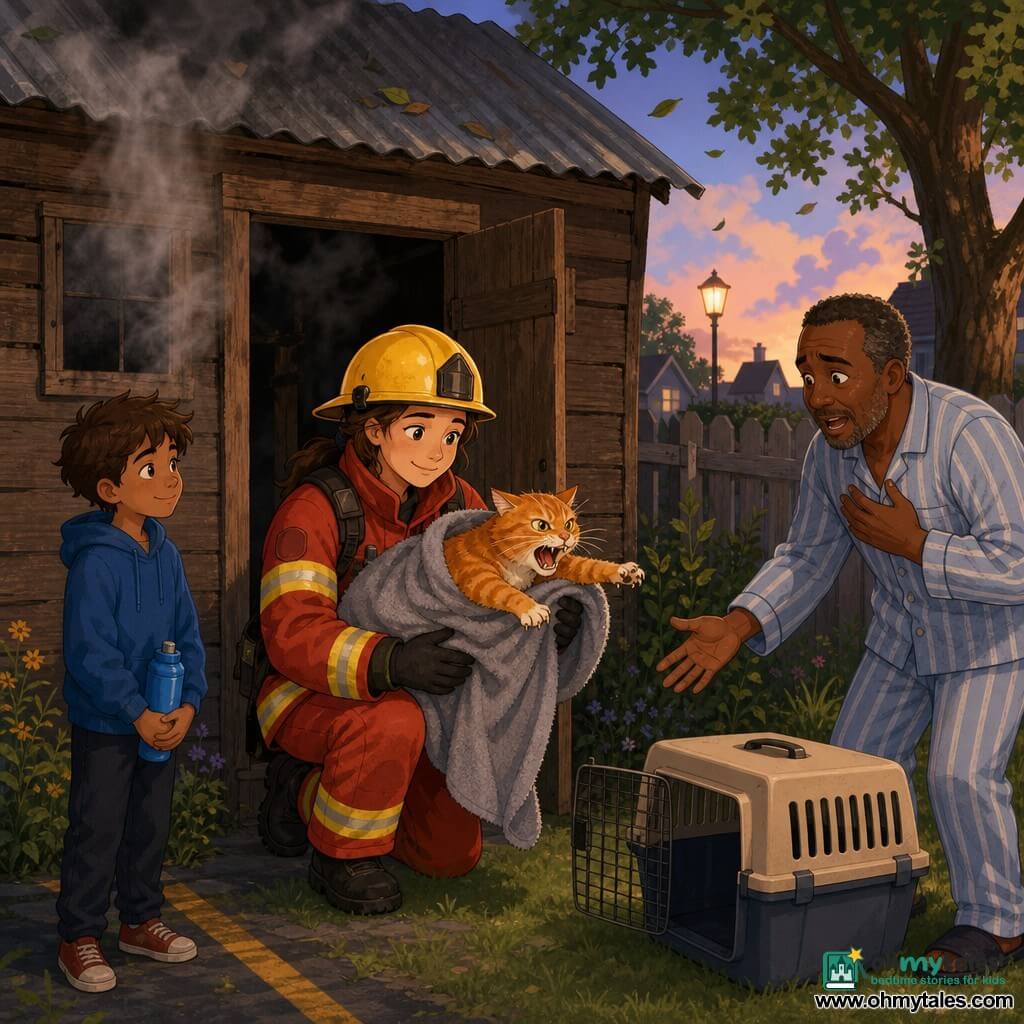
When they arrived, a small crowd stood in a backyard, pointing toward a wooden shed. Smoke curled from the roofline, thin but steady.
A man in slippers waved both arms. “My lawnmower! And my—my holiday decorations! Also my cat is in there!”
A cat yowl answered him—loud, offended, and extremely alive.
Mara stepped forward. “Okay. Everyone back. Give us space.”
She looked at the shed. The fire was small, likely electrical or from something smoldering. But small fires could turn greedy fast.
Captain Rojas assigned tasks. “Jessa, pull a line. Mara, assess entry and check for people or animals. Keep it safe.”
Mara nodded and crouched near the shed door, feeling the heat with the back of her gloved hand without touching it. “Warm, not scorching,” she reported. She glanced at the small window and saw movement—two glowing eyes and a tail lashing like a furious metronome.
“Cat is definitely inside,” she said. “And definitely upset about it.”
Leo watched from behind the safe line, hands clenched around his bottle. Mara pointed at him briefly. “Drink,” she mouthed.
He blinked, then obeyed, taking a quick sip as if hydration might help the cat too.
Jessa arrived with the hose line. “Ready.”
Mara spoke clearly. “We'll open the door slowly. Short burst if needed. We don't want to push smoke deeper or scare the cat into hiding.”
Captain Rojas nodded. “Do it.”
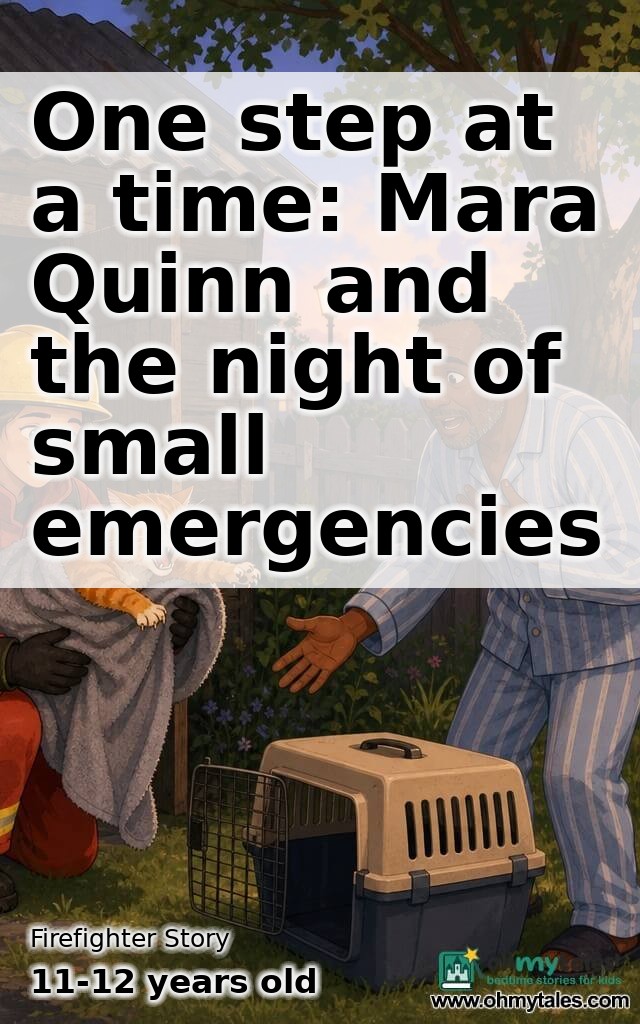
Mara used a tool to pry the door. As it opened, smoke puffed out like a sigh. The cat shot forward—not out, but straight up onto a shelf, as if the floor had personally insulted it.
Mara kept low. “Here, kitty,” she said, gentle and calm. “We're firefighters, not cat thieves.”
The cat yowled again. Jessa whispered, “It's calling you names.”
“Probably accurate,” Mara murmured.
Inside, a corner of the shed had a small smoldering pile—an extension cord melted into a sad plastic puddle, next to a cardboard box. Mara signaled. Jessa gave a quick, controlled spray. Steam hissed. The smoke thinned.
Mara's eyes stayed on the cat. “Okay, escape route is clear. Let's make the air better.”
They ventilated by opening the door wide and cracking the window. Mara reached for a pet carrier the homeowner shoved toward her with trembling hands.
“I—I keep it for vet visits,” he said. “He hates it.”
Mara nodded sympathetically. “Most cats do. Most firefighters also hate certain things. Like soggy socks.”
Jessa said, “And leg day.”
Mara inched closer to the shelf. The cat's ears were flat, but its eyes were bright. “You're okay,” Mara told it. “You're tough. But we're leaving now.”
She draped a thick towel gently over the cat, turning it into a surprised burrito. The yowl became muffled outrage.
“I apologize for nothing!” the cat's body language seemed to say.
Mara guided it into the carrier. The homeowner grabbed the carrier as if it were treasure. “Thank you! His name is Sir Pounce-a-Lot.”
Jessa coughed a laugh. “Of course it is.”
Mara turned serious again, looking at the smoldered corner. “This likely started from a damaged cord. Electrical fires can hide. We'll check the walls and make sure it's fully out.”
Captain Rojas inspected with the thermal camera. “No remaining hot spots. Good.”
The wind tugged at Mara's jacket as she stepped outside. The homeowner's face was pale, then slowly regained color. “I thought I was going to lose everything.”
Mara's voice was soft and sure. “You did the right thing calling early. And for future—don't overload extension cords, keep flammable things away from outlets, and check cords for damage.”
He nodded quickly. “I will. I swear.”
Mara glanced at the crowd. “Also, everyone take a breath. Drink some water when you go inside. Stress is sneaky.”
Leo, still behind the line, looked at her like she'd just performed a magic trick with science and calmness.
On the ride back, he said, “You didn't rush. But you were fast.”
Mara leaned her head back against the seat for a moment. “Fast doesn't have to be frantic. Fast can be focused.”
Leo stared at his reflection in the window. “I want to be focused.”
“You already are,” Mara said. “You followed rules, stayed calm, and remembered your water bottle. That's a strong start.”
Leo smiled in the dark. “Hydration Club saves the day.”
“Frequently,” Mara agreed.
Chapter 5: The Quiet Talk After the Loud Work
Back at the station, the crew cleaned equipment again. Water drained from the hose. Tools were wiped down. Gear was checked for soot and damage. Everything had a place, and every place meant speed later.
Mara sat on the bench to unlace her boots. She rolled her shoulders slowly, like someone putting down an invisible backpack.
Captain Rojas walked by. “Good call in there.”
Mara nodded. “Good teamwork.”
When the captain moved on, Leo came over, quieter now. The station, after alarms and sirens, felt like a calm aquarium—low voices, soft footsteps, gentle clinks of metal.
“Do you ever… feel small?” Leo asked. “Like the job is bigger than you?”
Mara considered. She didn't rush this answer, either.
“Yes,” she said. “Sometimes the problems are big. Sometimes you can't fix everything in one night. That can make anyone feel small.”
Leo's face tightened, as if he expected a scary truth next.
Mara continued, “But confidence isn't pretending you're never scared. It's knowing you can handle the next right thing. One task. One breath. One step.”
Leo let out a slow breath. “Like doubt is an alarm, and confidence is… the plan.”
Mara's eyes warmed. “That's beautifully said.”
Jessa wandered over with two paper cups. “I made cocoa. Mara, it's not water, but it is a warm hug in liquid form.”
Mara accepted a cup, sniffed it, and raised it like a serious toast. “We can enjoy cocoa. And then we drink water.”
Jessa sighed. “Hydration Club has no mercy.”
Leo giggled. It was the tired kind of giggle that meant the day had been big.
Mara took a careful sip of cocoa. It tasted like chocolate and quiet.
“Why are you a volunteer?” Leo asked. “You could probably do something else.”
Mara looked around the station. The gear, the engine, the people—ordinary in their own lives, extraordinary when the pager buzzed.
“I like my regular job,” she said. “But I also like helping my town. Volunteering means I'm choosing to show up. Over and over. It's hard sometimes, but it matters.”
Leo nodded slowly. “Like choosing to be ready.”
“Exactly,” Mara said. “And choosing to rest, too.”
She pointed at the bunks in the back. “We can't be helpful if we're exhausted. Rest is part of the job.”
Leo's eyes drooped a little, as if his body had been waiting for permission to be sleepy.
Mara stood and stretched. “Okay, helper. Time to head home. Big night.”
As they walked out, the sky was deep and clear, and the stars looked like tiny pinholes in a dark blanket.
Leo hugged his water bottle to his chest. “I'm going to tell my mom about Sir Pounce-a-Lot.”
“Please do,” Mara said. “He would want the fame.”
They reached Leo's house. The porch light was on, a soft circle of welcome. Leo paused at the steps.
“Thanks,” he said quietly. “For letting me come. And for… being calm.”
Mara's voice stayed gentle. “You were calm too. Remember that. You can trust yourself.”
Leo's grin returned, small but bright. “Goodnight, Mara.”
“Goodnight,” she said. “Drink water tomorrow.”
Leo saluted with the bottle. “Yes, ma'am.”
Mara walked home under the steady stars. She felt tired in her muscles, but peaceful in her mind—the kind of tired that meant you'd done something worthwhile.
Chapter 6: The Shelf of Remembering
The next afternoon, Mara returned to the station for a community open house. The bay doors were wide again, and sunlight poured in, turning the red engine glossy as an apple.
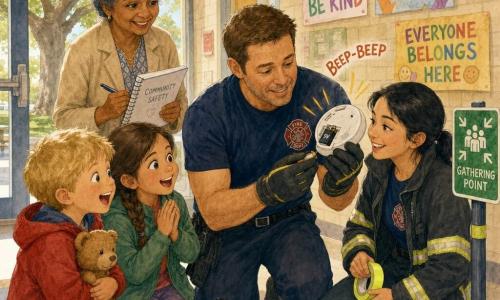
Families wandered through. Kids tried on helmets that wobbled over their ears. Parents asked questions about smoke alarms and escape plans. Someone handed out stickers that said FIRE SAFETY STARTS WITH YOU.
Mara stood by a table with brochures and a display of a smoke detector, a battery, and a small calendar.
“Change batteries twice a year,” she explained to a group of kids. “Pick two days you'll remember. Some people do it when clocks change.”
One boy raised his hand. “What if we forget?”
Mara tapped the calendar. “Put a reminder. Ask an adult. Make it a family habit. Confidence comes from habits, not wishes.”
At another corner, Jessa was demonstrating how to “stop, drop, and roll” using a stuffed bear named Captain Fluff.
Captain Rojas spoke to a group of adults about escape routes. “Two ways out of every room if possible. Practice your plan. Don't hide from firefighters in a fire—come to us.”
Mara noticed a row of greeting cards on a table near the wall—handmade, colorful, slightly crooked in the best way. They had been delivered to the station earlier that day by the local school.
THANK YOU FOR BEING BRAVE.
YOU HELP PEOPLE.
FIREFIGHTERS ARE COOL (LIKE, LITERALLY, YOU BRING WATER).
Mara chuckled at that one.
Leo arrived with his mom, looking proud and a little taller than yesterday. He waved at Mara, then hurried over.
“I made one too,” he said, holding out a card.
Mara opened it carefully. Inside was a drawing of a firefighter—helmet, hose, boots, and a speech bubble that said: DRINK WATER AND BE A REASONABLE DRAGON.
Underneath, Leo had written: Thanks for showing me that confidence is doing the next right thing.
Mara's throat tightened in a way that felt like warmth, not sadness.
“This is going on the shelf,” she said.
“The shelf?” Leo asked.
Mara pointed to a wooden shelf along the station wall, already lined with cards like bright little windows. “We keep them here. On hard days, we read them. They remind us why we train and why we show up.”
Together, they walked to the shelf. Mara placed Leo's card carefully among the others, aligning it so the edge matched the row—neat, steady, respectful. A whole line of gratitude, shoulder to shoulder.
Leo stood on his toes to look. “It's like… a memory wall.”
“A memory shelf,” Mara corrected softly. “Because memories don't have to be heavy. They can be light enough to sit quietly and still matter.”
Leo's mom took a photo. “Thank you for what you do,” she told Mara.
Mara nodded, calm as ever. “Thank you for teaching kids to notice helpers—and to be helpers.”
As the open house continued, a little girl handed Mara a cup of water from the refreshment table. “My dad said firefighters should drink,” she said solemnly.
Mara accepted it with the seriousness of accepting a medal. “Your dad is wise.”
She took a sip and looked at the shelf again—cards lined up in a cheerful row, bright colors against the station's steady walls.
The station was quiet for the moment. The engine waited, ready. The people laughed softly. Outside, the town went on, ordinary and safe.
Mara felt a comfortable confidence settle inside her—not loud, not flashy. Just steady, like a well-packed hose and a plan practiced until it fit your hands.
She glanced at Leo. “Remember,” she said, “confidence is built.”
Leo nodded, eyes on the shelf. “One step at a time.”
“And with water,” Mara added.
Leo grinned. “And with water.”