Chapter 1: The Station That Smelled Like Toast
The city fire station woke up the way it always did: with the soft hum of radios, the clink of mugs, and the mysterious smell of someone burning toast.
Captain Milo Reyes stepped out of the gear room, tugging his navy T-shirt straight. He was the kind of firefighter who could fix a jammed locker with a spoon and make kids laugh just by raising one eyebrow. His helmet sat on the bench like a loyal pet waiting to be adopted.
“Morning, Captain,” said Jade, one of the firefighters, pointing at the toaster. “We have a suspect.”
Milo leaned in. The toast was blacker than the night sky. “It's not a fire,” he said solemnly, then sniffed again. “But it is a tragedy.”
Jade grinned. “Should we call it in?”
Milo tapped his radio. “Dispatch, this is Station Seven. We have… crunchy bread. Please advise.”
A crackly voice answered, clearly trying not to laugh. “Station Seven, please keep toast emergencies to a minimum.”
Milo set the toast aside like it might bite him. Then he turned serious—serious but still kind, like a teacher who lets you redo a test.
“Before we start the day,” he said to the crew, “quick check. What's our rule about equipment?”
Jade and the others chimed in, almost like a song. “Respect it, check it, clean it, and put it back.”
Milo nodded. “Because the hose isn't just a hose. It's our water lifeline. The air tank isn't just a tank. It's our breath.”
He looked toward the big red truck, Engine 7, shining under the lights. Milo had polished one of the chrome handles himself yesterday, not because he had to, but because he liked things ready and cared for.
A new sound cut through the calm: the alarm bell—sharp, bright, and impossible to ignore.
Milo's face shifted into focused calm. “All right. Let's work.”
They moved like a practiced dance: boots on, jackets clipped, helmets down. Milo paused for half a second, eyes on the gear rack.
He asked out loud, because asking questions was one of his habits—like checking doors twice or counting steps on stairs. “Dispatch, what do we have? Smoke, flames, trapped people, or unknown?”
“Unknown smoke report,” dispatch replied. “Possible electrical issue at Maple Street Community Center.”
Milo's eyebrows rose. “Kids' after-school place. Got it. Any word on evacuation?”
“Staff says they're moving people out. No confirmed injuries.”
Milo clicked his radio. “Copy that. Team—remember: we go in smart. We keep each other safe. And we respect the equipment, because it respects us back.”
Jade whispered as they ran, “Does equipment have feelings?”
Milo buckled his seatbelt. “Not feelings. But it definitely has opinions.”
The truck roared out into the city, lights painting the buildings in red streaks as if the street itself was blinking awake.
Chapter 2: The Smoke That Wasn't a Monster
The community center looked normal from the outside—brick walls, cheerful posters, a basketball hoop over the side door. But a thin ribbon of gray smoke slid out from a window near the roof, curling like a curious cat.
Milo jumped down first. “Jade, you're on the hose line. Omar, bring the thermal camera. Nina, check the main entrance and confirm everyone's out.”
They moved quickly, but Milo's voice stayed calm, steady, and low—like a bedtime narrator who just happens to be wearing a helmet.
A staff member hurried over, hair frizzed from stress. “I'm Ms. Patel. We smelled smoke in the art room. I got the kids out—at least I think all of them.”
Milo crouched a little so he wasn't towering over her. “You did the right thing. Quick question: did anyone go back in for backpacks or phones?”
Ms. Patel grimaced. “Two tried. I stopped them.”
“Thank you,” Milo said. “Another question: do you know where the breaker panel is?”
“By the janitor closet, right hallway.”
Milo nodded. He looked at Nina, who was counting people outside with a clipboard someone had handed her. Nina gave a thumbs-up. “All out.”
Milo's shoulders loosened by half an inch. “Good. Then our job is to keep it that way.”
Jade rolled the hose with practiced strength. “Water on?”
Milo held up a hand. “Not yet. Let's not soak a building unless we must.”
He turned to Omar. “Thermal camera reading?”
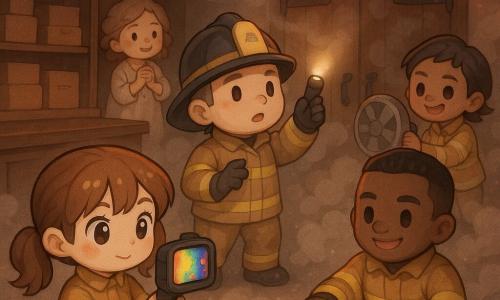
Omar lifted the device—like a chunky video game controller with a screen. “Hot spot near the ceiling in the art room. Could be wiring, light fixture, maybe a space heater.”
Milo nodded. “Electrical smoke can be sneaky. It smells sharp, kind of like burning plastic. If we spray water on live electricity, we make a new problem.”
Jade made a face. “The kind that bites?”
“The kind that bites,” Milo agreed.
They pulled on their face masks and checked each other's straps. Milo always did a buddy check—hands patting buckles, fingers tracing the seal. It wasn't fussy; it was respect.
He asked, “Everyone's air reading full?”
“Full,” the team answered.
Milo's gloved hand rested on the door handle. “All right. Slow and smooth.”
Inside, the hallway was dim, and the air tasted wrong—like the building had chewed on a rubber tire. Milo stayed low, sweeping his flashlight. Posters of smiling cartoon planets on the walls looked oddly serious in the smoke.
They reached the art room. A ceiling light fixture crackled softly, and smoke seeped around it.
Milo pointed. “Omar, confirm. Is that the main heat source?”
Omar checked. “Yes. Highest temp there.”
Milo keyed his radio. “Dispatch, we have an electrical fire in a ceiling fixture. Request utility company to cut power. We're controlling the area.”
Jade whispered, “Captain, why do you ask so many questions even when you already know stuff?”
Milo glanced at her, eyes bright behind his mask. “Because if I ask, I'm double-checking my brain. And if anyone else has a better idea, I want it to escape their head before we make a mistake.”
Jade nodded, like she'd just been handed a secret.
Milo pulled a small extinguisher from the wall bracket. “This is a CO₂ extinguisher. It doesn't leave a powdery mess, and it's safer for electrical fires.”
He aimed carefully. “Remember: we don't treat the building like an enemy. We treat it like something we want to save.”
A short blast. The crackle stopped. Smoke thinned.
Omar held the thermal camera up again. “Heat dropping.”
Milo exhaled slowly. “Good. Now we ventilate and make sure it doesn't restart.”
They opened windows and used a fan at the doorway, blowing smoky air out like a giant invisible broom.
Outside, Ms. Patel hugged herself. Milo approached, mask off now, voice gentle. “It's under control. Electric fixture fault. No flames spread.”
Ms. Patel sagged with relief. “Thank you. The kids were terrified.”
Milo nodded toward the truck. “We'll do a safety talk before we leave. Quick one. Fire doesn't like knowledge.”
Chapter 3: The Great Gear Lesson (Plus a Slightly Bossy Hose)
The kids stood in a loose crowd outside the community center, wrapped in jackets and curiosity. Some looked brave, some looked shaky, and one boy looked mostly annoyed because he'd dropped his snack.
Milo knelt beside the truck and opened a side compartment. “Okay, pop quiz,” he said. “What do you think this is?”
“A robot vacuum?” a girl guessed.
“Close,” Milo said, lifting the breathing apparatus. “This is an air tank and mask. It lets us breathe when smoke makes the air unsafe.”
A kid squinted. “Is it heavy?”
“It's like wearing a small backpack full of metal,” Milo said. “Not comfortable, but very helpful.”
Jade stepped forward holding a coiled hose. “And this,” she announced, “is Captain Milo's favorite noodle.”
Milo put a hand on his chest dramatically. “That's a serious accusation.”
The kids giggled.
Milo pointed at the hose coupling. “This hose has metal parts that can get damaged if we drag them across rough ground. So we lift, we guide, and we put it back clean. Respecting equipment isn't just being neat. It means the hose won't leak when we need it most.”
One boy raised a hand like he was in school. “So if you don't clean it, it stops working?”
“It can,” Milo said. “Dirt and grit can wear it down. Same with our tools. A tool that's treated badly can fail at the worst time.”
Ms. Patel joined them, listening. “The kids always think heroes don't do chores.”
Milo grinned. “Heroes do a lot of chores. Big ones, small ones. We check our truck every morning—tires, lights, water level, ladders, medical bags. We do it before emergencies so we're not surprised.”
He glanced at the crowd. “Question for you: If you see smoke in a building, what's the first thing you do?”
“Run in!” a kid blurted, then immediately looked guilty.
Milo's face stayed kind. “That's a brave thought. But here's the safer answer.”
“Tell an adult?” someone offered.
“Yes. And get out,” Milo said. “Tell others as you leave. Don't hide. Don't go back for stuff. Stuff can be replaced. People can't.”
Jade pointed at Milo's helmet. “What about the hat? Can we replace that?”
Milo looked offended. “This is not a hat. It is a crown of responsibility.”
More laughter, softer now. The tension was leaving, like smoke through an open window.
Omar came over. “Utility company cut power. Building's safe.”
Milo nodded. Then he looked at the kids again. “One more thing. Firefighters aren't just fire. We do medical calls, car accidents, rescues, and—”
“Toast tragedies,” Jade said.
“—toast tragedies,” Milo agreed. “But it all comes down to teamwork, calm thinking, and taking care of our gear.”
As they packed up, Milo watched Jade roll the hose back into the compartment with slow care. She didn't slam the door; she guided it shut like closing a library book.
Milo felt proud, the quiet kind of proud that doesn't need a trophy.
Chapter 4: Milo's Creative Plan and the Mystery of the Beeping Box
Back at Station Seven, the evening light poured through the windows, turning the floor into warm rectangles. Milo sat at the kitchen table with a notepad, sketching.
Jade leaned over. “Is that… a dragon?”
Milo nodded. “A safety dragon.”
Omar raised an eyebrow. “Please tell me it doesn't breathe actual fire.”
“Only educational fire,” Milo said. “Maple Street needs a better safety setup. We can help them make a simple evacuation map and a ‘sound check' routine. Also—Ms. Patel mentioned their smoke detector beeped last week, then stopped.”
Nina frowned. “Low battery beep?”
“Probably,” Milo said. “But that's how small problems turn into big ones if we ignore them.”
He tapped his pen. “I'm going to ask her a few questions. Did the beeping happen at night? Did anyone change batteries? Did someone take it down because it was annoying?”
Jade smirked. “People will do anything to stop a beep except fix the beep.”
Milo called Ms. Patel on speaker. “Hi, it's Captain Reyes. Quick follow-up. About that beeping smoke alarm—do you remember when it happened?”
Ms. Patel's voice came through. “Mostly at night. It drove the evening staff crazy.”
“Did anyone remove it?” Milo asked.
A pause. “Someone said they'd ‘deal with it.' I'm not sure what that means.”
Milo sighed softly, like a kettle that decided not to whistle. “Okay. Next question: do you have spare batteries on site?”
“Probably in the supply closet. If they haven't disappeared.”
Milo smiled. “We can help you set up a small checklist. Nothing fancy. Just: test alarms monthly, change batteries when they chirp, and never disable them.”
After he hung up, Milo drew the safety dragon again, this time wearing a tiny firefighter helmet.
Nina laughed. “You're really going to bring that to the community center?”
“Yes,” Milo said. “Kids listen to dragons.”
Jade crossed her arms. “I listen to dragons.”
Milo tapped the paper. “Tomorrow we'll visit and do a mini lesson: what alarms mean, how to leave safely, where to meet outside, and why you keep hallways clear.”
Omar nodded. “And we'll check their extinguishers and exit signs.”
Milo looked around at the station—at the neatly hung coats, the lined-up boots, the polished truck. “Also, tonight we clean and reset our gear. Respect, remember?”
Jade saluted with a sponge. “The gear shall be honored with soap.”
They cleaned masks carefully, checked straps for wear, refilled medical supplies, and wiped down tools. Milo showed them how to inspect a hose coupling for cracks and how to store it so it didn't kink.
“Question,” Jade said, squinting. “If a hose kinks, is it like when a garden hose goes all weird and angry?”
“Exactly,” Milo said. “It blocks water flow. And water flow is not something you want to argue with during a fire.”
By the time the station quieted, everything was in its place. The truck looked ready to leap into action, but for now it slept.
Milo poured a mug of herbal tea and sat back, letting the calm settle like a blanket.
Chapter 5: A Visit, a Dragon, and a Better Kind of Beep
The next afternoon, Milo and Jade returned to the community center with a small bag of supplies: batteries, a marker, a roll of bright tape, and a laminated drawing of the safety dragon.
Ms. Patel greeted them with a tired smile. “The kids have been talking about the ‘crown of responsibility' all day.”
Milo bowed slightly. “It's a heavy crown. Very dramatic.”
They gathered the kids in the main room. Milo held up the dragon poster. The dragon was green, friendly, and holding a checklist.
“Meet Sir Smokey Not-A-Real-Dragon,” Milo announced. “He has three rules.”
A girl read them aloud. “One: If you hear a smoke alarm, you move. Two: You meet outside at the meeting spot. Three: You don't go back in for stuff.”
Milo nodded. “Perfect. Now let's pick a meeting spot.”
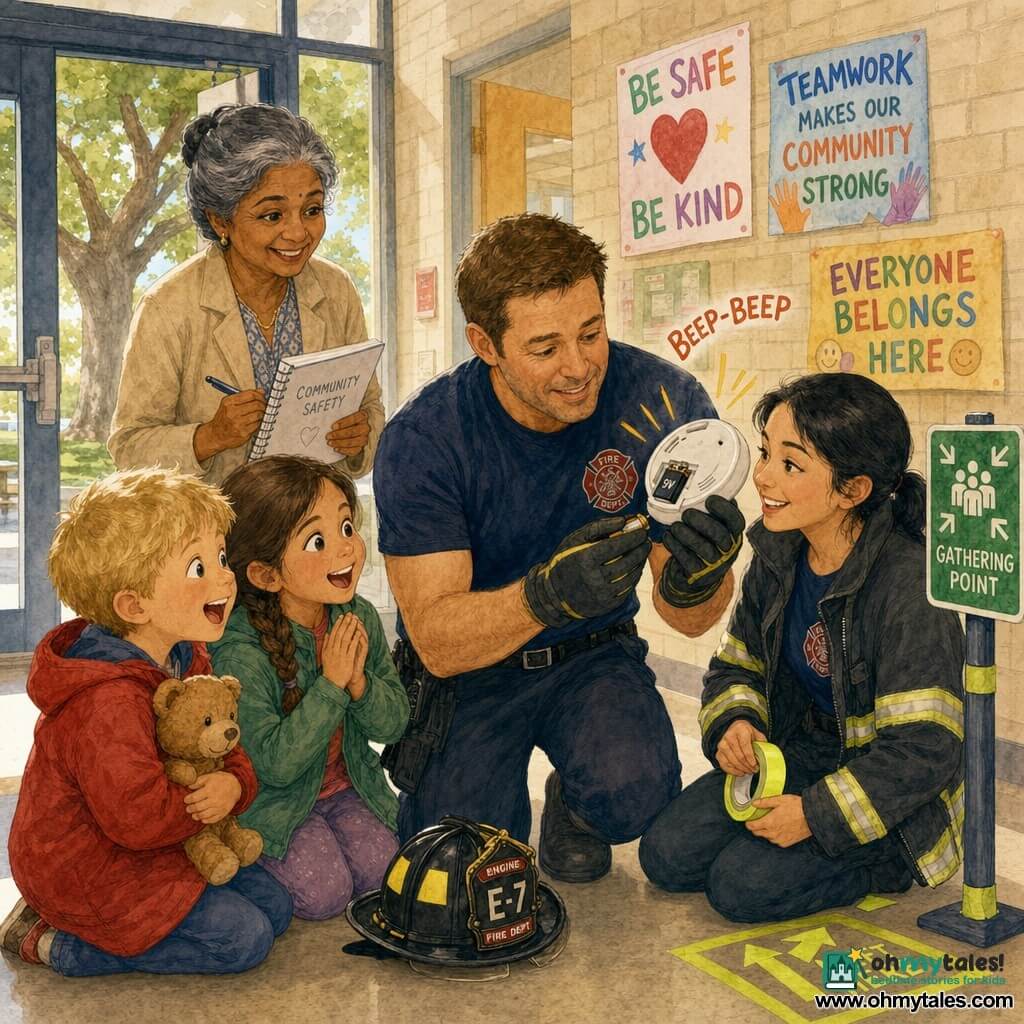
They chose a big oak tree across the street. Jade placed a strip of bright tape on a signpost. “This is our ‘Here We Are' spot. If you're ever outside during an evacuation, you go here and stay with a grown-up.”
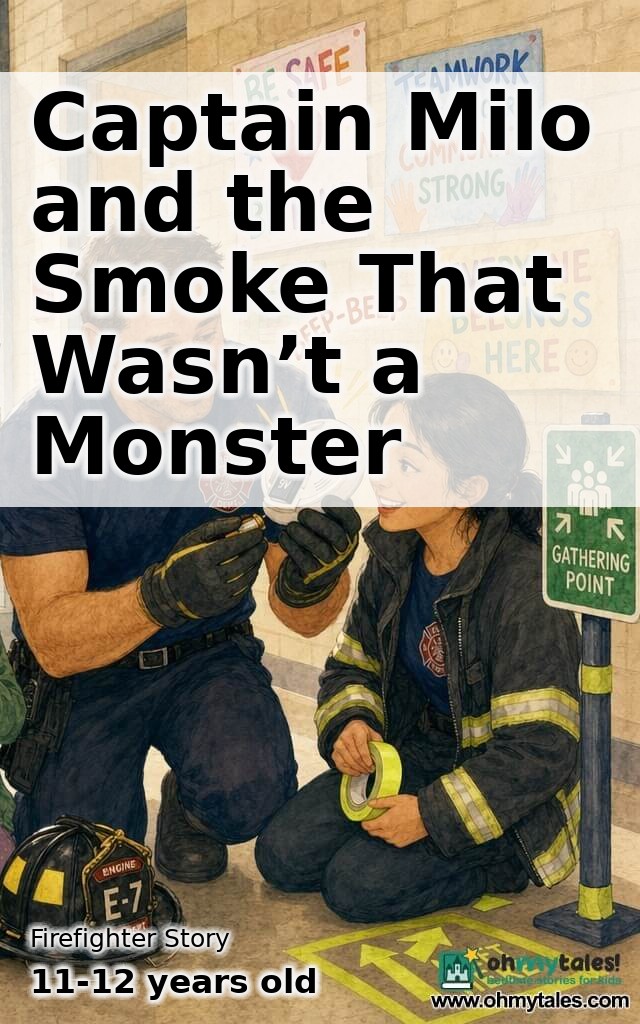
Milo walked with Ms. Patel to the hallway smoke detector. He pointed. “Can I check it?”
“Yes, please.”
He carefully twisted it down. The battery compartment was empty.
Milo raised an eyebrow. “Ah. Someone ‘dealt with it.'”
Ms. Patel covered her face. “Oh no.”
Milo kept his tone gentle. “It happens. But we fix it. That's the important part.”
He put in a new battery and clicked the detector back into place. Then he pressed the test button.
BEEP-BEEP-BEEP!
Several kids jumped, then laughed nervously.
Milo spoke over the sound. “That beep is annoying on purpose. It's a tiny alarm with a big job.”
He released the button, and the room settled again.
Jade said, “If it ever chirps—just one little ‘chirp' every so often—that usually means the battery is low.”
A boy asked, “What if it chirps in the middle of the night?”
Milo smiled. “Then you have two options: change the battery, or listen to the world's most stubborn bird.”
The kids giggled.
They checked exit signs and made sure the hallways were clear—no stacked chairs blocking doors, no boxes hiding the extinguisher.
Milo tapped the extinguisher gently. “This isn't a decoration. It's a tool. Treat it with respect. Don't play with it, don't hang backpacks on it, and tell an adult if the pressure gauge shows it's empty.”
Ms. Patel nodded, taking notes. “Monthly checks. Keep paths clear. Batteries ready.”
Before leaving, Milo crouched to the kids' level. “You did great yesterday. You listened, you left quickly, and you stayed together. That's real courage.”
On the way back to the station, Jade leaned her head against the seat. “Captain, do you ever get scared?”
Milo watched the road, calm eyes forward. “Sometimes. Being brave isn't never being scared. It's doing the safe, right thing even when your stomach does cartwheels.”
Jade smiled softly. “My stomach does cartwheels when I have to speak in class.”
“Then you're practicing bravery,” Milo said. “Different uniform.”
Chapter 6: The Small Story Told Twice
That night, the station was peaceful. The city outside made its usual sleepy noises—distant cars, a barking dog that sounded like it was arguing with the moon.
Milo sat in the common room with a few newer firefighters who were winding down. Someone had dimmed the lights. The truck rested in its bay like a giant red bedtime toy.
Jade wandered in, holding a blanket. “Captain, you always tell the rookies a story when it's quiet.”
Milo pretended to be shocked. “Do I? I thought I only told extremely serious speeches about hoses.”
“Story,” Jade insisted, pulling up a chair.
Milo set his mug down. “All right. A short one.”
He leaned back, voice low and warm.
“Today reminded me of something that happened early in my career. There was a little shop that sold musical instruments—trumpets, drums, shiny saxophones. We got a call for smoke. When we arrived, the owner was outside, hugging a trombone case like it was a puppy.
“I asked him, ‘Is anyone inside?' He said no, but he looked like he might sprint back in for that trombone anyway. So I asked a question—because questions slow down panic. I said, ‘What's more valuable: the trombone, or your lungs?' He blinked like I'd splashed water on his thoughts. Then he laughed a tiny laugh and said, ‘My lungs. I suppose I need those.'
“We found the source: a small trash can fire from a spark in the back room. We used the right extinguisher, ventilated the space, and saved the shop. Afterward, the owner tried to give me the trombone as a thank-you.”
Jade gasped. “Did you take it?”
Milo chuckled. “No. I told him, ‘Keep it. And please buy a smoke alarm that doesn't take vacations.' He promised he would.”
The rookies smiled, sleepy-eyed.
Jade yawned. “Tell it again,” she mumbled. “Just for the fun part.”
Milo raised an eyebrow. “You want the same story twice?”
She nodded. “Yes. It's like hearing a favorite song again.”
Milo's voice softened even more, like it was smoothing wrinkles out of the air.
“So,” he began again, “there was a music shop with instruments shining like treasure, and a man hugging a trombone case like it was a puppy…”
He told it a second time, slower, with the same gentle joke about lungs and the smoke alarm that didn't take vacations. The station seemed to listen with him: the boots lined up neatly, the gear cleaned and ready, the quiet pride of tools respected and prepared.
When he finished, the room held a comfortable silence.
Milo stood and turned off the last light. “Goodnight, everyone,” he said.
And somewhere in the city, a smoke detector gave a faithful little blink, ready to do its tiny, important job.