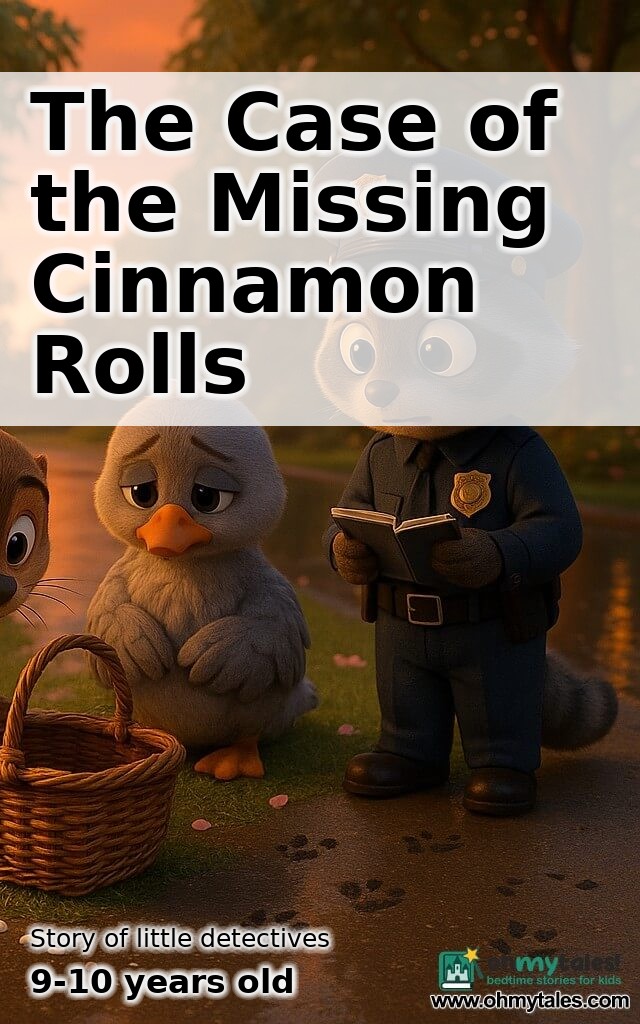
Chapter 1: The Empty Basket
Pip the otter liked two things almost equally: jokes and puzzles. Today, he was holding a puzzle with both paws.
It was a small shopping basket. Empty.
“Not empty,” Pip corrected himself, sniffing the air. “It smells like cinnamon rolls.”
He stood in the kitchen of Mrs. Bramble, the old badger who ran the neighborhood bakery. Flour dusted her nose like a tiny snowdrift.
“My morning delivery is gone,” Mrs. Bramble said. “A basket with six cinnamon rolls for the Library Tea. I put it right here by the door. Then I turned to frost cupcakes, and—poof!”
“Poof is not a clue,” Pip said, serious in a playful way. “But the door is.”
He crouched low. On the wooden floor were faint marks, like a basket had been dragged, not lifted.
“Who drags cinnamon rolls?” Pip muttered. “Someone in a hurry. Or someone small.”
Mrs. Bramble wrung her paws. “If the library doesn't get them, the Tea will be very plain.”
Pip straightened up. “I'll find your rolls. But you have to help me.”
“Me?” Mrs. Bramble blinked.
“Yes,” Pip said. “You must not chase rumors. You must not accuse anyone. You must wait until we have facts.”
Mrs. Bramble took a deep breath. “Responsibility,” she said, like she was tasting the word.
Pip nodded. “Exactly. Now, first fact: where did the basket go?”
He looked at the doorstep. A tiny smear of icing pointed outward, like an arrow.
Pip grinned. “The cinnamon trail begins.”
Chapter 2: The Cinnamon Trail
Outside, the street of Willowbrook was busy with animal neighbors starting their day. Pip followed the icing smear to the corner, then stopped.
The clues got tricky.
The sun had warmed the path. A few drops had melted into nothing. But Pip's nose was excellent, and his eyes were sharp.
He noticed three things at once:
1) A sprinkle of sugar near the gutter.
2) A short line of scuffed dirt, as if something had bumped along.
3) One small, gray feather stuck to a pebble.
“A feather,” Pip said. “Interesting.”
A robin swept down to a fencepost and tilted her head. It was Ruby, the mail carrier.
“Morning, Pip,” Ruby chirped. “Why are you sniffing the road? Did it drop a sandwich?”
“I'm on a case,” Pip said. “Missing cinnamon rolls. Have you seen a basket?”
Ruby tapped her beak thoughtfully. “I saw someone hurrying toward the market. Carrying… something. It was below my sightline, so I mostly saw elbows.”
“Elbows?” Pip repeated.
“Flappy elbows,” Ruby said. “Like this.” She flapped her wings fast, making a funny squeaky sound.
Pip tried not to laugh. “So, a bird?”
“Maybe,” Ruby said. “Or someone wearing a cape. It is a bold day for fashion.”
Pip pocketed the feather. “Thanks, Ruby. If you remember anything else, tell me at once.”
He followed the scuffed marks down Maple Lane. The smell of cinnamon came and went like a shy friend hiding behind trees.
At the next corner, he found another clue: a tiny muddy footprint.
It wasn't a paw print. It had three long toes.
Pip's whiskers twitched. “That's a bird footprint,” he whispered. “But why is it muddy?”
He looked up the lane. Ahead was the neighborhood market, noisy and bright.
If the cinnamon rolls had passed through there, Pip would need to rebuild the whole journey—step by step, stall by stall.
He tightened his little detective scarf. “All right,” he said. “Market time.”
Chapter 3: The Market of Many Stories
The market was like a box of crayons that had spilled everywhere. Striped awnings. Fruit piled high. Shoppers chatting, laughing, haggling, and bumping shoulders.
Pip moved carefully, like he was walking through a story where any sentence could hide a clue.
He stopped at the first stall, where a tortoise named Tilda sold apples. They were shiny as marbles.
“Tilda,” Pip said, “did you see anyone carrying a basket this morning?”
Tilda blinked slowly. “A basket? I saw a squirrel with a bag of nuts. Also a goat with a very dramatic hat. But a basket… wait.”
She pointed with her chin. “I heard a thump-thump-thump, like something dragging. It went past my stall and turned right.”
Pip followed her point. He walked past the honey stand, where a bee in a tiny apron offered samples.
“Free taste!” the bee buzzed. “One lick only. We are not running a tongue hotel.”
Pip smiled but kept going. He had to stay responsible. He couldn't get distracted by honey, no matter how polite it was.
At the fish stall—yes, Willowbrook had a fish stall run by cats who promised they were “only selling, not snacking”—Pip spotted another smear of icing on the edge of a barrel.
He leaned closer. It was fresh.
Then he heard a small, sharp voice behind him.
“Stop right there!”
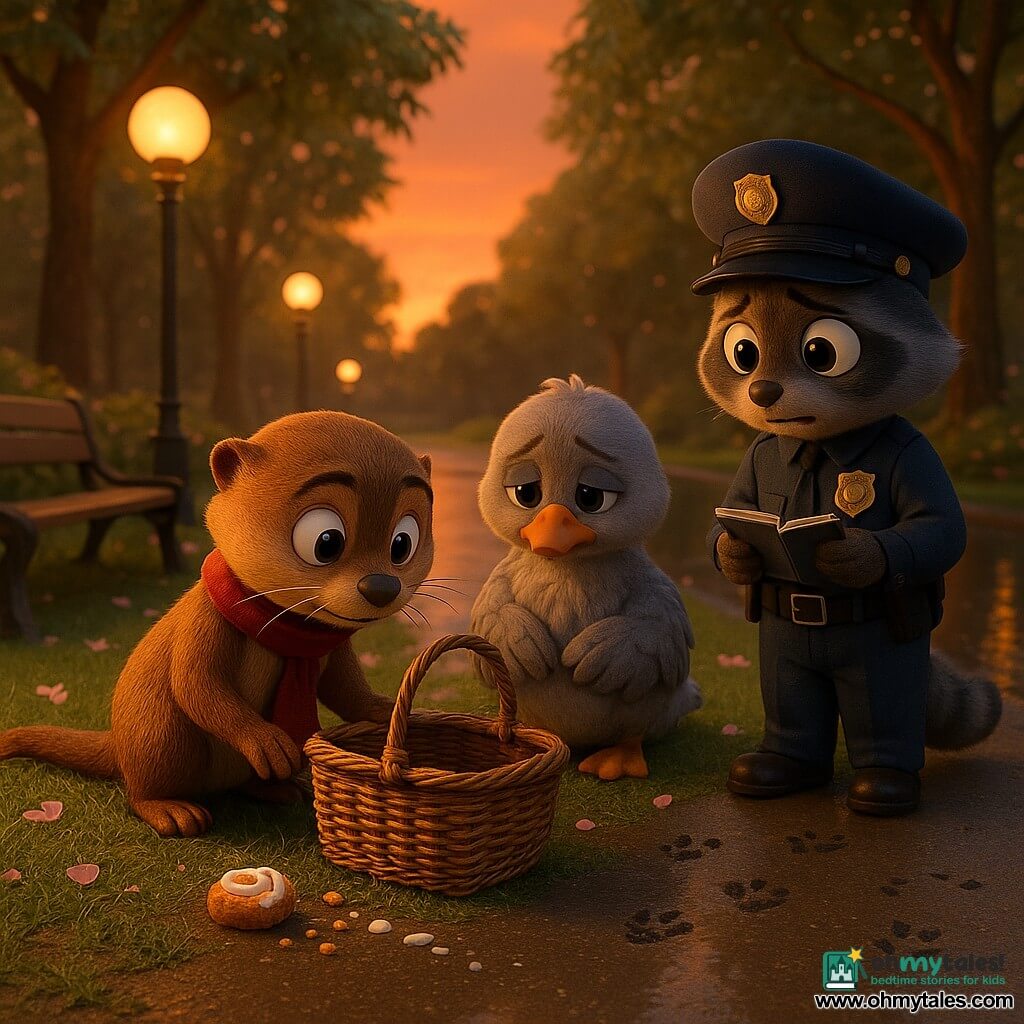
Pip turned. A young raccoon, Officer Nib, stood with a notebook and a pencil much too big for his paw.
“I'm keeping order,” Officer Nib said importantly. “No sticky paws on the barrels.”
“I'm investigating,” Pip said, calmly. “Missing bakery basket. I'm looking for clues.”
Officer Nib puffed his cheeks. “That sounds like my job.”
Pip nodded. “Great. Then we can do it together. Two sets of eyes. Less guessing.”
Officer Nib hesitated, then nodded like a grown-up. “Fine. But I ask the questions.”
“Deal,” Pip said. “Ask away.”
Officer Nib looked at the icing smear. “Question one: why is there icing at the fish stall?”
Pip answered softly, so the reader could think too. “Because the basket passed here. Or someone ate a roll here.”
Officer Nib scribbled. “Question two: who would carry cinnamon rolls through the market?”
Pip lifted the small gray feather from his pocket and showed it. “Someone with feathers.”
Officer Nib's eyes widened. “A bird thief!”
“Careful,” Pip said. “Not thief yet. We must be sure. Let's gather facts.”
They moved right, as Tilda had said, into a narrow aisle between stalls. It was quieter here. The smell of cinnamon grew stronger.
Pip noticed something on the ground: a thin line of damp mud, like a paintbrush had dragged across the stones.
“And here,” Pip said, pointing. “More three-toed footprints. Muddy.”
Officer Nib frowned. “But the market is dry. Where did the mud come from?”
Pip looked around. Across the aisle was a bucket of water by the flower stall. Beside it, a puddle of muddy water where someone had clearly stepped.
Flower petals were scattered like confetti.
Pip's mind clicked into place. “The trail is telling us a route,” he said. “From the bakery, to Maple Lane, into the market, past apples and fish, then here by the flowers.”
Officer Nib nodded slowly. “So where next?”
Pip pointed to the end of the aisle, where the market gate opened toward the park path.
“And we follow,” Pip said, “until the story makes sense.”
Chapter 4: The Park Path Puzzle
The park was calmer than the market. Trees whispered. A pond shone like a coin. Ducks waddled with important expressions.
Pip and Officer Nib followed the muddy line onto the path. The cinnamon smell was now very clear.
Pip stopped at a bench. On the wooden slats were tiny crumbs. Cinnamon crumbs.
Officer Nib lifted one crumb like it was treasure. “Evidence!”
Pip nodded. “Now let's think. Who has feathers, walks with three toes, and stepped in mud near the flower bucket?”
Officer Nib tapped his pencil on his notebook. “A pigeon.”
“Possible,” Pip said. “Or a sparrow. Or a duck who had a very busy morning.”
They heard a soft sniffle behind a bush.
Pip raised a paw. “Shh.”
They crept closer. Leaves rustled. Something small shifted.
Pip spoke gently. “Hello? We're not here to yell.”
Out stepped a young goose, gray-feathered and round as a pebble. Her eyes were shiny with worry. And in front of her sat the missing basket.
Empty.
Six cinnamon rolls were gone.
Officer Nib gasped. “Caught!”
The goose flinched. “I—I didn't steal them,” she blurted. “Well. I took them. But not like a bad criminal. I just—oh no, that sounds worse.”
Pip sat on the grass so he wasn't towering over her. “Tell us the whole thing. From the beginning. We'll listen.”
The goose took a shaking breath. “My name is Gilly. I was bringing flowers to the Library Tea. I tripped near the market flower stall. The bucket splashed, and I got muddy.”
Pip glanced at the muddy toes. That matched.
Gilly continued, words tumbling out. “Then I walked past the bakery. I smelled the rolls. I saw the basket by the door, and I thought… if I brought the rolls too, everyone would be happy. I wanted to be helpful.”
Officer Nib opened his beak—sorry, his mouth—to speak, but Pip lifted a paw.
“Keep going,” Pip said.
Gilly's shoulders drooped. “I couldn't carry it properly, so I dragged it. Then I went through the market because it's faster. But the basket was heavy, and I was late, and I got scared someone would be mad. So I hid in the park.”
Pip's eyes softened. “And the rolls?”
Gilly looked at the empty basket. “I ate one,” she confessed, almost whispering. “Just one. Then I felt guilty. And guilty makes you hungry, which is unfair, but true. So I ate another. Then… the rest.”
Officer Nib looked shocked. “That is… all of them.”
Gilly's voice squeaked. “I'm sorry. I was going to tell Mrs. Bramble. I just didn't know how.”
Pip nodded slowly. The mystery was solved, but now came the most important part: what to do next.
“Gilly,” Pip said, “being helpful is good. But taking without asking is not. Responsibility means you face the problem you made.”
Gilly wiped her beak with a wing. “I'll pay for them,” she said quickly. “But I don't have coins.”
Pip stood. “Then we'll make a plan. Together.”
Officer Nib looked uncertain. “Do we arrest her?”
Pip shook his head. “This is a gentle case. We fix, we learn, we do better.”
He picked up the basket. “Come on. We're going back. The route matters. We'll walk it in reverse, and we'll set it right.”
Chapter 5: The Tea Under a Clear Moon
They returned the way they came: park path, market gate, flower stall, fish barrels, apple stand, Maple Lane, bakery door.
As they walked, Pip asked Gilly questions, not to trap her, but to help her think.
“What could you do next time?” Pip asked.
Gilly swallowed. “Ask first. If I'm late, I tell the truth. And if I break something—” she glanced at the basket “—I don't hide.”
Officer Nib nodded, looking proud and a little relieved. “Good answers.”
At the bakery, Mrs. Bramble opened the door so fast her apron strings bounced.
“My basket!” she cried. Then she saw Gilly. Her eyes narrowed.
Gilly stepped forward, trembling. “Mrs. Bramble, I took them. I wanted to help, but I didn't ask. I ate the rolls. I'm very sorry.”
The bakery went quiet except for the soft tick of the cooling rack.
Mrs. Bramble stared at Gilly, then at Pip.
Pip spoke clearly. “Gilly will make it right. She can help bake a new batch for the Library Tea. And she can deliver them properly—with permission.”
Mrs. Bramble's whiskers twitched. “Can you bake?”
Gilly nodded quickly. “I can stir. And I can wash dishes. And I can carry things without dragging, I promise.”
Mrs. Bramble sighed, and her face softened. “All right,” she said. “But you will listen carefully. Cinnamon is powerful. It demands respect.”
Gilly almost smiled. “Yes, ma'am.”
They baked together. Gilly stirred until her wings ached. Pip measured sugar. Officer Nib read the recipe out loud with great drama, as if it were a royal speech.
“Two cups of flour!” he announced. “Let it be known!”
Mrs. Bramble snorted. “Less theatre, more kneading.”
When the new rolls came out, warm and perfect, they carried the basket to the library. This time, Gilly held it properly. Pip walked beside her. Officer Nib marched ahead like a tiny parade.
The Library Tea was saved. The librarian, an owl with spectacles, thanked them kindly. Gilly apologized again, and the owl nodded.
“Learning is why libraries exist,” the owl said. “And also for stories.”
That evening, after the last teacup was washed, Pip stepped outside. The neighborhood had quieted. Windows glowed softly. The air smelled faintly of cinnamon and night flowers.
Gilly and Officer Nib joined him on the library steps.
Above them, the moon hung clear and bright, like a polished lantern.
Officer Nib hugged his notebook. “Case closed,” he said.
Gilly looked up at the moon. “Thank you for not shouting,” she said to Pip. “I was so scared.”
Pip smiled. “Mysteries are easier when we use our heads—and our hearts. And when we take responsibility for our choices.”
Gilly nodded. “Next time I want to help, I'll ask first.”
Pip leaned back, watching the clear moon shine on Willowbrook's rooftops. The world felt safe again, not because problems never happened, but because friends could solve them—step by step—together.