Chapter 1: Proud Little Habits
Maya liked the quiet time after school, when the street sounded like bicycles and birds instead of morning traffic. She slid her lunchbox into the sink, rinsed it, and set it upside down to dry.
“No trash today,” she announced to her dad, holding up her reusable water bottle like a trophy.
Dad smiled from the table where he was sorting mail. “That's three days in a row.”
Maya's cheeks warmed. She didn't feel proud in a bossy way. More like a small, steady glow inside her, the kind you get when you finish a puzzle and the last piece clicks.
On the fridge, she had taped a sheet of paper called “Little Earth Helps.” It was written in bright green marker.
1) Turn off lights.
2) Walk or bike when I can.
3) Bring my own bag.
4) Use both sides of paper.
5) Don't waste food.
Maya knew her list wouldn't stop climate change by itself. Her teacher, Ms. Carter, had explained it carefully: too many gases in the air act like a blanket around Earth, keeping extra heat in. That heat can change weather patterns and make some places too dry, other places too stormy.
“It's a big problem,” Ms. Carter had said, “but big problems can be met with many small, honest actions. And with people working together.”
Working together sounded better than feeling scared.
That afternoon, Maya opened her toy shelf to look for her favorite stuffed penguin. The penguin was there, but it was squeezed between a pile of board games she hadn't played in months and a robot that had lost one arm. On the floor, a box of action figures stared up at her like they'd been waiting for rescue.
Maya sat back on her heels. “I have… a lot.”
Her little brother, Leo, wandered in chewing an apple. “Can I have your robot?” he asked around a mouthful.
“It's missing an arm,” Maya said.
“I don't care.” Leo shrugged. “I can be the arm.”
Maya laughed. “You can't be the arm.”
“Watch me.” He held his own arm up and made robot noises.
Maya's laugh faded into a thoughtful quiet. Toys were made from plastic, metal, cloth—things that took energy to make and ship. Ms. Carter had called it a “carbon footprint,” like an invisible trail left behind.
If toys could be shared instead of tossed, that trail could be smaller.
Maya stood up fast enough that her ponytail flipped. “Leo,” she said, “what if instead of just giving you the robot, we did something bigger?”
Leo blinked. “Like… a robot parade?”
“Like a toy swap,” Maya said. “A trade. So toys don't get wasted.”
Leo's eyes widened. “Can I trade my dinosaur that doesn't roar anymore?”
“You mean the one you roar for?” Maya asked.
He nodded proudly. “I'm very loud.”
Maya grinned and headed to the kitchen. Her heart felt light already, like it was floating on an idea. Tomorrow, she would ask Ms. Carter about the school's Eco Festival—the one with the big tents on the soccer field.
And maybe, just maybe, Maya's small steady glow could become something brighter, shared with other kids, like a string of lanterns at bedtime.
Chapter 2: The Honest Plan
The next morning, Maya carried a notebook to school as if it were important office paperwork. She had written “TOY SWAP” in bubble letters and drawn a tiny Earth wearing a party hat.
During class, Ms. Carter taught them about energy—how turning off a device that isn't being used saves electricity, and how electricity often comes from burning fuels that add heat-trapping gases to the air.
Maya raised her hand. “If we reuse things, does that help too?”
“It does,” Ms. Carter said. “Reusing means we don't need to make as many new things, which saves energy and materials. Why do you ask?”
Maya took a breath. She wanted to sound brave, but also honest. “I have too many toys,” she admitted. “Some are still good, but I don't play with them. I want to organize a toy swap at the Eco Festival. Kids can trade instead of buying new.”
Ms. Carter's eyes brightened. “That's a wonderful idea. The festival is on Saturday, and the community tent will be big enough. But you'll need a clear plan.”
Maya flipped open her notebook. “I started one.”
Ms. Carter leaned closer as Maya read:
“Rule one: toys must be clean and not broken. Rule two: be fair. Rule three: no lying about what a toy can do.”
Ms. Carter smiled. “That last one is especially important.”
Maya nodded. “Because if someone says a toy works but it doesn't, the other person will feel tricked.”
“And honesty builds trust,” Ms. Carter said. “Trust helps people cooperate. And we need cooperation for climate solutions.”
At lunch, Maya pitched her idea to her friends at the picnic table. Ava, who always had glitter pen ink on her fingers, loved it immediately.
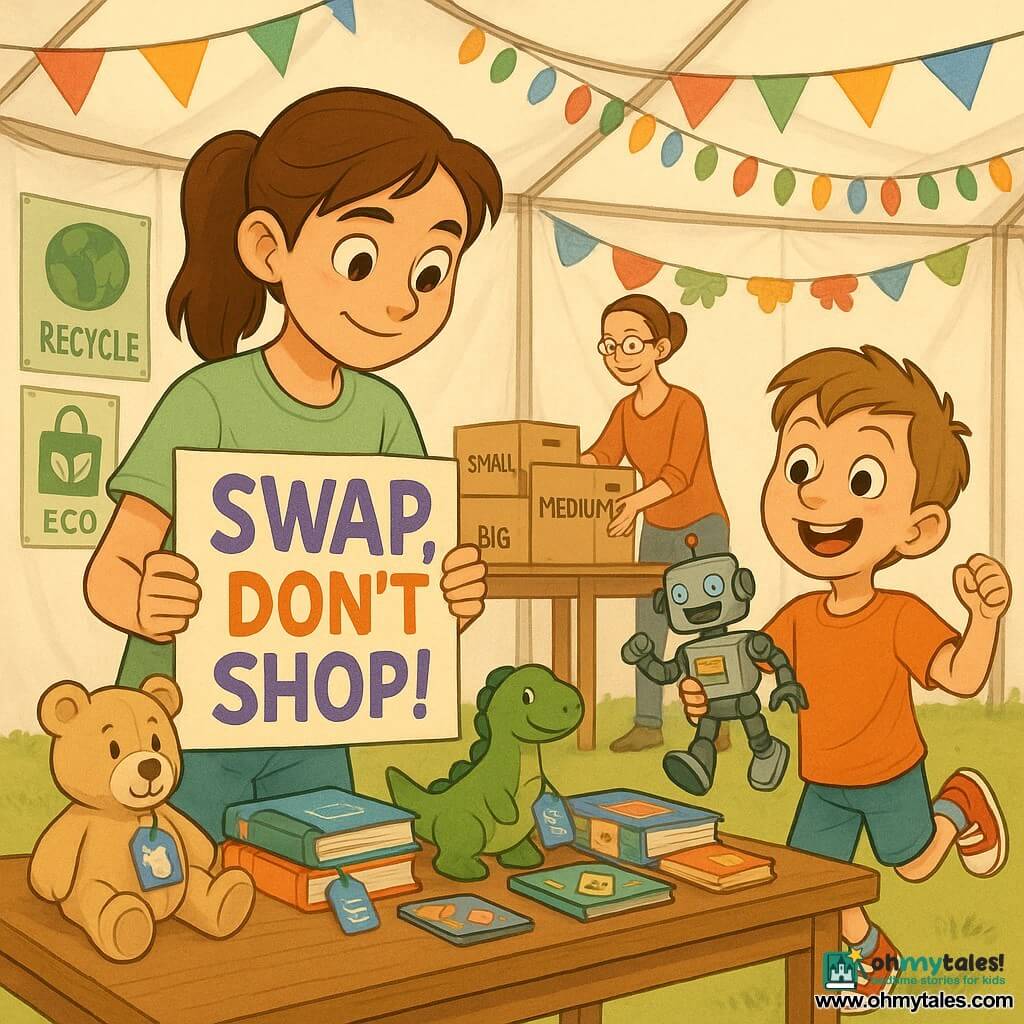
“We can make signs!” Ava said. “Like ‘Swap, Don't Shop!'”
Jamal, who was good at math and serious jokes, raised an eyebrow. “What if someone brings a tiny toy and wants a huge one?”
Maya had thought about that on the bus ride. “We can make trading zones,” she said. “Small for small, medium for medium, big for big. And if someone really wants something different, they can ask, but they have to be honest and polite.”
Jamal nodded. “That's… surprisingly reasonable.”
“Thank you,” Maya said, trying not to sound too pleased, and failing a little.
After school, she told her dad, who listened while chopping carrots for soup. Leo spun in circles beside the fridge, making wind sounds.
Dad wiped his hands and crouched to Maya's height. “I'm proud of you for wanting to help,” he said. “And I like that you're thinking about fairness. What do you need?”
“A table,” Maya said, ticking items off on her fingers. “Some boxes, signs, maybe stickers for categories. And… can we be part of the Eco Festival?”
Dad nodded. “We can volunteer. The festival is about real actions. Your swap fits perfectly.”
That evening, Maya and Leo sorted toys on a blanket in their room. Maya made three piles: “Ready to Swap,” “Keep,” and “Fix or Recycle.”
Leo held up a puzzle with missing pieces. “Swap?”
Maya shook her head gently. “Not fair. Someone would open it and feel sad.”
Leo made a dramatic sigh. “What if we pretend the missing pieces are… invisible?”
Maya giggled. “Still not fair. Let's put it in ‘Recycle' or maybe use the pieces for art.”
Leo considered that, then saluted the puzzle like a brave soldier. “Goodbye, invisible pieces.”
Maya kept sorting, and each time she placed a toy in the swap pile, she felt something else growing: a calm confidence. Not the kind that shouts, but the kind that says, I can do my part, honestly, and it matters.
Chapter 3: The Big Tent at the Eco Festival
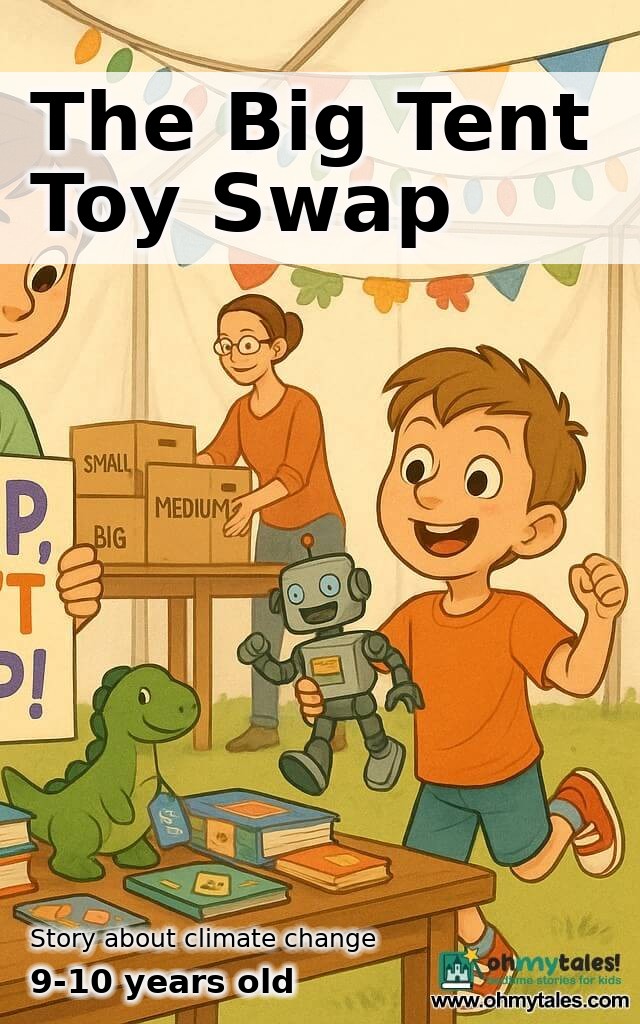
Saturday arrived with bright clouds that looked like slow, sleepy ships. Maya walked to the school field with Dad, Leo, and two canvas bags full of toys. The Eco Festival had transformed the place.
There were booths with posters about trees and bikes, tables with jars of seeds, and a corner where someone was teaching kids how to patch holes in jeans. Near the center stood a huge tent—taller than Dad—its sides tied back so the breeze could wander through. The fabric rippled softly, like it was breathing.
Maya's toy swap was set up inside the big tent. Ms. Carter waved from behind a table, already arranging cardboard signs.
Ava appeared with a stack of bright posters. “I brought the glitter,” she said proudly.
Jamal rolled in with his mom, carrying empty boxes. “For sorting,” he said, as if he'd been doing toy swaps his whole life.
Maya's stomach fluttered. This was bigger than her bedroom floor. Kids were arriving with backpacks and shopping bags. Parents hovered nearby with curious smiles.
Maya taped three signs to the front table:
SMALL SWAPS
MEDIUM SWAPS
BIG SWAPS
Underneath, she added another sign in careful handwriting:
BE KIND. BE FAIR. BE HONEST.
Leo stood beside her holding the robot with one arm. “I am the arm,” he whispered to anyone who looked.
A girl about Maya's age approached with a stuffed tiger tucked under her arm. “Hi,” she said. “I'm Nia. Is this where I trade?”
“Yes!” Maya said, suddenly grateful her voice didn't squeak. “Do you want small, medium, or big?”
Nia held up the tiger. “Medium? It's soft, but its whiskers are bent.”
Maya nodded. “That's honest. Medium is right over there.”
More kids came. The tent filled with quiet excitement, the kind that buzzed without being too loud. Toys piled up: books, building blocks, dolls, a skateboard with one scratched wheel, a set of magic tricks.
Maya checked items the best she could. “Does it work?” she asked one boy holding a remote-control car.
“Mostly,” he said.
Maya tilted her head. “What does ‘mostly' mean?”
The boy's ears turned pink. “Sometimes it goes in circles.”
Maya smiled kindly. “That's okay, but we should tell people. Maybe someone likes circles.”
The boy laughed, relieved. “Okay. It goes in circles. A lot.”
Soon, trades began. A small bear became a new favorite for a boy who missed his grandma. A stack of comic books found a home with a girl who said reading helped her fall asleep. Someone traded a soccer ball for a kite, then ran outside to try it in the breeze.
Maya watched, amazed. Every swap felt like a tiny rescue mission. Not dramatic, not loud—just helpful. Less waste. Less need for new stuff. More happy kids.
Ms. Carter stopped beside Maya. “Look around,” she said softly.
Maya did. The big tent was full of neighbors, classmates, and strangers smiling at each other. People were sharing stories about toys, talking about fixing things, asking questions. It didn't feel like a lecture. It felt like a community.
“This,” Ms. Carter said, “is what solutions look like. Many hands. Many honest choices.”
Maya's chest warmed. “It's kind of fun,” she whispered.
Ms. Carter chuckled. “The best kind of learning often is.”
Chapter 4: The Hard Trade
Mid-afternoon, when the sun turned buttery and the tent smelled faintly of lemonade, Maya noticed a boy standing near the medium table. He held a shiny board game box, the corners crisp like it had barely been opened.
He was watching a drone-shaped toy on the big table. The drone had thick plastic propellers and bright stickers. It looked exciting, like it belonged in a movie.
The boy stepped forward. “Can I trade my game for that drone?”
The kid guarding the drone—a tall girl with braids—crossed her arms. “No way,” she said. “This drone cost a lot.”
Maya walked over, trying to keep her voice calm. “Hi,” she said. “I'm Maya. We're trying to keep trades fair. The drone is in the big zone, and your game is medium.”
The boy's jaw tightened. “But my game is new.”
Maya nodded. “It looks new. That's a good thing. But size and value can be different. Also, does the drone work?”
The braided girl hesitated. “It… sort of works.”
Maya remembered the remote-control car. “What does ‘sort of' mean?”
The girl's cheeks rose. “The battery doesn't last long. And one propeller sometimes sticks.”
The boy's eyes narrowed. “You didn't say that.”
The girl looked down at her shoes. “I didn't want people to ignore it.”
Maya felt the tent's busy sounds soften for a moment, like everyone's ears had leaned in. She spoke gently, because she didn't want anyone to feel attacked.
“I get that,” Maya said. “But honesty is part of the swap. If we hide problems, then people won't trust it. And if people don't trust it, they'll stop swapping and go back to buying new. That makes more waste.”
The braided girl picked at a sticker on the drone. “I didn't think about that.”
Maya nodded. “Also, it's okay if you decide not to trade it. You can keep it, fix it, or recycle it later. No one has to trade.”
The boy hugged his board game tighter. “I don't want to get tricked,” he muttered.
“You won't,” Maya said. Then she looked at the braided girl. “Do you want to change how you're offering it? You could label it as ‘needs fixing,' and maybe trade for a different big item, or for two medium items, if both people agree.”
The girl took a slow breath. “Okay,” she said. She cleared her throat and spoke louder so the boy could hear. “It needs fixing. Battery is short, and one propeller sticks.”
The boy's shoulders lowered a little. “Thanks,” he said, still cautious.
Maya pointed to the “Fix-It Corner” booth outside the tent, where a volunteer was helping kids tighten screws and tape small tears. “We can ask someone to look at it,” she suggested. “If it can be fixed, it becomes more useful again.”
The braided girl nodded. “Can you come with me?”
Maya smiled. “Sure.”
They carried the drone to the Fix-It Corner. A friendly older man with a tool kit examined it carefully. “Propeller has a bit of grit,” he said. He cleaned it and showed the girl how to do it. He also explained that rechargeable batteries can wear down, and that charging them properly helps them last longer.
“It's like taking care of it,” Leo said, who had followed them, still being the robot arm.
“Exactly,” the man said. “Taking care of things is a climate action too.”
When they returned to the tent, the braided girl set the drone back on the table with a new sign: “BIG SWAP — FIXED PROPELLER, BATTERY SHORT.”
The boy looked at it, then at his board game. “I don't think I want it anymore,” he admitted. Then he smiled a little. “But I do want that stack of adventure books.”
“Medium for medium,” Maya said, relieved.
They traded, both satisfied.
As the afternoon drifted toward evening, Maya realized something important: her toy swap wasn't just about stuff. It was about telling the truth, even when it was awkward. It was about making choices that respected other people.
And that, she thought, felt like real strength—quiet, steady, and kind.
Chapter 5: A Light Heart at Home
When the festival ended, the big tent slowly emptied. The fabric sighed in the wind as volunteers untaped signs and folded tables. Maya's feet were tired, but her mind felt clear, like a window after rain.
Some toys remained in the swap boxes—good toys that no one had chosen. Ms. Carter helped Maya make a plan.
“We can donate these to the community center,” Ms. Carter said. “Or we can save a box for next time.”
“Next time?” Maya repeated, surprised.
Ms. Carter nodded. “People asked if we'd do another swap in a few months.”
Maya's tiredness turned into a small spark. “Really?”
“Really,” Ms. Carter said. “You started something.”
On the walk home, Dad carried the lighter bags. Leo dragged his dinosaur along the sidewalk, making it stomp in slow motion.
Maya looked up at the sky. The clouds had turned pink at the edges, as if someone had brushed them with paint. A breeze smelled like grass and distant popcorn.
“Did we help climate change today?” Leo asked suddenly.
Maya thought carefully. She wanted to be honest, not magical about it. “We didn't fix it all,” she said. “It's still a big problem. But we helped a little. We saved toys from being thrown away. And we showed people they can share and fix things.”
Leo nodded as if this made perfect sense. “So Earth got… a tiny high-five.”
Maya laughed. “Yes. A tiny high-five.”
At home, Maya washed her hands and poured herself a glass of water. On the fridge, she added a new line to her “Little Earth Helps” list:
6) Swap and share things.
She stared at the list, then wrote one more, smaller, under it:
7) Tell the truth, even when it's hard.
At bedtime, she tucked her stuffed penguin under her chin. Her shelf looked calmer now, with space between the games and books. It didn't feel empty. It felt peaceful.
Dad sat on the edge of her bed. “You did good work today,” he said.
Maya nodded, her eyelids heavy. “It felt… normal,” she whispered. “Like something kids can actually do.”
“That's the point,” Dad said. “Real changes are made from real days.”
Maya listened to the quiet house: the soft hum of the fridge, Leo's muffled dinosaur roars fading down the hall, the wind tapping the window like gentle fingers.
She thought of the big tent breathing on the school field, full of people choosing to share. She thought of the braided girl telling the truth about the drone. She thought of the boy who decided he'd rather have books than a toy that might disappoint him.
Maya's heart felt light, not because everything was solved, but because she knew what to do next: keep noticing, keep helping, keep being honest.
And with that warm, steady thought, she drifted into sleep.