Chapter 1: The Choice of Two Wheels
Milo the rabbit lived at the edge of Maple Town, where the houses had neat gardens and the sidewalks smelled like warm bread in the mornings. Milo liked rules. Not the bossy kind—more like the helpful kind. Rules kept everyone safe. Rules kept things fair. Rules made it easier to know what to do when you felt unsure.
On Tuesday, Milo's class had a special after-school campout in the school garden. They would learn about weather, plants, and how to take care of their neighborhood. The campout started before sunset and ended with a quiet stargazing circle.
Milo packed carefully: a water bottle, a small notebook, a pencil, a light jacket, and a banana muffin wrapped in paper. He checked the list twice. Then he looked at the street outside his burrow.
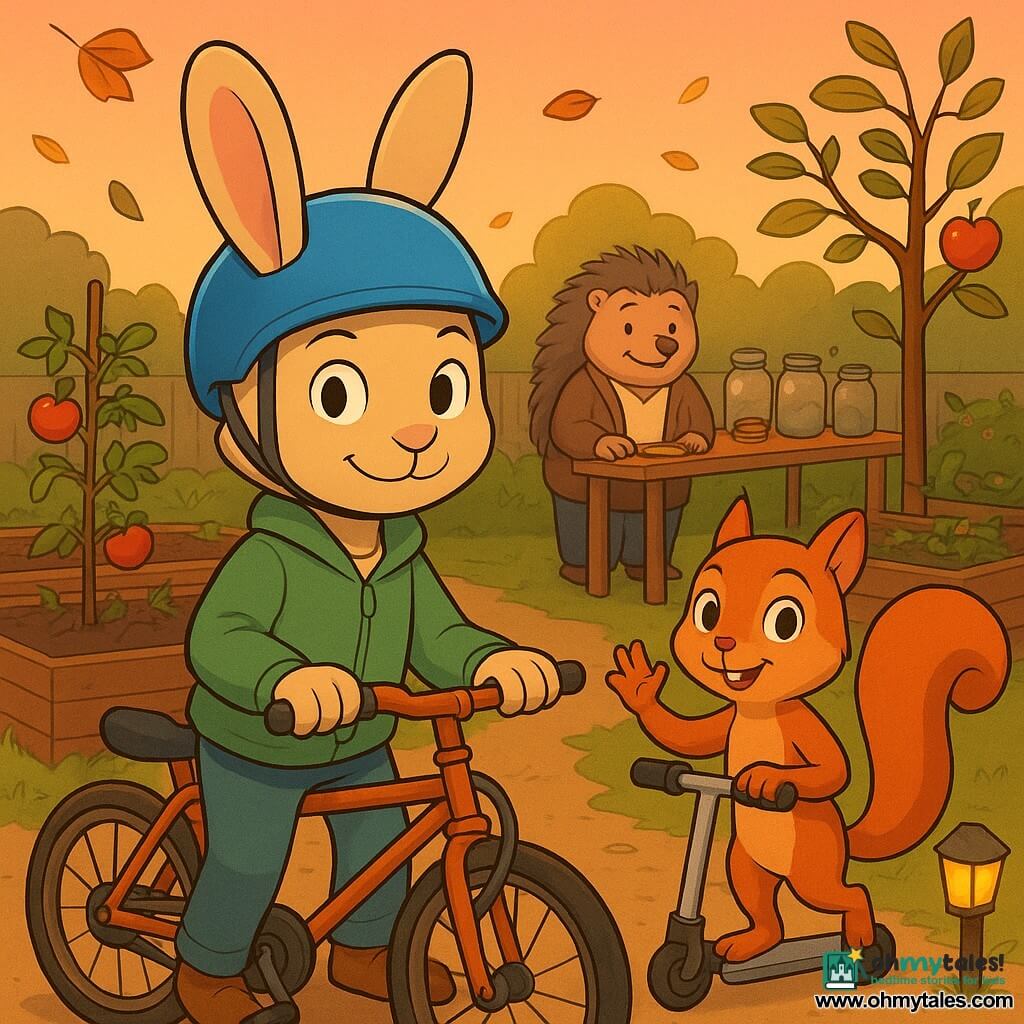
His friend Nora, a squirrel from two houses down, zoomed by on her scooter, waving.
Milo had two choices. He could ask his dad for a ride, like some kids did. Or he could walk or take his bicycle, which leaned against the fence like it was waiting for him.
Milo stared at the bicycle. Sometimes he worried he would wobble too much, or take too long, or look silly with his ears sticking out from his helmet.
Then he remembered their class talk from yesterday: cars are useful, but they burn fuel and make gases that warm the air. That warming can change rain patterns, make some summers hotter, and make it harder for some plants and animals to find what they need. It didn't mean cars were “bad.” It meant it was smart to use them when you really needed them—and choose other ways when you could.
Milo tightened the strap of his helmet. “I can do this,” he told himself, softly, like a secret.
He rolled the bicycle to the path and began pedaling. The wheels hummed over the smooth ground. Maple leaves flickered like little green flags. A breeze cooled his cheeks, and soon he wasn't thinking about wobbling anymore. He was thinking about how strong his legs felt.
At the corner, he stopped at the crosswalk like the rules said. He waited. He looked both ways. A bus rumbled past, carrying many kids at once. Milo nodded, pleased. That was a good choice too.
When the light changed, Milo crossed, steady and proud, and reached the school with a calm, happy hop in his chest.
Chapter 2: The Garden That Listens
The school garden sat behind the playground, bordered by low wooden beds filled with soil as dark as chocolate cake. There were tomato plants with fuzzy stems, bright marigolds, and a small apple tree supported by two stakes like gentle arms.
Mr. Pebble, the teacher, stood by a table with jars, charts, and a big pitcher of water. “Welcome, campers,” he said. “Tonight we'll learn to notice the world. Good observers make good helpers.”
Milo parked his bicycle in the rack and locked it, just like the sign requested. He liked signs. They were like friendly reminders.
The first activity was simple: touch the soil and describe it. Milo pressed his paw into the garden bed. The soil was crumbly, cool, and a little damp. He wrote in his notebook: “Feels like soft cake crumbs. Smells like rain.”
Next, Mr. Pebble showed two clear jars. One jar had a lid. The other didn't. Both had warm water inside.
“We'll leave them in the sun for a bit,” Mr. Pebble explained. “The jar with the lid traps more heat. That's a bit like what happens with certain gases in the air. They act like a blanket. A blanket can be nice on a cold night, but if it gets too thick, the world warms more than it should.”
Milo watched the jars, feeling thoughtful. The idea wasn't scary. It was more like learning how a kettle works so you don't let it boil over.
They also checked the rain barrel near the shed. “Collecting rainwater helps us use less treated water,” Mr. Pebble said. “Small choices add up.”
Milo liked that sentence. Small choices add up. It sounded like something you could hold in your paw.
Later, everyone helped with a garden job. Some pulled weeds. Some watered gently around the roots. Milo was assigned to the compost bin. It was a sturdy box with a lid, and inside it were vegetable peels and dry leaves, turning into rich soil.
Nora wrinkled her nose. “It smells like old salad.”
Milo chuckled. “It's salad becoming superhero dirt.”
Mr. Pebble laughed too. “That's a good way to say it.”
As Milo stirred the compost with a small shovel, he felt useful. He wasn't just learning facts. He was doing something real. And even though he was a rabbit with long ears and a helmet slightly too shiny, he belonged here.
Chapter 3: The Evening Walk and the Warm-Air Map
As the sun lowered, the sky turned the color of peach slices. The campout leaders guided the class on a short walk around the neighborhood to compare different spots: the tree-lined street, the parking lot by the grocery store, and the tiny park with a pond.
They carried a simple “warm-air map” made from cardboard. It had three sections: “Shady and Cool,” “Sunny and Warm,” and “Very Hot.”
Milo liked that the map wasn't complicated. It made sense right away.
On the tree-lined street, the air felt cooler. Milo could tell because his whiskers didn't feel dry, and the breeze was gentle. Birds hopped in the branches, and the sidewalk was spotted with shade like a quilt.
In the parking lot, the ground shimmered. The air felt warmer, even though it was the same time of day. The dark pavement held heat like a big stone left in the sun.
Mr. Pebble pointed to the ground. “Places with lots of trees and plants can feel cooler. They also help by taking in carbon dioxide, one of the gases that traps heat.”
Milo wrote: “Trees are like air helpers.”
At the park, they sat near the pond. The water reflected the sky, and a frog made a soft “plonk” sound as it slipped under.
Nora whispered, “Do you think the frog cares about climate change?”
Milo thought carefully. “Maybe the frog cares about having enough clean water and not too much heat.”
“That's a good answer,” Nora whispered back.
Mr. Pebble gathered them and spoke in a calm voice. “Climate change is real. It can make some storms stronger and some places drier. But we are not helpless. We can learn, notice, and choose. We can plant, save energy, waste less, and travel in cleaner ways when possible.”
Milo's ears lifted. Travel in cleaner ways. He had done that today.
As they walked back to the school garden, the first stars began to appear, shy and pale. Milo felt a quiet confidence growing, like a small light inside him. He didn't need to be perfect. He just needed to keep choosing, one day at a time.
Chapter 4: The Starry Campfire Circle
Night arrived gently. The school garden looked different in the dark—calmer, like it was holding its breath. Solar lanterns glowed along the path, making little pools of warm light.
The class formed a circle on blankets. In the middle, there wasn't a roaring campfire. The school didn't allow open flames, and Milo respected that. Instead, Mr. Pebble placed a lantern that flickered like firelight. It was safe, and it still felt cozy.
Above them, the sky opened like a deep blue book filled with bright letters. The stars were scattered in patterns Milo didn't fully understand, but he liked trying to connect them.
Mr. Pebble passed around a small telescope. When it was Milo's turn, he leaned in and saw the moon's surface—pale, bumpy, and quiet.
“It looks like an old cookie,” Milo whispered.
Nora giggled. “A moon cookie!”
Everyone took turns sharing one “green plan” they could do at home or school. The rules were simple: choose something small, something doable, and something kind.
A hedgehog student said, “I can turn off the light when I leave my room.”
A fox student said, “I can remind my family to bring reusable bags.”
Nora said, “I can help my grandma water her plants with the rain barrel.”
Then Milo felt his turn coming like a slow drumbeat. His paws tingled. He wanted to say something good. He wanted to be honest.
He cleared his throat. “I… I rode my bike here today instead of getting a car ride,” he said. “And I think I can do it more often. Not every time—sometimes it's raining hard or I'm carrying big things. But most days, I can choose walking or biking. And I can follow the road rules and be safe.”
Mr. Pebble nodded. “That is a strong plan. It helps the air. It helps your body. And it shows confidence.”
Confidence. Milo liked how the word felt. It didn't mean never feeling nervous. It meant doing the right thing even when you felt a little wobbly.
They sat quietly for a moment, listening to night sounds: a distant dog bark, leaves brushing together, the soft squeak of a swing moving in the wind.
Mr. Pebble spoke again, voice low and steady. “When you look at the stars, remember this: our planet is special. The air, the water, the soil—these are shared. Taking care of them is a team effort.”
Milo stared up at the sky. The stars didn't rush. They didn't shout. They simply shone, patient and bright. Milo felt his breathing slow, like the whole night was teaching him how to be calm.
Chapter 5: Home, Quiet Pride, and Green Dreams
The campout ended with careful clean-up. Everyone packed their blankets, checked the garden beds, and made sure no trash was left behind. Milo liked that part. It felt respectful, as if they were saying thank you to the garden.
Outside the school, the streetlights made soft circles on the pavement. Milo took his bicycle from the rack and clipped on a tiny white light, just like the safety rules required. He looked both ways before starting.
Nora walked beside him for a while, pushing her scooter.
“You were brave tonight,” she said.
Milo blinked. “I just… said what I'm going to do.”
“That's brave,” Nora replied. “Some people don't say it because they're scared they won't keep it.”
Milo considered that. He wasn't sure he would be perfect, but he could try. And trying counted.
When they reached the corner where their paths split, Nora waved. “See you tomorrow, bike rabbit.”
Milo smiled all the way home.
At his burrow, Dad was waiting on the porch with a warm towel for Milo's ears, because night air could be chilly. “How was it?”
Milo hung up his helmet neatly. “Good. We learned that the air can trap heat like a blanket. We learned trees help cool places down. And we made small plans.”
Dad poured Milo a cup of herbal tea with a spoonful of honey. “What's your plan?”
Milo sat a little taller. “Walk or bike more. Follow the rules. And maybe… plant something.”
Dad's eyes softened. “Tomorrow we can plant parsley in a pot. Parsley is tough and cheerful.”
Milo liked the sound of tough and cheerful. It sounded like the kind of rabbit he wanted to be.
Later, tucked under his blanket, Milo listened to the quiet of his home. He could still picture the stars. He could still smell the garden soil. His legs felt pleasantly tired, like they had done something important.
As his eyelids grew heavy, Milo imagined Maple Town with more trees along the sidewalks, more bikes in the racks, more rain barrels, more gardens humming with bees. He imagined himself pedaling steadily, ears in the wind, not rushing, not showing off—just doing his part.
Sleep came softly.
And in Milo's peaceful dreams, everything was green: green leaves clapping in the breeze, green sprouts pushing up bravely through soil, and a green, hopeful path stretching forward, one small choice at a time.