Chapter 1 – The Hot Autumn
Mia was nine years old, and she loved three things more than anything: drawing clouds, collecting smooth stones, and asking questions that made grown‑ups scratch their heads.
That autumn, the air in her small town felt different. It was hotter than usual. At school, the leaves on the big maple tree outside the window turned brown and fell off very fast, as if someone had pressed a “skip” button on the season.
“Isn't autumn supposed to be cool?” Mia asked her teacher, Mrs. Patel, as she fanned herself with her notebook.
“It usually is,” Mrs. Patel answered. “The climate is changing. The planet is getting warmer.”
Mia frowned. “Like global warming?”
“Yes,” said Mrs. Patel. “We call it climate change. It makes weather less predictable. Some places get more storms, some get less rain. It can be a problem for plants, animals, and people.”
Mia pressed her pencil into her page. She pictured the Earth wearing a winter coat it couldn't take off. It didn't seem fair.
On the walk home, she noticed the river beside the path was lower than last year. Muddy banks showed like bare knees under rolled‑up trousers. A duck waddled where water used to be.
Mia stopped and watched the ripples. “If the world is changing,” she murmured, “what can a kid do?”
Chapter 2 – The Trip to the Countryside
Two weeks later, Mia's class went on a trip to the countryside. The bus rolled past golden fields and clusters of dark green trees. The sky was a wide, calm blue.
“You will each be in a different group,” Mrs. Patel said, standing at the front of the bus. “You'll work with classmates you don't usually choose. Remember, everyone sees the world in their own way. Today we learn from each other.”
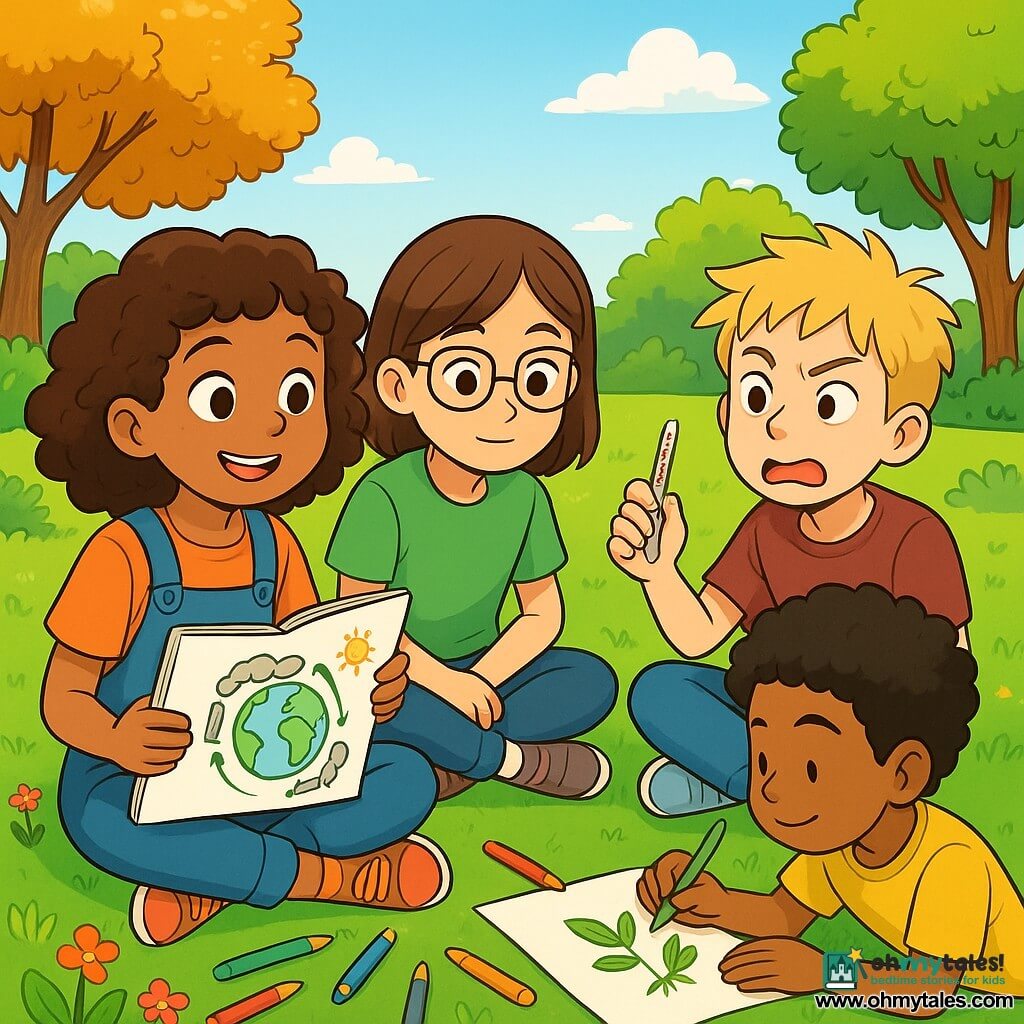
Mia checked the list. She was with Hana, who loved science, Luca, who was always joking, and Amir, who spoke quietly and drew amazing comics.
When they got off the bus at Sunnybrook Farm, the air smelled of grass and warm earth. Chickens scratched near a small wooden barn. A farmer named Mrs. Green met them with a friendly wave.
“Look around,” Mrs. Green said. “This farm has changed because the climate is changing. Your job is to observe and ask questions.”
Mia's group followed a narrow path to a field. Some plants looked strong and tall, but others were brown and droopy.
“Last year, we had too much rain,” Mrs. Green explained. “This year, it's been too dry. We have to keep adjusting.”
“Like changing a recipe over and over,” Hana said.
“Exactly,” Mrs. Green nodded.
Amir sketched the cracked soil. Luca poked a dry clump with his shoe. “It looks like the land is tired,” he said. “Like it just wants a nap and a big drink of water.”
Mia crouched, running her fingers over the dusty ground. She felt a small, steady worry in her chest. But the breeze was soft, the birds were singing, and in the distance, hills rose like gentle sleeping animals. The world was still beautiful, even if it was troubled.
Chapter 3 – The Mistake with the Thermometer
In the next field, Mrs. Green handed each group a simple thermometer. “You'll measure the temperature in the shade and in the sun,” she said. “Then we'll talk about what warmer days might mean for farms.”
Hana read the instructions. “We have to wait three minutes,” she said carefully.
“We should start in the sun,” Mia suggested.
Luca grabbed the thermometer. “I'll hold it. I'm practically a scientist,” he said, grinning.
“Careful,” Amir warned. “Don't cover it with your hand. Your fingers are warm.”
Luca waved his hand. “Relax, I got this.”
They waited. Mia counted slowly in her head. When they checked, the little red line was very high.
“Whoa,” Luca said. “It's super hot.”
Hana frowned. “That doesn't seem right.”
Mia raised her hand. “Mrs. Green? Our thermometer says it's almost fifty degrees.”
Mrs. Green walked over, her boots crunching on the dry grass. She examined the thermometer. “Hmm. Did anyone hold the bulb with their fingers?”
Luca's face went red. “Maybe. A little.”
Mrs. Green smiled gently. “Then you've warmed it up with your hand, not the air. That's a mistake, but it's a good one. Now you know what not to do next time.”
“I ruined the experiment,” Luca groaned. “I'm useless at this.”
Mia shook her head. “No. We just learned something. Mistakes are like… practice puzzles.”
Hana nodded. “We'll do it again. This time we all watch.”
They repeated the experiment, carefully keeping their hands away. The new reading was lower.
“That makes more sense,” Mrs. Green said. “Science is full of mistakes. We just have to be honest about them and try again.”
On the bus home, Luca slumped next to Mia. “I felt so dumb,” he said quietly.
“I mess up all the time,” Mia told him. “I once watered a plastic plant for a week before I realised. My mum laughed so hard she cried. But now I always check if plants are real.”
Luca snorted. “You watered plastic?”
“Yes,” Mia said, laughing. “We just keep learning. That's the important part.”
Chapter 4 – The Idea for a Letter
That evening, Mia sat at the kitchen table while her mum cooked pasta. The smell of garlic and tomatoes filled the room. Outside, the sun slipped behind the houses, painting the clouds orange and pink.
Mia spread her notebook and drew the fields: the strong plants, the droopy ones, the cracked soil. She added a little duck standing on dry river mud.
“Thinking hard?” her mum asked.
“At the farm, Mrs. Green said she had to change how she grows food because of climate change,” Mia said. “At school, the playground is hotter. The river is lower. I want to do something, but I can't fix the whole world.”
“You don't have to fix the whole world,” her mum replied. “But you can help in your town. Maybe you could talk to someone who makes decisions.”
Mia tapped her pencil. “Like the mayor?”
“That's one idea,” her mum said. “You could write a letter.”
Mia hesitated. “What if I say something wrong? What if my ideas are silly?”
Her mum turned down the stove and sat beside her. “Everyone makes mistakes. Grown‑ups too. What matters is trying your best and being willing to learn. You already care. That's powerful.”
Mia looked at her drawing again. She thought of Luca's thermometer mistake. They hadn't given up; they had just tried again.
“I'll write,” she said. “Even if it's not perfect.”
She opened a clean page and carefully wrote at the top:
“Dear Mayor Lewis,”
Chapter 5 – The Letter to the Mayor
The next day at school, Mia brought her half‑finished letter. She asked her group to meet under the maple tree at break time.
Hana read aloud: “Dear Mayor Lewis, my name is Mia, and I am nine years old. I am writing because I love our town and I am worried about climate change…”
“That's good,” Hana said. “Very clear.”
Mia chewed her lip. “I want to add ideas, not just worries. But I don't know if they're good ones.”
“Let's think together,” Amir said. He pulled out his pencil. “Brainstorm time.”
They sat in a small circle on the grass. The air still felt warmer than usual, but in the shade, it was pleasant.
“We could ask for more trees,” Hana suggested. “Trees give shade and help cool the air.”
“Shade for the playground!” Luca added. “My back gets roasted on the swings.”
Amir grinned. “And bike lanes, so more people can ride bikes instead of driving cars. Less pollution.”
“And maybe solar panels on the school,” Mia said slowly. “So some of our electricity comes from the sun.”
Luca scribbled a list. “We're geniuses,” he announced.
“We might be wrong about some things,” Mia said. “I don't know how much solar panels cost.”
“That's okay,” Hana replied. “We can say, ‘Maybe you could think about these ideas.' We're not the boss. We're helpers.”
Back in class, Mia wrote neatly, with her friends' ideas beside her. She added a sentence:
“We know we might make mistakes because we are still learning, but we want to try.”
She felt a little flutter in her stomach as she signed her name. Then she drew a small picture at the bottom: their town with more trees, bikes, and a bluer, fuller river.
Mrs. Patel read the letter and smiled. “Would you like to add your friends' names too?” she asked.
“Yes,” Mia said. “We did it together.”
Each of them signed: Mia, Hana, Luca, Amir.
Mrs. Patel put the letter into an envelope. “I'll help you send it to Mayor Lewis,” she said. “This is exactly how change begins—small, thoughtful steps.”
Chapter 6 – A Quiet Hope
A week later, an official‑looking envelope arrived at school. Mrs. Patel called Mia's group to the front of the class.
“It's from Mayor Lewis,” she said.
Mia's heart beat faster as Mrs. Patel unfolded the paper and read:
“Dear Mia, Hana, Luca, and Amir,
Thank you for your thoughtful letter. I am glad you love our town as much as I do. You are right to care about climate change. We are already working on some of the ideas you mentioned, like planting more trees and improving bike lanes. Your letter shows that children are paying attention, and that helps us make better decisions.
Please keep observing, learning, and sharing your ideas. Even when we make mistakes, we can adjust and try again.
With thanks,
Mayor Lewis”
The class clapped. Luca whispered, “He didn't say my ideas were silly.”
“Of course not,” Mia whispered back. “We're all just learning.”
That evening, Mia walked by the river again. The water still ran low, but a soft rain had fallen during the day, leaving tiny silver drops on the grass. The sky was a gentle purple now, with one bright star already awake.
She thought of the quiet countryside fields, of chickens scratching the earth, of trees standing patient by the road. She thought of the farmers, the ducks, the people in her town, and children in other places she would probably never meet, all living under the same wide sky.
The Earth, she realised, was not only in books or on screens. It was the cool shade of the maple at school, the tickle of grass on her ankles, the slightly sticky feel of warm air on her skin. It was her home, and also everyone else's.
Mia took a deep breath. The air smelled of wet soil and fallen leaves. She felt a steady, quiet hope.
The planet was changing, and that was serious. But she was not alone. She had her friends, her teachers, her family, and even the mayor, all trying, all sometimes making mistakes, all learning together.
She watched the river shimmer in the fading light and whispered, “You're beautiful. We'll do our best for you.”
Then she turned for home, her steps light and calm, already wondering what small, careful thing she could do next to help her one, wonderful Earth.