Part 1: Mia and the New Kid
Mia was five years old, and she liked calm things. She liked lining up her crayons by color. She liked toast cut into squares. She liked when people took turns and used kind words.
After dinner, the sky outside her window turned soft purple. Mia sat on the carpet with her stuffed rabbit, Button, and listened to the quiet sounds of her home: the sink running, a spoon clinking, her dad humming.
“Mia,” Mom said, coming in with clean pajamas. “Tomorrow a new child is joining your class.”
Mia's eyes got wide. “A new friend?”
“Yes,” Mom said. “His name is Sami. He moved here with his family.”
Mia hugged Button. New things could feel wiggly inside her tummy. But Mia also liked learning. She liked seeing how other people did things.
“What does he like?” Mia asked.
Mom smiled. “We don't know yet. That's the fun part. You can ask him.”
Mia nodded, very slowly. “I can ask.”
The next morning, Mia put on her yellow shirt with tiny stars. At school, her teacher, Ms. Green, stood by the door. “Good morning, Mia.”
“Good morning,” Mia said, using her best clear voice.
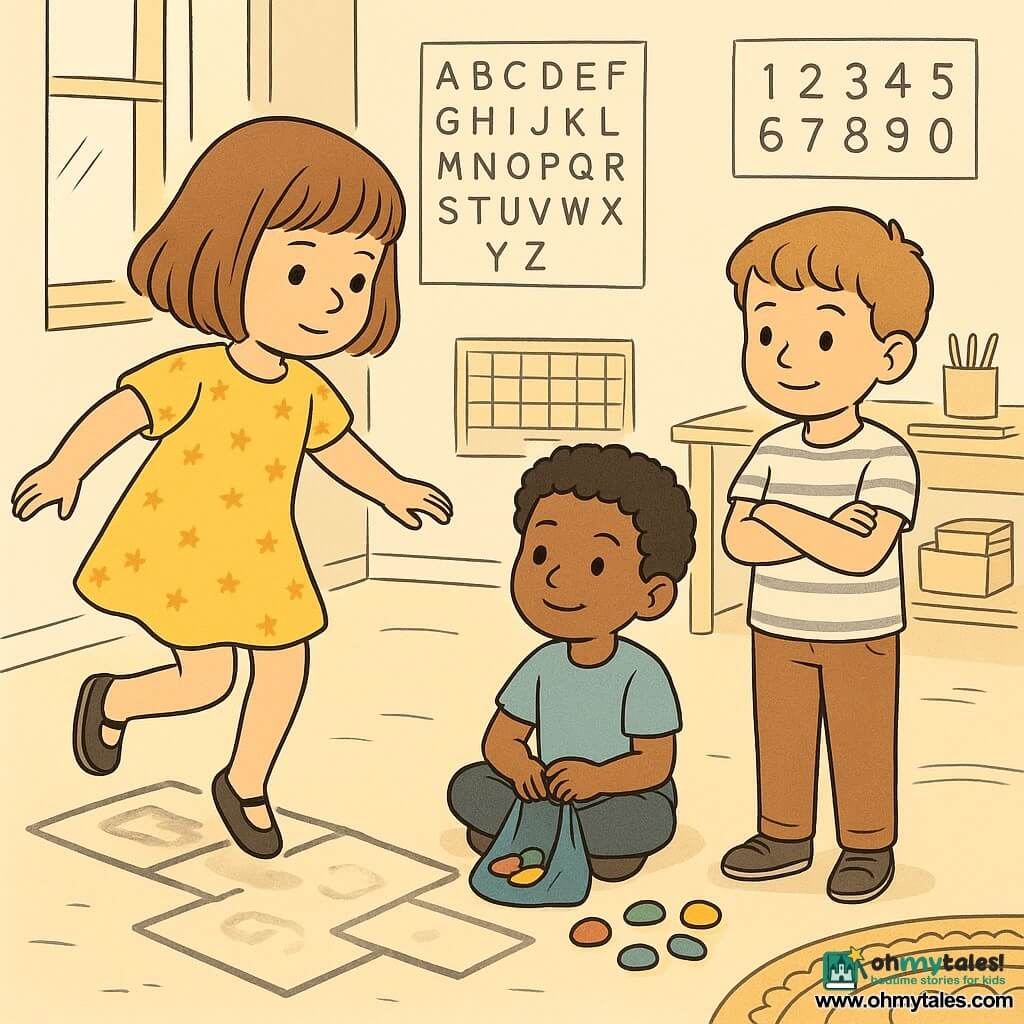
Inside, the classroom smelled like paper and pencils. There were posters of numbers and letters, and a big calendar with bright squares. On the rug, the kids sat in a circle.
Ms. Green held up her hand. “Class, we have a new friend today. This is Sami.”
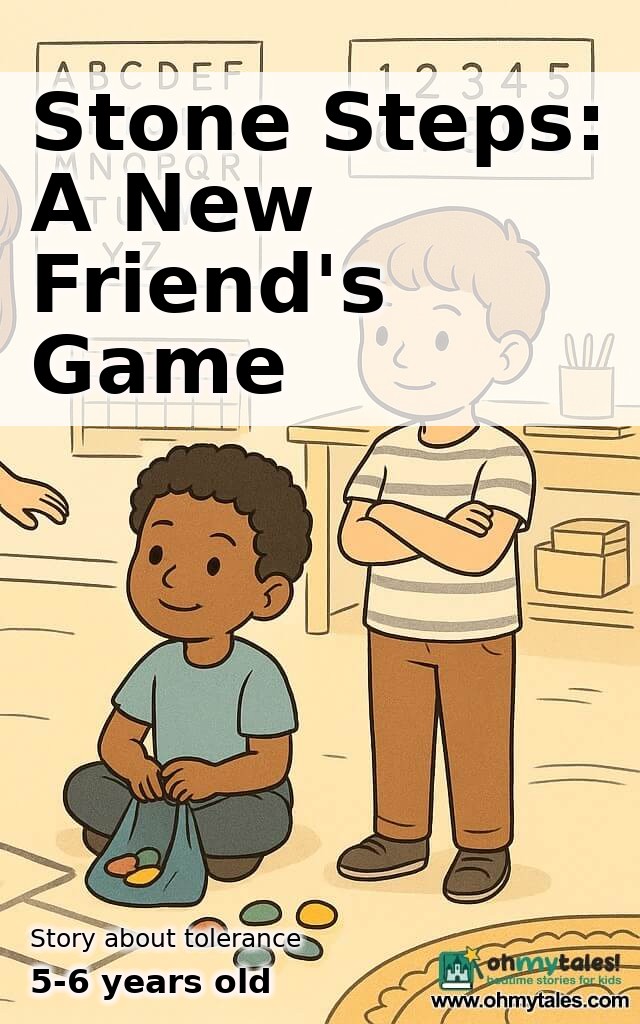
A boy stepped in. He had dark curly hair and a shy smile. He held a small blue bag close to his chest.
“Hello,” Sami said. His voice was soft, like a whisper in a library.
“Hello, Sami,” the class said back.
Mia watched him sit down. He sat very straight, knees tucked in, like he wanted to take up as little space as possible.
At play time, Mia walked over to him. Her feet felt a little heavy, but her face stayed friendly.
“Hi,” Mia said. “I'm Mia.”
Sami looked at her. “Hi. I'm Sami.”
“Do you want to play blocks?” Mia asked. “Or cars? Or… drawing?”
Sami's eyes flicked to his blue bag. “I have a game,” he said. “From my old home.”
Mia leaned in. “A game?”
Sami nodded. He opened the bag and took out a small cloth pouch. Inside were smooth little stones, painted in bright colors: red, green, yellow, and blue. There was also a small piece of chalk.
Mia's mouth made a small “o.” “Pretty stones.”
“They are for a game,” Sami said. He looked down. “It is called ‘Stone Steps.'”
Mia liked the name. It sounded like a path in a garden.
“Can you show me?” she asked.
Sami's shoulders loosened a tiny bit. “Yes,” he said.
Part 2: Stone Steps and a Small Problem
Sami took the chalk and drew squares on the floor near the window, where the light was warm. He drew them in a line, like stepping stones across a stream.
“This is the path,” Sami explained. “You throw a stone and hop.”
Mia watched closely. She liked rules. Rules made games feel safe.
Sami held a red stone and tossed it into the first square. Then he hopped on one foot, light and careful, skipping the square with the red stone. He turned at the end and hopped back.
Mia clapped once. “That is like hopscotch!”
Sami's eyes brightened. “Yes! Like hopscotch. But we use stones we paint at home.”
Mia thought about her own games. She knew “Duck, Duck, Goose.” She knew “Simon Says.” She knew “Hide-and-Seek.” She had never played with painted stones before.
“Can I try?” Mia asked.
Sami handed her a green stone. It felt cool and smooth in her palm.
Mia tossed it. It landed in the second square, a little crooked, but still inside. She smiled. “I did it!”
She hopped, tongue poking out in focus. One hop, two hops—then her shoe slipped a bit on the floor. Mia wobbled, windmilled her arms, and landed with both feet.
“Oh,” she said, cheeks turning warm. “I messed up.”
Sami looked worried for a second, like he thought she might be mad. But Mia took a slow breath, the way Mom showed her.
“That's okay,” Mia said gently. “I can try again.”
Sami's face relaxed. “Yes,” he said. “Try again.”
Mia tried again. This time she went slower. Her foot landed in the squares like soft taps.
Then a loud voice came from behind them.
“What are you doing?” asked Leo, a boy from Mia's class. He frowned at the chalk squares. “That's not the right game.”
Mia's tummy did a small flip. Leo sometimes decided things quickly.
“It is a game,” Sami said quietly. He hugged the pouch of stones.
Leo pointed. “We play hopscotch on the playground. Not in the class. And we don't use rocks.”
Mia looked at the stones. They didn't feel like rocks. They felt like little treasures. But she also knew classroom rules mattered.
Mia glanced at Ms. Green, who was helping someone with a puzzle. Ms. Green had not seen them yet.
Mia wanted everyone to be okay. She wanted Sami to feel welcome. She wanted Leo to feel heard. Her thoughts went round and round like a small merry-go-round.
Then Mia said, “Leo, it is kind of like hopscotch. Sami is teaching it.”
Leo crossed his arms. “I don't want to.”
Sami's eyes went down to the floor. The warm light by the window suddenly felt smaller.
Mia's heart squeezed. She remembered what it felt like when someone didn't want to play with her.
Mia thought of something. Something simple.
“Leo,” she said, “you don't have to play. But you can watch. If you want.”
Leo blinked. Watching was easier than joining.
“And we can ask Ms. Green,” Mia added. “So we follow the rules.”
Mia raised her hand. Ms. Green looked over. “Yes, Mia?”
Mia stood up straight. “Sami has a game from his old home. It uses painted stones and chalk squares. Is it okay if we play it in this spot? We can clean the chalk after.”
Ms. Green walked over. She looked at the stones and the squares. “These stones are beautiful,” she said. “Thank you for sharing, Sami.”
Sami's lips lifted in a small smile.
Ms. Green nodded. “We can play here as long as we are careful and keep the stones on the floor. No throwing them high. And yes, we will clean the chalk when we are done.”
Mia felt relief spread through her chest like warm cocoa.
Leo shifted his feet. “Can I… watch first?” he asked, quieter now.
Mia smiled. “Yes.”
Sami took a breath. “You can watch,” he said. “And if you want, you can try one hop.”
Leo nodded.
They played. Mia hopped. Sami hopped. Leo watched, then tried a small hop, then another. When Leo's stone landed outside a square, he made a face.
Mia said, “It's okay. I fell first too.”
Leo looked at her, surprised. Then he tried again, slower. His stone landed inside.
“I did it,” Leo said, and his voice sounded proud.
Sami grinned, and for the first time, he laughed—a small, happy sound.
Later, Ms. Green handed them a damp cloth. “Teamwork time,” she said.
Mia, Sami, and Leo wiped the chalk away together. The squares faded, but the game stayed in their heads.
Part 3: A Bag Ready for Tomorrow
That evening, Mia told her parents about Sami and the painted stones while she ate peas one by one.
“He has a game from his old home,” Mia said. “It's like hopscotch, but with pretty stones. Leo didn't like it at first, but then he watched and tried.”
Dad nodded. “That sounds brave. For Sami, and for you.”
Mia tilted her head. “Me?”
“Yes,” Dad said. “You helped everyone feel safe. You asked the teacher. You gave Leo a way to join without pushing him.”
Mia thought about it. She had not shouted. She had not grabbed the stones. She had just tried to make space for everybody.
After bath time, Mia put on her pajamas with little clouds. Mom sat with her on the bed and opened a storybook, but Mia's eyes kept drifting to her school shelf.
“Mom,” Mia said, “can I pack my bag for tomorrow now?”
Mom smiled. “Of course.”
Mia slid off the bed and pulled her small backpack closer. It was pink, with a zipper that made a zzzip sound. She liked that sound. It sounded like getting ready.
She put in her lunch box. Then her water bottle. Then her spare socks, folded neat.
She paused and held Button in her arms. “Button doesn't go to school,” she told him softly. “But you can help me think.”
Mia looked at her crayons on the table. She remembered Sami's stones, their bright colors. She remembered how happy he looked when someone wanted to learn his game.
Mia chose four crayons: red, green, yellow, and blue. She put them in a small pouch and tucked it into her backpack.
Then she added a piece of paper and a pencil.
Mom watched. “What are those for?”
Mia's voice was sleepy but sure. “Tomorrow I want to draw a ‘Stone Steps' path on paper. So Sami can show me more rules. And maybe we can make our own paper stones, so everyone can have one.”
Mom's eyes softened. “That is a lovely idea.”
Mia climbed back into bed. Mom turned off the big light and left a small night lamp glowing like a gentle moon.
Mia pulled the blanket up to her chin. “Mom?”
“Yes, sweetheart?”
Mia thought of Sami holding his blue bag tight. She thought of Leo's frown turning into a smile. She thought of how it felt when different things did not bump into each other, but fit together like puzzle pieces.
“It's okay when games are different,” Mia said. “They can still be fun.”
Mom brushed a curl from Mia's forehead. “Yes. Different can be interesting. Different can be kind.”
Mia yawned. “And you can watch first,” she added, remembering her own words.
Mom chuckled softly. “That's a very smart way to start.”
Mia's eyes grew heavy. She pictured tomorrow: the classroom, the warm window light, the chalk squares, and friends taking turns. She pictured asking Sami, “Can you teach me?” and saying to Leo, “Want to try?”
On the chair by the door, her backpack sat ready for morning—quiet, packed, and waiting.
Mia snuggled Button close. The room felt safe and calm.
“Goodnight,” Mia whispered.
And in her mind, the path of Stone Steps stretched forward, bright and welcoming, with space for everyone to hop along.