Chapter One: Morning on the Bridges
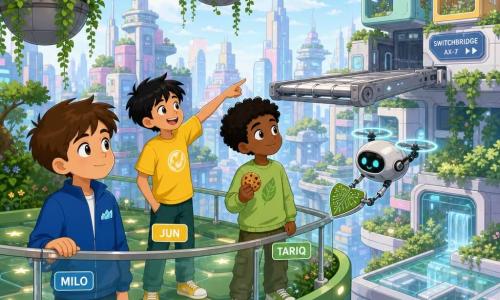
Dawn arrived in Skybridge City like a soft song. The sky was the colour of brushed steel, and the bridges that stitched the city together gleamed with tiny lights. Skybridge City hung in layers—glass walkways, green terraces, and curved towers that hummed with gentle machines. People moved in quiet pods and slow bicycles. Somewhere a delivery drone floated by, carrying a box of warm bread. The city felt alive and kind.
Leo lived on the fifth bridge from the top. He was almost eight, with a freckle on his left eyebrow and an eager way of looking at the world, as if it were a puzzle waiting to be solved. Ari lived two bridges down, and he was almost eight too, with hair that always stuck up where he'd just fallen asleep. They were best friends and loved the small, useful jobs their neighbourhood needed.
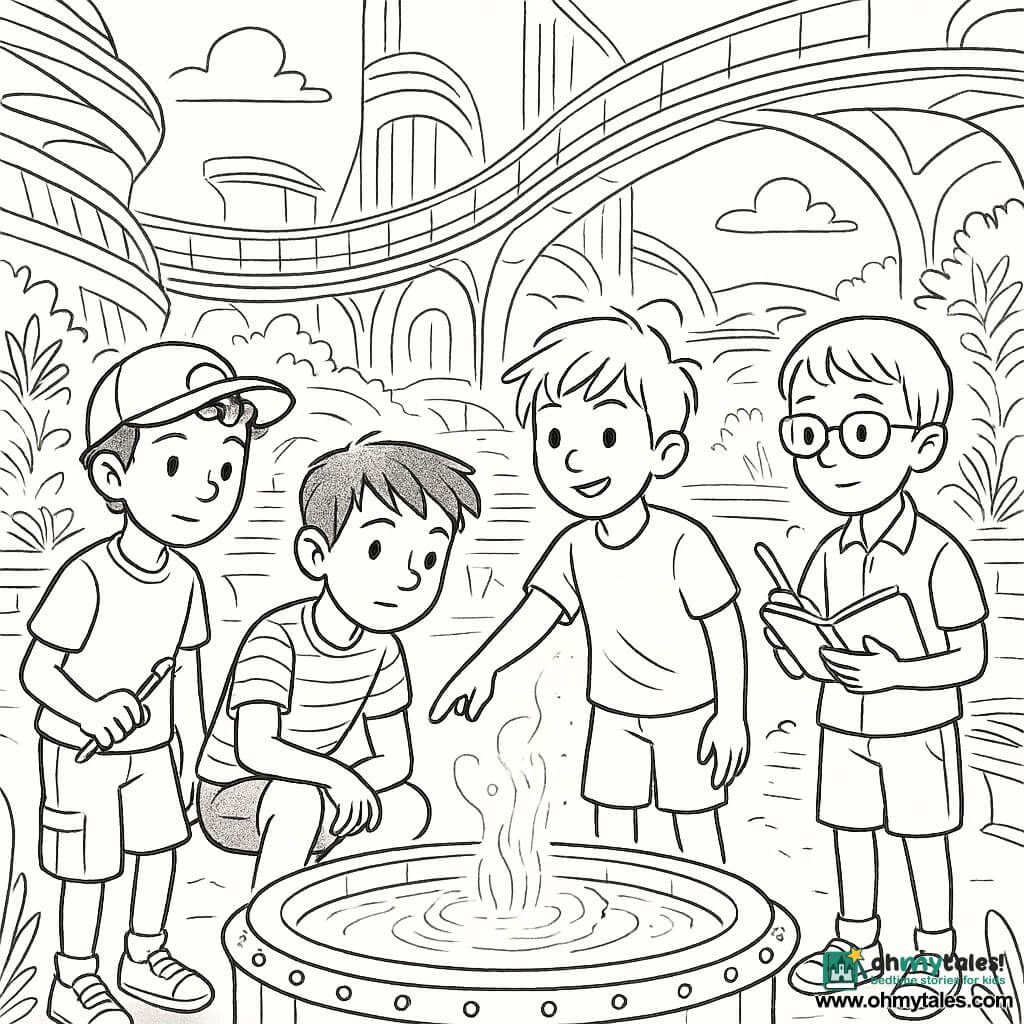
One bright morning, the two boys met by the fountain that steamed soft mist into the air. It was the round fountain that marked the centre of their bridge—a place where gardeners left watering cans and grandmothers fed quiet pigeons. Today the fountain bubbled in a different tone; it sputtered and sang a shaky tune. "It sounds tired," Leo said, pressing his ear to the cool stone.
Ari poked a finger into the mist. "Like it's got a cold," he said, smiling. "We should check it."
The fountain machine was not very big, but it had lovely, brass valves and a small screen that blinked with a friendly face. Its name was Fizzle, which sometimes flashed on its display. Fizzle's face showed an anxious squiggle. "Low water pressure," it whispered in a tiny voice. "Pump feels sleepy."
"That's easy," said Leo, full of the kind of hope that made other kids believe in magic. "We help Fizzle wake up."
Ari grinned. "And if it needs a bandage, I brought stickers."
They ran to find their friends. Milo lived above the rooftop gardens and carried a satchel of tools—little screws, a bright orange screwdriver, and a magnifying lens. Ben loved maps and rules; he had a tiny tablet with notes, and he always asked one careful question before acting. The four boys crowded around the fountain, each feeling important in their own small way.
"What's the plan?" Ben asked.
"Check the pump, then the pipes," Milo said. He opened his satchel with a flourish. "And if it's hungry, feed it." He wiggled a wrench like a sword.
Leo laughed. "Pumps don't eat—unless you count electricity."
"Then we feed it electricity," Ari said, pretending to balance a tray.
They worked like a team. Ben held open Fizzle's tiny service hatch. Milo slipped inside a hose and tightened a loose clamp. Leo cleaned a grate from the fountain that had caught a cloth. Ari found a small sticky crystal—the city's version of a patch—left by a gardener to mend torn irrigation lines.
"Look!" Ben said as his tablet chimed. The screen showed a little map of the fountain pipes. A red dot blinked where the pressure dropped. "Here—near the fountains under the rose pergola."
They followed the map under the bridge to a narrow tunnel where soft light glowed from safety strips. The tunnel smelled like rain and soil, because run-off from the terraces ran through it. There, half-hidden by a mossy bell, they found a tiny valve clogged with leaves. The valve had a lock that clicked when it moved. Someone had hooked it with an old toy ring—a child's harmless prank that had made the valve slip just enough to slow the flow.
Milo worked with nimble fingers and a patient hum. "Ready?" he asked.
Ben shrugged. "We always are."
Milo eased the ring off. The valve met the flow, and the pipes sighed happily. The pressure pulse came back through the system like a deep breath. Fizzle above sang a clearer tune and lifted its little face.
"Thank you," it chirped. "Maintenance rewarded: water."
The fountain poured again, silver and joyful, and a spray dotted the boys with a fine mist. They laughed. An older neighbour, Mrs. Kori, who kept the hanging gardens, came by with a tray of honey biscuits to thank them. "Small fixes," she said, smiling. "They're what keep us moving. Thank you, children."
The boys felt proud, not because of a prize, but because their careful hands had helped something live happily again.
Chapter Two: The Quiet Room
Later that day the boys wandered to the Skybridge Library, a gentle glass building that floated a few metres above the plaza. Inside, the air smelled like paper and soft lights. Robots with polite voices shelved books by colour and by emotion—"Curiosity" shelves smelled faintly of lemon. The library had a quiet room where people came to focus. Lila, the librarian, met them at the door with a worried smile.
"Can you help?" she asked softly. "My whisper-bots aren't whispering. They are out of tune and the quiet room is noisy."
The whisper-bots were small feather-light drones that floated around the quiet room and made a calming hum. Today they buzzed like bees, too loud and a little frantic. People who needed to read or study used them to keep the sound soft and the room focused.
Ari put a hand to his ear. "They sound like they drank too much fizzy juice," he said.
Lila chuckled. "Look, here's a maintenance code," she said, handing them a small paper card. "If the bots spin in circles, they need realignment. It is a simple fix, but we must be gentle."
Ben read the card aloud. "Adjust the gyros—align the calm nodes—sing to the bots if they are anxious." He looked up at the adults nearby. "That's the important part, I think."
"Sing?" Milo blinked.
Leo brightened. "I can sing! Sort of."
They went into the quiet room in a line, making sure to whisper invitations. The whisper-bots greeted them with a fluttering of lights that went too bright. One bot zipped towards the window and hovered, flaring like a comet of candlelight. It only took a little ray of sunlight to make it jitter. If machines could be nervous, these were.
Leo remembered how he calmed his little sister when a storm scared her—by humming the same tune each night. "Let's hum," he said. "A steady hum."
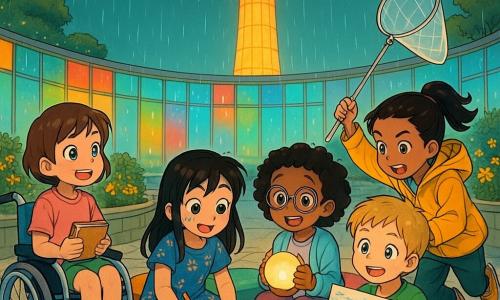
They formed a circle. First Milo tapped the rhythm with three soft knocks—one, two, three. Ben counted discreetly. Ari added a small whistle. Leo hummed. The notes were simple, no words, just long, rounded sounds. The whisper-bots blinked. The humming made their lights steady. Milo, who loved machines, hummed in a way that matched the bots' internal pulse. Ben kept the slow beat. Ari added little harmonies like birds. Together the boys made a calm, steady sound that was like wrapping a blanket around the room.
The bots slowed. Their frantic whirr turned into a gentle breeze. They resumed their orbit, softly arranging the reading lamps to the right brightness. Lila wiped her eyes and smiled at the boys with relief. "You found the human tune," she said. "Thank you. Not everything can be fixed with a wrench."
"Sometimes it's just a song," Leo said.
They sat for a while on the cushions and read picture-books with pages that shuffled with tiny fans, telling stories of skywhales and seed-lights. The boys felt the pride of doing small things well—the kind of pride that made them tuck their chests just a little straighter.
Chapter Three: The Fountain's Secret
Evening settled into Skybridge City like a warm blanket. Lights winked on along the bridges, and the towers held their glow like lanterns. The boys met again by Fizzle, where a small crowd had gathered. A faint blue sheen spread across the fountain pool, and in that light, the water's surface looked like a map.
"We've fixed the pump and the bots," Ben said. "What's wrong now?"
The fountain's screen showed a tiny picture: a droplet with a key. "I found something," Fizzle whispered. "A song-key. It unlocks old stories under the bridge. It hummed with curiosity, then sank."
Curiosity was a kind of light in Skybridge City. Long ago, people had stored neighbourhood memories in small music-keys, folded little notes that played a tune and told a story. Most had been given back to families, but sometimes one slipped away. Fizzle had found a key that pulsed faintly beneath the surface. The screen blinked: "Key needs warmth."
Leo felt a thrill. "An underwater key? This sounds like a story."
Milo frowned. "But it's small and heavy. How do we dive? We don't have adult suits."
Ari pointed to a nearby tree whose roots drew up mist with clever filters. "There are surface breathers—plants that make bubbles," he said. "They give tiny breath-holds. We can use them, careful and together."
Lila offered a ribbon of safety—an anchor-line used for library deliveries. The boys tied it around their waists and practiced a few safety gestures. Ben checked the tablet and marked the plan. Milo fastened a tiny lamp to his cap. They promised they'd go no deeper than a few breaths and that they'd return if anyone felt uneasy.
"Be brave," Leo said, and his voice wasn't loud, just steady. "But be safe."
They leaned over the fountain. Inside, the key showed as a silver fish with a note in its fins. Leo slipped a hand into the cool water. It felt like pressing the skin of the sky. He reached down and felt a small, smooth object. It was light but warm, as if it had been sitting on someone's palm.
"Got it!" he said.
When Leo brought the key out, it chimed like a bird. The sound spilled across the plaza and made people pause. The key's tune was small and hopeful. Fizzle's screen brightened. The key glowed and unfolded a paper-thin map. The map showed the underside of Skybridge City and a little house—the house of an old man named Tomas, who used to tell stories about the first bridges. The map's tune matched a lullaby Tomas used to hum.
"Maybe it belongs to Tomas," Lila said softly. "He is lonely sometimes. He misses telling stories."
"Let's return it," Ari said without hesitation. The boys loved the idea as if it were a secret treasure mission.
They walked through the city's terraces, past gardens that glowed with soft bioluminescent plants, and over a skywalk that hummed like a giant tuning fork. Skybridge at night looked like a circuit board that had learned to grow flowers. They knocked at Tomas's door—a round door with a porthole.
Tomas opened the door and rubbed his hands in surprise. He was not so old as the boys had imagined, but he had cheeks like maps of past smiles. When he saw the music-key, his eyes filled with light. He took it carefully between his fingers.
"My song key!" he whispered. He put it to his chest and then to his small wooden box of stories. He pressed it into the box's groove, and the box sang.
Out poured a small hologram of a young Tomas, teaching a little boy how to fix a kite. "When you mend a kite," the little Tomas said, "you mend a sky." The boys leaned in. The room smelled of spice and old paper. Tomas sat down and let the music play. "This key carried a story of fixing things," he chuckled. "I used to share it at the markets. Thank you."
He invited them in. They sat on cushions while Tomas told them stories: of bridges that bent to two friends who walked across them at the same time, of gardens that learned neighbours' names, of a fountain that once decided it preferred to sing in a new key. His voice was gentle, and the boys listened like seeds.
"When I lost the key, I thought I might lose the stories too," Tomas said. He looked at each of them with calm eyes. "But you returned it. That's the best kind of fix."
They stayed until the lamps in Tomas's house dimmed. On the way back, Leo felt the warmest sort of pride—small and steady. The city felt like a big machine made of people, each part cared for by hands that wanted things to be better.
Chapter Four: Small Fixes, Big Smiles
Days passed and Skybridge City kept waking with gentle routines. The boys returned to small rounds of help. They picked up scattered seeds in the terrace gardens and replanted them in neat rows. They helped an elderly neighbour find a lost glove that had fallen into a vent. Each small act was like threading a seam; it kept the city's fabric strong.
People began to nod at them when they passed. Children hummed the quiet room tune in the playground. Mrs. Kori began leaving a tiny jar of honey biscuits by the fountain every other morning. The boys discovered that fixes didn't have to be grand to matter. They learned to listen to machines, to read a map, to sing a calm tune, to reach for what was sinking.
One afternoon, the children spotted a notice on the community board: "Skybridge Repair Day—Local Help Needed." It invited neighbours to gather and share tools and recipes and stories. The boys decided to make a little booth called Small Fixes. They made stickers with a pump, a song, and a key. Their booth was small but bright, lit by fairy-lamps and decorated with moss.
At first, only a few neighbours visited. Then more came—an old woman with a frayed hat who asked for someone to tighten her hat ribbon, a teacher who needed a map redrawn for her class, a toddler who brought a toy that wouldn't sleep. The boys listened, offered a quick solution, and sometimes simply sat with someone to hear their story. Each person left with a small repair or a warm smile.
At sunset, Tomas came by with his wooden box of stories and sat at the boys' booth. He told a new tale about a bridge that taught a city to sing. The crowd leaned in, and even the whisper-bots hovered to listen. The boys felt the joy that comes when people gather and help one another.
"Fixing things is like telling stories," Tomas said later as they packed up. "You start with a small stitch, and suddenly you've sewn a pattern."
Ben looked thoughtful. "So little things add up."
"Exactly," Tomas said, tapping the edge of his box. "And you're doing it with kindness."
Ari grinned. "And stickers."
They laughed. The sky turned a deep violet, and the bridges glowed with soft trails of light. The city looked calmer than ever. Above them, a gentle transport cloud carried a family home. Leo looked at his friends and then at the city that had taught them to listen and help.
"Do you think when we grow up we'll still do small fixes?" Milo asked.
"We always can," Leo said. "Big or small, fixing makes the world better. It just needs hands and a little courage."
Ben added, "And checks. And stickers."
They planned not for huge inventions but for steady care. They decided to meet each morning by the fountain to look for things that needed tidying or a tune. Skybridge City had taught them that every problem had a small starting step: a wrench, a song, a kind hand. They knew now that when people worked together, the city hummed happier.
That night, the boys walked home underneath the bridges, their shadows long and close like friends. The city's lights shimmered on their faces, and the fountain sang a new, clear tune. Leo and Ari skipped ahead, and Milo and Ben followed, talking about tomorrow's small repairs and tomorrow's honey biscuits.
Skybridge City slept in layers of soft light, confident and kind. The boys had learned something important—how little fixes could make big smiles. And as they went to bed that night, each boy carried a quieter, braver feeling in his chest: ready for the next small thing that needed doing.