Chapter 1 — The City of Gentle Fog
The little wolf woke to the soft hiss of the city waking up. He lived in a small apartment that looked out over a street of glass trees whose leaves turned light into tiny, warm maps. Beyond the trees, the city rose in smooth shapes—domes and towers that caught the light like shells. The fog lay like a thin blanket over everything, silver and slow. It did not fear anyone. Here, fog was a friend. It kept the streets cool and the gardens happy.
This was a city that learned. Sensors embroidered into the sidewalks listened to steps. Lamp-posts blinked when children laughed too loudly. On the domes that covered parts of the city, tiny cogs and soft screens hummed and rearranged the sky—making rain where gardens needed drink, warm sun where babies slept, and shade where elders read in the park. People called it the City of Gentle Fog because it always chose weather that helped everyone.
The little wolf loved mornings best. He padded to his window and watched the domes tilt a little as the city decided, "Today, let's make a patch of blue with sun for the schoolyard." The dome answered with a ripple, and sunlight fell in a neat square where children piled like bright stones. He smiled, teeth small and neat. His name was Milo, and he was eight moons old.
"Are you coming, Milo?" called his neighbor, Tessa the tabby, from below. She had a bike that sang when she pedaled.
"Almost!" Milo called back. He packed his snack—two nutty biscuits and a piece of sun-dried apple—tucked it into his little satchel, and bounced down on soft paw-steps. Today, he would meet his friend Arun at the Learning Dome, where small animals practiced ideas and the dome adjusted the light to help them think.
The streets smelled of roasted rootbread and clean rain. The fog hugged the ground in gentle waves. Above, a sign moved—an air-slate that told today's learning theme: "Inventing with Friends." Milo liked inventing with friends. It meant sticky glue and big laughter.
As he walked, the walkway hummed and changed colour according to his steps. The pavement knew which shoes were good for skipping. "Good morning, Milo," it whispered in a voice like small bells. Milo giggled. He touched the rail beside him. The rail hummed back, "Good morning. Remember to share your idea."
Milo tucked that advice into his pocket. He liked sharing. It made his ideas bigger and softer.
Chapter 2 — A Roll on the Wind
On the way to the Learning Dome, Milo noticed something new. A glossy shape skated through the fog with the grace of a fish and the confidence of a cloud. Wheels glowed faint blue and left short streaks of light like comets. The skater wore a suit that hugged close and a helmet with a friendly face-display. She—or he—moved without feet touching the ground. Milo stopped, stunned.
Arun arrived and bumped his elbow. "Wow," Arun whispered. "That's a gravity roller patroller."
Milo's eyes were wide. "Patroller? Like the safety robots?"
"Sort of," Arun said. "They watch, they help, and they keep paths clear. But they glide. Look!"
The patroller slowed near them and stopped with a tiny puff of fog. A cheery face on the helmet shifted into a bright smile. "Good morning!" said the helmet in a gentle voice. The patroller took off the helmet, and Milo saw that it was Lia, a patrol officer who often helped with lost items and gently redirected noisy drones.
"Hello, little ones," Lia said. She had small scales of silver on her jacket and a badge that glowed with a warm pulse. "Is everything all right?"
"We're going to the Learning Dome to invent things," Milo explained. "Do you skate like that often?"
"Every day," Lia laughed. "It's the best way to feel the city. The rollers let me follow air-currents and listen to the domes. The city speaks when you lean into the fog."
Milo's tail wagged. "Can you teach me?"
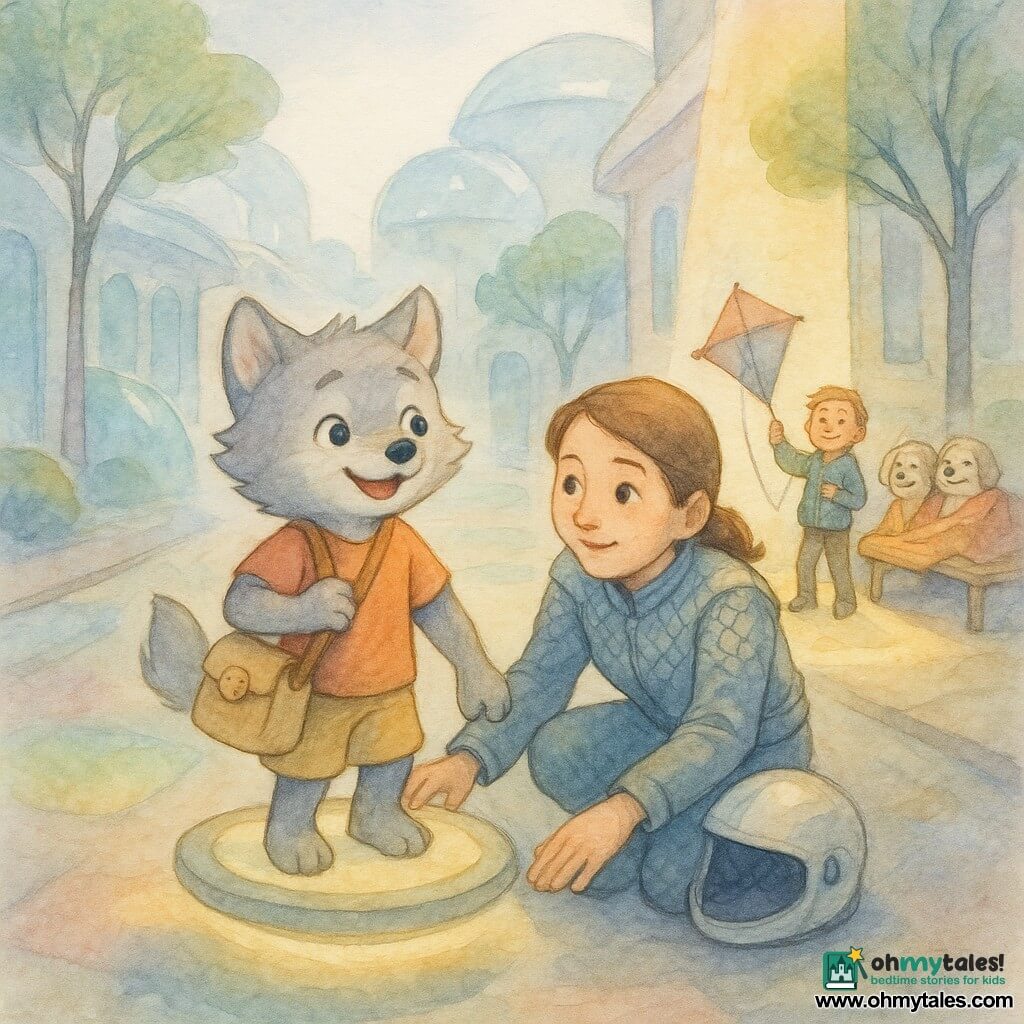
Lia crouched so her eyes were level with his. "Sure. Today, I'll show you how to roll gently and how to listen for the domes." She lifted him onto a small, round platform that sat like a cushion on her roller. The platform glowed and hummed, and Milo felt the gentle pull of the gravity rollers as if the ground had learned to lift him a little.
"Hold tight," Lia said. The darkened fog parted around them like curtains. They glided down the lane, past market stalls where vendors sold luminous berries and knitted clouds. Milo's stomach fluttered with delight. The city sang very softly; the pavement told a story in colors beneath them.
They stopped at a corner where a dome loomed above a community garden. Its glass shimmered green. Lia pressed a small panel on her arm, and the dome answered with a little ripple. "This dome needs more shade on the north beds," Lia said. "It learned that the seedlings were getting too much sun. See—"
A band of gentle shade slid across the garden like a curtain, and the tiny plants sighed in relief. A gardener popped out and waved, his face bright. "Thank you," he called. "The seedlings feel better already."
Milo clapped. He loved how the city helped. "Is the city like a friend?" he asked.
"In ways," Lia said. "But friends are people, too. The city learns from us, and we must care for it back. That's the most important part."
Milo thought about that. He had seen domes that gave more rain when someone watered a plant, and lights that dimmed when an old cat wanted quiet. The city cared back because people told it what they needed. Milo liked the idea of saying thank you to the dome. He felt it was only polite.
"Would you like to try patrolling with me for a little while?" Lia asked. "You can help me listen to the domes and share small gifts of kindness where it's needed."
Milo's ears perked. "Yes, please!"
Chapter 3 — Listening to the Domes
Lia and Milo skated from dome to dome, like two bright comets polishing the morning. Each dome had a different mood. One shimmered with warm orange—good for reading. Another twinkled with tiny stars projected inside, perfect for sleepyheads. The domes had small screens that learned from how people moved beneath them and adjusted the weather accordingly.
"Here," Lia said, bringing them to a dome above a long alley where the fog grew thicker. "This dome is learning to manage fog for people who like the cool. But it's been a bit confused this morning because three helpers asked for more fog at once. The sensors are hungry for easy answers and they made a patch that is all fog, no sun. Some folks down there might miss their warmth."
Milo peered below. A group of older dogs sat on a bench with knitted blankets. They shivered lightly. A child sat on a step with a dripping kite and sad eyes. Milo's paws felt warm with the urge to help.
"What can we do?" he asked.
"Small things help," Lia said. "Tell the dome what you see. The dome learns our words, our gestures, and even what we share." She handed Milo a tiny tablet that looked like a thin leaf. "Speak simply, and the dome will try new things."
Milo swallowed. He had never talked to a dome before. He stepped forward and spoke into the leaf. "Hello, dome. The bench friends are cold, and the kite is wet. Can you give warm sunlight to the bench and a soft breeze to dry the kite?"
The leaf glowed and hummed. The dome paused, as if thinking very carefully. The fog above the alley shimmered and then took a gentle step aside. A soft strip of warm light fell over the bench. The older dogs stretched and smiled. The child's kite wobbled and fluttered dry. He jumped up and waved both arms.
"Thank you!" the child shouted. "How did you—"
Milo felt his chest fill with a happiness he could almost taste. Lia tapped the rail with a satisfied knock. "You did well. The dome listened. Sometimes the domes need a kind voice to learn more thoughtful answers."
They continued, and the day filled with small, shining moments. A bus stopped where a blind mole needed help crossing. Milo pressed a panel and the sidewalk flashed wide arrows, and the mole crossed safely. A bakery's ovens were too hot near the window where a nesting box for city sparrows sat. Milo suggested a cooler spot; the dome made a thin veil of shade that slid just so. The sparrows chirped and hopped, and the baker waved them a tiny crumb.
"Listen," Lia whispered at one point. They skated by a building whose dome had grown thick and noisy. A crowd stood beneath, faces worried. A child's balloon had tangled on a wire, and the dome's sensors had tried to spin the air too quickly. The more it spun, the tighter the balloon rose.
Milo thought of a simpler way. He waved his paw gently and said, "Dome, please let the wind be slow and kind so the balloon can come down."
The dome breathed. The air calmed like a gentle sigh, and the balloon drifted low enough for the child to pluck it free. The crowd cheered, small and bright, like pebbles tossed in a pond.
"People think the domes are magical machines," Lia said as they moved on, "but really they are learners. When we show them kindness and patience, they ask better questions. They become better friends."
Milo liked that. To be patient and kind was something he could do. It felt simple and very strong.
Chapter 4 — A Small Problem, A Big Heart
At noon, while they rested by a fountain that bubbled with tastefully cooled water, the city made a worried noise. Sensors in the nearby plaza flashed orange and hummed a little distressed tune. A delivery drone had dropped a crate, and inside it were tiny garden robots that wiggled and wanted to help—but they were scattered and a little lost.
"They learn from the city, too," Lia said. "But they need guidance right now. If the domes send them into places that are already full, they'll tangle like yarn."
The plaza bristled with people looking for a solution. Some wanted to shove the robots into corners; others wanted to shut off the dome. Milo remembered Lia's words about kindness. He nudged a small robot that blinked awake. "Hello," he whispered. "Do you want to help plant the new seeds?"
The little robot chirped and projected a tiny map. It wanted the north garden, but the north garden already had too many helpers. Milo thought of the rooftop greenhouses that hummed faintly above the bakery. They were quiet this morning—perhaps the domes had sent shade there to help seedlings rest.
"I know a place," Milo said. He showed the robot the route. Lia tapped a few commands on her cuff, and the city opened a gentle corridor of clear air and calm lights. The robots followed Milo, their metal feet making light music.
A few steps behind, a crowd of neighbors came to help carry the crates and sort the seeds. "We can make room," an old fox said, rolling up his sleeves. "My greenhouse is smaller but it will teach the seedlings to be brave." A young raccoon offered a watering can that sang when it poured. The sky above tilted slightly and let a piping of warm daylight in. The domes cleared and learned how to share space.
The robots found their places. Seedlings were planted on the rooftops; herbs took root in window boxes; tiny vines threaded through community trellises. Milo handed out biscuits to the helpers. "Thank you," he said. "The city becomes kinder when we work together."
"We wouldn't have done it without you," Lia replied. "You saw a path and you walked it. That is what solidarity looks like—small paws joining many hands."
By the time the last seed was tucked, the robots hummed like happy clocks. The domes above rearranged into a mosaic of sunshine and soft fog, each patch tuned to the needs of the plants below. The city shone.
Milo sat on a bench and looked at the people around him. Faces were flushed with the warmth that comes from doing something good together. Strangers chatted like old friends. The little wolf felt his chest swell with pride. He had been small. He had been brave in the little ways a wolf of his size could be brave.
Lia rolled closer and set the gravity rollers beside the bench with a soft tick. "You did well today," she said. Her voice velvety with approval. "You taught the dome, you guided the robots, and you shared your biscuit. That matters."
Milo grinned and munched. "I couldn't have done it without the city," he said. "And without you showing me how to listen."
"And without you showing us how to be kind," Lia said. She placed her hand—callused and warm—on a small console of her roller and made it buzz gently. "The city is better because of people like you. Because of people who think of others."
Milo watched as a small group of kids began to dance on a patch of sunlight the dome had made just big enough for tiny feet. A little balloon floated along, bobbing like a cheerful cloud.
Chapter 5 — A Promise and a Hand
The day melted into late gold. The Learning Dome closed its shutters with a polite yawn, saving the light for tomorrow. Milo walked home with his satchel light and his heart heavier with good feelings. The fog had thinned into thin ribbons that caught the evening light and embroidered the city with silver thread. The domes glowed, each one humming softly with the day's learnings and ready to learn more from tomorrow.
As Milo turned into his street, Lia skated up beside him. "You have a bright way of saying what a dome needs," she said. "Some people use big words. You use small, true words. The domes like that."
Milo looked up at the domes; they were like patient faces that listened and then smiled. "Will the domes remember today?" he asked.
"They will," Lia said. "But memory is like a tide. They remember better if we always tell them when they do well and help them when they make mistakes. We keep showing them kindness, just like you did."
They walked under an arch of glass-tree leaves that rustled like soft coins. At the end of the lane, a small plaque shimmered. Someone had planted it months ago: "We live well when we listen." Milo touched the plaque. It felt warm.
"I'm going to keep listening," Milo said with a promise in his voice. "I'll look for places that need help. And I'll share my biscuits."
Lia laughed—a bright, clean sound. "And I'll watch the fog and roll where needed. Together, we'll teach the city everything it needs to know."
They paused at Milo's doorstep. His neighbor Tessa waved from her window. Moonlight gathered like silver sugar on the domes. The city hummed a lullaby to itself, soft and steady.
Lia placed one hand on Milo's shoulder. It was gentle and steady, the kind of touch that says you are not alone. Milo felt the warmth travel down his spine. It was a small thing, but it meant a great deal. He had learned, he had helped, and he had been seen.
"Good night, Milo," Lia said.
"Good night," Milo replied. He looked up at the domes one more time. They blinked back, tiny lights like the promise of many tomorrows.
As he closed the door, Milo felt happy and small and perfectly enough. He curled up near the window where he could see the domes breathe. Outside, the city continued to learn, to adapt, to care. Inside, Milo dreamed of gentle fog, bright rollers, and roofs full of plants. He dreamed of people sharing work and biscuits and laughter.
A hand on his shoulder.