Chapter 1: Brightwater City Wakes Up
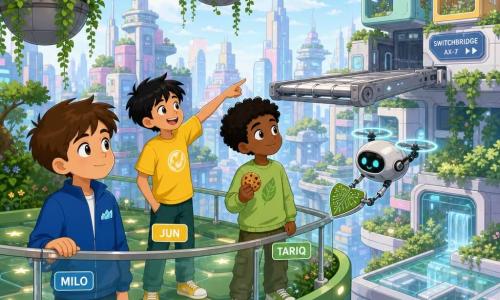
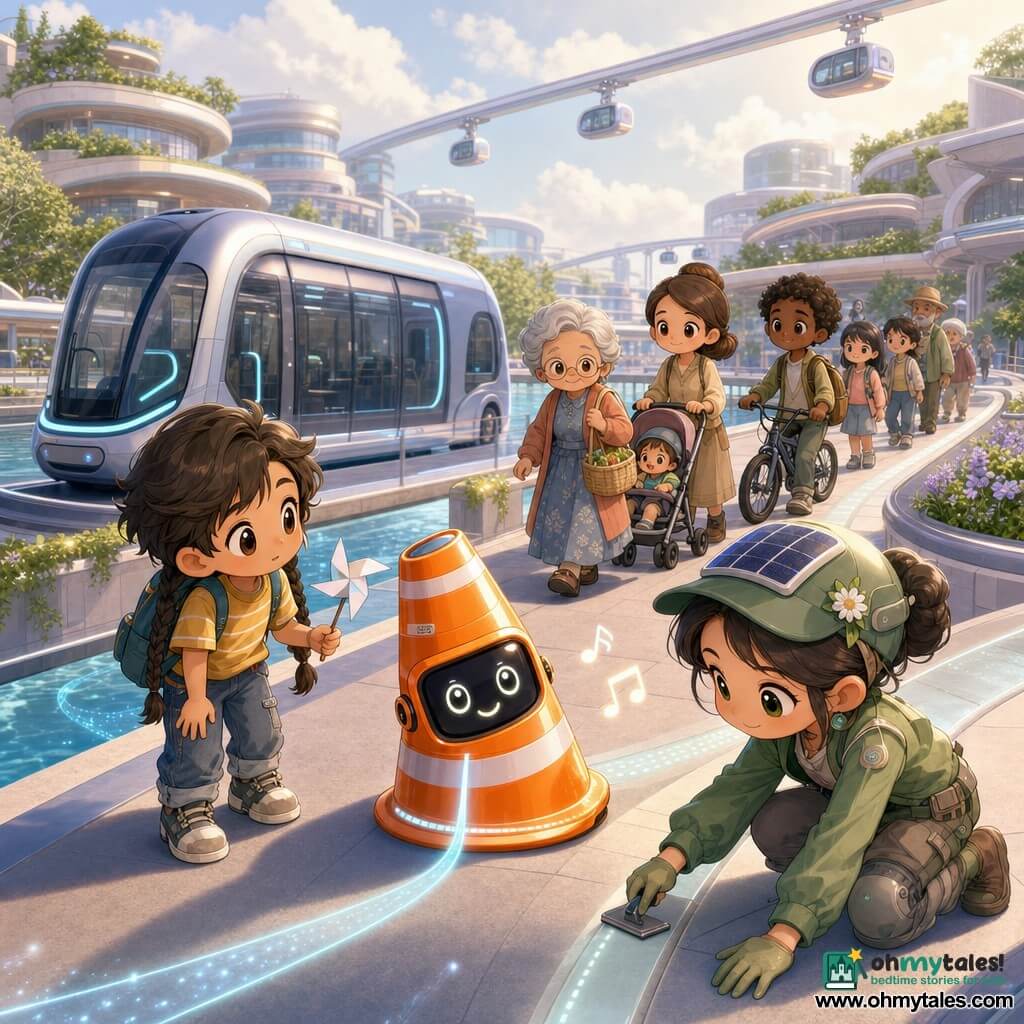
In the year 2146, Brightwater City shone like a clean coin under the morning sun. Rooftops wore gardens like green hats. Tall windows blinked with soft light. And everywhere, water moved—quiet canals that slid between buildings the way paths run through a park.
Along the canals, the streets were calm. No roaring engines. No smoky clouds. People rode slow bikes with wide seats, or stepped onto moving walkways that hummed like sleepy cats. Above, thin sky-rails carried little pods that whispered past, powered by sun and wind.
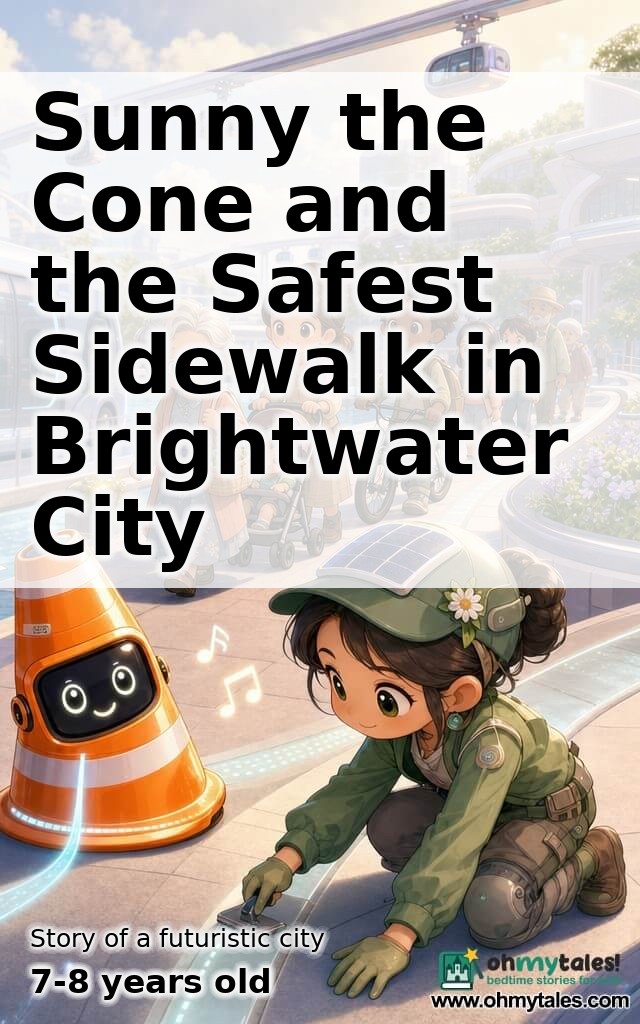
On Canal Nine, a small orange traffic cone stood at the edge of a floating dock. His white stripes were crisp. His base was wide and steady. On his side, a tiny screen glowed with friendly icons: a smile, a map, a listening ear.
His name was Cone-7, but most people called him Sunny, because he always looked as if he belonged in good weather.
Sunny's job was to help everyone cross safely—especially where the canal paths met the walkways and docks. In Brightwater City, crossings were gentle, but they still needed care. A fast scooter, a busy family, a floating shuttle arriving at the same time—little tangles could happen, like shoelaces in a hurry.
Sunny liked untangling.
He did it with clear lights, soft beeps, and, most of all, listening.
At the dock, a pilotless shuttle drifted in. It was shaped like a smooth seed, silver and blue, with big windows and a quiet belly. No driver sat inside. The shuttle guided itself, following canal lines that glowed under the water like blue ribbons.
Sunny's screen blinked: ARRIVAL—SHUTTLE “LILY-LOOP.”
A group of children leaned over the railings to watch. Their teachers held hands in a neat chain, like a friendly fence.
Sunny made a gentle “bip-bip,” and his top light turned green. A moving walkway slowed down nearby. A soft chime played from the railing, saying, “Crossing time.”
People smiled. They always did when the city worked like this—simple, smooth, kind.
Then Sunny noticed something odd: a tiny wobble in the docking line. The glowing ribbon under the water flickered, as if it had hiccuped.
On his screen, a small warning icon popped up—not red, just yellow. CHECK CROSSING PATH.
Sunny didn't panic. Brightwater City didn't like panic. Panic made people stop listening.
He tilted slightly toward the canal and activated his listening mode. That meant he didn't just “hear” sounds. He read soft signals: footsteps, wheel speeds, walkway rhythm, shuttle glide, even the tapping of rain if rain appeared.
Today there was no rain. Only sunshine and a gentle breeze.
Yet the docking line still flickered.
“Hmm,” Sunny thought, in his own quiet cone way. “Something wants attention.”
A little delivery cart rolled up, carrying a stack of recycled-paper parcels. Its wheels were round and polite, and it stopped at the crossing like it had been taught.
A girl with two long braids pointed at the canal. “Look! The light under the water is blinking.”
Her teacher nodded. “It is. Good eyes.”
Sunny's top light stayed green for people, but his side screen added a tiny note: PLEASE WALK—NO RUN. It also showed an ear icon, reminding everyone to listen to the chime.
Because listening was the city's best tool.
Sunny decided: after this shuttle docks, he would check the crossing path. A safe crossing today meant a safer sidewalk tomorrow.
Chapter 2: The Flicker on Canal Nine
The shuttle Lily-Loop glided closer. Its front sensors twinkled like small stars. It slowed, then slowed more, until it floated beside the dock with perfect manners.
Sunny watched the water-ribbon flicker again—short, short, long. Like someone knocking.
He sent a calm message into the city's network: “Crossing helper Cone-7 reporting: Docking line flicker at Canal Nine. Requesting check.”
A reply came almost at once, warm and friendly: “Received, Sunny. Any danger?”
“No danger,” Sunny sent back. “Just a hiccup. I will listen and look.”
The dock gates opened with a soft sigh. People stepped off: a grandmother with a basket of herbs from the roof gardens, two office workers with light backpacks, and a boy holding a small model windmill.
The boy paused near Sunny. He crouched down, reading Sunny's screen. “You're Sunny! My class saw you in a safety video.”
Sunny gave a tiny cheerful beep. His screen showed a smiling face.
The boy grinned. “Cool. My windmill is for science club. It makes power from air. Like the city!”
He stood and moved along. Sunny felt pleased. He liked when children noticed how things worked.
When the last passenger stepped off, the shuttle's doors closed again. It waited, as if it didn't mind being patient.
Sunny turned his attention fully to the canal.
He couldn't jump into water—cones were not built for swimming—but he could extend his base sensors. A thin ring at his bottom glowed, and he “tasted” the signals in the ground and railing. Vibrations, tiny heat changes, and the gentle pulse of the canal's guide lights.
The flicker wasn't random.
It was coming from a small corner near the edge of the dock, where a new piece of sidewalk had been installed last week. A fresh, pale strip of smart pavement connected the dock to the main path. It was meant to help everyone: strollers, scooters, wheelchairs, tired feet, dancing feet.
Sunny remembered the builders. They had laughed kindly and patted his side. “You'll like this, little helper,” they said. “It listens, too.”
Now that pale strip looked fine. But its signal was… shy. Like it was trying to speak and didn't know how.
Sunny's ear icon brightened. He activated “slow listening,” which meant waiting longer between checks and letting faint messages arrive.
A quiet signal came through, like a whisper: MISALIGNED EDGE—SPEED CHANGES—CONFUSION.
Sunny understood. The new pavement was smart, but it was not fully aligned with the older crossing rhythm. The moving walkway nearby was matching the old rhythm. The dock gates were matching the old rhythm. The shuttle docking light was matching the old rhythm. But the new strip was tapping a different beat.
Not dangerous yet. Just confusing. And confusion was the first step to bumping toes.
Sunny turned his top light yellow—Brightwater City's color for “Let's be careful together.” A gentle chime played: “Please slow down.”
A few people looked up. They slowed without grumbling, because the city often asked politely, and people were used to answering politely.
Sunny scanned the crowd. He needed someone who could help adjust the pavement's rhythm. He could report it, yes. But he also wanted to organize a safe passage right now, while the city's repair team traveled here.
A boy on a scooter came zooming toward the canal path. His helmet had stickers of planets. He was not trying to be bad. He was simply excited.
Sunny flashed a friendly icon: a turtle.
The boy giggled and slowed. “Okay, okay,” he said, almost like the cone could hear him. He placed one foot down and rolled gently.
A woman with a stroller hesitated, watching the yellow light. She didn't want to get stuck on the edge.
Sunny showed an arrow and a footprint: THIS WAY—SMOOTH PATH.
He angled his body a little, pointing to the older, flatter section beside the new strip. It wasn't perfect, but it was steady. People could pass one by one, like stepping stones.
Soon, a small line formed. No one pushed. No one ran. Sunny made soft beeps to keep the pace. The moving walkway slowed a bit more, matching the line.
Listening made it work.
Still, Sunny wanted the new pavement to feel confident. He sent another message: “Canal Nine crossing: smart pavement rhythm misaligned. I'm guiding slow safe passage. Please send a technician.”
The city replied: “On the way. Estimated arrival: 12 minutes. Keep it calm, Sunny.”
Sunny's screen showed a thumbs-up.
Twelve minutes could be long for busy feet. But it could also be a good time to practice something important.
Patience.
And listening.
Chapter 3: A Crossing Made by Listening
Sunny took charge the way he always did: with gentle signals and clear choices.
First, he set a “soft lane.” He projected a thin line of light onto the ground, curving around the tricky edge. It looked like a ribbon of moonlight on pavement.
Next, he started a rhythm: bip… bip… pause. Bip… bip… pause. It matched the older crossing system, and the moving walkway adjusted to it like a friend joining a song.
People began to follow the light ribbon. A man with a folding bike nodded in thanks. A girl with a violin case stepped carefully, then relaxed when her wheels rolled smoothly.
The shuttle Lily-Loop waited at the dock, its windows showing a cozy inside with seats that could warm or cool, depending on what you liked. It didn't complain about being late. Pilotless shuttles in Brightwater City were designed to be calm, because calm kept everything safe.
A little group of tourists arrived, looking up at the buildings as if they were tall trees. They spoke softly and pointed at the canals.
Sunny showed them a simple message on his side screen: “SLOW CROSSING—FOLLOW LIGHT.”
One tourist lifted a hand in a small wave toward Sunny, as if greeting a helpful neighbor.
Then the boy with the model windmill returned. He had been waiting by a railing, watching. Now he came closer, eyes curious.
He crouched again, and this time he spoke as if he were talking to a friend. “Sunny, is it hard to do your job?”
Sunny's screen showed an ear.
The boy nodded, as if he understood. “Right. Listen first.”
Sunny liked this boy. Not because he asked questions—many kids did—but because he paused after asking, letting the answer arrive in his own mind.
The boy looked at the flickering underwater ribbon. “It's like when my windmill blades don't line up. It shakes.”
Sunny displayed: YES—GOOD THINKING.
The boy's smile grew. “Could you… um… tell the pavement to match the other beat?”
Sunny could not talk to the pavement like people talked to each other, but he could send a syncing pulse. He tried a gentle one: a “tap” in the city network that said, “Here is the shared rhythm. Join us.”
The pale strip responded with a slightly steadier glow, like a shy friend stepping closer to the group.
But then it flickered again. Not as much, yet still enough to matter.
Sunny understood: it needed a real adjustment, not just encouragement.
He kept guiding people along the soft lane. He watched faces. If anyone looked unsure, he slowed the rhythm. If someone looked rushed, he reminded them with the turtle icon. People laughed softly at the turtle and slowed anyway.
A tiny mishap almost happened when a delivery drone—small and round—hovered too low near the dock. It wasn't scary. It simply got confused by the new strip's odd signal and dipped, wobbling like a tired bumblebee.
Sunny made a quick, clear beep-beep-beep. The drone rose and moved aside. It flashed an apology light and zipped away.
“Good save,” said a teacher, not loudly, just warmly.
Sunny's screen showed a modest little star.
At last, a maintenance trike arrived, rolling silently along the canal path. It was long and low, with three wheels and a box of tools that looked like shiny lunch tins.
A technician hopped off. Her jacket was bright green, the city's color for “care team.” She wore a cap with a solar patch on top.
She knelt by the pale strip and placed a small device on it, like a gentle stamp. The device blinked. The strip blinked back.
Sunny watched carefully.
The technician didn't rush. She tapped, waited, listened. Then she adjusted a setting and waited again.
Sunny liked her method. It matched his.
“What's it saying?” asked the boy with the windmill, peeking from behind his teacher.
The technician smiled. “It's telling me it's not sure which beat to follow. So we're helping it learn the city's beat.”
Sunny's ear icon glowed brighter. That was exactly it.
The technician pressed one last button. The pale strip's glow became steady and smooth. The underwater ribbon stopped hiccuping and shone like a calm line of stars.
Sunny's top light turned green again, not too bright, just right.
The chime changed to a happy tone: “Crossing clear.”
People walked normally now. The stroller rolled easily. The scooter boy sped up a little—still safe, still polite. The drone returned and hovered higher this time, behaving like it had learned, too.
The shuttle Lily-Loop opened its doors to welcome new passengers.
Sunny felt a warm hum in his base sensors: the feeling of a place that made sense again.
But the technician didn't leave right away. She looked at the edge where the new strip met the older pavement. “We fixed the rhythm,” she said. “But I think we can make the sidewalk even safer.”
Sunny's screen showed a question mark.
She pointed to the meeting line. “See this tiny lip? Most feet don't notice. But some wheels might. And when the rain comes, a tiny lip can be slippery.”
Sunny agreed. Safety was not only about big problems. It was about small kindnesses.
The technician opened her tool box. “Let's build a gentler edge. A safer sidewalk.”
Sunny's screen showed a bright yes.
Chapter 4: The Safest Sidewalk in the City
The technician set up a small fold-out barrier—not to scare anyone, just to guide them around the work area. It was see-through and friendly, with little drawings of fish and leaves.
Sunny organized the passage again, this time even smoother. He placed his light ribbon in a wider curve. The moving walkway adjusted its speed to match the detour, as if it were happy to help.
People flowed around the work like water around a stone.
The boy with the windmill stayed nearby, watching quietly. When his teacher started to lead him away, he asked, “Can I listen for a bit longer?”
His teacher considered, then nodded. “Yes. But we stand back and we watch. Listening also means giving space.”
The boy stood with hands behind his back, very serious in a seven-year-old way.
The technician worked with simple tools: a small heater that softened the edge, a smoothing paddle, and a strip of recycled rubber that smelled faintly like new sneakers. She pressed the strip into place, making a gentle ramp so wheels and feet could pass without catching.
Sunny observed every step. He saved the pattern in his memory, so he could suggest it at other crossings.
While she worked, the technician spoke softly, mostly to herself, but also to the boy and Sunny. “A city is like a big team,” she said. “The shuttles, the walkways, the canals, the people, the helpers like you. When something feels off, we listen. Then we fix it together.”
Sunny's screen displayed: LISTEN—THEN HELP.
The boy nodded as if those words were a secret password to the future.
At last, the technician stepped back. The new edge looked like a smooth smile. The pale strip's glow stayed steady. The underwater ribbon shone without flicker.
She removed the barrier and tested the sidewalk by rolling a small wheel tool across it. It glided like a skater on clean ice.
“Perfect,” she said.
Sunny turned his top light a bright, proud green. Not shouting, just shining.
The boy held up his model windmill. The breeze caught its blades, and it spun. “It's like the city,” he said quietly. “When things line up, it works.”
Sunny displayed a star, then an ear, then a heart.
A new group of children arrived for an afternoon canal tour. They stepped off the shuttle, and their guide pointed toward the crossing.
“No worries,” the guide said. “This is one of the safest sidewalks in Brightwater City.”
Sunny felt his base settle into the ground with contentment. Safe. Smooth. Clear.
A girl in the group looked down at Sunny. “Thank you,” she said, as if thanking a helpful neighbor.
Sunny beeped once, softly.
The moving walkway hummed. The canal shimmered. Bikes rolled by with little bells. Above, a sky pod slid past like a quiet bird.
And on Canal Nine, at the edge of the floating dock, Sunny stood watch, listening to the city's gentle music.
When the underwater ribbon glowed steady, it looked like the future was smiling back.
And the sidewalk—wide, smooth, and kind—welcomed every step.