Chapter 1: The Shh-Sneeze Problem
Pip the Paperclip liked quiet. Not “nobody-breaths” quiet—just the soft, cozy kind of quiet that made every page-turn sound like a polite whisper.
That was why Pip loved working in the Library of Riddles.
The library was built like a maze made of bookcases. Lanterns shaped like question marks glowed above the aisles. Bookmarks fluttered like little flags. And every shelf had a tiny brass label that read things like: PLEASE RETURN YOUR LOGIC TO THIS SHELF.
Pip zipped along the edge of a reading table, feeling important and very properly bent.
Then a loud sound exploded in the silence.
“A-CHOO!”
A dusty dictionary had sneezed so hard its pages flapped like startled pigeons.
“Oh no,” groaned a nearby Atlas. “If the library gets too loud, the Riddles will wake up.”
Pip blinked. “Riddles sleep?”
“Of course,” said Atlas. “If they're awake, they start asking questions. And if you answer wrong, they… rearrange you.”
Pip tried not to imagine being rearranged. He had worked hard to become this shape.
Just then, a bell chimed from the tallest shelf. A scroll unrolled itself with a dramatic sigh and announced, “ATTENTION, STATIONERY AND REFERENCE MATERIALS! TODAY'S IMPOSSIBLE CHALLENGE HAS ARRIVED!”
The scroll thumped onto the table in front of Pip.
Pip read the curly letters out loud: “Challenge One: Carry Silence Across the Squeaky Bridge.”
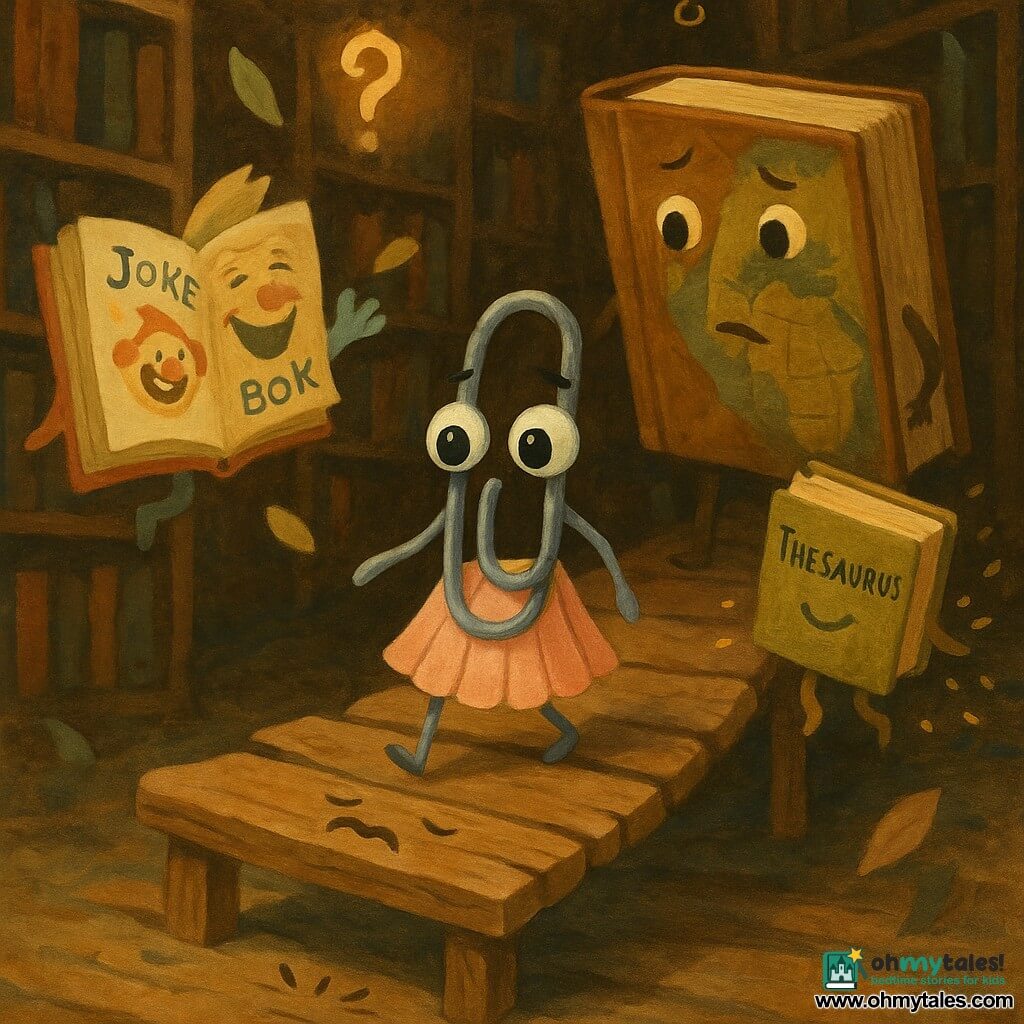
Pip peered down the aisle. At the far end, between two shelves, was a bridge made of old floorboards. It wobbled over a little gap where lost bookmarks drifted like fallen leaves.
And it squeaked. Loudly. Even the thought of it squeaked.
Pip gulped. “I can't carry silence. Silence isn't… holdable.”
The scroll sniffed. “That's why it is called ‘impossible.' Please proceed with bravery and a reasonably clean attitude.”
Pip's first thought was, This is ridiculous.
Pip's second thought was, But also kind of interesting.
“All right,” Pip muttered. “Let's fail in a creative way.”
Chapter 2: The Squeaky Bridge Stares Back
Pip approached the bridge. It stared back with the confidence of something that had squeaked at champions and enjoyed it.
A tiny sign dangled from the first board: DO NOT TIPTOE. THE BRIDGE FINDS IT FUNNY.
Pip squinted. “That is extremely rude.”
A nearby Book of Jokes leaned open and whispered, “Try walking normally.”
Pip stepped onto the first board with a bold, normal step.
“EEEEEEEK!” screamed the bridge, as if Pip had stepped on its toe.
From deep inside the shelves came a sleepy voice: “Wha—who answered ‘banana'?”
A few books rustled. A riddle yawned somewhere.
Pip froze. “I didn't say banana!”
The Book of Jokes giggled. “The bridge always screams. It's dramatic.”
Pip tiptoed backward, which made the bridge squeak again, this time like an insult.
Pip looked around. Silence sat in the air like a delicate bubble. How could he carry it across something determined to pop it?
He spotted a stack of felt page-markers in a basket. Soft, thick, and quiet.
Pip had an idea so odd that he laughed at himself. “If I can't carry silence,” he said, “maybe I can carry… quiet feet.”
Pip clipped himself onto the edge of one felt marker. Then another. Then another, building a little felt “skirt” around his body.
The Book of Jokes gasped. “Fashion!”
Pip waddled to the bridge, now wearing felt like a fluffy cloud.
He stepped on the first board.
Nothing.
Pip stepped again.
Still nothing.
Pip's eyes widened. “It's working!”
The bridge tried to squeak, but the sound got stuck in the felt like a sneeze trapped in a pillow. The bridge seemed offended.
Pip crossed halfway, grinning.
Then the last board made a tiny, traitorous chirp: “Eep.”
From the shelves, the sleepy voice mumbled, “Is that… a mouse spelling?”
Pip held his breath. The library listened.
The chirp faded. The riddles did not wake.
Pip reached the other side and bowed. “Silence delivered, slightly wrinkled but intact.”
The scroll reappeared, rolling itself into view like it was late for something. “Challenge One: Completed. You may now attempt Challenge Two: Solve the Unsolvable Pun.”
Pip groaned. “I knew there would be puns.”
Chapter 3: The Pun That Refused to Behave
Challenge Two waited in a room called The Giggle Alcove. It had cushions shaped like commas and a chandelier made of tiny magnifying glasses.
In the center sat a stone pedestal with a riddle carved into it:
I CAN BE BROKEN WITHOUT BEING HELD.
I CAN BE GIVEN WITHOUT BEING SOLD.
WHAT AM I?
Pip read it twice. “This one is famous,” he said. “The answer is ‘a promise.'”
A nearby Thesaurus fluttered its pages. “Careful. This library's riddles are… fussy.”
Pip cleared his throat and announced, “A promise!”
The pedestal made a sound like a disappointed pancake. “WRONG.”
Pip blinked. “How is that wrong? It's right everywhere else.”
A pun drifted by on a scrap of paper, humming to itself. It stopped and said, “Maybe the riddle is in a mood.”
Pip stared at the carved words. Something felt sneaky. He noticed tiny letters at the bottom, almost invisible: P.S. I HATE SERIOUS ANSWERS.
Pip groaned. “Oh. It wants a pun.”
He tried again. “A… prom-iss? Like ‘promise' but with… missing?”
The pedestal rumbled, unimpressed.
Pip paced. “Broken without being held… given without being sold…”
The Thesaurus offered, “Vow. Oath. Word.”
Pip waved a felt-covered “hand.” “It hates serious answers!”
The scrap-paper pun twirled. “Try making it silly. Riddles love being silly.”
Pip sat down on a comma cushion. He looked at the words until they started to wobble in his mind like jelly.
Then he snorted. “Broken… given…”
He stood up, suddenly excited. “A joke!”
The Thesaurus frowned. “A joke?”
Pip nodded fast. “You can break a joke—like ruin it—without holding it. And you can give a joke away without selling it!”
The pun scrap clapped itself in half. “Nice!”
Pip faced the pedestal and said, clearly, “You are a joke.”
For a moment, nothing happened.
Then the pedestal burst into laughter. Not mean laughter—more like a rock finally hearing something it'd been waiting for its whole life.
“CORRECT!” it boomed, coughing dust like confetti.
A little drawer popped open and offered Pip a shiny sticker that said: OPEN-MINDED THINKER.
Pip clipped it proudly onto his felt skirt. “I'm not just surviving impossible challenges,” Pip said. “I'm starting to… enjoy them.”
The Thesaurus smiled, which looked like a book bending politely. “That is called growth.”
The scroll swooped in again, sounding far too cheerful. “Challenge Three: Organize the Unorganizable Shelf. Please scream quietly if needed.”
Pip's grin faltered. “That sounds like something I might actually scream about.”
Chapter 4: The Shelf That Wouldn't Sit Still
The Unorganizable Shelf was in the back of the library, where the air smelled like old paper and stubbornness.
The shelf itself wiggled. Books slid left, then right, as if the shelf couldn't decide what it wanted to be when it grew up.
A label dangled from it: SORT BY SOMETHING THAT ISN'T ALPHABETICAL. ALPHABETICAL IS BORING.
Pip stared. “But… alphabetical is the best kind of boring.”
A stack of cookbooks slid by like a parade. A poetry book drifted upside down, humming dramatically. A map tried to fold itself and failed with a loud flap.
Pip grabbed the edge of the shelf with his clip. The shelf shivered.
“Stop moving,” Pip begged. “I'm trying to be helpful!”
The shelf wiggled harder, like it was laughing without making a sound.
Pip thought of the bridge. He thought of the pun. Both had seemed impossible until he stopped trying to do them the “normal” way.
Maybe this shelf didn't need force. Maybe it needed a game.
Pip climbed onto the shelf and called out, “All right, everyone! New rule: We're sorting by… how you make people feel!”
The books paused, as if they had never been asked about feelings before.
A mystery novel crept forward. “I make hearts go thump.”
A fairytale anthology fluttered. “I make people hopeful.”
A book of spooky stories hissed softly. “I make people check under the bed.”
Pip nodded, delighted. “Perfect! Make three piles: Thumpy, Hopeful, and Under-the-Bed.”
The shelf stopped wiggling, curious.
Books began sliding into groups. The poetry book floated into Hopeful, sighing happily. Cookbooks went into Hopeful too, because soup was comforting. The atlas went into Thumpy because it contained cliffs and storms and, apparently, dramatic sea monsters.
Soon the shelf looked… organized. Not by letters, but by mood. It was the strangest tidy Pip had ever seen, and also the most fun.
A tiny bell rang. The shelf gave a pleased little creak, the kind that sounded like a chair settling in for a good story.
The scroll appeared one last time. “Challenge Three: Completed. You have organized the unorganizable by using imagination instead of wrestling. Please accept your final reward.”
A hatch opened in the wall. Out rolled a small, wheeled cart stacked with blank notebooks.
Pip blinked. “What are these?”
A nearby Index Card whispered, “They're for new riddles. The library likes fresh puzzles.”
Pip touched a notebook cover. It felt smooth and full of possibility.
Pip had arrived thinking impossible challenges were annoying traps.
Now Pip was thinking: Impossible just means nobody's tried the funny way yet.
Chapter 5: A New Kind of Impossible
That evening, the library grew extra quiet—the cozy kind, not the scared kind.
Pip rolled the cart of notebooks into a bright corner under a question-mark lantern. The Book of Jokes, the Thesaurus, and even the dramatic Atlas gathered around.
Pip cleared his throat. “I'm going to write an impossible challenge.”
The Book of Jokes bounced. “Make it ridiculous!”
The Thesaurus rustled. “Make it thoughtful!”
Atlas said, “Make it… safely thrilling.”
Pip picked up a pencil that had been lounging nearby like it owned the place. “I need a challenge that sounds impossible but is really about being open-minded.”
Pip wrote carefully, tongue sticking out in concentration:
CHALLENGE: TEACH A GRUMPY BOOK TO GIGGLE.
Pip looked up. “Too mean?”
A dusty, grumpy encyclopedia harrumphed from a nearby shelf. “I do not giggle.”
Pip rolled closer. “That's perfect.”
Pip flipped open the Book of Jokes. “Tell us your best joke,” Pip said.
The Book of Jokes said, “Why did the bookmark blush?”
The encyclopedia muttered, “Because it was… pressed.”
Pip blinked. “Wait. That was good.”
The Book of Jokes whispered, “Don't act impressed. It'll get shy.”
Pip nodded seriously and asked, “Because it… saw the inside of a romance novel?”
The encyclopedia tried not to smile. It failed. A tiny snort escaped.
The atlas gasped. “That was a giggle!”
“It was a throat malfunction,” the encyclopedia insisted, but its pages were wobbling like it was fighting laughter.
Pip leaned in and said gently, “You don't have to be grumpy all the time, you know.”
The encyclopedia went quiet. Then, in a voice like a book trying on a new cover, it said, “Perhaps… I could be… slightly amused.”
Pip beamed. “That counts.”
The question-mark lantern above them glowed a little brighter, as if the library itself approved.
Pip clipped the new challenge page onto the cart and looked down the long aisles. There were still bridges to cross, riddles to soothe, shelves to tame. Maybe even a few sneezes to survive.
But Pip didn't feel trapped by “impossible” anymore.
Pip felt like the library was opening, one funny problem at a time—like a door that only swung wide when you pushed it with a new idea.
Pip rolled forward, sticker shining, felt skirt swishing, ready for the next “impossible” thing to become a game.