Chapter 1: The Impossible Curtain
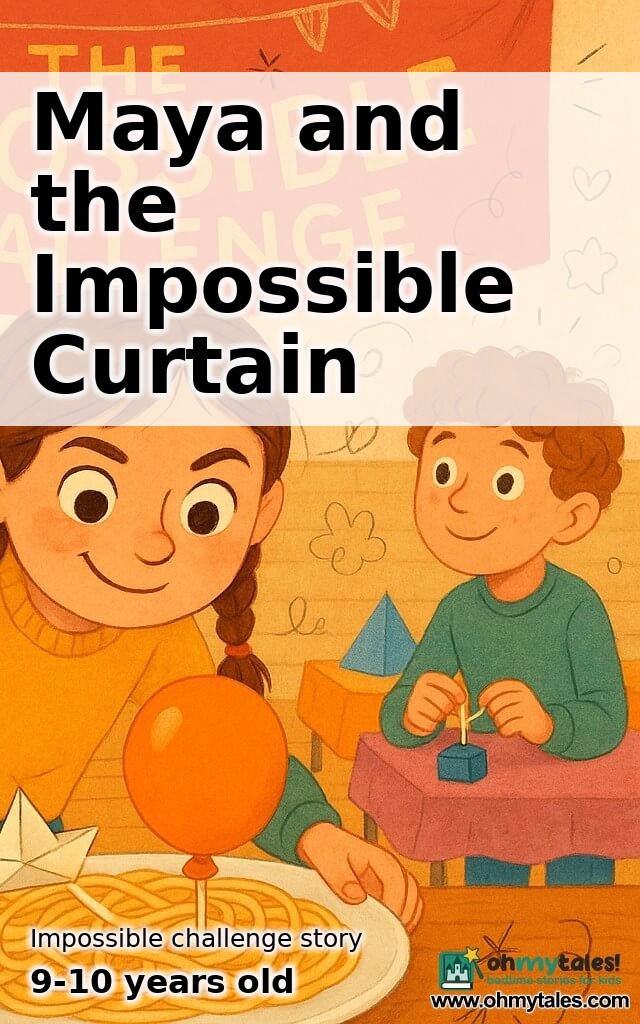
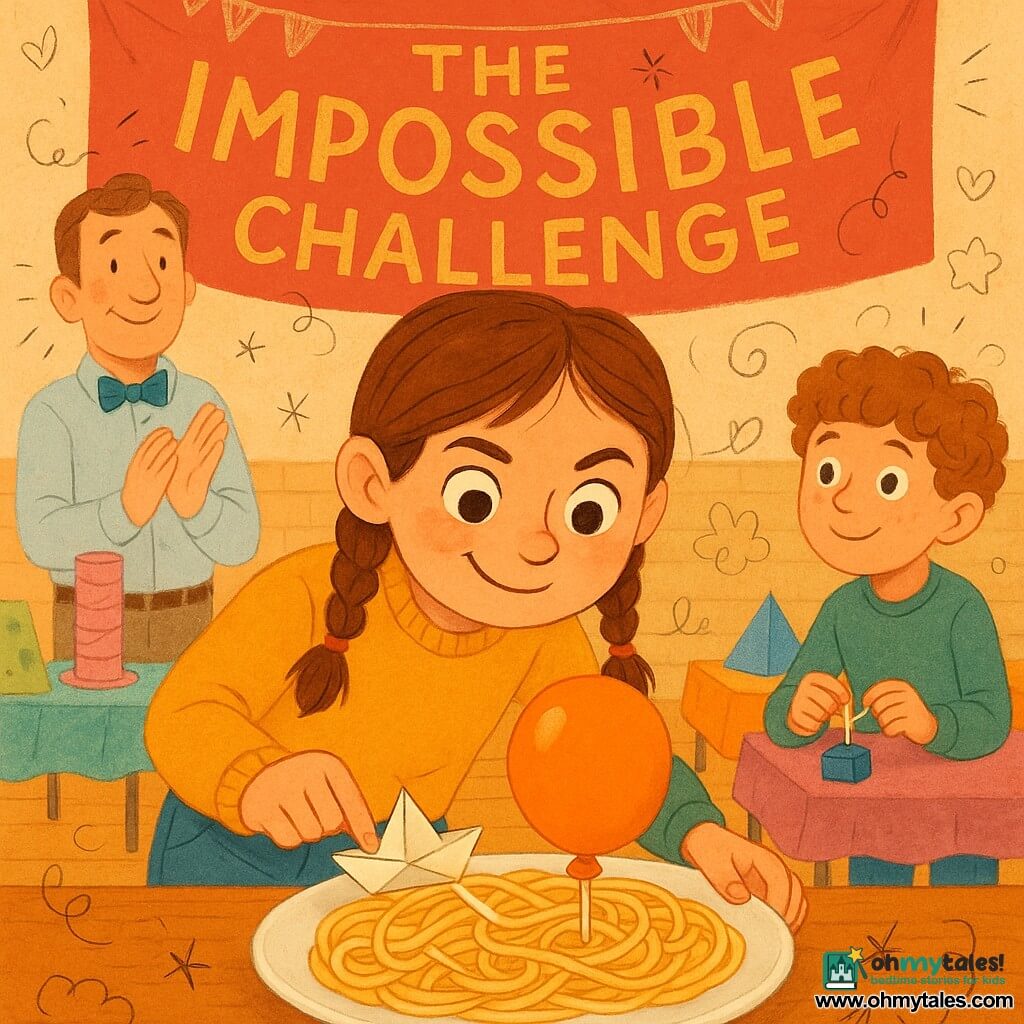
Maya tugged at her laces, stepped into the school gym and blinked. The science-and-art expo was a festival of wobbling volcanoes, glittering robots and a papier-mâché whale that nodded like a sleepy parent. But at the far end, beside a table of politely humming fans, stood a tall, velvet curtain with a sign: THE IMPOSSIBLE CHALLENGE. The letters were painted in orange, as if daring her.
She was nine, curious to the tips of her sneakers, and had earned a patch that morning for “Excellent Question-Asking.” This seemed like the perfect place to ask more. A kindly judge with a bow tie that kept sliding sideways peered out and said, “Only the bravest, cleverest, and silliest may try.”
Maya loved “brave,” she liked “clever,” and she adored “silly.” She stepped forward. Behind the curtain, she heard drums and a faint giggle. When she pulled the velvet aside, she saw a tiny stage with three impossible objects sitting on pedestals: a pancake that refused to flip, a clock that ticked backward, and a balloon stuck in the very middle of an enormous maze made of borrowed spaghetti.
“You must solve one!” announced a megaphone that hadn't earned its voice yet. Maya peered. Each object had a riddle hovering like soap bubbles. The pancake's bubble said, “Flip me without touching me.” The clock's bubble said, “Make me run forward.” The balloon's bubble said, “Free me without breaking the maze.”
Maya exhaled. She felt a bubble of giggle rise in her chest. “All right,” she whispered to herself. “We'll make impossibles into funnies.”
Chapter 2: Pancakes, Plans, and a Short List
She went for the pancake first because pancakes are nicer than backward clocks. The pancake lay on a plate under a glass dome, sulking. Maya tapped the dome; the pancake did not move. Around the plate were all sorts of cooking gadgets: a tiny fan, a feather duster, a matchbox boat and a rubber chicken. The judge winked. “No hands, no magic, no pancake-things.”
Maya sat down cross-legged and made a short list on a scrap of expo program she'd found in her pocket. She wrote large, quick letters:
1. Make the pancake want to flip.
2. Use something that's not a hand.
3. Make it laugh.
She liked lists because they turned thoughts into marching soldiers. She read the first item out loud: “Make the pancake want to flip.” She frowned. How do you make a pancake want anything? She looked at the rubber chicken. Chickens sometimes peck pancakes in cartoons. She looked at the fan. Wind makes bubbles dance. She looked at the matchbox boat and imagined a tiny pancake pirate.
Maya arranged the fan behind the plate. She perched the rubber chicken like a flag on the fan's rim using a paperclip she borrowed from a poster board display. Then she took the feather duster and gently tickled the pancake's edge through a tiny slit in the dome, making it wiggle. The pancake, suspicious at first, started to shimmy. Maya hummed a silly tune and clapped once with her shoe. The chicken, flapping thanks to the fan, flew a paper-flag loop and landed against the dome making a small, theatrical boink.
With each tiny boink the pancake wiggled more. Then—surprise!—it did something no pancake should do: it rolled like a sleepy donut and, with a triumphant flop, flipped over. The crowd giggled. The judge bowed and handed Maya a sticker that said “First Giggle.” She stuck it on her shirt and felt proud. “On to the next impossible,” she said.
Chapter 3: Turning Back Time (Mostly)
The backward clock sat like a drowsy owl on its pedestal. Its hands swept left, and when Maya tried to read the numbers, they looked like they had been written after a party. The bubble above it shimmered: “Make me run forward.”
Maya scratched her chin. No hands. No magic. The clock was stubborn, like a cat that prefers to nap on your homework. She thought of things that could coax it: music, a race, a chant. Then she thought of her grandfather's old pocket watch that had once started ticking when she sang to it as a baby. Sound, she decided, might be the secret.
She looked around the expo for something musical. A group of students were demonstrating glass bottles tuned to different notes. Maya asked, “Can I borrow a note?” They handed her a small bottle that sang a warm C when tapped. She found a cardboard tube and a tiny mirror from the robotics table. She set the mirror so it reflected the sunbeam that slipped through the gym windows and pointed it at the clock face.
Maya tapped the bottle. The note hovered like a bright bird and landed on the clock's rim. The mirror gave the note a friend—sunlight bounced, the sound stretched, and for a tiny, shiny moment the clock's leftward hands watched the note and considered. Then the clock hiccupped. It gave a polite backward tick, like a sneeze, and then… inched forward. Encouraged, Maya tapped again, then clapped with her shoe in rhythm. The clock, now entertained, decided to be forward for a bit and started moving clockwise—slowly, but confidently.
Someone shouted, “Reverse-engineered music!” and clapped. Maya grinned. The judge handed her a little brass gear as a prize. She tucked it into her pocket next to the stick of gum she had not eaten. “One more,” she whispered.
Chapter 4: The Great Spaghetti Maze and a Careful Finish
The balloon challenge was the biggest. The maze of spaghetti arched like ivory fences across a table as large as a small island. The balloon perched in the center, orange and patient, and a tiny sign read: “Free me without breaking the maze.” Around the edges, kids had tried poking in straws, whispering promises, and one ambitious scientist had attempted to build a mini zip line with paperclips. The maze had survived all.
Maya studied the maze. The spaghetti strands were long and delicate, stuck to the table with clumsy glue dabs. The maze looked impossible not because it was tall, but because it demanded carefulness—one wrong move and the entire noodle city might collapse. Maya could feel the juice of a plan forming.
She recalled a story about a brave mouse who carried a bridge in its teeth. She remembered the way sunlight had helped the clock and the way the pancake had liked laughter. Maybe the balloon needed a friend who could carry it. But what could do that without popping it and without touching the maze? She scanned for helpers. A poster board sailboat from the earlier volcano project had a tiny mast. A team had left behind a tray of used paper straws. The robotics club had donated a gentle servo arm for testing. It was all here, like puzzle pieces waiting to be held.
Maya made a second tiny list inside her head—no paper this time, hands off the maze, no popping. She took a paper straw, a rubber band, and the servo arm. She taped the straw to the mast of the poster boat and threaded the rubber band through the straw like a seatbelt. Then she attached the other end of the rubber band to a penny for weight and balanced the fleet on its hull. The servo arm would tug the penny to pull the little carrier toward the balloon.
She practiced the tug movement on the table edge, careful as a squirrel testing a branch. When she was ready she set the boat on the maze's edge, away from noodles. She used the servo's gentle whirr to send the penny sliding across the table. The rubber band stretched, tightened, and the tiny straw-saddle slid up like a shoal of minnows, carrying a savory cargo of nothing more than warm air. When the straw-sledge reached the maze's outermost ring, Maya used a second mirror like a paddle to steer its reflection, nudging the sun to make the air puff just enough to lift the balloon a millimetre.
The balloon wobbled, surprised. A little breeze from a hidden fan—placed far from the maze so no noodles would wobble—trembled across its side. The straw-sledge hugged the balloon as if offering a gentle handshake. Slowly, slowly, the balloon began to glide, carried on a current of laughter and light engineering. The maze held. No spaghetti fell. The crowd inhaled and then burst into a soft, delighted cheer.
Maya guided the balloon to the maze's edge. A child in the front row reached out, but Maya, remembering the rules and the fragility of noodle cities, stopped the child with a small, careful gesture: she placed her palm over the child's hand like a gentle bridge and whispered, “Let me finish.” With a final steady breath she lifted the balloon from its straw-saddle onto a paper cup platform and rolled it to the finish line. The judges erupted into clapping that sounded like rain on a tin roof.
She had done it. She had turned pancake, clock, and balloon into a comedy of cleverness. The expo awarded her a certificate with a smiling sun and the words: CREATIVE COURAGE. Maya pinned it on her shirt beside her First Giggle sticker and felt like a superhero who wore a cardigan.
As people congratulated her, she remembered she had promised herself a careful finish. The judges asked her how she managed it. She shrugged, hands behind her back, and said, “I made friends with the problems.”
Before she left, she took one small, careful step: she found the student who owned the robotics servo and returned it with a bow-tie-sized thank-you note. The owner smiled, and Maya felt the warmth of a job done and a promise kept.
Outside, the sun dipped low. Maya looked at her list—now smudged, but triumphant—and crossed the items off one by one with a pompous little flourish. She walked home with a certificate in her backpack, a sticker on her shirt, and a head full of ideas for more impossible things to turn into giggles.
That night, she placed the certificate on her bedside table, smoothed it like a blanket, and made one last, very careful gesture: she turned off her lamp with a quiet hand and crawled into bed, dreaming of the next funny impossible waiting behind a curtain.