Chapter 1: Morning on Maple Street
Officer Theo Morales liked how the town woke up. It started like a book that cleared its throat. Porch lights blinked off one by one. Bakery windows fogged with warm air. A sprinkler hissed across a rectangle of lawn and made the world smell like a garden hose on a summer day. Theo zipped up his navy jacket and checked his duty bag on the front seat of his patrol car. In it he kept his radio, a small first-aid kit, a reflective vest, a box of neon-orange cones that stacked like party cups, a notebook, a pack of pencils that he sharpened himself, a tin of throat lozenges, and a handful of shiny stickers shaped like stars. He had learned that the stickers could be as useful as any tool.
He left his driveway as the sun washed the tops of the maple trees along the street. The leaves were just starting to gild at the edges with fall. He drove slowly, the way you do when you know you're part of a neighborhood's morning choreography. He rolled past Mrs. Wu's crossing guard post and pulled to the curb.
“Good morning, Officer Morales!” Mrs. Wu called, raising her sign like it was a flag of a tiny country: Safety.
“Morning, Captain of Crosswalks,” he said with a grin. “How's the traffic looking?”
“Sleepy,” she said, her eyes warm above her scarf. “But it can wake up fast.”
Theo nodded. He knew that was true. Streets could change moods like people did. He set a cone near a patch of a broken curb. He'd already called the city about it, but the cone was a little bright reminder: pay attention.
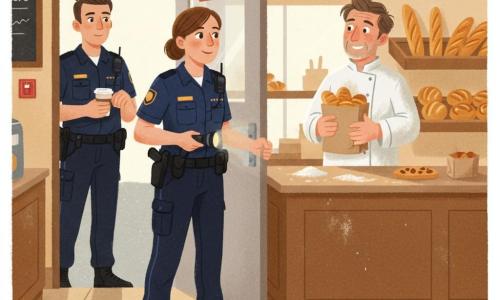
As kids gathered along the chalk lines near the crosswalk, Theo waved to Mr. Garcia, who was sliding trays of rolls into the bakery window.
“Save me a cinnamon roll?” Theo called.
“For the man who keeps my delivery truck from blocking the hydrant? Always,” Mr. Garcia replied.
Theo smiled. The exchange was easy, but under it sat a steady purpose. The hydrant had to stay clear. If a fire engine ever needed it, seconds would matter. Many things he did were like that cone: small, bright, and meant to prevent bigger trouble later.
His radio murmured with a morning briefing from the station. The voice of the supervisor was calm and clipped. Construction on Pierce Avenue, expect delays. A community meeting at seven tonight in the library about the new park plans. Stop by if you can. Everyone check your first-aid kits and defibrillator batteries. The tone was friendly, almost like a teacher organizing a class. Theo liked that. It made him feel as though his day had shape.
He sipped warm tea from a travel mug and checked his notebook. He kept a list, each item marked with a square. The satisfaction of turning squares into checks never faded. There was a call to visit the senior center about a talk on phone scams. There was a reminder to call Ms. Patel, the fifth-grade teacher, who wanted to schedule a tour of the station. He had scrawled a star next to that. He liked showing kids the inside of things, how the pieces fit together, how people worked quietly to keep a town ticking.
A gust of wind made the crossing guard sign wiggle in Mrs. Wu's hands. She planted her feet and raised it like a lighthouse. Theo stepped out of his car, and Mrs. Wu smiled and nodded toward a line of bikes.
“You've taught them well,” she said. “Look at those helmets.”
“We teach each other,” Theo replied. “And sometimes a sticker helps.”
A little boy with a backpack shaped like a whale shuffled up, shoes untied. He looked uncertainly at the line of sidewalk chalk. Theo crouched.
“Nice whale,” he said.
The boy glanced at him, then at his laces.
“Want to learn a double knot?” Theo asked.
The boy nodded, and Theo showed him slowly, the loops a pair of hugging minnows. The boy's hands copied his, clumsy but determined.
“That knot will hold while you run,” Theo said softly. “That's what a good rule does.”
He stood as a delivery van turned the corner and paused too close to the curb cut where strollers and wheelchairs rolled. Theo offered a palm-out gesture, friendly but firm, and the driver adjusted without fuss. It felt good when a small motion got a big result.
His phone buzzed with Ms. Patel's number. He answered.
“Good morning, Officer Morales,” Ms. Patel said. “Do you have time to talk about our class visit to the station?”
“I was just hoping you'd call,” he said. “Let's make it the kind of visit no one forgets. How many students?”
“Twenty-four, plus two chaperones. They're curious and very opinionated.”
“That's my favorite kind,” Theo said. “I'll show them how we listen to different opinions and find fair paths.”
“We want them to understand what you really do,” Ms. Patel said. “Not just what they see on TV.”
“Perfect,” Theo replied. “Plan on Friday morning?”
“Done,” she said. “And, Officer Morales?”
“Yes?”
“They've been learning about fairness. I think they'll be ready.”
“So am I,” he said.
He clicked off, the word fairness humming in his head like a quiet engine. Fairness wasn't a fence you stood behind. It was a place you walked to, deliberately, step by step. He liked the work of walking.
As the first bell rang at the school, the street shifted. Parents waved and stepped back. Mrs. Wu lowered her sign like a curtain after a matinee. Theo checked the curb again, nudged the cone, and slid back into his car. He liked this part: the moment between two tasks when the day felt like a map and he got to choose the next road. He tapped the first square on his list and made a neat check.
His radio crackled: A neighbor had called about a dog trotting along Maple without a leash. Not an emergency, just an animal with the morning zoomies. Theo drove slowly until he spotted the spaniel nosing a storm drain.
“Hey, friend,” he said out the window, his voice low and cheerful.
The dog wagged and stayed put, tail drawing happy commas in the air. He hopped out, crouched, and read the tag. There was a number. He dialed.
A sleepy voice answered. “Hello?”
“Hi there. This is Officer Morales. I found a brown-and-white champion sniffler on Maple. Is this his person?”
“Oh my goodness,” the voice said, waking up all at once. “Yes! I didn't even realize the gate didn't latch. I'm coming now.”
Theo waited with the dog, scratching ears and letting himself feel the simple joy of companionship. When the owner arrived, breathless and grateful, he handed over a sticker and a neighborly reminder about latches. He didn't write a citation. A sticker, a smile, and a suggestion were enough. Prevention often looked like kindness wearing a reflective vest.
By the time he turned toward the park, the day had stretched like a yawn. He was thinking about what to show the students on Friday. The radio room, where voices braided together like streams and became decisions. The community room, where meetings about traffic, trees, and playground fences were sometimes as dramatic as any show. The equipment room with rows of flashlights, each one checked and charged because light mattered. And the wall where the department's code of ethics hung: a few paragraphs that tried to fit the size of a promise.
He tapped his notebook with a pencil. He wrote: Fairness game? Listening circle? Invite Mrs. Wu? He chuckled. A station tour with a crossing guard cameo would be a treat.
At the park, children spun on a tire swing as if stirring a pot of morning. Theo stepped into the day with the feeling of stepping into a story that would be told with inside voices and bright ideas.
Chapter 2: The Listening Bench
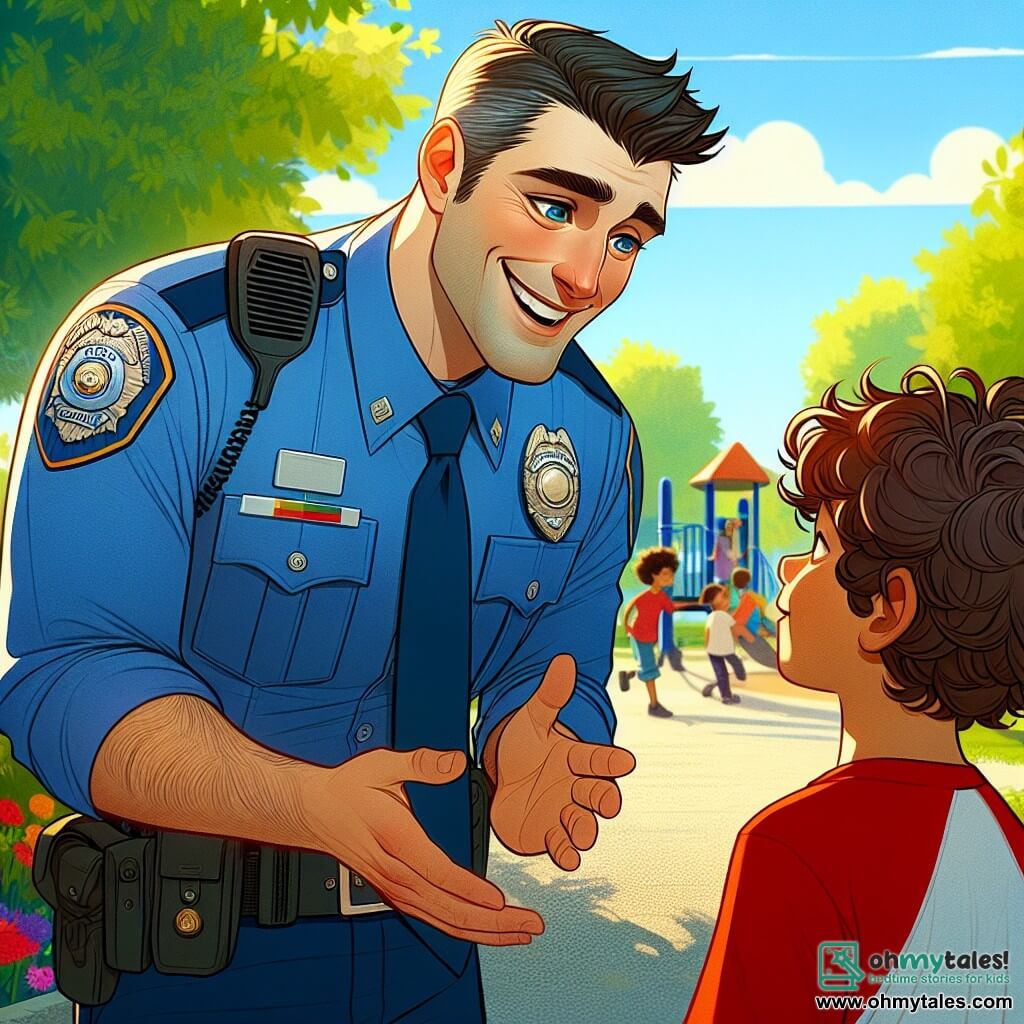
A blue-painted bench sat under a wide elm by the park's path. Someone had attached a small sign: Listening Bench. Sit here if you want to be heard. Theo liked the bench because it told the truth. Listening wasn't magic, but it felt like it when someone did it right.
He adjusted his jacket and took a seat. The bench creaked in a friendly way. A boy in a red hoodie skidded his skateboard to a stop nearby, then picked it up and cradled it like a turtle.
“Are you the police officer who gives out star stickers?” the boy asked.
“I'm the police officer who listens, and sometimes I bring stickers,” Theo said.
The boy looked thoughtful. “My name's Jamal. The music store lady keeps telling us to stop skating by the window because it rattles the guitars. But the sidewalks are smoother here.”
“What have you tried so far?” Theo asked.
“Skating quieter?” Jamal said, shrugging.
“That's a start,” Theo replied. “Let's go talk to her together. If we listen, we might find something that works for both the wheels and the guitars.”
They walked to the music store, bells on the door jingling like a small percussion band. Ms. Luna, who ran the store, looked up from polishing a trumpet.
“Morning, Officer Morales,” she said. “And Jamal. I've already asked them to skate farther down, but the window's old. It hums.”
Jamal scuffed his sneaker. “It's just—this is the smoothest spot.”
Theo nodded toward the guitars, which hung on the wall like wooden suns. “They are beautiful and sensitive,” he said. “Maybe we can make a plan that treats the guitars like sleeping babies and the skaters like athletes warming up.”
Ms. Luna smiled a little. Jamal's mouth twitched, almost a smile.
“What would help you feel better, Ms. Luna?” Theo asked.
“Less rattling,” she said. “Between eleven and two, when I give lessons, especially.”
“What would help you, Jamal?” Theo asked.
“A place that isn't cracked every meter,” Jamal said. “We practice tricks and need a run-up.”
Theo nodded. “What if we mark a skate-free zone near this window during lesson hours, with chalk lines to remind everyone, and I'll ask the parks crew if they can smooth the patch by the basketball court. I can't promise a new sidewalk, but I can promise to ask. And I can bring cones until then to define a ‘quiet lane.'”
Ms. Luna tapped the trumpet. “I can live with that.”
Jamal looked at the floor, then up through his lashes. “Me too. And I can tell the others.”
“Great,” Theo said. “Two yeses is a good morning.”
He set two small cones on the sidewalk and chalked a gentle curve that almost looked like a smile. Jamal spun his board by one wheel and nodded. Ms. Luna rolled out a sign that read, Lesson Hours: Please No Skating Here. He left them talking about favorite guitar songs, an unexpected bridge between them.
Back under the elm, a girl with a domino-patterned headband approached the Listening Bench with determination. She sat, feet swinging above the gravel.
“I'm Anaya,” she said. “Is it true you're letting our class visit the station on Friday?”
“It is,” Theo said. “What do you want to see most?”
“Where you keep all the clues,” she said. “I love mysteries.”
Theo smiled. “Most of our clues are made of words. Notes. Reports. Stories that people tell us. We keep them organized so we can test if they make sense.”
“Do you have a clue room?” Anaya asked.
“We have a room for evidence when a case is serious,” he said. “But most days, the biggest evidence I work with is a conversation, or a pattern I notice when I look at all my notes. We like to solve things before they become big. That's called prevention.”
Anaya nodded. “My aunt says you're always writing. What do you write?”
“I write what people say, what I observe, and what I do,” Theo said. “It helps me remember, and it helps others check my work. Checks are part of being fair.”
She tilted her head. “Do you get to decide what's fair?”
“I get to practice being fair,” he said. “That means I listen to everyone involved, I try not to make up my mind too soon, and I follow rules that are meant to treat people equally. The rules are like the guardrails on a bridge.”
Anaya seemed to like that. She pressed her shoes together and smiled. “I want to be part of that.”
“You already are,” Theo said, and handed her a small card with the station's non-emergency number. “If you ever see a problem that isn't dangerous but needs attention, you can call this. That's part of fairness too—knowing which tool to use.”
From the playground, a parent waved. It was Mr. Singh, holding two coffees like careful chemistry beakers. He offered one.
“Peacekeeping juice,” he joked.
“I'll never say no to that,” Theo said.
Mr. Singh leaned on the bench back. “My twins can't wait to see the station. They think you sit in a chair and look at a wall of screens.”
“Sometimes,” Theo said. “Mostly, I sit with people and talk. Sometimes I sit on a curb with someone who's had a rough day and give them a bottle of water. And sometimes I sit with someone who made a mistake and explain what happens next, slowly and respectfully, because understanding matters.”
Mr. Singh nodded. “That's the part I want them to know. That you're part of our ‘us.'”
“That's the goal,” Theo said quietly. “All of us.”
He looked up through the elm's leaves, green light flickering. He thought of the station tour, of kids' hands touching the radio room's big map, of explaining difference between 911 for emergencies and the station's non-emergency line for things like a broken streetlight or a suspicious noise that keeps recurring at the same time each night. He pictured showing the reflective vests, bright as sunflowers, and the little cards they carried that explained people's rights in simple words. He'd tell them: You can ask questions. You deserve to be treated with dignity. You matter.
A text pinged his phone. It was from Mr. Garcia the baker: Pots knocked over. Not sure if kids. Can you swing by? Theo's fingers flew a quick reply—On my way—and he stood, feeling his purpose sharpen the way a pencil does when it meets a blade. He waved to the park, to Anaya, to the Listening Bench itself, then set off down Maple, where every front yard felt like a chapter he knew how to read.
Chapter 3: The Case of the Tipped Pots
The sidewalk outside Garcia's Bakery always smelled like sugar and patience. Mr. Garcia kept geraniums in terracotta pots on the ledge below the front window. They were like flags of cheerful red, inviting people to stop and say hello. Today, two pots lay on their sides, a scatter of dirt like coffee grounds across the concrete. A few red petals clung to a clump of roots, looking brave.
Mr. Garcia stood with his hands on his hips, concern furrowing his forehead. A neighbor, Ms. Cho, hovered nearby with her postal bag slung across her chest, and a teen in a baseball cap—Kofi—leaned on his bike.
“I don't like it,” Mr. Garcia said. “Who would do this?”
“We shouldn't jump to who,” Theo said, taking out his notebook. “Let's start with what and when.”
“Between closing and now,” Mr. Garcia said. “I locked up at eight and came at six.”
“Any other signs?” Theo asked, crouching to peer at the soil. He noticed little crescent shapes in the dirt, as if someone had pressed something like coins.
Kofi whistled low. “Looks like footprints. Teen-sized.”
“They look like marks from a cart wheel,” Ms. Cho said sharply. “I saw a delivery late last night across the street.”
Theo held up a hand gently. “Let's collect the pieces. I see curved impressions that could be a wheel. I also see crumbs.” He pointed to a faint sifting of powdered sugar leading toward the alley. A trail of sweetness. Not very criminal.
Kofi brightened. “Maybe a raccoon threw a party.”
“I'll keep that as a theory,” Theo said, smiling. “Mr. Garcia, do you have a doorbell camera?”
Mr. Garcia nodded. “It doesn't see the ledge, but it catches the sidewalk.”
“Let's take a look,” Theo said.
Inside, among the good smells and the soft coughs of ovens, they watched the black-and-white footage on Mr. Garcia's phone. For a while, nothing happened. The street was a loaf, rising slowly in darkness. Then a gust of wind pushed hard; you could see the tree limbs in the reflection bow. A bicycle with no rider leaned against the lamppost and shuddered. Just after that, a rectangle moved into view—someone pushing a delivery cart at a sensible, not suspicious pace. The cart's back wheel bounced over a crack, wobbled, and the cart clipped the corner of the ledge. One pot wobbled, teetered, and fell. The person didn't seem to notice and rolled on. A minute later, a scruffy dog on a nighttime mission trotted past, sniffed, and nuzzled the fresh dirt. Its paws printed those crescent shapes.
Theo paused the video, noting the time. He looked at the outside view again. The second pot, he suspected, had been toppled by the wind after its neighbor fell and shifted the arrangement.
“Accident,” he said simply. “From a delivery cart, plus wind. The paw prints are from a dog. No vandals, no intention. Just movement and gravity.”
Mr. Garcia exhaled so long it felt like a gust of relief. “I'm glad. I didn't want to think badly of our kids.”
“We shouldn't decide without listening to what the world is showing us,” Theo said. He crouched by the pots, righted one, and gathered the spilled dirt with his hands. Kofi set down his bike and joined, then Ms. Cho knelt too, scooping soil into the pot like it was a return journey.
“I'll call the delivery company and let them know to take the corner wider,” Theo said. “And I'll ask the city to smooth that crack. Meanwhile, Mr. Garcia, we can put little wedges under the pots so they're less likely to tip.”
Kofi wiped his hands. “I can cut rubber squares from an old bike tire,” he offered. “My dad has one in the garage.”
“That's excellent prevention,” Theo said. “Small things that keep other small things from becoming big.”
Ms. Cho cleared her throat. “I'm sorry I jumped to a conclusion. I deliver mail. I should know that evidence tells the story.”
“Apology accepted,” Mr. Garcia said warmly. “I'll give you extra cookies anyway.”
Theo smiled as he wrote his notes. He liked these endings—where the mystery was solved not by catching someone but by paying attention. He called the delivery company, and the manager thanked him for the heads-up, promising to remind drivers to slow near the corner. He sent a request to the city about the crack, attaching a picture. The system wasn't magic. It was people sending thoughtful messages back and forth until something got fixed.
A shadow fell across the doorway. It was Anaya from the park, peering in as if the bakery itself was a novel she was curious about.
“Did you find a clue?” she asked.
“We found a chain of events,” Theo said. “Wind and wheels and gravity. And a dog.”
Anaya nodded. “That's a good twist.”
“We also figured out how to prevent a sequel,” he said, pointing to where Kofi was now trimming a square of rubber. “You see, we don't just write up what happened. We try to make the next page turn more gently.”
Anaya thought about that. “For our visit on Friday, can we see your notebook?”
“You can,” he said. “I'll show you how I date every entry and write down who I spoke with, and how I check my words later to make sure they're clear. Writing clearly is a kind of honesty.”
Mr. Garcia slid a plate of tiny cinnamon rolls onto the counter, each one glazed like a shiny penny. Theo took one and mmm'd in a way that made Mr. Garcia laugh. He slipped some napkins into his pocket for later. He thanked everyone, promised to stop by again, and stepped back into the morning that was now fully awake.
Near the corner, a woman with a stroller waved him down. “Officer, which number do I call to report a streetlight that buzzes and flickers?”
“For a streetlight, the city maintenance line,” he said, and gave her the number printed on a small card. “If you forget, you can call the station's non-emergency line and we'll point you in the right direction.”
She smiled. “Thanks. I like that you have the numbers ready.”
“It's like having all the right spices next to the stove,” Theo said, and she laughed.
He returned to his car and wrote another check in his notebook: Bakery pots—accident. Prevention: rubber squares, driver reminder, crack repair request. He liked the neat box around those words. He liked that when he closed the book, the story was still open in the world: people who would do their small part. He started the engine, the radio murmuring again about the day. He hoped the station tour would feel like this—like stepping behind the scenes and seeing how many hands carried the weight of one town.
He drove toward the station, thinking about the game he would set up for the kids. Maybe a fairness exercise where they had to share cones for different pretend tasks: directing school traffic, helping at a fun run, covering a playground crossing. They'd have to decide where to place the cones for the best safety. There would be no right answer, only a more careful one. He smiled, enjoying the puzzle even before it existed.
Chapter 4: The Station, Unwrapped
The station sat on the corner of Maple and Third, a brick building with wide windows and a flag that raised and lowered on time, the way everything inside tried to. The lobby was a small, sun-bright room with chairs that didn't pretend to be sofas but weren't cold either. Theo liked the lobby's bulletin board. It held flyers for the farmers' market, a self-defense class, a poster about recognizing phone scams, and a printout of the department's promise: We will treat you with respect. We will listen. We will explain what we are doing. We will be fair.
He met with the desk officer, Lynn, who had a voice like a morning radio host and a laugh that made people exhale. “Friday tour?” she said, adding a star to the calendar near her computer. “Love it. I'll make sure the community room is free, and I'll ask Dispatch if we can do a short radio demonstration.”
“Thanks,” Theo said. “I'm setting up stations—listening, learning, and a tiny bit of pretending.”
He walked down the hallway, his steps softened by rubber-mat runners. A whiteboard listed shifts and notes: School liaison meeting at 3. Downtown street fair on Saturday: bring cones. Theo skimmed the board the way you run your hand above grass to feel if it's wet. It told him much all at once.
He paused at the radio room. Headsets rested on hooks. Maps covered one whole wall, layered with clear panels that could be written on and wiped clean. Dispatchers sat in chairs that made them look like pilots in a cockpit. Their fingers danced, but it wasn't a dance of panic; it was a careful choreography. Voices threaded through the room, each one distinct. The dispatcher on duty, Arturo, waved Theo in.
“Can we show the kids how we find units on the map?” Arturo asked.
“If you can spare a minute,” Theo said. “I'd like them to see how we answer calls, too. The difference between an emergency and something that can wait.”
Arturo nodded. “People ask great questions when they see what we see.”
Theo walked past the equipment room, where the shelves were tidy. Flashlights sat in their chargers like a row of lighthouses resting. Reflective vests were folded like triangles of citrus. First-aid kits had their zippers closed but ready. Radios sat humming to themselves. He ran a hand along a shelf and felt the smooth plastic curve of a traffic wand. He liked the everydayness of tools. They were honest. They were there to be used and then put back.
In the community room, he set out chairs in a circle. Circles made people face each other. He placed a small sign on a table: Words We Use to Be Fair. Next to it, he laid out cards with words: Listen, Ask, Explain, Decide, Review. He stacked the cones in the corner. He wrote on the board: Fairness is not two sides tugging; it's everyone holding the middle steady.
A knock tapped the doorframe. It was Theo's nephew, Milo, with his mom. Milo was eleven, all elbows and eagerness. They'd agreed to meet so Theo could see how the tour might feel to kids the age of Ms. Patel's class.
“Uncle Theo!” Milo said, the words fast like a small bird hopping. “Is this where the radio magic happens?”
“It is,” Theo said. “Want to help me test the stations?”
Milo touched the cones, made a little tower, then looked at the circle of chairs. “What's with the circle?”
“That's where we do our listening,” Theo said. “Everyone gets to look everyone in the eye.”
Milo sat and swung his feet. “Okay, pretend I'm a kid on the tour.”
“Pretend?” Theo teased, and Milo rolled his eyes.
“Say I ask, do you ever mess up?” Milo said.
Theo sat across from him, hands folded. “Yes,” he said. “I'm a person. I can make mistakes. I try hard not to. When I do, we have ways to review. My supervisors, body-worn cameras, written reports—these help us look again. Sometimes people from outside the department look too. We want to catch mistakes and fix them. That's part of fairness.”
Milo nodded slowly. “What if someone is rude to you? Do you get to be rude back?”
“No,” Theo said. “I can be firm without being rude. I'm trained to calm things down. My words can be like the cones we set out in the street—to guide people without pushing them.”
Milo considered. “What if two people think the rules say different things?”
“I explain what the law says,” Theo replied. “I listen to their stories. Sometimes I mediate. If it's something that needs a judge to decide, I help start that process the right way. But a lot of disagreements can be solved by thinking about what's safe and fair for everyone.”
Milo's mom, Lily, picked up one of the word cards and smiled. “Review,” she read. “I like that. Do you ever review and realize you could have explained something better?”
“Every week,” Theo said, honest and easy. “I practice. I talk with other officers about how to say things clearly and kindly. We learn from each other.”
They toured the rest of the station. Theo showed them the small gym where officers stretched and did boring but important exercises that kept backs from getting hurt when lifting heavy stuff like traffic barriers. He introduced them to Lynn at the front desk, who handed Milo a sticker and asked him how sixth grade was going as if she had known him for years. They peeked at the evidence room door, which stayed closed with a keypad, because respect for rules meant even officers followed them. He pointed to a poster about first aid and explained that all officers learned CPR, how to stop bleeding, and how to spot when someone needed to see a doctor right away.
They returned to the community room to test the “cones game.” Theo set three maps on the floor: the school drop-off loop, the town square for a festival, and a playground crossing. He handed Milo a small stack of cones.
“Place these where you think they'd do the most good,” Theo said. “You have five cones for each map. Talk through your choices.”
Milo crouched. “Okay, at the school, one at each end of the crosswalk, one near the bus door, one where the curve is too tight, and one by the sign that says No Parking but everyone forgets.” He looked up. “Is that fair?”
“It's thoughtful,” Theo said. “That's the goal. Fairness starts with thought.”
Milo beamed. “Can I try the radio room now?”
They stepped into Dispatch again, where Arturo lifted a headset onto Milo with a grin. “Press that button, and you'll hear the weather alert,” Arturo said. “Don't talk. Listen.”
Milo listened, eyes wide at the stream of information that sounded like calm water with a direction to it. He took off the headset.
“Your job is like a big group project,” he said to Theo. “But you never turn your part in late.”
Theo laughed. “We try not to.”
As they walked back to the parking lot, rain dots began to speckle the pavement—just a few, like the sky was trying out a recipe. Lily opened an umbrella.
“Your tour is going to be good,” she said. “It feels like a tour of how to be a person.”
“That's what I want,” Theo said. “A tour of how to be a neighbor who wears a uniform.”
He watched them drive away and felt a warm clarity. He went back inside to write notes on the whiteboard for Friday. He added: Bring extra water cups. Ask kids: What does fairness feel like? He copied the question into his notebook too, because he wanted to remember to ask it of himself.
Chapter 5: The Day of the Visit
Friday morning arrived with a sky the color of a fresh page. Theo arranged the chairs again, adjusted the stack of word cards, and tested the flashlight chargers one more time. He filled a pitcher with water and set out a sleeve of paper cups. He pinned his name tag straight. People read names as if they were exactly what they are: an invitation to say hello.
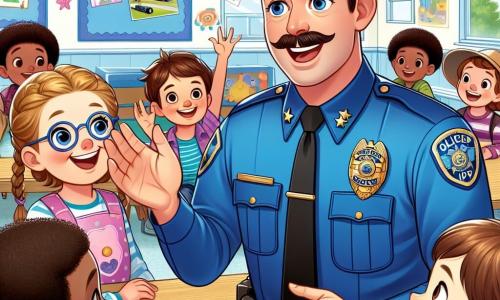
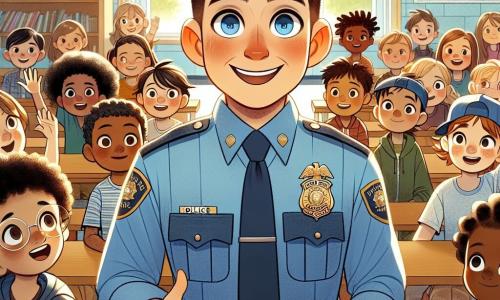
The first wave of voices came before the kids. It was Ms. Patel and two chaperones, checking headcounts in the lobby. Then came the students, stepping into the room like explorers. Anaya waved. Jamal from the skate debate raised a hand. Theo recognized Mr. Singh's twins, their ponytails swinging like metronomes.
“Welcome,” Theo said. “I'm Officer Morales, but you can call me Officer Theo today if that's easier. This place belongs to all of us. I'm glad you're here to see how it works.”
He led them to the radio room. Arturo kept it short and lively, showing how calls popped onto screens and how they decided which officer to send. He played an example of a non-emergency voicemail about a streetlight, and then an example of an emergency: a person having chest pain. The difference was clear in the tones, the urgency, the words.
“Questions?” Theo asked when they stepped into the hall.
“What happens if someone calls 911 by accident?” a girl with a green scrunchie asked.
“We call them back to make sure everything is okay,” Theo said. “It's always better to check.”
“Do you ever get scared?” another boy asked, his voice trying to sound casual but not quite.
“I get alert,” Theo said. “It's different from fear. I notice more. I breathe slower. I use what I practiced. If I'm really worried, I ask for help. We help each other.”
They visited the equipment room, and every flashlight got a moment of admiration. Theo explained that they checked their gear at the start of each shift not because it was fun—though flashlights were fun—but because readiness was a way to respect the people they served. In the community room, he had them take seats in the circle and placed the word cards in the middle.
“Today,” he said, “we're going to talk about fairness. Not the kind where you slice cake with a ruler, though that's sometimes useful. The kind where you listen for the truth and make choices that help as many people as possible.”
Ms. Patel smiled at the cake image. The students leaned in.
“Fairness is like holding a rope steady while two groups pull,” Theo continued. “You don't get to drop the rope. You don't yank it toward your favorites. You keep it steady so people don't fall. You explain what you're doing. And afterward, you look at your hands. Were you steady? Could you be steadier?”
He looked around the circle. “What does fairness feel like to you?”
“Being heard,” said Anaya.
“Getting the same chance,” said Jamal.
“Rules that make sense,” said one of the twins. “And someone telling me why the rule exists.”
Theo nodded at each, placing their words carefully in his mind. He explained that when he listened to people in a disagreement—like the skaters and the music store—he asked the same three questions: What happened? How did it affect you? What would make it right? He told them how those questions help even when there's no law broken, just feelings and needs.
He described the difference between laws and rules, too. Laws were the big rules the whole community agreed on through their councils and representatives. A store's rule about no skating was smaller, but it still mattered because it protected fragile things. Police didn't make laws. They learned them, enforced them with care, and explained them kindly. And they took action when someone was in danger, choosing the safest paths they could find.
“Let's play a game,” he said. “The cones game. You have three tiny towns on these maps. You have five cones for each. Where will you put them? Tell me why.”
The class split into groups and moved like a bright spill of marbles around the room. Discussions blossomed. At the school map, they argued gently about whether the cone near the bus door mattered more than the one by the No Parking sign. At the festival map, they debated how to make the vendor lanes clear without trapping strollers. At the playground crossing, they placed cones to slow bicycles before the crosswalk, a compromise that made skateboarders and parents nod.
He loved the way kids explained things to each other. They had the knack of making ideas look like shapes in the air. When they presented their choices, they used the word “because” often, which to Theo was the best word in the English language. Because meant they were thinking.
Halfway through, the sky shifted from page-blue to pencil-gray. Rain tapped at the windows. Lynn peeked in. “Just so you know, we've got a sudden downpour,” she said cheerfully. “You might hear the lobby door pop if the wind pushes it.”
“Thanks,” Theo said. He refilled the water cups and carried them around the circle like a waiter at a small party.
A knock sounded at the community room door. An older man in a yellow raincoat stood there, hat in hand, looking apologetic. Lynn hovered behind him. “This is Mr. Alvarez,” she said. “He came to file a lost property report. He left his car in Zone B last night and can't find it now. We're a little short in the lobby because of the rain, so I wondered if you could say hello while he waits. He might enjoy the kids' game.”
Theo nodded and waved Mr. Alvarez in. “Come see how we figure things out,” he said. Mr. Alvarez smiled in a way that wrinkled his face like tissue paper.
“Is this all right?” Ms. Patel murmured.
“It's perfect,” Theo said. “They'll see how we help with ordinary problems.”
Mr. Alvarez watched the playground map group debate cone positions, his eyes bright with interest. Then he sighed softly. “I'm sorry to interrupt. I'm just getting old. Zone B looked like Zone C in the rain.”
“That happens,” Theo said. “We'll help you find it. Do you remember any landmarks?”
“The big mural with the birds,” Mr. Alvarez said. “But then there was a delivery truck, and I got turned around.”
Anaya raised her hand without meaning to. “Maybe it's like the bakery pots,” she said. “We need to think steps.”
“Let's make steps,” Theo agreed. He turned to the class. “This is ordinary police work, too: helping someone find their way. What's Step One?”
“Don't panic,” Jamal said.
“Good,” Theo said. “Step Two?”
“Ask questions,” said a twin.
“Step Three?” Theo asked, looking at Mr. Alvarez.
“Tell the truth, even if it sounds silly,” Mr. Alvarez said shyly. “I thought I remembered a statue, but it might have been a traffic cone.”
Theo laughed kindly. “That's not silly. Cones are very heroic statues in their own way.”
They gathered bits: the time he had parked, the corner bakery he'd gone to, the birds on the mural, and the way the wind had sent his hat flying. Theo dialed the parking office to check if a car had been towed. It hadn't. He asked Lynn to check the security camera facing Zone B. She did, then called back: A car matching Mr. Alvarez's had driven out at 9:10 a.m.—and had turned left, toward Zone C. Theo looked at Mr. Alvarez.
“Did someone else drive your car this morning?” he asked.
“My son,” Mr. Alvarez said, smacking his forehead gently. “He said he might move it closer to my appointment. I forgot. He must have moved it to Zone C. I'm sorry to bother you.”
“It's no bother,” Theo said. “This is what we do. We help problems tell us what they really are.”
The kids grinned. The air in the room felt like a solved puzzle. Theo walked Mr. Alvarez back to the lobby and wrote a quick note for the file: Citizen in lobby, thought vehicle was missing, found to be moved by family member. Assisted with check. No further action. He liked writing “no further action.” It often meant peace.
When he returned to the community room, the lights flickered once, a small surprise. The rain thudded harder on the roof. The door to the hallway bumped open, ushered by a gust. Lynn called, “All good!” from the front, and Theo gave a thumbs-up. He stepped into the circle.
“This is a good moment to talk about calm,” he said. “Sometimes things flicker. Our job is to do what Lynn just did: check, communicate, and keep going.”
He handed Jamal a card with the non-emergency number. “For flickers,” he said. “Save 911 for when someone is in danger or needs medical help now.”
They finished the cones game and gathered in the circle. Theo traced the word cards with his finger. Listen. Ask. Explain. Decide. Review. He took a breath.
“Before you leave,” he said, “I want to tell you something I tell myself before I start each shift. I say it like a quiet promise. Maybe you'll find your own version. I say: Today I will help where I can. I will listen fully. I will be fair and explain my fairness. I will remember that the person in front of me is someone's child, someone's friend, someone who matters.”
The room held the words gently. Ms. Patel's eyes shone like lake water at dusk. A boy in a basketball hoodie raised his hand.
“What do you do when people don't like you?” he asked. “Like, just because you're a police officer.”
“I keep being the kind of police officer I wish they'd met first,” Theo said. “I can't control how people feel about the uniform. I can control how I act in it.”
Another hand. “Do you ever laugh at work?”
“All the time,” Theo said, smiling. “Not at people. With people. Laughter is a good glue for a community.”
He stood and clapped his hands once. “One more thing. We have a front lobby bell that sometimes sticks. It dings twice when the wind pushes the door, and a little zing when someone actually opens it. The difference matters. On your way out, stand still in the lobby for a second with your eyes closed. Listen for the double ding and the zing. It's good practice for life: noticing small differences.”
They walked to the lobby, where the rain was starting to soften. The group paused. The door creaked with the wind—ding-ding—and then opened as someone came in—ding-zing. The students smiled, finding the music in it. Mr. Garcia stepped in, water dots on his shoulders. He held a tray.
“I brought treats,” he announced. “Permission to turn your lobby into a small bakery?”
“Always,” Lynn said, guiding him to the side table.
“Mr. Garcia solved a mystery with me this week,” Theo told the class. “It involved wind, wheels, and a dog.”
“Sounds delicious,” Ms. Patel said, and everyone laughed.
They ate tiny cinnamon rolls and brown-bag cookies that made the room smell like Saturday mornings. Theo thanked Mr. Garcia, and Mr. Garcia thanked everyone for not letting his pots become a grumpy story. Jamal told him about the cones outside the music store window. Ms. Luna walked in too, as if drawn by the aroma, and called out, “The quiet lane is working. The guitars are napping peacefully.”
It felt like a small town inside a small building inside a large storm that was already thinking about passing. Theo stood near the door and watched his visitors button jackets and tug hoods. He handed out stickers shaped like stars and cards with numbers and shook hands both serious and silly.
As they filed out, Anaya lingered. “I liked the word ‘review,'” she said. “It's like saying, I like stories so much that I read them twice.”
“Exactly,” Theo said. “Review is how we show we respect the story.”
She drew a shape in the air with her finger—a circle. “Thanks for showing us the middle and the edges.”
He nodded. “Thanks for helping me hold the rope steady.”
When the last student was gone, the station felt quiet in the good way, like an instrument that had just been tuned. Theo went back to the community room to clean up. He stacked the chairs, loaded the cones into their bin, and tucked the word cards back into their envelope, the way you would tuck a note into your wallet because you want it close.
He sat for a moment in the circle that was no longer a circle and thought of the day: the listening, the laughter, the small gust that pushed the door, the way the light flickered and then returned as if remembering itself. He thought of Mr. Alvarez's lost car that wasn't lost. He thought of the bakery pots that had fallen and been righted and how the red flowers looked determined and unbothered, the way some people look after a good nap.
He opened his notebook and wrote a final entry for the day: Class tour—questions about fairness. Showed Dispatch and equipment. Cones game successful. Mr. Alvarez assisted—vehicle moved by family. Rain. Lobby bell—teaching moment. Reviewed promise to self. He added a small star in the margin. The star was a code only he needed; it meant something more than routine had happened. It meant he had felt the shape of the work and the way it fit his hands.
As he closed the notebook, his radio murmured with the afternoon shift checking in. He stood, stretched, and felt the day settle around him like a jacket that fit. He walked to the lobby, where the bulletin board waited with its bright flyers, and pinned a new one he had made: Station Visit—Thank You, Ms. Patel's Class! He used two pushpins, one for each corner, because things held up better that way.
Outside, the rain had eased to a polite mist. The maple leaves held beads of water like tiny glass marbles, and when a breeze moved through, the beads rolled and fell and disappeared into the sidewalk where someone else would walk. Theo stepped out into the afternoon, turned his face to the soft light, and felt in his pocket for a sticker. He found one, pressed it to his thumb, and smiled at the star. He had work to do, simple and steady. He was part of a net that you only noticed when something needed catching—light, strong, and held by many hands.
He thought about fairness again, not as a thing he had to chase, but as a place he could help others stand. Not far away, a crossing guard lifted her sign. A boy tied his double knot like a little sailor. Somewhere, a delivery cart took a corner wide. Everywhere, the town continued, humming and breathing and practicing being good to itself. And Officer Theo Morales, a neighbor with a badge, walked along Maple Street, his steps a quiet promise that would begin again tomorrow.