Chapter 1
Officer Maya Chen tightened the laces on her black boots and checked the mirror in the station locker room. Her uniform looked neat, like it had been ironed by a very serious robot. She smiled anyway.
“Ready for another night shift?” asked Officer Patel, leaning in the doorway with a paper cup of tea.
“As ready as anyone can be at eight p.m.,” Maya said. “My brain thinks it's bedtime.”
“That's why we have tea,” Patel replied. “And because people need us, even when our brains want blankets.”
Maya clipped her radio to her shoulder, ran through her checklist—badge, notebook, torch, gloves—and stepped out into the cool evening. The city was quieter at night, but not asleep. Streetlights hummed. A bus sighed at a stop. Somewhere, someone laughed.
Maya and Patel walked to their patrol car. On the side it read: COMMUNITY POLICING UNIT.
“That sounds friendly,” Maya said once, when she first joined. Her supervisor had nodded.
“It's supposed to be,” the supervisor had said. “We prevent problems. We talk. We listen. We help. We're firm when we need to be, but the goal is safety, not scaring people.”
Tonight, Maya wanted to do exactly that.
They drove past a row of shops, then a small park where the swings moved a little in the wind, as if invisible kids were finishing one last turn.
Maya tapped her notebook. “I'm going to write down three things I notice tonight,” she said. “Not crimes. Just… details.”
Patel grinned. “Detective of the ordinary.”
“Exactly. Ordinary is where most of policing happens.”
Their radio crackled softly with updates—lost keys found, a noise complaint solved by someone turning down music and apologising. Nothing dramatic. Just people living close together and learning how to share space.
Maya felt her shoulders relax. This was the kind of shift she liked: calm, useful, and full of chances to talk.
Chapter 2
They parked near the community centre, where a bright poster on the door read: “Neighbourhood Youth Club—Board Games Night!”
A group of preteens spilled out, laughing loudly like laughter was a sport. One boy held a cardboard crown. A girl wore it for exactly two seconds before it slid over her eyes.
Patel nodded toward them. “Good place to be on a Friday night.”
Maya stepped out of the car and walked over, keeping her hands visible and her face friendly. “Evening,” she said. “Who's winning?”
The crowned boy lifted the crown like a trophy. “Me. Obviously.”
The girl who'd worn it snorted. “He cheated. He tried to hide an extra card in his sleeve.”
“It was a magic trick,” the boy said, trying to look innocent and failing.
Maya chuckled. “Here's a question. If you win because you cheated, do you actually win?”
They all paused like someone had turned off the music.
“Um,” the boy said, “you win the game?”
“But you lose trust,” Maya said gently. “And trust is harder to win back than a board game.”
A tall kid with curly hair leaned closer. “Are you a real police officer?”
Maya tapped her badge. “Real. And tired.”
They laughed.
“Do you catch bad guys?” the curly-haired kid asked.
“Sometimes,” Maya said. “But most of my work is helping people solve problems before they become big problems. Like making sure everyone gets home safe, and helping neighbours talk instead of shout.”
The girl tilted her head. “So you're like… a referee?”
“A bit,” Maya said. “Except the rules are about keeping people safe. And I don't carry a whistle.”
The crowned boy squinted. “Then why do you have handcuffs?”
“Good question,” Maya said. “They're a tool, like a fire extinguisher. You hope you don't need them. But if someone is in danger, I have to act quickly. Mostly, though, I use my voice. I ask questions. I listen.”
Patel added, “And we write reports. Lots of reports.”
Maya made a serious face. “The paperwork is the real villain.”
That got a new wave of laughter.
Inside the centre, an organiser waved. “Officer Chen! We've got hot chocolate if you want some.”
Maya stepped in for a moment. The room smelled like cocoa and marker pens. A few kids were setting up a game on a long table—colourful pieces, tiny dice, rules that looked like they had their own rules.
A boy with glasses pointed to Maya's radio. “Does that talk to other officers?”
“Yes,” Maya said. “It's like a walkie-talkie, but more official. We use it to share information. If something happens, I can ask for help. And my dispatcher can send us to where we're needed.”
“Do you get to choose where you go?” the boy asked.
“Not exactly,” Maya said. “We respond to calls, but we also patrol places where people might need support. And we do community visits like this—because knowing people makes everything safer.”
The organiser handed Maya a small cup of hot chocolate. “Thank you for coming by,” she said. “It means a lot to the kids.”
Maya warmed her hands on the cup. “It means a lot to us, too. We work better when we know the community.”
As they left, the curly-haired kid called after her, “Officer Chen! If I ever become a police officer, do I have to like paperwork?”
Maya looked back. “No,” she said. “But it helps if you can be brave about boring things.”
Chapter 3
Later, they patrolled along Maple Street, where houses had tidy gardens and the occasional plastic flamingo standing guard like a pink soldier.
A sound floated through an open window—two adults talking sharply. Not yelling, but close. The kind of tense conversation that made you hold your breath without realising.
Patel slowed the car. “You hear that?”
Maya nodded. “Let's check if everything's okay.”
They parked and approached the house calmly. Maya knocked once, then stepped back, giving space. A woman opened the door, looking surprised.
“Evening,” Maya said. “I'm Officer Chen, this is Officer Patel. We heard raised voices and just wanted to make sure everyone's safe.”
The woman blinked, then exhaled. “Oh. Sorry. It's not… it's not a fight. It's my brother and me. We're arguing about the rubbish bins.”
From inside, a man called, “Because you keep putting the glass in the wrong one!”
The woman rolled her eyes so hard Maya worried they might get stuck. “See? This is my life.”
Maya kept her voice steady. “Rubbish bins can cause surprisingly strong feelings. Would you like help talking it through?”
The woman hesitated, then opened the door wider. “Honestly? Yes. Please.”
Inside, the brother stood near the kitchen, arms folded, wearing an apron that said KISS THE COOK. His expression suggested no one should kiss anyone right now.
Maya introduced herself again and asked, “Can I hear each of your sides? One at a time.”
The brother pointed toward the back door. “She keeps mixing the recycling. Then the collectors leave it. Then we get a note. Then I have to sort it all, and it's gross.”
The woman crossed her arms, mirroring him like a sibling reflex. “I'm trying. The labels are confusing. And he talks to me like I'm five.”
Patel leaned slightly against the wall, listening, not judging. Maya nodded. “Okay. Here's what I'm hearing: You want the recycling done correctly because it matters, and you feel frustrated when you have to fix it. And you want to help but feel talked down to, so you get annoyed. Is that right?”
They both paused. The brother's shoulders lowered a little. “Yeah.”
The woman's voice softened. “Yes.”
Maya said, “Let's try a simple solution. Would you be open to making a clear chart? Maybe with pictures. And could you agree on a phrase you'll use when something's wrong—something neutral. Like, ‘Let's check the chart.'”
The brother looked embarrassed. “I guess I could… not sound like a grumpy teacher.”
The woman raised an eyebrow. “That would be nice.”
Maya smiled. “Also, if the council provides a guide online, I can show you. Different areas have different rules, so it's normal to get confused.”
The brother's face shifted from angry to curious. “Really?”
“Really,” Maya said. “Policing isn't only about laws. It's also about helping people find the right information.”
She pulled out her phone, keeping it low and visible. “May I?” she asked, waiting for permission.
The woman nodded.
Maya found the council's recycling page and turned the screen so they could both see. Together, they read it, and the brother actually laughed when the guide showed a cartoon banana peel with a dramatic “NO!” sign.
“That banana looks offended,” he said.
“It's been rejected,” Patel said solemnly. “A tragic peel.”
Even the woman laughed, and the air in the kitchen felt lighter—like someone opened a window inside the room.
Before leaving, Maya said, “If you two can talk like you just did, you'll be fine. Remember: it's you and your brother versus the problem. Not you versus each other.”
At the door, the woman said quietly, “Thanks. I didn't know police could… do that.”
Maya nodded. “We can. And we should.”
Chapter 4
Back at the station near midnight, the fluorescent lights made everything look extra honest. Maya sat in the briefing room with other officers, sipping water and trying not to yawn too loudly.
Their supervisor, Sergeant Lewis, stood at the front with a clipboard. “All right,” she said, “quick check-in. Any updates, any good examples of community work, any lessons learned?”
Maya raised her hand.
Sergeant Lewis pointed. “Officer Chen.”
Maya stood, feeling a little warm in the face. Talking in front of colleagues always made her voice want to hide. But she remembered what she'd told the kids: be brave about boring things. And meetings, she decided, counted.
“Tonight,” Maya began, “we visited the youth club. Mostly it was board games and questions—lots of questions. Then we responded to a noise concern on Maple Street. It turned out to be a sibling argument about recycling.”
A few officers chuckled.
Maya continued, “No one was in danger, but the conversation was getting sharper. We used active listening—letting each person speak, summarising what we heard, and helping them agree on a simple plan. A chart, neutral wording, and council guidelines. They left the conversation calmer.”
Sergeant Lewis nodded. “Good. What's the positive takeaway?”
“That people often just need help translating feelings into words,” Maya said. “And that checking in early can prevent things from escalating.”
Patel added, “Also, banana peels are dramatic.”
More laughter. Even Sergeant Lewis's mouth twitched.
Sergeant Lewis said, “Well done. This is exactly why community policing matters. We're not only responders; we're problem-solvers. Dialogue is a tool. Use it.”
Maya sat down, feeling a small glow in her chest—like a night-light, not a spotlight. She liked that kind of pride. Quiet and steady.
After the meeting, she completed her report. She wrote clearly, using simple facts, not opinions: time, location, what was said, what actions were taken. It wasn't exciting, but it was important.
Patel passed by and read the top of her page. “Look at that handwriting,” he said. “So neat it could arrest someone.”
Maya snorted. “If my handwriting could arrest people, my job would be much easier.”
She finished the report, filed it, and checked the clock. The shift was almost done.
Outside, the city was still calm. The night had that soft feeling of a blanket being pulled up to someone's chin.
Chapter 5
At home, Maya changed into pyjamas and made herself a cup of warm milk with cinnamon. She sat on her sofa and listened to the quiet. Her cat, Noodle, marched across the room as if inspecting her for rule-breaking.
“You're late,” Maya told the cat.
Noodle blinked, clearly refusing to confirm or deny anything.
Maya thought about the kids at the centre, the recycling siblings, the meeting. She liked the parts of policing people didn't always imagine: the gentle questions, the calm tone, the way listening could untangle a knot.
Her phone buzzed with a message from her mum: Did you eat? Love you.
Maya replied: Yes. Love you too. Also I prevented a recycling war.
Her mum sent back: Proud of you. Also recycle properly.
Maya laughed quietly, careful not to wake the neighbours. She brushed her teeth, set her alarm, and slid under her duvet.
As she drifted toward sleep, she remembered something Sergeant Lewis had said during training: “Your calm can become someone else's calm.”
Maya decided she wanted to be that kind of officer—respectful, firm, and steady, like a lighthouse that didn't shout at the boats. It just showed the way.
Noodle curled up at her feet, warm and heavy like a small loaf of bread.
Outside, the city kept breathing.
Chapter 6
The morning alarm rang at 6:45, bright and insistent. Maya sat up, hair sticking out in a way that made her look like she'd argued with a pillow and lost.
She turned it off and stretched. For a few seconds, everything felt normal—sleepy, slow, ordinary.
Then her work phone buzzed. A message flashed on the screen: ALARM ACTIVATION—HARTLEY'S BAKERY—VERIFY.
Maya's tiredness snapped into focus. Not panic, just readiness—the calm kind.
She dressed quickly, hair tied back, uniform smooth again. Noodle watched from the doorway like a judgemental supervisor.
“Guard the house,” Maya told the cat.
Noodle yawned. The yawn somehow felt like a promise.
At the station, Maya met Patel by the car. He held up a takeaway coffee. “Morning,” he said. “I brought fuel.”
Maya took it. “You're a hero.”
They drove to Hartley's Bakery. The sun was barely up, painting the streets pale gold. The bakery smelled amazing even from outside, as if the building itself was dreaming about bread.
The alarm light blinked by the door. No broken windows. No forced lock. Just the steady beep-beep of a system doing its job.
Maya approached carefully, scanning the street. “We follow steps,” she said, partly to Patel and partly to herself. “Observe first. Look for signs of entry. Confirm with the owner. Don't assume.”
Patel nodded. “Safety first. And croissants second.”
Maya called the bakery owner from the number on file. A sleepy voice answered. “Hello?”
“Mr Hartley? This is Officer Chen. Your alarm has activated. We're outside now. Can you tell me if anyone should be inside?”
A pause. “No,” he said, sounding suddenly more awake. “No one. Oh dear. Is it… bad?”
“We don't see any damage from outside,” Maya said calmly. “It may be a false alarm. Could be a sensor, or a door not fully latched. Are you able to come and meet us?”
“Yes, I'll be there in ten minutes,” he said. “I'm sorry—those alarms, they get nervous.”
Maya smiled at the phrase. “It's okay. We'd rather check and find nothing than not check and miss something.”
While they waited, Maya walked around the building with Patel, keeping to well-lit spots, checking the back door, the windows, the vents. Everything looked intact. A cat—someone else's, not Noodle—sat on a bin and stared at them like they were the strange ones.
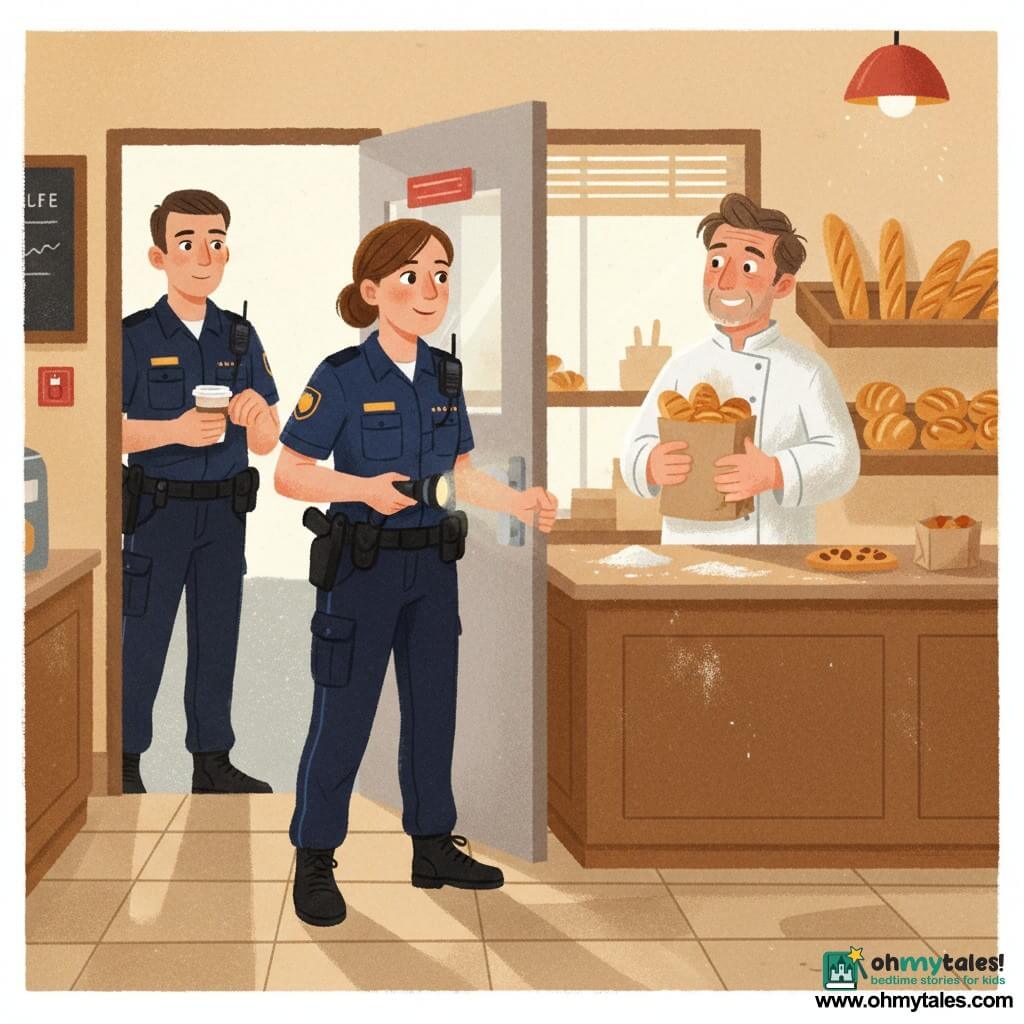
Mr Hartley arrived in a flour-dusted jacket, hair sticking up like he'd fought sleep and escaped. He unlocked the door with shaking fingers.
Maya held her torch ready, staying to one side. “We'll enter together,” she said. “You lead, but we stay alert. If anything feels wrong, we step back.”
Inside, it was quiet. Trays were stacked neatly. The counter gleamed. The smell of yeast and sugar hung in the air like a promise.
Mr Hartley checked the alarm panel. “It says ‘rear door sensor.' But the door looks closed.”
Maya examined the rear door. She pressed it gently. It moved a millimetre, then clicked into place.
Patel raised his eyebrows. “Not fully latched.”
Mr Hartley let out a long breath. “Oh. I must have been rushing yesterday.”
Maya nodded. “That happens. These systems are sensitive, and that's a good thing. It means they notice small changes. Do you want a quick tip?”
“Yes, please,” he said, looking embarrassed.
“Before you set the alarm,” Maya said, “do a simple walk-around: check doors, windows, and any loose frames. Make it a habit, like washing your hands. And if the sensor keeps acting up even when the door is secure, you can ask your alarm company to test it.”
Mr Hartley's shoulders relaxed. “Thank you. I feel silly calling you for… a door that needed a push.”
Maya shook her head. “You did the right thing by having an alarm. And the alarm did its job by telling us something wasn't secure. This is what prevention looks like—small checks that stop bigger problems.”
Mr Hartley smiled, relief softening his face. “Since you're here… would you like a couple of fresh buns? For saving my morning.”
Patel's eyes shone. “For community relations,” he whispered.
Maya tried to sound professional. “Only if it's allowed.”
Mr Hartley laughed. “It's allowed if I insist.”
Maya accepted a small paper bag. “Thank you. And please—get some rest later.”
As they stepped back into the morning, the sun climbed higher, and the city looked wide awake now. Maya felt steady. The alarm had been real enough to check, and gentle enough to solve with a simple click.
On the drive back, Patel said, “So, what did we learn?”
Maya took a careful sip of coffee. “That dialogue works with people… and sometimes with doors.”
Patel nodded seriously. “We should start talking to our station door. It sticks.”
Maya laughed, warm and quiet. The day had begun with a beep, but it ended with safety—and the comforting smell of bread in a paper bag.