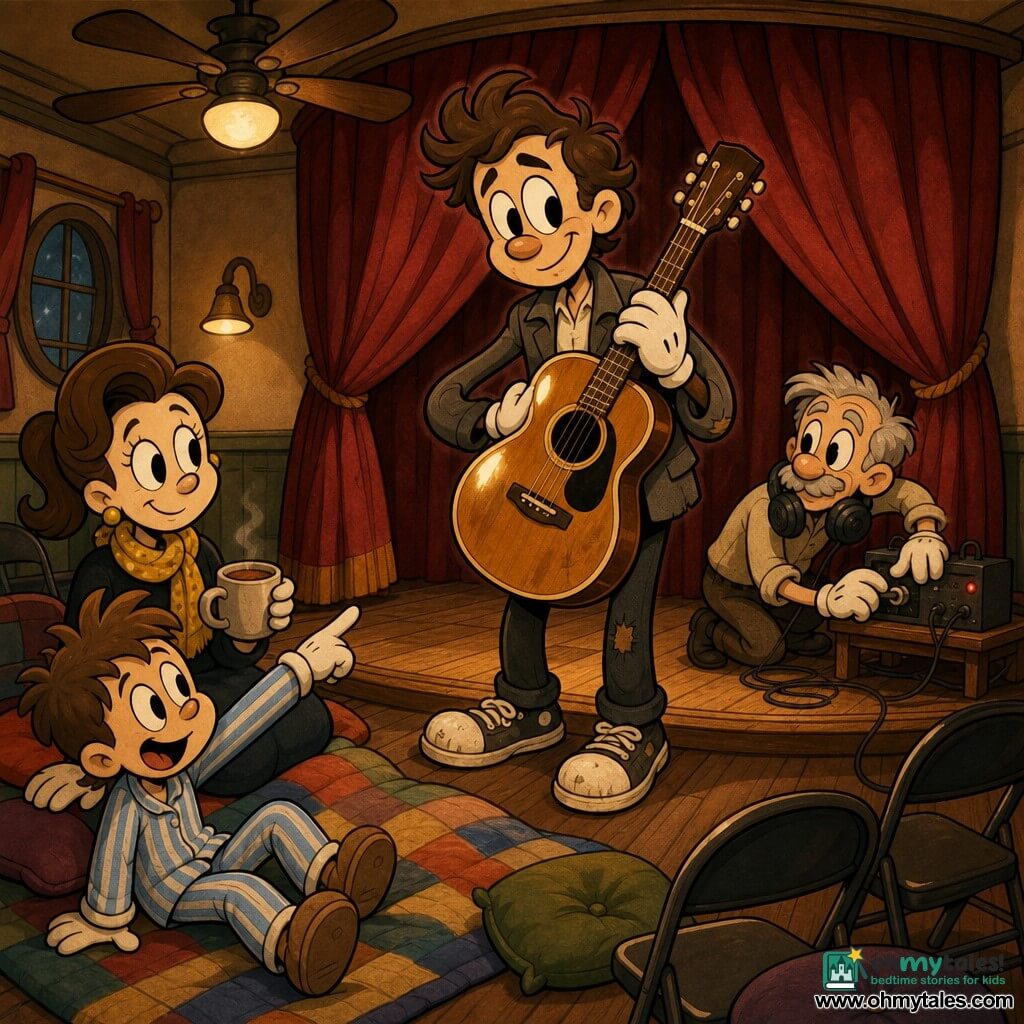
Chapter 1: The Quiet Warm-Up
Milo Gray didn't look like the kind of man who would step onto a stage and make a whole room hold its breath. He wore a plain jacket, scuffed sneakers, and a backpack that always seemed a little too full. If you passed him on the street, you might guess he was a teacher or a librarian.
But Milo was a singer and a musician.
That evening, he unlocked the side door of the Oak Street Community Hall with a key that squeaked like a tiny mouse. Inside, the air smelled of polished wood and old curtains. The stage lights were off, and the dark felt soft, like a blanket.
Milo set his guitar case down and whispered, “Okay, voice. Let's be brave.”
He didn't shout. He didn't even sing yet. He did what professional singers do when nobody is clapping—he warmed up.
First came the breathing: slow in through the nose, then out like he was fogging up a window. Then gentle humming, the sound sliding up and down like a little elevator. He rolled his shoulders, stretched his jaw, and tapped his chest lightly.
“Your voice is part of your body,” he once told a kid at a workshop. “So you treat it kindly, like you'd treat your knees before a soccer game.”
Tonight, there would be a sleepover concert—music for families, quiet and dreamy. Milo had planned a simple set: a few songs, some soft guitar, and a little lesson about music tucked in between, like hidden notes in a melody.
Still, his stomach fluttered. Not because he wanted applause. Because he wanted the songs to help.
He opened his notebook. On the first page, he'd written: Be honest. Be gentle. Be brave.
Then the hall's old ceiling fan clicked once, as if it agreed.
Chapter 2: A Problem in the Sound
An hour later, chairs scraped across the floor as volunteers arrived. They carried blankets, pillows, and paper cups of cocoa. The hall slowly filled with warm chatter.
Milo plugged his guitar into the small sound system and strummed one bright chord. It should have sounded like sunlight.
Instead, it sounded like a grumpy robot chewing crackers.
Milo froze. He tried again—softer, then louder. The speaker buzzed and coughed.
“Oh no,” Milo murmured.
A woman in a yellow scarf leaned over the sound table. “Is it supposed to do that?”
“No,” Milo said, keeping his voice calm even though his thoughts were sprinting. “That's… not a creative choice.”
He knelt and checked the cable. Then the plug. Then the outlet. The buzzing stayed, stubborn as a fly.
Milo swallowed. He could pretend everything was fine and hope people didn't notice.
But being brave wasn't pretending.
He stood, lifted his hand, and called, “Hi, everyone. Quick update: my sound is acting like it drank too much soda. I'm going to ask for some help.”
A boy with a messy haircut said loudly, “The speaker is burping!”
A few parents chuckled. Milo smiled, relieved by the laughter. Humor was like a small lantern.
From the back, an older man stepped forward. He had silver hair and wore headphones around his neck like a necklace. “Name's Theo,” he said. “I run sound for the jazz band down the street. What seems to be the trouble?”
Milo exhaled. “Theo, I'm really glad you're here.”
As Theo examined the equipment, Milo explained what he knew—how the guitar pickup worked, how a microphone turned air vibrations into an electrical signal, and how the speaker turned it back into sound you could feel in your ribs.
“Music,” Milo said, “is invisible, but it's not magic. It's waves. Like ripples in a pond. Our job is to guide the ripples.”
Theo nodded. “Good explanation. Now let's guide this rippling robot.”
Theo switched cables, checked the mixer knobs, and frowned thoughtfully. “Your input is too hot. It's clipping.”
“Clipping?” asked the messy-haired boy, inching closer.
Theo pointed to a tiny red light blinking like an angry firefly. “That red light means the sound is too strong for the system. It chops off the top of the wave, and it becomes that crunchy buzzing.”
Milo leaned in. “So we lower the gain?”
“Exactly,” Theo said.
He turned a knob, and Milo strummed again.
This time, the chord rang out clear and round, like a bell that had been polished.
The room actually clapped. Not for Milo's playing—just for the sound working again.
Milo chuckled. “Thank you, Theo. Seriously.”
Theo winked. “Sometimes courage is just asking before it gets worse.”
Milo wrote the word clipping in his notebook, underlined twice.
Chapter 3: The Circle of Chairs
To keep everyone entertained while Theo finished tidying the cables, Milo walked to the center of the hall and clapped twice.
“Okay,” he announced, “before we start, I want to try something musicians do all the time: we listen to each other.”
Volunteers arranged chairs into a large circle. It wasn't a perfect circle—one chair stuck out like it was trying to escape—but it was close enough to feel like a friendly planet.
People sat down: kids in pajamas, parents with sleepy smiles, even Theo with his headphones now hanging like a calm scarf.
Milo sat too, guitar across his lap. “Welcome to the Circle of Chairs,” he said dramatically.
The messy-haired boy snorted. “Sounds like a secret club.”
“It is,” Milo said. “The password is… ‘shh.'”
Everyone giggled, and then, surprisingly, the room quieted. The circle made it easier to see faces, to feel included. No stage, no spotlight—just people and breath and attention.
Milo plucked one string. “When I sing, I'm not throwing sound at you. I'm sharing it. And when you listen, you're playing your own invisible instrument.”
A girl with purple socks raised her hand. “Do you have to be born with a good voice?”
Milo shook his head. “You have to practice. Voices are like muscles. The more you use them well, the stronger and steadier they get. Some people start with longer legs, sure, but everybody can learn to run.”
He showed them an easy rhythm by tapping his guitar body: tap-tap… tap. Then he nodded around the circle.
“Let's build a song together,” he said. “One person starts with a sound. A snap, a clap, a hum—anything. Then the next person adds to it.”
A tiny boy began with a soft whoosh sound like wind through grass. A parent added a finger snap. The purple-socks girl hummed a low note. Someone else clicked their tongue. Soon the circle was full of gentle noises that fit together like puzzle pieces.
Milo listened carefully. That was part of a musician's job too—finding the shape of sound. Noticing what was missing.
He added a simple chord, then another, letting the circle's rhythm carry him.
“You're an orchestra!” Milo whispered, as if the word might startle the music away.
Theo, still in the circle, murmured, “Not bad for a room full of sleepy humans.”
Milo grinned. “My favorite kind.”
In the circle of chairs, Milo didn't feel like a performer above anyone. He felt like one note in a bigger chord. Humble, held.
And when he sang a short line—soft and warm—everyone answered with the rhythm they'd made, like the room itself was breathing in time.
Chapter 4: The Stage, the Song, and the Courage
When it was time for the concert, the chairs stayed in a half-circle facing the small stage. Blankets were tucked under chins. A toddler hugged a stuffed rabbit like it was a ticket to dreamland.
Milo stepped onto the stage, but he didn't stride like a hero. He walked like a person carrying something fragile: a melody.
He adjusted the microphone. “Hi,” he said. “I'm Milo. I sing and play guitar for a living. That means I practice when nobody is watching, I take care of my voice, and I learn from mistakes—especially the crunchy robot kind.”
A few kids laughed.
Milo continued, “It also means I get nervous sometimes. Even adults do.”
A parent whispered loudly, “Me too,” and more laughter rolled through the hall, soft as a drum brushed with feathers.
Milo lifted his guitar and began with a song that sounded like rain tapping gently on a roof. His voice was clear but not loud, like a lantern light instead of a spotlight.
Between songs, he shared little pieces of the musician's world:
“Before a show, I check my strings. If they're old, they can break, and then the song gets a surprise it didn't ask for.”
He changed a string quickly to demonstrate, fingers moving with careful speed. “You wind it around the tuning peg. Then you tune it. Tuning means matching the pitch—how high or low a note feels. Like finding the right shelf for the right book.”
He plucked the string and turned the peg, and the note climbed until it settled into place.
“Also,” Milo said, “musicians listen a lot. To the room. To each other. To silence.”
He paused. The quiet in the hall didn't feel empty. It felt full—full of waiting, full of calm.
Then Milo sang a lullaby-like song about a boat made of paper floating down a moonlit street. His voice had a smile in it, even when the melody dipped into something a little sad. That's another skill singers learn: telling the truth of a song without drowning in it.
Halfway through the set, Milo's foot accidentally bumped his guitar stand. It wobbled.
Milo caught it in time, but the hall gasped.
He laughed softly. “That,” he said, “is why we place our gear carefully. Musicians are part artists, part careful librarians, and part friendly problem-solvers.”
Theo called from the sound table, “And part cable wranglers!”
Milo nodded solemnly. “We respect the cables.”
The audience chuckled again, and Milo felt his shoulders loosen. Courage wasn't only doing big brave things. It was continuing after a wobble. Smiling when you felt embarrassed. Singing anyway.
For the final song, Milo invited the audience to join on a simple chorus: just three words, easy as stepping stones.
“Ready?” he asked.
The room answered softly, “Ready.”
Milo sang, and the chorus rose from blankets and pillows, from small throats and tired grown-up voices. It wasn't perfect.
It was beautiful.
Chapter 5: The Last Note and the First Dream
After the applause faded, Theo began packing up the sound equipment. Families moved slowly, like they were walking inside a song that hadn't quite ended.
Milo stayed behind to coil cables neatly—over-under, so they wouldn't twist. He wiped down his guitar, because sweat and dust can wear wood over time. Caring for instruments, he knew, was part of respecting the music they carried.
Theo came over, holding a roll of tape. “Good show,” he said. “You kept it calm, even when things went weird.”
Milo shrugged. “I asked for help. That was the brave part.”
Theo nodded. “And you taught them something without making it feel like homework.”
Milo smiled. “That's the secret. You hide the lesson inside a good story, like a note inside a chord.”
When the hall was empty, Milo turned off the last light. The darkness felt friendly now, not heavy. He stepped outside. The night air was cool and smelled faintly of lilacs.
At home, Milo placed his guitar in its stand as carefully as if it were a sleeping pet. He drank water—singers hydrate, because vocal cords need moisture to vibrate smoothly. Then he brushed his teeth, because even teeth and tongue shape the sound of words.
In bed, Milo stared at the ceiling and replayed the concert in his mind: the circle of chairs, the shared rhythm, the way people's voices joined like threads weaving one blanket.
His eyelids grew heavy.
In his half-asleep thoughts, the community hall stretched wider and wider until it became a grand concert space made of moonlight. The chairs were still in a circle, but now they floated gently in the air, turning slowly like a merry-go-round.
Milo stood in the center, humble as ever, holding his guitar. Around him sat an orchestra—violins shimmering like bright fish, cellos like warm chocolate, flutes like silver wind. Even the timpani drums looked polite, as if they had been taught good manners.
Theo appeared in the dream too, wearing a conductor's coat. He raised a baton that looked like a thin star.
Milo whispered, “I don't know if I belong here.”
Theo smiled without speaking, and the orchestra began to breathe together—one huge, quiet inhale.
Milo felt the sound before it happened, the way you feel thunder in your bones before you hear it. Then the music rose, not loud, but wide. It wrapped around him like a soft scarf. Every instrument made space for the others. Nobody pushed. Nobody vanished.
Milo started to sing. His voice wasn't bigger than the orchestra; it was braided into it. Courage felt like that—joining in, even when you're unsure, trusting the group to hold the note with you.
The last chord glowed and drifted upward, as if it were a lantern being released into the sky.
Milo smiled in his sleep, and the orchestra in his dream played on, gentle and steady, carrying him into morning.