Chapter 1: The Smile That Kept Time
Mara's smile had a peculiar habit: it showed up right on the beat.
When the kettle clicked off—smile. When her sneaker laces snapped tight—smile. When the city bus sighed at the curb—smile. People sometimes thought she was laughing at secret jokes, but really her face was just listening. Her grin was a little metronome, tapping time across her cheeks.
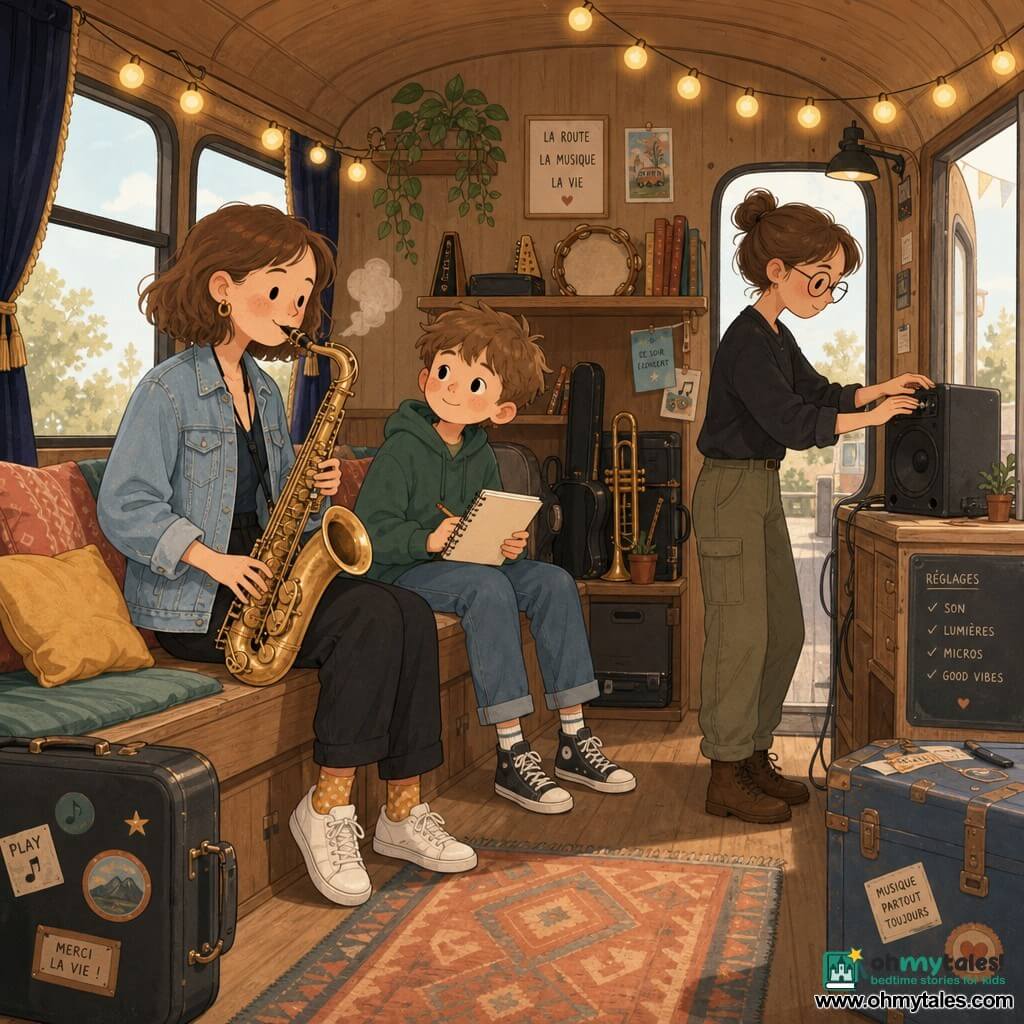
Tonight, Mara climbed into her favorite place in the world: an old bus that had been turned into a cozy traveling studio. The outside was painted the color of late-night blueberries, and the windows wore curtains like stage velvet. Inside, the floor was warm wood, the seats had been replaced with cushioned benches, and tiny string lights glowed like polite fireflies.
Her saxophone case waited on the table. Mara ran her fingers over it the way you might smooth a wrinkled pillow—gentle, careful, grateful.
“Ready, Reed?” she whispered.
Reed was the saxophone. He wasn't truly alive, of course, but Mara had a way of treating instruments like teammates instead of objects. And somehow, when she did that, the music came out kinder.
A soft knock tapped the bus door.
“Coming!” Mara called, her smile landing exactly on the rhythm of the knock.
At the steps stood Theo from next door, holding a notebook and a pencil behind his back like a magician hiding a rabbit.
“I heard you're playing at the community night,” Theo said. He was eleven, with the kind of curious eyes that looked like they could read labels on clouds. “Can I… can I watch how you practice? I'm doing a school project on jobs.”
Mara stepped aside. “Come in. But fair warning—my job includes embarrassing warm-up noises.”
Theo's face brightened. “Even better.”
He climbed inside, eyes widening at the bus's cozy world. “It smells like… wood and oranges.”
“Cork grease and tea,” Mara said. “Musicians run on strange fuel.”
Theo looked at her sax case. “So you're a singer and a musician?”
Mara nodded. “Both. Singing is my first instrument. The saxophone is my shiny second voice.”
Theo opened his notebook. “What do you do first?”
Mara's smile clicked into place. “First, I listen.”
Chapter 2: Warm-Ups, Wiggles, and Work
Mara set a small digital metronome on the table. It blinked like a tiny lighthouse.
“Musicians don't just jump on stage and hope their notes behave,” she said. “We prepare. Like athletes. Like bakers. Like… dragon trainers.”
Theo grinned. “Dragon trainers definitely warm up.”
Mara rolled her shoulders. “Exactly. Step one: body.”
She stretched her arms overhead, then shook them out. “If your body is stiff, your sound gets stiff. Saxophone playing uses your breath, your posture, your fingers, your jaw. It's teamwork.”
Theo scribbled. “Body = instrument holder.”
Mara laughed. “Nice. Now step two: breath.”
She placed a hand on her belly. “Breathe low. Like you're filling a balloon under your ribs.”
Theo tried it and made a surprised face when his stomach moved. “Whoa. My belly just did a push-up.”
“Good,” Mara said. “A singer uses breath like a painter uses a brush. Too little paint and you get scratches. Too much and it drips everywhere.”
She hummed gently, sliding up and down like a sleepy elevator. “Mmm—mmm—mmm.”
Then she did a few silly sounds: “Brrr,” like a horse. “Zzz,” like a friendly mosquito.
Theo snorted. “That is definitely embarrassing.”
“Professional embarrassing,” Mara corrected.
She opened the saxophone case. Reed gleamed, gold in the soft bus lights. Mara assembled him carefully: neck, mouthpiece, ligature. Her hands moved with quiet respect.
Theo leaned closer. “Why do you put it together like that?”
“Because it's not just metal,” Mara said. “It's a tool that carries air into music. If I rush, I can bend something or chip the reed. A musician learns patience. It's part of the job.”
Theo wrote: Patience. Care. Don't rush the reed.
Mara picked up a thin piece of cane. “This is the reed. It vibrates when I blow. That vibration makes the sound.”
Theo's eyebrows rose. “So the reed is like… the vocal cords?”
“Exactly,” Mara said, pleased. “For saxophone, my breath is the engine and the reed is the sparkly little door that flaps open and shut super fast.”
She slid the reed into place and tightened the ligature. “Not too tight,” she murmured. “A reed is like a teammate's shoelace. Secure, not strangled.”
Theo nodded seriously. “No strangling teammates.”
Mara played a long note, warm and steady. The bus seemed to hold its breath with her, then exhale sound into the curtains.
Theo's pencil paused. “It feels… soft. But also brave.”
Mara's smile landed on the note's ending. “That's the saxophone. It can whisper like a secret or shout like a parade. Tonight, we're going for bedtime-brave.”
Chapter 3: The Bus That Became a Stage
Later, Mara and Theo sat on a bench while the bus rumbled gently. Mara had to drive to the community center for soundcheck, and the bus—her rolling studio—was coming along.
Theo buckled in. “This bus is awesome. How did you make it like this?”
Mara guided the steering wheel with easy hands. “Slowly. I saved money from gigs, fixed things myself, asked friends for help. Musicians don't always have fancy budgets. We make what we can with what we have.”
Theo wrote: Resourceful. Ask for help.
Outside, streetlights slid past like glowing commas, giving the night little pauses.
Theo looked up from his notebook. “Do you ever feel like you're… super famous?”
Mara chuckled. “Nope.”
“But you perform,” Theo insisted. “People clap. That's kind of famous.”
Mara tapped the wheel lightly to the rhythm of the road. Her smile appeared on the beat again, as if the asphalt had its own drum.
“Here's something important about this job,” she said. “Applause is a gift. But it's not a crown.”
Theo blinked. “What's the difference?”
“A crown makes you think you're better than everyone,” Mara said. “A gift makes you grateful. If I start thinking I'm the main character of the universe, my music shrinks. It turns into a mirror instead of a window.”
Theo's pencil scratched. “Humility = window music.”
Mara nodded. “Also, music is never just me. There are people who built my saxophone, wrote the songs, taught me, booked the show, set up the lights, sold the tickets, cleaned the room, and listened. Even the quietest listener is part of the performance.”
Theo stared out the window thoughtfully. “So being a musician is like being on a team with… a lot of invisible teammates.”
“Yes,” Mara said. “And the audience is the biggest teammate. Without them, the music has nowhere to land.”
The bus gave a happy creak, as if it agreed.
They reached the community center, where a few volunteers waved. Mara parked and opened the bus door. The cool night air slipped inside, smelling like grass and distant pizza.
Inside the center, the hall looked different from daytime—chairs in rows, a small stage, cables like black noodles. A sound technician named Jada knelt by a speaker.
Mara approached with her sax case. “Hi, Jada. Need anything?”
Jada looked up and smiled. “Hey, Mara. Quick favor—can you play a few notes for levels?”
Mara glanced at Theo. “Field trip moment.”
Theo's eyes sparkled. “Yes!”
Mara stepped onto the stage and played gentle scales while Jada adjusted knobs. The sound came back through the speakers, bigger but still warm.
Jada pointed. “Try softer, then louder.”
Mara did, controlling the volume with breath and embouchure—her mouth shape around the mouthpiece. Theo watched like it was magic, but Mara knew it was practice stacked on practice, like careful bricks.
Jada nodded. “Perfect. Also, your mic stand is a little loose. I tightened it.”
“Thank you,” Mara said sincerely.
On the way back to the bus, Theo asked, “Is soundcheck part of your job too?”
“Absolutely,” Mara said. “A musician isn't just a person who plays. We plan, practice, travel, communicate, rehearse, check equipment, and take care of our bodies. And we say thank you a lot.”
Theo scribbled: Musician job = more than notes.
Mara's smile arrived on the last word.
Chapter 4: The Runaway Note
Back inside the bus, Mara prepared for the show. She polished Reed with a cloth, checked her reeds, and sipped warm tea.
Theo sat with his notebook open. “Do you ever get nervous?”
“Every time,” Mara admitted. “Nerves mean I care. The trick is to turn them into focus.”
Theo nodded slowly. “Like turning fizz into… soda energy.”
“Exactly.” Mara reached for her favorite reed.
And then she froze.
The reed wasn't in its case.
She opened the box, then another. Nothing.
Mara's smile didn't appear this time. Her face looked off-beat, like a song with a missing drum.
Theo's voice dropped. “Is that bad?”
Mara inhaled carefully. “It's not the end of the world. But it is… inconvenient. I only brought two good reeds tonight. One is on the sax, and the spare is missing.”
Theo leaned in. “Could it be in the bus?”
“Probably,” Mara said, forcing calm. “Reeds are tiny. They hide like they're playing tag.”
They searched. Under the bench cushions. Between notebooks. In the tea basket. Inside Mara's hoodie pocket (nope, just a cough drop). Mara opened the drawer where she kept cables, tuners, and sticky notes. Still nothing.
Theo crawled to look under the table. “Found a guitar pick!”
Mara laughed despite herself. “That belongs to my friend Lila. She played here last week. Put it in the lost-and-found jar.”
Theo dropped it into a jar labeled THANK YOU FOR BEING HONEST in Mara's handwriting.
Mara took a slow breath. “Okay. New plan. I'll be extra gentle with the reed I'm using. But I'd feel better with a backup.”
Theo chewed his pencil. “Could someone at the community center have one?”
“Maybe,” Mara said. “But reeds aren't like spare batteries. They're personal. Different strengths, different cuts. It's like borrowing someone's shoes in the middle of a race.”
Theo snapped his fingers. “What about the music store? Isn't there one near here?”
Mara glanced at the clock. “It closes in twenty minutes.”
Theo's eyes widened. “We can make it!”
Mara hesitated. She was the performer, and she still had to get ready. Yet a missing reed was a real problem, and this was also a lesson Theo wouldn't forget.
“All right,” she said. “Adventure mode. But safely.”
They jogged—Theo's sneakers squeaking, Mara's keys jingling—down the sidewalk to the little music shop. Its sign read: HARMONY HOUSE, and the window displayed a trumpet wearing a paper crown.
Inside, the shop smelled like polished wood and old songs. An older man behind the counter looked up.
“Mara!” he called. “Cutting it close.”
“Hi, Mr. Phelps,” Mara said, slightly breathless. “I need a tenor sax reed. Strength two-and-a-half, if you have it.”
Theo whispered, “You know all the numbers?”
Mara whispered back, “Part of the job.”
Mr. Phelps rummaged. “Lucky you. Last pack.” He set it on the counter. “Big show?”
“Community night,” Mara said.
Mr. Phelps nodded. “Good crowd. Good hearts.”
Theo watched as Mara paid. Then Mr. Phelps added a small reed guard. “For your spare,” he said. “So it doesn't run away again.”
Mara smiled—right on the beat of his kindness. “Thank you.”
As they hurried back, Theo panted, “So musicians have to know… equipment stuff.”
“Yes,” Mara said. “Tools matter. But more importantly, how you treat people matters. Mr. Phelps didn't have to help us so fast. He did because relationships are also part of the music world.”
Theo wrote while walking, his handwriting wobbling with every step: Be kind. Be prepared. Have backups.
Back in the bus, Mara opened the new pack like it contained tiny treasure. She slid the spare into the reed guard. “No more tag,” she told it.
Theo grinned. “You just gave a reed a bedtime rule.”
“Everything in here follows bedtime rules,” Mara said. “Even me.”
Chapter 5: Singing, Sax, and Sharing the Spotlight
The hall filled with people—families, teens, grandparents, kids with restless feet and sparkling eyes. The stage lights were gentle, like warm moons.
Backstage, Mara did one last breath exercise. Theo stood nearby, now holding his notebook like a passport.
“You can sit in the front row,” Mara told him. “But remember—during songs, no loud page turning.”
Theo raised two fingers. “Silent spy mode.”
Mara stepped onto the stage. The room quieted, the way snow quiets a street. Mara greeted the crowd, voice calm and friendly.
“Good evening,” she said. “I'm Mara. Tonight I'll sing and play saxophone. If you feel like closing your eyes during the slow songs, that's allowed. If you feel like smiling, that's also allowed.”
A ripple of soft laughter moved through the chairs.
She began with a simple song, her voice light and clear. She sang about buses that learn new roads, about stars that practice shining, about a heart that keeps time even when nobody claps.
Then she lifted Reed. The first sax note floated out—round, honey-gold, and gentle. It swirled up to the ceiling and came back down like a warm scarf.
Theo watched, stunned, as Mara's smile appeared at the end of each phrase, perfectly timed, as if her face and the music were holding hands.
Between songs, Mara spoke a little. Not a long speech—just small, useful bits, like pocket-sized wisdom.
“This song has a chorus,” she explained once. “A chorus is the part that comes back, like a friend checking in.”
Another time she said, “When I practice, I start slow. Speed is earned. It doesn't arrive by yelling at your fingers.”
People nodded, as if their own homework suddenly felt more possible.
Halfway through, Mara invited Jada to the stage. “Jada makes me sound like I'm singing inside a cozy blanket,” Mara said. “Please clap for the person behind the knobs.”
The audience applauded, and Jada bowed dramatically, making a few kids giggle.
Theo leaned toward his notebook and wrote: A good musician shares credit.
For the last piece, Mara blended singing and saxophone. She sang a line, then answered herself with the sax, like two friends telling the same story in different languages. The melody was a lullaby with a playful wink.
When the final note faded, the room held still for a moment, as if nobody wanted to break the spell. Then the applause rose—warm, steady, grateful.
Mara bowed, not too deep, not too proud. Just thankful.
After the show, people came to say hello. A little kid asked if the saxophone was heavy. Mara let him hold it (with both hands and a serious promise). A grandmother said the last song reminded her of summer evenings. Mara listened like those words were medals made of paper—soft, meaningful, easy to carry.
Theo waited until the line thinned. Then he approached, eyes shining.
“You did it,” he said.
“We did it,” Mara corrected gently.
Theo blinked. “I didn't play.”
“You listened,” Mara said. “And listening is part of music. Plus, you helped save the reed situation.”
Theo laughed. “The Great Reed Rescue.”
Mara's smile matched his laugh's rhythm. “Exactly.”
Chapter 6: A Quiet Ride and a Steady Heart
Night had deepened by the time they returned to the bus. The string lights glowed softly, and the curtains made the world feel far away—in a good way.
Mara set Reed back in his case, careful as placing a sleepy cat into a basket. She cleaned the mouthpiece, dried the keys, and tucked the spare reed safely into its guard.
Theo yawned, trying to hide it by pretending to study his notes.
Mara poured two cups of chamomile tea—one for her, one for Theo with extra honey. “So,” she said, sitting across from him. “What did you learn about being a singer and musician?”
Theo flipped through his notebook. “Okay. Um… You warm up your body and breath. Your breath is like paint. The reed is like vocal cords. Soundcheck is part of the job. You have to take care of your instrument. You have to be resourceful. And you have to be humble, because applause is a gift, not a crown.”
Mara listened, her smile appearing softly at the end of his list, right on the beat of his final word.
“That's a great summary,” she said. “One more thing?”
Theo tilted his head. “What?”
“Music is a way to make space for other people's feelings,” Mara said. “Sometimes someone needs a song the way they need a blanket. If I remember that, I'll stay humble. Because the point isn't ‘Look at me.' The point is ‘Here, have some warmth.'”
Theo's eyelids drooped. “That's… nice.”
Outside, the night was quiet. The bus settled, the way a big animal settles into sleep. Somewhere, a far-off car whooshed by like a gentle cymbal brush.
Theo stood up, swaying with tiredness. “Thanks for letting me tag along.”
“Thanks for asking good questions,” Mara said. “That's a musician skill too, you know.”
Theo smiled sleepily. “Maybe I'll be… a question musician.”
“A curious musician,” Mara corrected. “The best kind.”
Mara walked him to the door and watched him cross to his house, notebook tucked under his arm like a treasure map. When he disappeared inside, Mara returned to the bus and sat alone for a moment.
She turned off the brighter lights, leaving only the soft string glow. She placed a hand on her chest and listened.
Thump.
Thump.
Not loud, not hurried. Just steady—like a quiet drummer practicing kindness.
Mara breathed in, and her smile arrived on the exhale, perfectly in time.
The bus was still. The saxophone slept in its case. The night wrapped everything in gentle dark.
And in the calm, Mara's heart beat tranquil and sure, keeping the softest tempo of all.