Chapter 1: The Warehouse That Learned to Breathe
Mara loved the sound of evening. Not the big, noisy kind—more like the gentle kind that slipped under doors and curled around lamps.
She carried her drumsticks in her jacket pocket the way some people carried lucky coins. As the regular drummer for a small neighborhood band, she practiced almost every day. Her hands knew rhythms the way feet knew stairs.
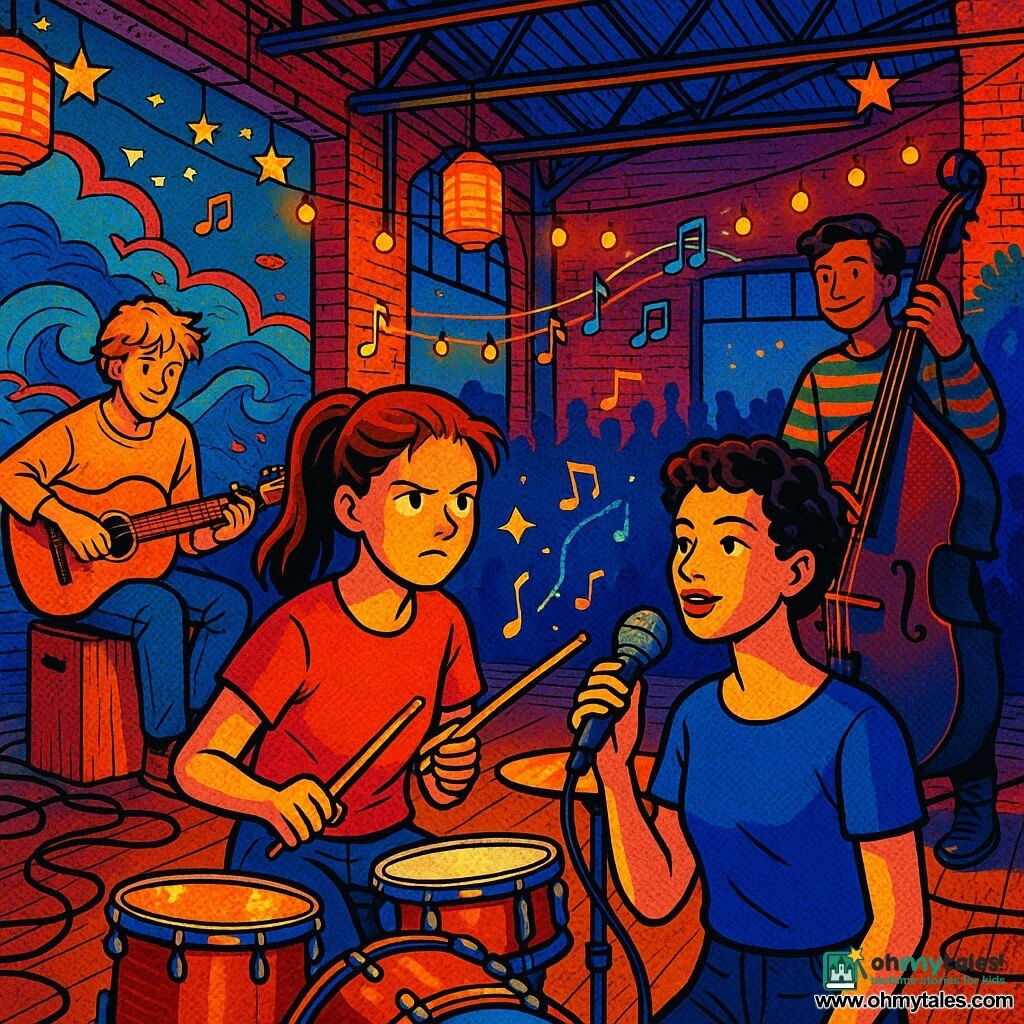
Tonight, she walked toward a rehabilitated hangar by the river. It used to be a cold warehouse full of dust and echoing emptiness. Now it had warm lights, painted murals, and old wooden pallets turned into benches. When Mara pushed the door open, the place sighed like a friendly giant waking up.
Inside, cables lay like sleepy snakes, and a scent of pine cleaner mixed with metal and fresh paint. High windows wore the last orange of sunset.
“Hey, Mara!” called Jae, the bassist, waving from behind a stack of speakers. “We're trying not to trip over our own ambition.”
Mara laughed. “Ambition should really come with warning labels.”
On the small stage, Lila the singer warmed up softly—“mmm-mmm”—like she was tasting notes the way you taste soup. Theo, the guitarist, sat cross-legged with his instrument, plucking little sparks of sound.
Mara set her drum kit in place. The snare felt crisp under her fingers, the hi-hat cool as a coin. She tapped a simple beat—one-two-three-four—like knocking on the door of a song.
Lila tilted her head. “Tonight's the community showcase. Big crowd.”
Mara's stomach fluttered. “Then we'll give them something steady to hold onto.”
“Drummers,” Theo said, grinning, “are the floor of music. Without you, we all fall over.”
Mara twirled a stick. “Good. I like being a floor. Floors don't panic.”
But deep inside, a tiny worry tapped its own rhythm: What if I mess up?
Chapter 2: A Map Made of Sound
They began rehearsal with their usual song. Mara counted them in, and her beat spread through the hangar like a heartbeat waking up the walls. The bass thumped. The guitar shimmered. Lila's voice lifted, clear and warm.
Still, something felt missing—like a story that ended too quickly.
After the last chord, Lila exhaled. “It's good,” she said, “but… it's not special yet.”
Jae nodded. “We need an intro that pulls people in. Something that sounds like walking into this place for the first time.”
Theo strummed a thoughtful chord. “An arpeggio could do that. Like stepping stones.”
Mara blinked. “An arpeggio? That's more of a guitar or keyboard thing.”
“It's a pattern,” Theo said. “Notes of a chord played one after another instead of all at once. It can feel like climbing or falling, like raindrops or a staircase.”
Lila looked at Mara. “You write rhythms the way other people write sentences. Could you write an arpeggio… but for us? Something we can build around?”
Mara's sticks paused in mid-air. She was used to being the timekeeper, the steady engine. Writing a line of notes felt like being asked to paint with a new color.
“I can try,” Mara said, surprising herself with how brave her voice sounded.
Jae leaned closer. “We'll do it together. Cooperation, remember? No one solos in a storm.”
Theo pointed at the hangar's high ceiling. “This place has an echo. If we find the right notes, they'll hang in the air like lanterns.”
Mara listened to the quiet between them. Even silence had a pulse.
“Okay,” she said. “Let's make lanterns.”
Chapter 3: The Arpeggio Puzzle
They gathered in a circle on the stage floor. Theo placed his guitar across his knees. Jae rested a hand on the bass strings. Lila sat with her notebook open, pencil ready.
Mara didn't have a keyboard or frets, just drums—skin and metal and wood. But she had ears, and she had imagination.
Theo played a chord softly. “This is A minor,” he said. “It feels like evening—calm, a little mysterious.”
He plucked the notes one by one: A… C… E… A.
The sound rose like a slow staircase.
Lila closed her eyes. “That's like the river outside when it's dark. It's still moving, but you can't see the current.”
Mara tapped her thigh with a stick. “If it's a staircase, the drums can be the steps. Not too loud. Like sock-feet on wood.”
Jae chuckled. “Sock-feet beat. Very technical.”
Mara made a soft pattern on the rim of her snare: tap—tap—pause—tap. It sounded like someone thinking.
Theo tried the arpeggio again, matching her spacing.
“No,” Mara said, frowning gently. “The notes are right, but the shape isn't.”
“The shape?” Lila asked.
Mara searched for words. “It needs to feel like opening a door. First a small creak, then a slow swing, then—light.”
Theo nodded. “So we change the rhythm of the notes, not the notes themselves.”
They experimented. Theo played the same A minor notes but in a different order, different timing: A… E… C… A. The hangar answered with a softer echo, like it approved.
Mara added a brush on the snare, a whispering sweep. Shhh—shhh—like wind through tall grass.
Lila began to hum on top, a simple melody that curled around the notes. “Hmm-mm… hmm-mm…”
Jae tried a bass note that pulsed under everything, steady as a lighthouse.
They stopped.
Theo scratched his head. “Still not quite.”
Mara stared at the mural on the hangar wall—painted waves and bright fish, as if the river had climbed inside. She thought about arpeggios as stepping stones. But stepping stones weren't all the same size. Sometimes you had to stretch.
“What if,” Mara said slowly, “we write the arpeggio like a question first, then an answer?”
Lila's eyes lit up. “Like: ‘Are you here?' and then: ‘Yes, I am.'”
Mara nodded. “Exactly.”
Theo played three notes upward—A, C, E—then left a tiny gap, like a held breath. Then he played A again, lower, like coming home.
Mara added a gentle kick drum on the “home” note—thum—so the answer landed safely.
Jae smiled. “That feels right.”
Theo looked at Mara. “You just wrote an arpeggio.”
Mara's cheeks warmed. “I… guess I did.”
The hangar seemed to hum quietly, as if it was proud of them too.
Chapter 4: Lessons in the Spotlight
The next day, the hangar buzzed with preparation. Volunteers taped cables to the floor. Someone hung paper stars from the rafters. The smell of hot cocoa drifted from a small table near the entrance.
Mara arrived early and found Lila practicing breathing exercises.
“In through the nose,” Lila said, demonstrating. “Out slowly, like cooling soup.”
Mara tried it. Her shoulders loosened.
Lila smiled. “Being a singer is partly about courage, but also about craft. Breath support, posture, listening. Your voice is an instrument you carry everywhere.”
Mara watched Theo tune his guitar, turning the pegs carefully.
“Tuning,” Theo explained to a kid who was helping, “is making sure each string is the right pitch. If one string is off, the whole chord feels wobbly—like a chair with a short leg.”
Jae adjusted an amplifier. “And volume matters. Music isn't just sound; it's respect. Too loud, and you flatten people's ears. Too soft, and the story gets lost.”
Mara checked her drums. She tightened the snare, tested the hi-hat, and positioned her cymbals so her arms could move smoothly. A drummer, she knew, didn't just hit things. She shaped time. She guided energy. She listened for everyone else and made room.
A small boy peeked at her kit. “Do you get tired?” he asked.
“Sometimes,” Mara said. “But it's the good kind of tired. Like after swimming. Rhythm uses your muscles, but also your mind. You have to count, feel, and watch. Drumming is teamwork with your own hands.”
The boy's eyes widened. “Cool.”
Mara winked. “Also, sticks are excellent for pointing at snacks.”
He giggled and ran off.
When the band gathered for a final run-through, Mara spoke up. “Let's remember the intro. The arpeggio is our doorway. We enter together.”
Lila reached out her hand. Jae put his on top. Theo added his. Mara placed hers last, the calluses on her fingers like tiny badges.
“Cooperation,” Lila said.
“Timing,” Jae added.
“Trust,” Theo finished.
Mara swallowed her nerves. “And lanterns.”
They broke the huddle, and for the first time that day, Mara's worry wasn't tapping. It was waiting quietly, willing to be taught.
Chapter 5: The Night of Lantern Notes
The showcase began. The rehabilitated hangar filled with people—neighbors in sweaters, kids clutching cookies, grandparents leaning on canes that clicked like metronomes. The paper stars overhead trembled gently in the warm air.
Backstage—really just behind a painted curtain—Mara rolled her shoulders.
“You okay?” Jae asked.
Mara nodded, though her hands felt a bit like cold spoons. “If I drop a stick, tell everyone it's modern art.”
Theo chuckled. “If you drop a stick, I'll drop a chord. Then we'll call it ‘experimental.'”
Lila leaned in. “Remember your breath, Mara. In and out.”
Mara breathed. The sound of the audience was a soft ocean. She imagined her beat as a boat, sturdy and kind.
They stepped onto the stage.
The lights weren't blinding—just golden, like late afternoon trapped in lamps. Mara sat at her kit and placed her sticks lightly on her knees.
Lila whispered, “Doorway.”
Theo began the arpeggio they had written: A… C… E… (a pause)… A.
The notes floated upward and hung in the hangar's air like tiny lanterns. The crowd quieted, as if everyone had leaned closer at once.
Mara entered with the softest brush sweep: shhh—shhh—then a gentle kick: thum.
Jae's bass joined, warm and steady. Lila's voice slid in like a ribbon: clear, confident, carrying words about rivers, old buildings, and the brave act of making something new.
Mara counted without thinking now. Her wrists moved smoothly. She watched Theo's strumming hand, matched Jae's pulse, followed Lila's phrasing. Drumming wasn't just keeping time—it was listening so hard that your body answered.
Halfway through the song, Mara felt a tiny slip—her right stick glanced off the rim with a click. A mistake, quick as a blinking eye.
Her heart jumped.
But she didn't freeze. She turned the click into a tiny accent, like it had always belonged there. She nodded at Jae, and he grinned, locking in tighter. Theo leaned into the groove. Lila sang on, unshaken.
The music didn't crumble. It flexed.
When the final note faded, the hangar held a second of silence—then applause burst like popcorn.
Mara stood, bowing with the others. Her chest felt light, as if the rhythm had swept dust out of her lungs.
Back behind the curtain, Lila squeezed her shoulder. “You didn't just play. You led.”
Mara blinked. “I almost messed up.”
“You almost,” Theo said. “And then you didn't. That's the whole job, sometimes.”
Jae raised an eyebrow. “Also, your ‘modern art' accent was pretty stylish.”
Mara laughed, and the laughter felt like a cymbal shimmer—bright, ringing, and then calm.
Chapter 6: A Quiet Beat to End the Day
Later, when the hangar emptied and the river outside returned to its nighttime whisper, the band helped pack up. They coiled cables, stacked chairs, and folded the paper stars into a box labeled “NEXT TIME.”
Mara carried her snare case to the door. The air outside was cool, and the moon looked like a pale drumhead waiting to be tapped.
Lila walked beside her. “You know,” she said, “a musician's life isn't only performances. It's practice. Listening. Writing. Sharing.”
Mara nodded. “And being brave enough to learn something new.”
Theo locked the hangar door behind them. “That arpeggio is ours now. We built it together.”
Jae pointed at Mara's pocket. “And you—regular drummer—wrote the doorway.”
Mara felt a deep, steady confidence settle in her, not loud or flashy. More like a solid rhythm under everything.
“I used to think my job was just to keep everyone together,” she said.
“It is,” Lila replied, “but that's huge. Cooperation is not ‘just.' It's a kind of music all by itself.”
They stood for a moment, listening to the river. Mara imagined the water making its own arpeggio over stones: ripple… glint… hush… ripple.
“Next time,” Mara said, “I want to write another one. Maybe a brighter staircase. Or a falling-star pattern.”
Theo smiled. “We'll make lanterns again.”
As they parted ways, Mara walked home with her drumsticks warm in her pocket. Her steps found a gentle tempo on the sidewalk. The night seemed to breathe with her—slow, safe, and steady—like a lullaby made of trust.