Chapter 1: The New Desk
Milo liked to do things the careful way. He packed his backpack the night before, sharpened two pencils (just in case), and checked the weather twice, even though his dad said, “The sky will do what it wants, kiddo.”
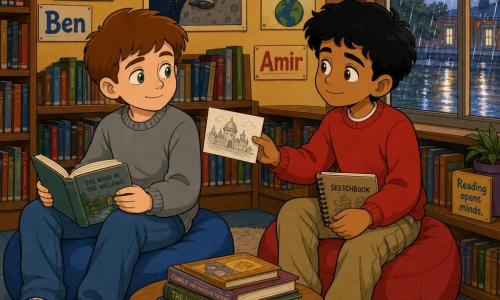
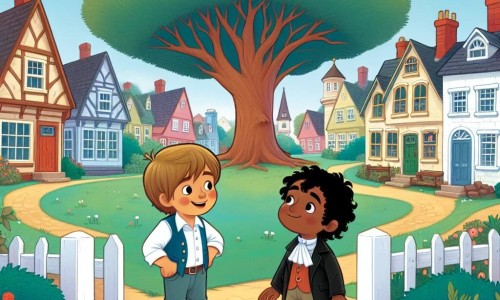
On Monday, Milo walked into Room 12 and noticed something different right away: a new desk beside his. It was neat and empty, with a name tag that read: AMIR.
Milo sat down slowly, like his chair might squeak too loudly. He watched his classmates bounce around, trading stickers and talking about a soccer game. Milo didn't rush into circles. He liked to look first, listen first, and then decide.
The classroom door opened, and Ms. Kwan entered with a boy about Milo's age. The boy had a dark blue backpack and a shy, steady face.
“This is Amir,” Ms. Kwan said. “He's joining us today. Let's help him feel welcome.”
A few kids waved right away. One boy whispered loudly, not even trying to hide it, “He talks funny.”
Milo felt his ears warm. Amir didn't look up, but Milo saw his fingers tighten around the backpack strap.
Ms. Kwan smiled gently, like she had heard plenty of whispers in her life. “Everyone has a voice,” she said. “And every voice belongs.”
Amir sat at the new desk. Milo noticed Amir's pencil case was carefully lined up—pencils in one row, eraser in the corner. That made Milo feel a little calmer, as if the room had found a tiny bit of balance.
When Ms. Kwan asked everyone to share one weekend highlight, Milo listened. When it was Amir's turn, Amir spoke quietly.
“I… went to the river with my uncle. We fed ducks.”
His words sounded different, yes—like the edges of each sentence had traveled a longer road. But the meaning was clear, and ducks were ducks.
Milo raised his hand. His heart beat fast, but he liked being sincere, even when it made his voice shake a little.
“I like ducks,” Milo said. “They waddle like they're wearing invisible boots.”
A couple of kids laughed. Amir's mouth lifted into a small smile, as if a door had opened a crack.
Chapter 2: A Quiet Moment
On Tuesday, Ms. Kwan wrote on the board: COMMUNITY WALK — PLEASE BE RESPECTFUL.
She explained that the class would visit the small park near school. A community group had made a new garden there in memory of someone important to the neighborhood. They would see it, learn about it, and leave a paper note of thanks.
Milo liked clear plans. Walking in a line, staying with a partner, using inside voices outside—those were rules he could hold onto.
At the park, the air smelled like cut grass and warm dirt. There was a wooden sign near the garden with painted flowers. Beneath it, a short message said the garden was a place to pause and remember.
Ms. Kwan gathered the class. “We're going to have one minute of silence,” she said. “That means no talking, no giggling, no shuffling around. Just a quiet minute to show respect.”
Milo stood very still. He tried to make his thoughts quiet too, which was harder than keeping his feet quiet. He watched a ladybug crawl along the edge of a leaf like it had a mission. He listened to a distant dog bark once and then stop, as if even the dog remembered the rule.
When Milo peeked sideways, Amir's eyes were closed. His hands were folded in front of him. He looked calm and serious, like someone who knew how to be respectful in a deep way.
The minute ended. Ms. Kwan nodded, pleased.
As the class walked toward a bench to write their notes, one of the kids muttered, “Why do we have to do the silent thing? It's boring.”
Amir didn't say anything. Milo didn't either, at first. He could feel words in his mouth, but he didn't want to throw them like rocks. Milo tried to choose the careful way.
“It's not about being entertained,” Milo said quietly, more to the air than to the muttering kid. “It's like… making room for someone else.”
Amir looked at him then. “Yes,” Amir said, and his voice sounded stronger. “Making room.”
Milo blinked. He liked how Amir said it, like a simple truth.
Later, Milo wrote his note: THANK YOU FOR MAKING A PLACE THAT FEELS PEACEFUL. Milo.
He added, after a moment: ALSO, LADYBUGS LIKE IT.
Chapter 3: The Honest Invitation
On Wednesday, the class had a group project: create a “welcome poster” for the hallway. Ms. Kwan put everyone in pairs. Milo's name landed next to Amir's.
Milo felt a pinch of worry. Group work could be messy. Messy could mean misunderstandings. Misunderstandings could mean people getting upset.
Amir pulled out his markers and lined them up by color. Milo felt that calm feeling again.
“Do you want to draw?” Milo asked.
Amir nodded. “I can draw buildings. And flags. If you want.”
Milo hesitated. He didn't want the poster to feel like a bunch of random things smashed together. He also didn't want Amir to think Milo didn't like his ideas.
Milo took a breath. Sincere. That was important. Sincere didn't mean rude. It meant real.
“I want it to look like our class,” Milo said. “Like… different stuff, but it all fits. I'm not sure how yet.”
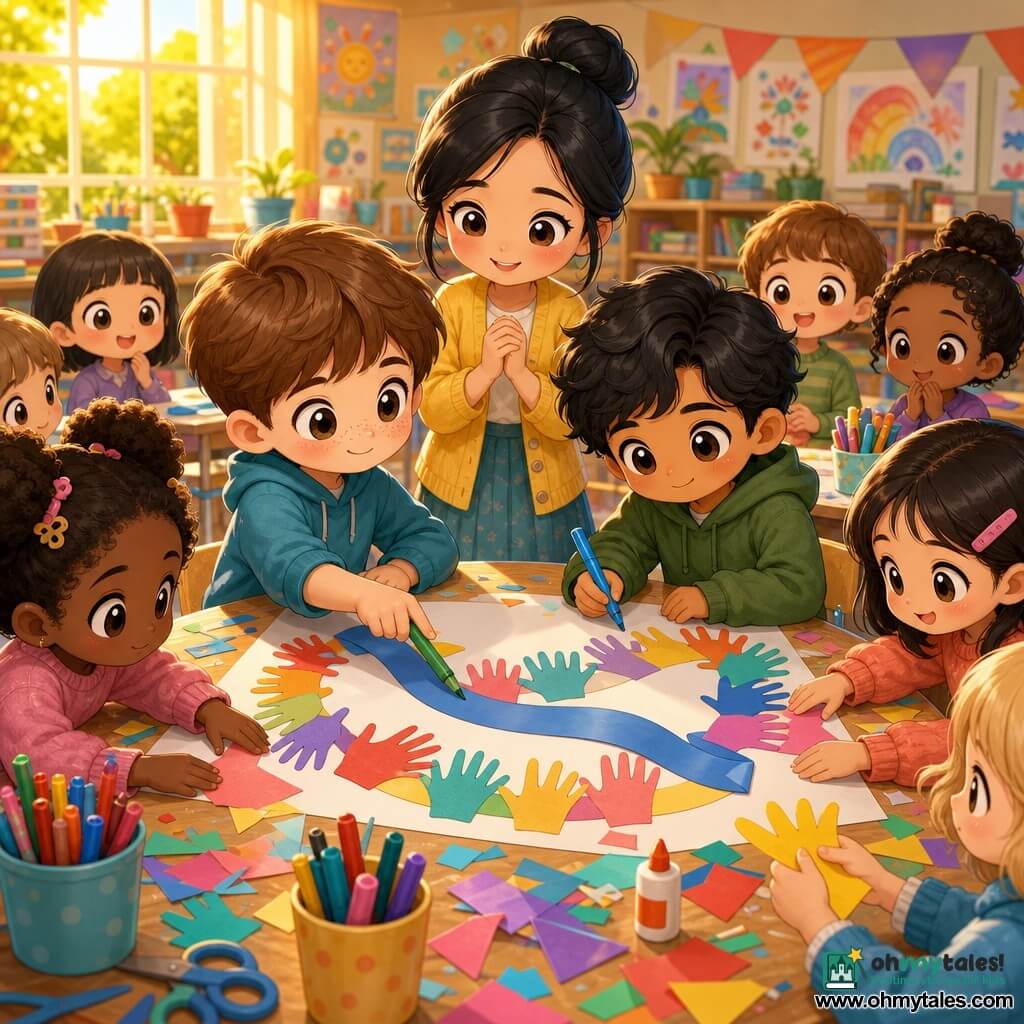
Amir considered that, tapping a marker cap against his thumb. “We can draw many hands,” he said. “Different colors. All holding one long ribbon.”
Milo pictured it. It sounded organized. It sounded meaningful. “Yes,” he said. “And we can write words on the ribbon. Like ‘hello' in different languages.”
Amir's eyes brightened. “I can write ‘hello' in Arabic,” he offered.
Milo grinned. “I can do Spanish. I only know one word, but I know it with confidence.”
Amir laughed—an actual laugh, not just a small smile. “Confidence is good,” he said.
While they worked, two kids from another table drifted over.
“What are you writing?” one asked, squinting at Amir's letters.
“It says ‘hello,'” Amir replied.
The kid shrugged. “Looks like scribbles.”
Milo's stomach tightened. His careful brain wanted to calculate a safe answer. But his sincere side—his honest side—stood up inside him.
“It's not scribbles,” Milo said, keeping his voice calm. “It's another way to write. Like cursive. Like… secret code, but not secret.”
Amir glanced at Milo, surprised.
The kid rolled his eyes and wandered off. Milo felt shaky, but also proud, like he had done the right thing without making a scene.
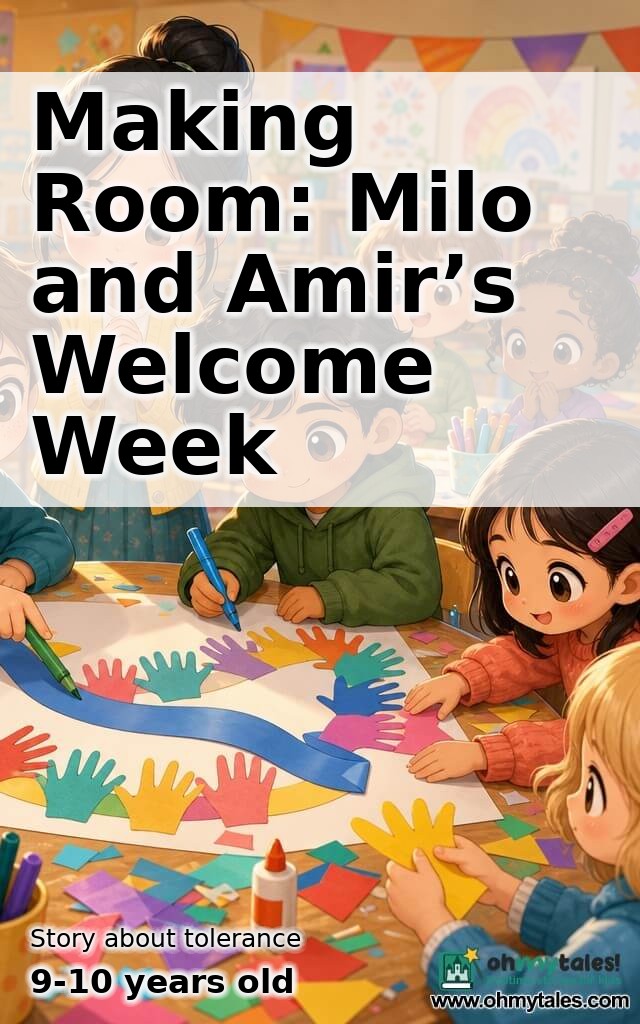
When the poster was finished, it looked bright and balanced: hands of many shades, one ribbon looping across them, greetings written clearly.
Ms. Kwan stopped beside their table and nodded. “This feels welcoming,” she said. “It feels sincere.”
Milo caught Amir's eye. Amir's smile said thank you without needing extra words.
Chapter 4: The Mix-Up at Recess
Thursday brought wind that slapped the playground fence and made loose papers chase each other like tiny panicked birds.
At recess, a group of kids played a game called Four Square. Milo didn't always join. He liked watching first, learning patterns, and then stepping in when he understood the rules.
Amir stood near the wall, looking like he wanted to join but didn't know where to begin. Milo walked over.
“Do you want to play?” Milo asked.
Amir nodded. “Yes. But… I don't know all rules.”
“I can explain,” Milo said, relieved. Explaining rules was one of Milo's favorite things in the world. Rules were like guardrails that helped everyone not fall off.
Milo explained: bounce the ball, stay in your square, don't catch, don't hold, if the ball bounces twice you're out. Amir listened closely, eyes following Milo's hands.
They joined the line to play. When Amir's turn came, he stepped into a square and waited.
The ball bounced toward him. Amir hit it back, but it flew too high and landed outside the lines.
“Out!” someone shouted.
Amir frowned. “I thought… high is okay?”
“It's okay if it lands in,” Milo said quickly, trying to help without sounding bossy.
A kid with a loud voice snorted. “He doesn't get it.”
Amir's shoulders tightened. Milo recognized that look: the look of someone trying hard and being told, even without words, that trying was embarrassing.
Milo felt his own anger rise like a balloon. He didn't like it when people made others feel small.
He stepped closer to Amir. “It took me two weeks to stop hitting it into the teacher parking lot,” Milo said. “And I did that in front of Ms. Kwan, which is a special kind of humiliating.”
A couple of kids laughed, this time in a kinder way. Even the loud-voice kid looked slightly less impressed with himself.
Amir blinked. “You hit in teacher parking lot?”
“Twice,” Milo admitted. “One time it bounced off a cone like it was mocking me.”
Amir let out a quick chuckle. Then he took a deep breath. “Okay,” he said. “I try again.”
When Amir got back in, Milo made a small suggestion. “Aim for the middle. Not the sky.”
Amir nodded. This time, he hit the ball low and steady. It landed cleanly in the next square. Someone called, “Nice!”
Amir's face lit up, and Milo felt something warm in his chest—not because Amir had played perfectly, but because Amir belonged in the game now. Trying had turned into learning, and learning had turned into fun.
Chapter 5: A New Way to Play
On Friday afternoon, the classroom felt sleepy in the best way. The sun made bright squares on the floor, and even the loud kids sounded softer, like someone had turned down their volume.
Ms. Kwan said, “We're going to end the week with a game. But we're going to reinvent it a little.”
She held up a soft foam ball. “It's called Pass the Story. We'll sit in a circle. When you hold the ball, you add one or two sentences to a story. Then you pass it. The goal isn't to be the funniest or the loudest. The goal is to make sure everyone can join.”
Milo liked that goal. It had rules, but it also had kindness built into it.
They sat in a circle on the rug. Ms. Kwan started: “A kid found a mysterious box on the way home from school…”
She passed the ball to Milo.
Milo held it carefully. He didn't want to mess up the story. He also didn't want to show off. He chose sincerity, the way he had been practicing all week.
“The kid was cautious,” Milo said, “so he didn't open it right away. He shook it gently and listened, just to learn more.”
He passed the ball to Amir.
Amir held it like it mattered. “Inside the box,” Amir added, “was not something scary. It was a note that said, ‘If you are different, you are still welcome.' And also… a small packet of seeds.”
A quiet “aww” went around the circle.
The story moved on. Each person added something. Someone added a silly squirrel. Someone added a bike with a squeaky bell. Someone added a grandma who made hot chocolate.
Ms. Kwan watched, smiling, but she didn't rush anyone. When a kid stumbled over a sentence, another kid helped. When Amir searched for a word, Milo waited without interrupting, and Amir found it.
Near the end, Ms. Kwan said, “Now, for the reinvention: the last part must be made by two people together.”
She looked at Milo and Amir. “Would you two like to finish?”
Milo felt nervous, but in a good way—like standing at the top of a small hill before sliding down. Amir nodded, and Milo nodded too.
They leaned in slightly, speaking softly so they wouldn't trip over each other's ideas.
Milo began, “The kid planted the seeds in a shared garden…”
Amir continued, “And each seed grew into a different flower. Some tall, some small, some bright, some gentle.”
Milo added, “People from the neighborhood came to look. They didn't all speak the same way, and they didn't all like the same games…”
Amir finished, “So they made a new game. Everyone stood in a circle, and the rule was simple: you pass the ball to someone who hasn't had a turn yet. And when you pass, you say their name kindly.”
Milo looked around the real circle they were sitting in. It felt like the story had stepped out into the classroom.
Ms. Kwan clapped once, softly, and everyone followed. Not loud. Not wild. Warm.
As the bell rang, Milo packed his bag the careful way. Amir zipped his backpack and glanced at Milo.
“Thank you,” Amir said.
Milo didn't pretend he hadn't noticed the hard moments this week. He didn't pretend he had been brave every second either. He chose the honest truth.
“I was nervous,” Milo admitted. “But I'm glad you're here.”
Amir's smile was easy now. “Me too,” he said. “Next week, we play new game again?”
Milo nodded. “Yes. And this time, I'll try not to hit the ball into the teacher parking lot.”
Amir laughed, and Milo laughed too, and the week ended like a soft light being turned off—calm, safe, and bright in their minds.