Chapter 1: The Quiet Corner
Ben liked places that didn't ask him to talk. The library after school was perfect: soft lights, gentle footsteps, and the whispery smell of paper and pencil shavings.
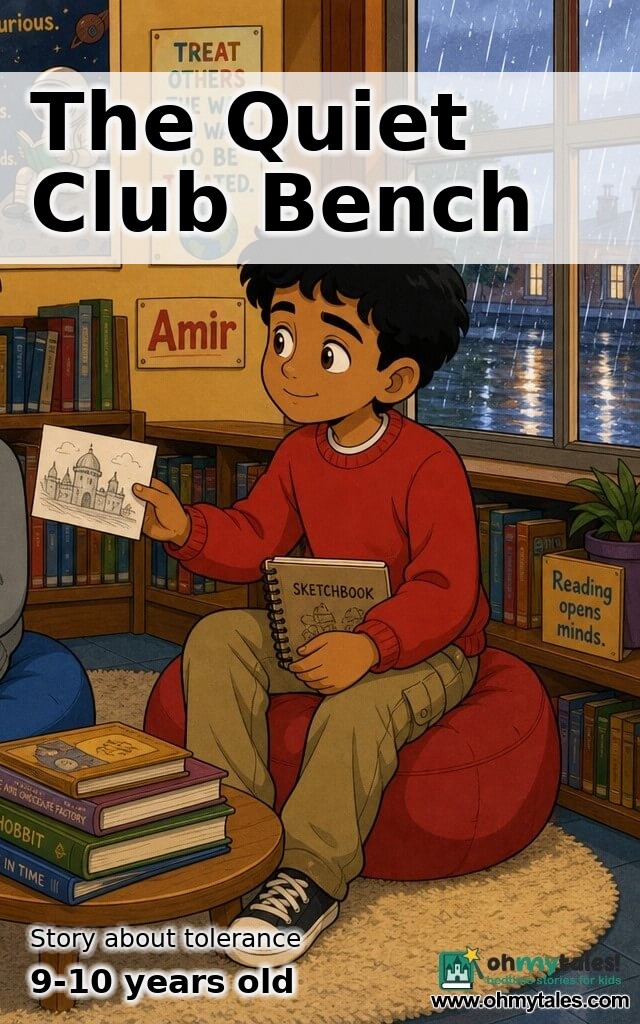
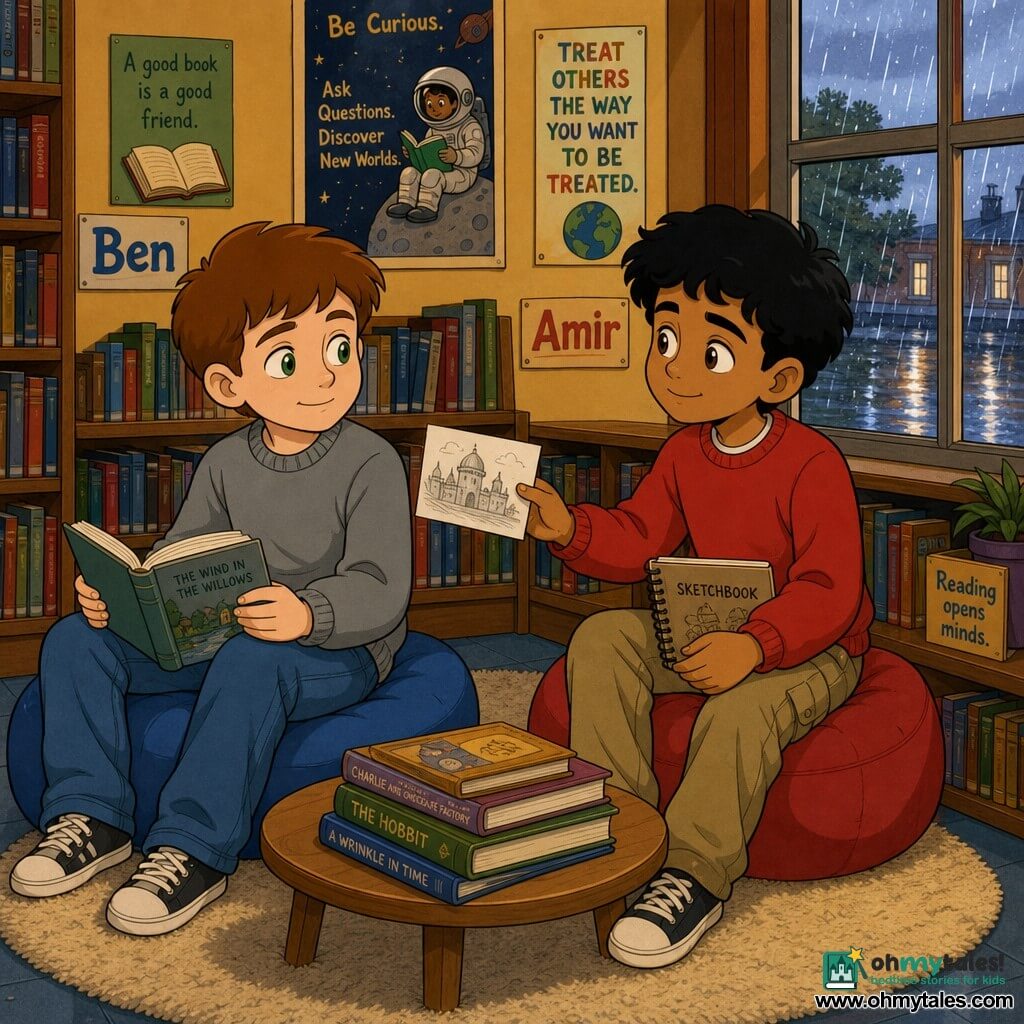
That Thursday, Ben slipped into his favorite spot by the window. It was a small corner with two beanbags and a low table. Outside, rain tapped the glass like tiny fingers practicing a drumbeat.
Ben opened his book and decided to share the space in silence. Not because he was angry. Not because he was scared. He just felt calmer that way, like his thoughts could stretch out without bumping into words.
A minute later, another boy stepped into the corner, holding a notebook covered in bright stickers. The boy's hair was damp from the rain, and he looked around as if the room might suddenly change shape.
Ben stayed still and turned one page.
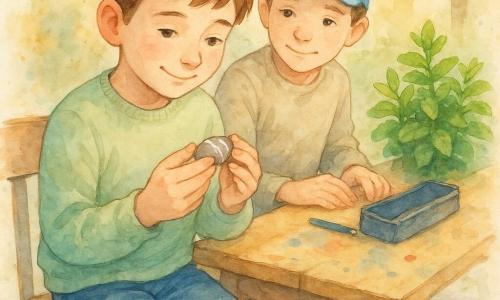
The boy sat on the other beanbag. He didn't speak either. He just took a deep breath, opened his notebook, and began to draw.
Ben glanced sideways. The boy was sketching a tiny robot holding an umbrella.
The boy noticed Ben looking and gave a small, careful smile, like he didn't want to break anything.
Ben nodded once. Then he went back to reading.
For several minutes, the only sounds were rain, pages, and the soft scratch of a pencil.
Ben thought, This is okay. We can be quiet together.
Chapter 2: A Message Without Words
The next day, Ben returned to the same corner. The beanbag by the window still had a little dent from where he'd sat yesterday. That made him feel oddly proud, like he had a tiny claim on the peacefulness.
The other boy arrived again, right on time, shaking raindrops off his sleeves.
He sat down, opened his notebook, and started drawing. Today it was a soccer ball with wings.
Ben watched for a second longer than he meant to.
The boy didn't talk. Instead, he tore off a small square of paper, drew something quickly, and slid it across the table toward Ben.
Ben hesitated. Then he picked it up.
It was a little comic panel: a stick-figure boy sitting on a beanbag with a speech bubble that said, “…” and next to him another stick-figure boy with a speech bubble that said, “…” too. Underneath, the boy had written: “Quiet Club?”
Ben felt a laugh push at his chest. It came out as a silent smile instead.
He took Ben's pencil from his bag, wrote carefully under the drawing, and slid it back: “Yes. Ben.”
The boy's eyebrows lifted in a happy way. He wrote under Ben's name: “I'm Amir.”
Ben had heard the name before in class, but he'd never really talked to Amir. Amir was new this year. He sometimes ate lunch with a book open beside his tray, like he needed stories nearby.
Amir drew another tiny picture: two hands waving very small waves, like mini hello's.
Ben waved back—just a little.
They sat again, shoulder to shoulder but not touching, sharing the same quiet like it was a blanket.
Then Amir's pencil paused. He looked at Ben, then at the book in Ben's hands.
“Is it good?” Amir asked softly, as if he was testing the volume of his voice.
Ben swallowed. Talking wasn't impossible. It just felt like stepping into cold water—better if you did it slowly.
“It is,” Ben said. “It's about a kid who finds a secret tunnel.”
Amir's eyes brightened. “I like tunnels,” he whispered. “They feel… safe. Like the world is smaller.”
Ben nodded. “Smaller can be nice.”
They didn't say much after that, but the few words felt careful and friendly. Like placing blocks without knocking the tower over.
Chapter 3: The Different Lunch
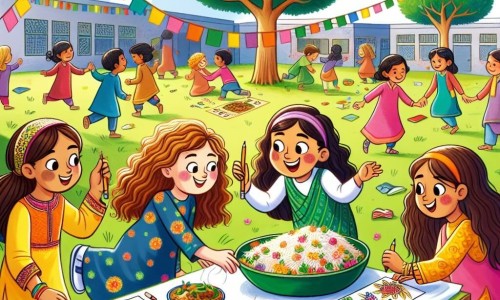
On Monday, Ben walked into the cafeteria with his sandwich and apple. The room was loud in a bouncy way—shouting, laughing, chairs scraping like giant insects.
Ben spotted Amir at a table near the wall. Amir was opening a lunchbox. The smell of something warm and spicy floated into the air.
Two kids at the next table wrinkled their noses.
“What is that?” one of them said, not quietly.
“It smells weird,” the other added, giggling.
Ben's stomach tightened. He didn't like it when people pointed at someone like they were a mistake.
Amir kept looking down, pretending he hadn't heard. But his shoulders went a little stiff.
Ben stood there with his tray, feeling a choice wobble in his hands. He could sit somewhere else and stay invisible. Or he could walk over.
Ben walked over.
He sat across from Amir. He didn't say anything at first, just opened his sandwich like it was the most normal thing in the world.
Amir's eyes flicked up, surprised.
Ben leaned forward a bit and spoke quietly, aiming his words only at Amir. “What is it?”
Amir hesitated, then seemed to decide Ben was safe. “It's my grandma's rice,” he said. “With chicken and spices. In my family we eat it a lot.”
Ben sniffed the air. It did smell strong, but not bad. Like warm peppers and toasted bread.
“It smells… like you cooked something for real,” Ben said, then added honestly, “Mine is just bread and cheese.”
Amir's mouth twitched. “Bread and cheese is a classic.”
The kids at the next table listened. One of them said, “Do you even like that? It looks kind of brown.”
Amir's fingers tightened around his fork.
Ben felt heat rise in his cheeks. His voice came out steadier than he expected. “Brown food can be good. Chocolate is brown.”
A couple of kids laughed, but it wasn't mean laughter. It sounded surprised, like someone had opened a window.
Amir looked at Ben, and his shoulders relaxed a tiny bit.
Amir took a breath. “It's called kabsa,” he said, a little louder. “If you don't like the smell, you can move.”
The kid blinked. “We're not moving.”
Ben wasn't sure what else to do, so he did the simplest thing. He pointed to Amir's lunch and asked, “Can I see it closer?”
Amir slid the lunchbox forward. The rice was speckled with spices like tiny stars. There were raisins too, shiny and sweet-looking.
Ben said, “It looks like treasure.”
Amir chuckled—an actual sound, not too loud. “It kind of is.”
The next table got quieter. One kid leaned over and asked, “Does it taste spicy?”
“A little,” Amir said. “Not super spicy.”
Ben added, “Probably spicier than my cheese.”
That earned another small laugh, and the tension softened like butter on warm toast.
After lunch, Amir walked with Ben to the library. Ben didn't talk much, but he stayed close enough that Amir didn't look like he was walking alone.
Chapter 4: The Poster Problem
On Wednesday, their teacher announced a class project: a “Welcome Wall” poster for the hallway.
“Your poster should show what makes our class a good place for everyone,” the teacher said. “Different interests, different families, different ways of learning—everything.”
Ben liked drawing more than speaking. Amir liked drawing too, and he had a neat way of making everything look alive. They ended up as partners.
They sat in the library after school with a big sheet of paper between them. Ben chose markers in calm colors. Amir chose bright ones. Together, their marker pile looked like a rainbow trying to decide if it wanted to whisper or shout.
Amir drew a big school building in the center. Ben added a path leading to the door. On the path, Ben drew footprints—some big, some small, some with zigzag soles.
Amir nodded. “Different shoes,” he said.
Ben wrote, slowly and carefully, “Everyone belongs.”
Amir drew speech bubbles around the building—some with words like “Hi,” “Help,” and “Want to play?” Others were filled with pictures: a smile, a thumbs-up, a heart, a question mark.
Ben paused, then pointed. “Those ones don't have words.”
Amir shrugged. “Not everyone talks the same. Or at the same time.” He glanced at Ben with a gentle look. “Some people are quiet. Some people are new. Some people are learning English. But they still have things to say.”
Ben felt his throat tighten, not in a bad way. More like his feelings were too big for his body.
He nodded, then drew a bench under a tree next to the school. He shaded it carefully, making it look soft.
Amir leaned closer. “What's that?”
Ben tapped the bench. “A quiet place,” he said. Then, after a second, he added, “For sharing space. Even without talking.”
Amir smiled and drew two small figures on the bench. They weren't holding hands or doing anything dramatic. They were just sitting side by side, both looking at a tiny bird on the grass.
When they finished, the poster looked full without being messy. Loud colors and calm colors sat next to each other like they were friends.
The next day, the teacher hung it up. Kids stopped to look.
One girl pointed at the speech bubbles with pictures. “I like those,” she said. “Sometimes I don't know what to say either.”
A boy traced the footprints with his finger. “Hey, my shoes have zigzags,” he said, pleased.
Ben stood a little behind everyone, but he felt included anyway, like he was part of the wall itself—steady and real.
Chapter 5: The Bench and the Bird
Friday evening, Ben and Amir went to the library corner one last time before the weekend. The rain had stopped, and the window showed a sky the color of a washed-out blue crayon.
They sat on the beanbags, their usual spots. Ben opened his book. Amir opened his notebook.
For a while, they shared the space in silence. It wasn't empty silence. It was the kind that had room to breathe.
Then Amir drew something and nudged the paper toward Ben.
It was their bench from the poster, but now it was real, sitting under a tree. And there were two boys on it, one holding a book, the other holding a pencil. Above them, a bird carried a tiny banner that read, “Thanks.”
Ben looked at the drawing for a long moment.
“I didn't… talk much,” Ben said, choosing each word like a smooth stone. “But you still… sat here.”
Amir's voice was gentle. “You don't have to be loud to be kind.”
Ben nodded. He thought about the cafeteria, the poster, the way Amir's shoulders had softened when someone finally treated his lunch like it mattered.
Ben said, “I'm glad you're in our class.”
Amir's smile was bright, but not too big. “Me too. And I'm glad you walked over.”
They packed up their things. At the library door, Amir held it open for Ben. Ben stepped through, then held it open back. A small, normal exchange—like a quiet handshake with the world.
Outside, the air smelled clean. The puddles reflected the streetlights like little glowing coins.
As they walked home in the early dusk, Ben didn't feel like he needed to fill the air with words. Amir didn't push him. They simply moved side by side, different in plenty of ways, and still perfectly matched for the moment.
[July 3, 2026]