Chapter 1: The Sign-Up Sheet
The after-school room smelled like pencil shavings and the orange cleaner the custodian loved a little too much. On the wall, a poster said: COMMUNITY NIGHT — FOOD, MUSIC, STORIES.
Maya stood on tiptoe to read the sign-up sheet. The words swam like fish that wouldn't line up.
She tapped her earbud case in her pocket. “Audiobooks would never do this to me,” she muttered.
“Talking to paper again?” Zoe asked, sliding in beside her with a grin. Zoe's hair was in two neat braids, like she'd braided her thoughts into place.
Maya smiled. “Paper started it.”
Aisha leaned over Maya's shoulder, her bangles clinking softly. “What does it say we need?”
Before Maya could answer, Lina rolled up in her wheelchair, spinning one wheel in a tiny circle like she was revving an engine. “If it says ‘bring a dragon,' I'm out,” Lina said.
Zoe laughed. “Community Night is not that kind of party.”
Ms. Carter, their teacher, clapped her hands. “Okay, team leaders! Each group will host one table. Your table should show something about diversity—how our differences make us stronger. You can use food, games, or stories.”
Maya's stomach fluttered, excited and nervous at the same time. She loved stories—she just preferred them to come through her ears, not her eyes.
Ms. Carter handed Maya a clipboard. “Maya, could you be a leader? You're great at bringing people together.”
Maya's cheeks warmed. “I can… try.”
Aisha bumped her shoulder gently. “We've got you.”
Zoe pointed at the sheet. “We should sign up before the soccer team claims all the good spots.”
Maya took a breath. “Okay. We're doing this.”
She wrote their names, slow and careful. The letters weren't perfect, but they stood tall anyway.
When she finished, Lina nodded at the clipboard. “Look at that. Four names, one team. Like a superhero group, but with snacks.”
“Snacks are my superpower,” Aisha said.
Maya tucked the clipboard under her arm. “Then let's build the best table in the room.”
Chapter 2: Listening for a Plan
They met at Maya's kitchen table that evening. The table was covered in homework, a bowl of grapes, and one lonely spoon that never made it to the drawer.
Maya pressed play on her phone. A narrator's warm voice filled the room: “—and the travelers learned that the map was easier to understand when they listened together.”
Zoe raised an eyebrow. “Is this… research?”
“It's an audiobook,” Maya said, proud. “When I listen, my brain feels like it's riding a smooth bike path instead of bumping over rocks.”
Aisha popped a grape into her mouth. “I like that. Smooth bike path brain.”
Lina leaned forward. “So what's our table idea? No dragons, but maybe… something fun.”
Zoe opened her notebook. “We need something that shows differences. Like… languages? Or traditions? Or learning styles.”
Maya paused the audiobook. “What if our table is about how we all do things differently—like reading, talking, moving, cooking—and we still work together?”
Aisha's eyes lit up. “Like a ‘Different Ways, Same Team' table.”
Zoe scribbled fast. “We could have a game. People try tasks in different ways.”
Lina pointed at the spoon. “First task: find the spoon's family.”
Maya laughed. “Okay, okay. Real game ideas.”
Aisha said, “Food brings people together. We could have small snacks from our families. My aunt makes date balls—like tiny sweet planets.”
Zoe nodded. “My grandma makes apple cake. It's basically a hug you can eat.”
Lina said, “My dad's specialty is… toast. But he's very confident about it.”
“That counts,” Maya said. “Confidence is a culture.”
Zoe tapped her pencil. “We should also include stories. Quick ones. Like audio clips.”
Maya's heart jumped. “Yes! We can record short ‘micro-stories' about times we felt different but included.”
Aisha leaned in. “And we can invite people to record their own.”
Lina grinned. “A ‘story station.' Like a little podcast booth, but less fancy.”
Maya imagined it: headphones, a small sign, a cozy chair. Listening instead of squinting at words. Her favorite kind of learning.
Zoe looked at Maya. “You'd be perfect running the audio part.”
Maya swallowed. “What if I mess up? What if people think it's weird?”
Aisha's voice softened. “Then we show them it's normal. Everyone has something.”
Lina nodded. “Also, if anyone is rude, I will roll over their shoelaces.”
Zoe smiled. “Solidarity with consequences.”
Maya laughed, and the flutter in her stomach settled into something steadier.
“Alright,” Maya said. “Different Ways, Same Team. Snacks, a game, and audio stories.”
Aisha clapped once. “Let's do it.”
Chapter 3: The Practice Round
On Saturday, they tested their game in Zoe's backyard. The air smelled like fresh-cut grass and the neighbor's barbecue, which made everyone suddenly hungry.
Zoe set up stations with signs written in thick marker:
1) Draw a simple shape with your non-dominant hand.
2) Listen to a short story and answer a question.
3) Describe a picture without using certain words.
4) Pass a ball without standing up.
Lina rolled up to station four and smirked. “Finally. A sport designed for my personal victory.”
Maya put on headphones and pressed play. Her recorded story began: “Hi. I'm Maya. Sometimes letters jump around like they're playing tag…”
Zoe listened carefully, then said, “Question: How do you feel when you use audiobooks?”
Maya answered, “Like the story is holding my hand, not tripping me.”
Aisha tried drawing with her left hand. The result looked like a confused potato. She stared at it, then laughed. “My hand is not cooperating.”
Zoe did the “forbidden words” station with a picture of a busy market. “Okay,” Zoe said, “I can't say ‘people' or ‘shopping' or ‘food.' Great.”
She tried anyway. “There are… humans… no, can't say that—there are… uh… moving shapes—”
Lina snorted. “Moving shapes is my new band name.”
They played, they adjusted rules, they argued about whether “humans” counted as “people,” and they kept laughing until their cheeks ached.
But when Maya looked at the station signs, her stomach tightened. So many written instructions.
“What's wrong?” Aisha asked quietly, stepping closer.
Maya traced a finger along the marker letters. “At the event, there will be kids like me. Or adults. If they struggle with reading, these signs might feel like a wall.”
Zoe's face shifted, serious now. “You're right. We can make it more accessible.”
Lina said, “We can add symbols. Like icons. And we can have audio instructions too.”
Aisha nodded. “We could make QR codes that play the directions.”
Maya blinked. “That's brilliant.”
Zoe grinned. “We'll call it ‘scan and listen.'”
They spent the rest of the afternoon making simple drawings: a hand with a wobbly pencil, an ear with sound waves, a mouth with a little “no” sign, a ball rolling into waiting hands.
As the sun sank, painting the fence gold, Maya felt something click into place.
Differences weren't problems to hide. They were clues—ways to build something that fit more people.
On the walk home, Lina rolled beside Maya on the sidewalk. “You know,” Lina said, “I'm kind of proud of us.”
Maya nodded. “Me too.”
“And if anyone says ‘moving shapes,' I'm taking full credit,” Lina added.
Maya laughed so hard she almost missed the curb.
Chapter 4: Community Night Chaos
Community Night arrived with the smell of popcorn and the squeak of folding chairs. The school gym looked different—like a small festival inside a familiar space.
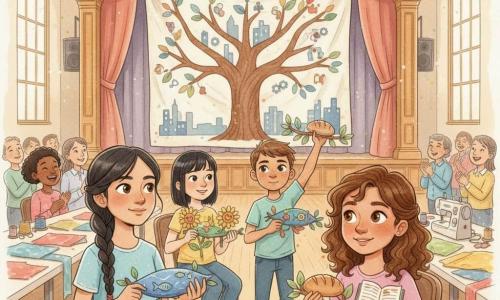
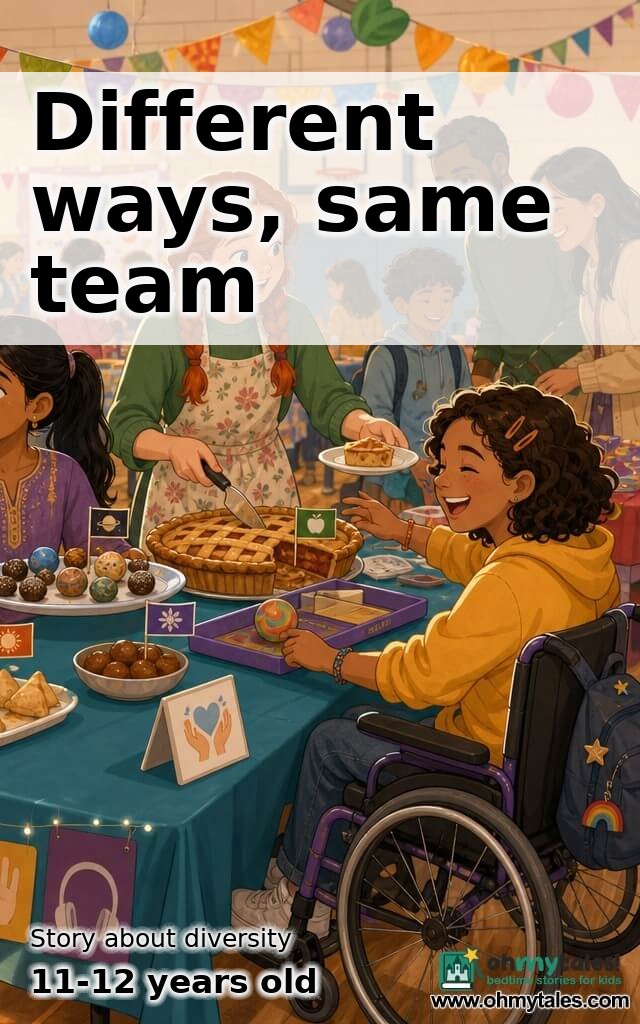
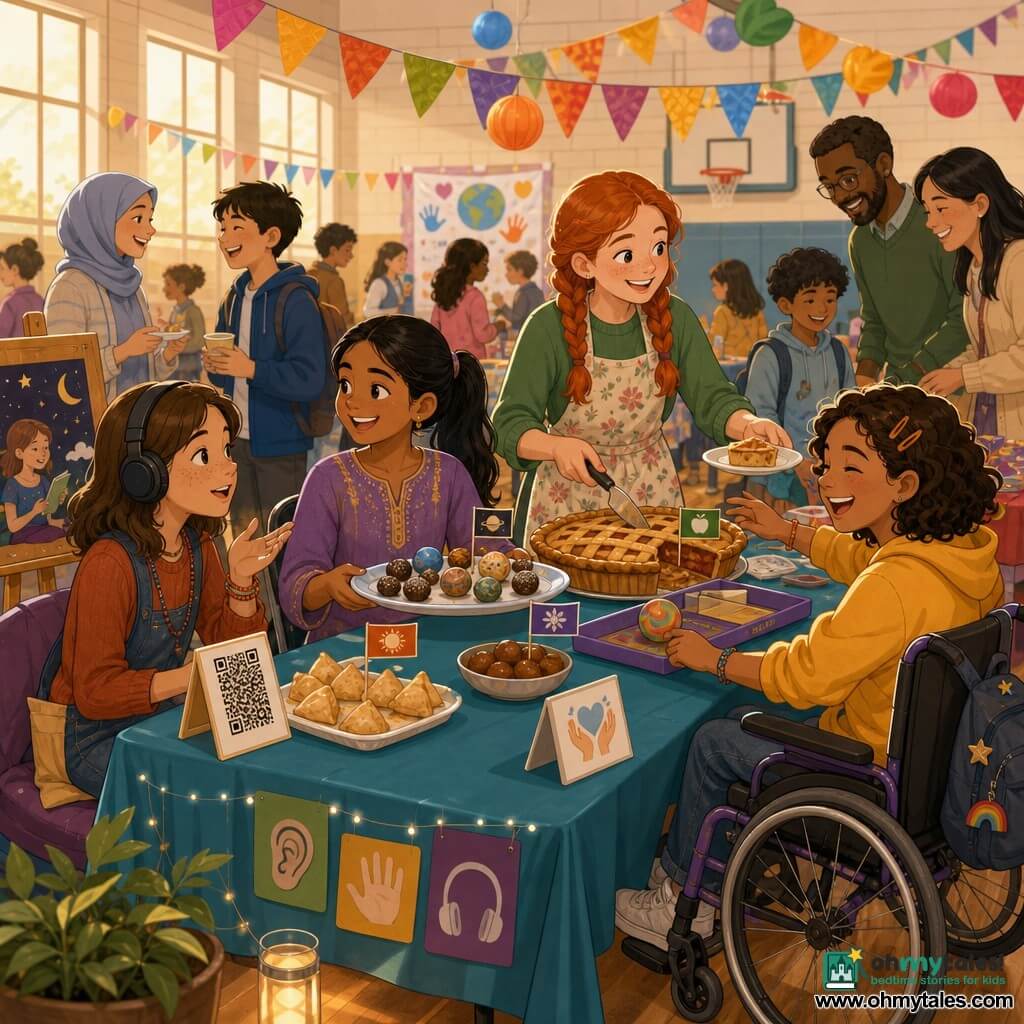
Their table sat near the window. They taped up their icons, set out snacks with little flags, and arranged a phone and headphones at the story station.
Aisha placed a tray of date balls in the center. “Tiny sweet planets,” she announced.
Zoe set down slices of apple cake. “Hug food.”
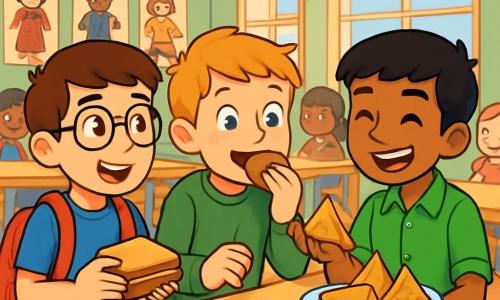
Lina added a plate of toast triangles. “Confidence toast.”
Maya tried not to laugh as she lined up the headphones. She checked the audio files one more time.
Then—disaster.
Her phone froze. The screen went dark, then bright, then dark again, like it was blinking slowly in confusion.
“No,” Maya whispered. She tapped. Nothing.
Zoe leaned in. “What's happening?”
“It's stuck,” Maya said, throat tight. “The story station—our whole listening thing—”
Aisha's brow furrowed. “Do you have a charger?”
Lina said, “Do we perform the ancient ritual of turning it off and on again?”
Maya swallowed. She could feel the noise of the gym pressing in: voices bouncing off walls, sneakers squeaking, someone laughing loudly near the stage.
She hated how quickly her brain went from “We can fix this” to “Everyone will be disappointed.”
Zoe placed a hand on the table, steady. “Okay. We're a team. What's our backup?”
Maya stared at the dead screen. Then she remembered her earbud case. And her own voice.
“We… we can do live stories,” Maya said slowly. “No phone needed.”
Aisha's face softened. “You mean, like, tell them out loud?”
Maya nodded. “Short ones. People can share too.”
Lina grinned. “A story circle. Old-school. Unplugged diversity.”
Zoe snapped her fingers. “Yes. And we can still use the icons for instructions.”
Maya took a deep breath. “Okay. Let's do it.”
The first visitors were a little boy and his dad. The boy stared at the toast like it was a rare animal.
Maya smiled. “Want to try our game? You can pick any station.”
The boy pointed at the ear icon. “That one.”
Maya crouched so she was at his level. “This station is about listening. Since our phone is taking a nap, I'll tell you a story.”
Zoe whispered, “Phone is a moody teenager,” and Aisha stifled a laugh.
Maya began, voice gentle but clear. “Sometimes words on a page feel like they're wiggling. For me, listening helps the story sit still. And my friends help too, like when we use pictures and audio directions so everyone can join.”
The boy's eyes widened. “Like captions, but for ears?”
Maya's smile grew. “Exactly.”
His dad nodded. “Thanks for sharing that.”
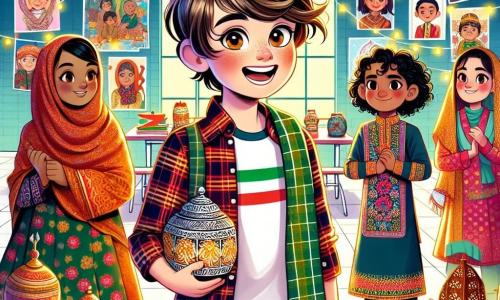
More people came. A girl wearing a hijab and a boy with freckles and a grandma with a cane. Some tried drawing with their non-dominant hand and giggled. Some struggled with the “forbidden words” game and got hilariously stuck saying “moving shapes,” which made Lina beam like she'd won a prize.
At the story circle, people shared small moments:
“I moved here last year and didn't know anyone.”
“I speak two languages at home and sometimes I mix them up.”
“I'm shy, but my cousin always saves me a seat.”
Each story was like a pebble placed gently in a jar. Different shapes, same music when they settled together.
Maya noticed something else too: when she spoke, her friends watched her with real attention, like she was holding something important.
She was.
And it wasn't a phone. It was her voice.
Chapter 5: Same Team
Near the end of the night, Ms. Carter stopped by their table with a warm smile. “I've been hearing good things. Someone said your table made them feel… seen.”
Zoe straightened proudly. “We tried.”
Aisha offered Ms. Carter a date ball. “Sweet planet?”
Ms. Carter laughed. “Sure.”
Lina gestured toward the story circle where a younger student was speaking softly while their older sibling listened. “We had a tech problem. So we made it human.”
Ms. Carter looked at Maya. “How did that feel?”
Maya thought about the loud gym, the frozen phone, the moment her stomach had dropped like an elevator. Then she remembered the boy saying “captions, but for ears,” and the way the grandma had patted Maya's hand after sharing a story.
“It felt scary,” Maya admitted. “And then it felt… good. Like we didn't need everything perfect to include people.”
Zoe nodded. “Also, chaos forced us to be creative.”
Aisha said, “And to rely on each other.”
Lina added, “And to accept toast as a cultural artifact.”
They all laughed, and even Ms. Carter's eyes crinkled.
As the crowd thinned, they began cleaning. Crumbs dotted the table like tiny constellations. A smear of frosting tried to hide under a paper plate. Someone had left a pencil behind, as if it wanted to join their group.
Maya wiped the table in slow circles. Zoe stacked plates. Aisha gathered the signs and icons. Lina held open a trash bag and pretended it was a hungry monster.
“Feed me your paper!” Lina growled.
Zoe dropped in a napkin. “Behold, mighty beast, a sacrifice.”
Aisha pointed at their icons. “We should keep these. They worked.”
Maya nodded. “Yeah. Pictures, listening, different ways in.”
When the table was finally clean, it looked calm and simple, like a fresh page that wasn't trying to fight anyone.
They stood for a moment, hands resting on the smooth surface.
Maya spoke softly, as if the gym were already turning into bedtime quiet. “Tonight we learned that diversity isn't just big, famous things. It's everyday stuff—how we learn, how we talk, what we eat, how we move.”
Zoe added, “And that making space for different ways helps everyone.”
Aisha said, “Solidarity means you don't leave someone behind when the plan breaks.”
Lina nodded. “You build a new plan together. Preferably with snacks.”
Maya looked at her friends—four almost-twelve-year-olds, different in a hundred small ways, lined up like a team photo.
She felt proud of her own difference too, the one she used to hide in the shadow of messy letters. Tonight, it had helped them make something kinder.
“Same team,” Maya said.
“Same team,” they echoed.
The lights dimmed as volunteers folded chairs in the distance. Their clean table waited quietly, ready for tomorrow—like a promise that everyone could belong.