Chapter 1: The Map on the Kitchen Table
Eli spread a sheet of graph paper across the kitchen table like he was about to plan a space mission. His pencil made soft scratching sounds, and his cereal bowl sat nearby, abandoned halfway through.
On the paper, he'd drawn their neighborhood: Maple Street, the little park with the crooked slide, the library that smelled like paper and lemon cleaner, and the corner shop where the bell over the door always jingled like it was laughing.
His mom leaned over his shoulder. “That's a lot of careful lines for a Saturday.”
Eli didn't look up. “It's for Noor.”
“Noor with the bright sneakers and the even brighter opinions?”
Eli smiled. “That's him.”
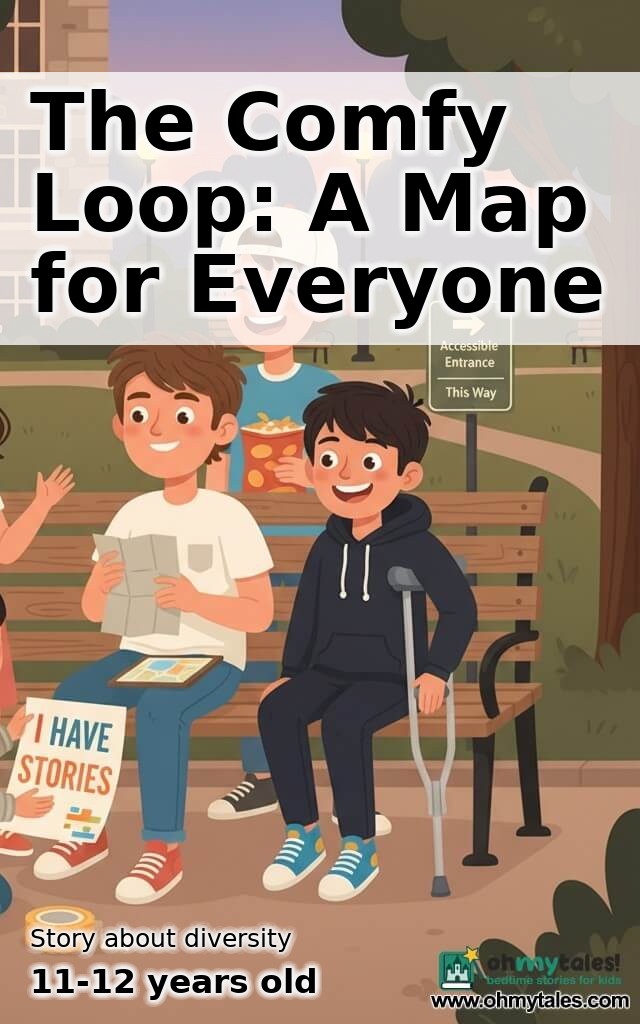
Noor had started at Eli's school a month ago, right after he'd broken his leg in a biking accident. He moved with crutches now—quick, determined clicks on the hallway floor. Some kids stared. A few whispered. Noor usually pretended he didn't notice, like he had armor made of jokes.
Eli tapped his pencil on the paper. “I want to make a route. Like… a fun walk. But actually accessible. So Noor won't have to worry about weird stairs or bumpy sidewalks.”
His mom poured tea. “That's thoughtful.”
Eli tried to sound casual, but his chest felt warm. “Also,” he added, “I want him to feel like he belongs. Like, we're not just doing stuff while he watches.”
Mom nodded slowly. “Belonging is a big deal.”
Eli drew a star at the park. Then another at the library. Then, for no reason except it made him laugh, he drew a tiny skull-and-crossbones on the steep alley behind the old bakery. “Noor's Crutch Trap,” he muttered.
“What was that?” Mom asked.
“Nothing,” Eli said, grinning. “Just… planning.”
Chapter 2: The Sidewalk Test
That afternoon, Eli met Noor outside his apartment building. Noor's crutches were silver and slightly scratched, as if they'd already fought a few dragons.
Noor raised an eyebrow. “Why are you holding a clipboard?”
Eli looked down. He had, in fact, brought a clipboard. He also had a measuring tape, because he'd seen his dad use one and thought it made him look like a professional human being. “It's for the route test,” Eli said.
Noor's mouth twitched. “Are you going to grade the sidewalk?”
“If it deserves it,” Eli said, trying to keep his face serious.
They started down Maple Street. The air smelled like cut grass and car exhaust, the normal perfume of Saturday. Eli watched Noor's steps carefully—how he placed the rubber tips, how he leaned, how he moved forward with a rhythm that was almost like a dance.
At the first corner, the curb ramp was cracked. One side dipped like a sad pancake.
Noor tested it with one crutch. “This one's annoying,” he said. “Not impossible. Just… annoying.”
Eli wrote: CRACKED RAMP—ANNOYING. He paused. “Should I write ‘sad pancake' too?”
Noor snorted. “Only if you draw syrup.”
They kept going. Past Mrs. Kline's garden, where sunflowers stood like tall guards. Past the bus stop where a little kid was licking an ice pop as if it might run away.
Then they reached the bakery—warm air spilling out, smelling like cinnamon and butter. The shortest path to the park was the alley beside it, but the alley was steep and made of uneven stones.
Noor looked at it and shook his head immediately. “Nope.”
Eli nodded. “Nope is a valid answer.”
They took the longer route instead, around the block where the sidewalks were smoother. Noor's pace stayed steady, but Eli noticed how his shoulders tightened when they passed a group of older kids.
One of them stared a little too long.
Noor lifted his chin and said loudly, “Yes, I'm a robot. My charging port is under my left armpit.”
The older kids blinked, confused, and then laughed—not meanly, just surprised. The moment loosened like a knot coming undone.
Eli whispered, “Do you actually have a charging port?”
Noor whispered back, “Only on weekends.”
When they finally reached the park, Noor let out a breath like he'd been holding it for miles. “Okay,” he said. “This route? Not terrible.”
Eli's pencil hovered. “Not terrible is basically a compliment from you.”
Noor pointed a crutch at him. “Don't get used to it.”
Chapter 3: The Stairs That Said “No”
Two days later, Eli met Noor again, this time with a bigger plan. “Today,” Eli announced, “we add the library to the route.”
Noor's eyes brightened. “Yes. Books. And air-conditioning.”
They set off after school, backpacks bumping against their shoulders. The sky was a pale blue that looked like someone had washed it.
At the library, Eli marched toward the front steps—and stopped.
There were six stone steps up to the main doors. Beautiful, wide, and completely unfriendly to crutches.
Noor halted behind him. For a second, the air felt heavy.
Eli turned around, feeling his face go hot. “I didn't think.”
Noor shrugged, but it wasn't his usual easy shrug. “It happens. People don't see stairs until they're the ones stuck at the bottom.”
Eli stared at the steps. They looked different now, like they were blocking more than just a doorway.
A librarian came outside with a cart of returned books. She had short gray hair and glasses on a chain.
Noor asked, polite but direct, “Is there another entrance?”
The librarian's expression changed—like a light turning on. “Yes! Around the side. There's a ramp by the community room. It's not very obvious, though.”
Eli felt a little spark of anger on Noor's behalf. “Why isn't it obvious?”
The librarian sighed. “Old building decisions. We've asked for better signs. We keep asking.”
Noor nodded. “Maybe it needs more than asking.”
Eli followed them around the side. The ramp was there, but it was hidden behind a bush that had clearly decided to grow wherever it wanted. The ramp itself was fine, but it felt like a secret.
Inside, the library was cool and quiet. The carpet muffled their steps. Noor exhaled, and his shoulders dropped.
Eli leaned closer and whispered, “I'm sorry about the stairs.”
Noor whispered back, “Thanks. Also, stairs are rude.”
Eli smiled, then said, “What if we make the ramp less secret?”
Noor's eyes gleamed. “Now you're speaking my language.”
Chapter 4: The Sign Plan (and the Poster Disaster)
The next day at lunch, Eli and Noor sat at the end of a table with a stack of paper, colored markers, and a packet of gummy bears Noor claimed were “for energy, not bribery.”
Eli drew a big arrow. Noor added thick letters: RAMP THIS WAY! in bright green.
Eli added a little drawing of a book with legs. “So it looks welcoming,” he explained.
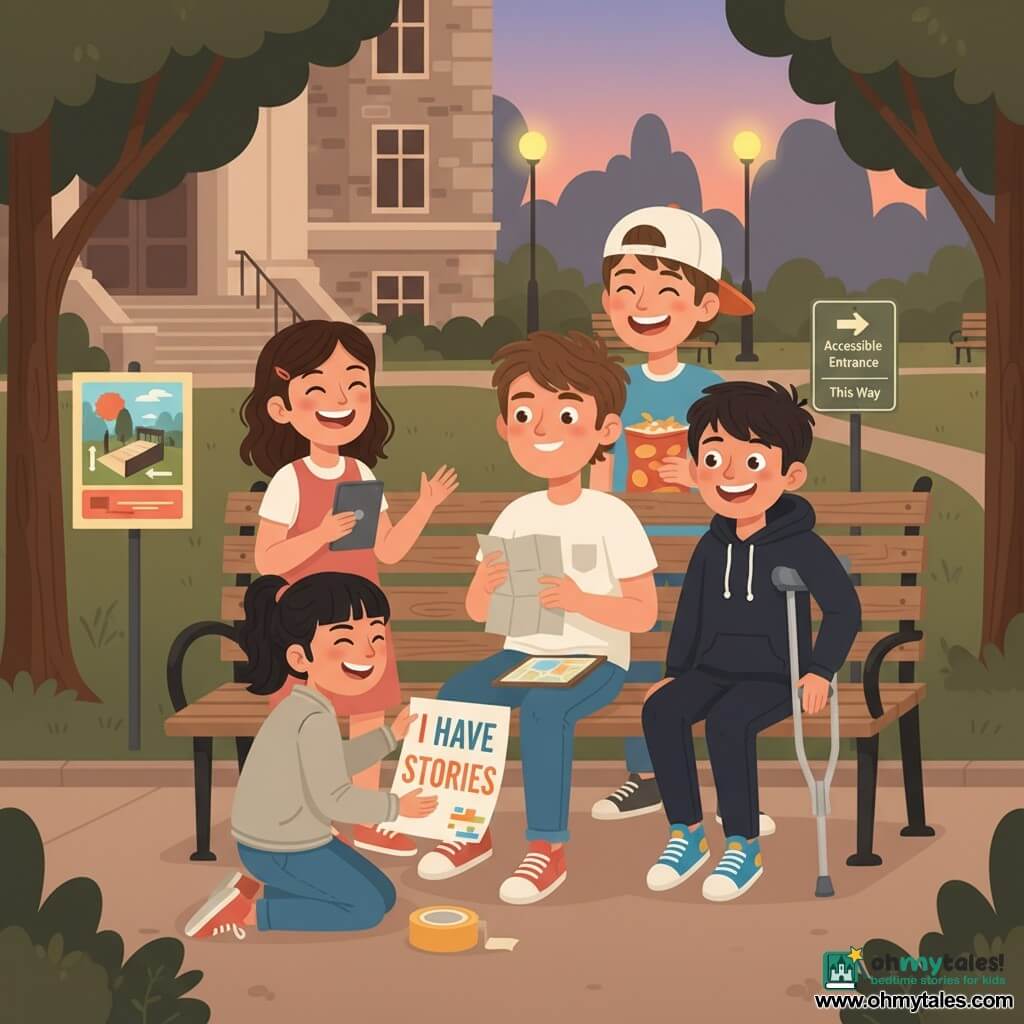
Noor added a speech bubble: “I HAVE STORIES.”
Eli laughed and almost snorted milk through his nose, which would have been the worst possible use of milk.
Their friend Mei slid into the seat across from them. “What are you two plotting?” she asked, eyes narrowing with playful suspicion.
“Noor is starting a library revolution,” Eli said.
Mei read the poster. “This is actually good. But maybe we should make it… nicer? Like, less shouty?”
Noor tilted his head. “The ramp deserves excitement.”
Mei tapped the words with her finger. “What if you write: Accessible Entrance—This Way. And keep the arrow.”
Eli looked between them. “We can do both. One official-sounding and one fun.”
Soon, two posters existed: one calm and clear, one cheerful and a little silly. Mei added small icons: a wheelchair symbol, a crutch, a cane, and footprints—different ways of moving, all heading in the same direction.
Eli paused, marker in hand. “That's kind of the point, isn't it?”
Mei nodded. “Different bodies. Same building. Same books.”
Noor popped a gummy bear into his mouth. “Same air-conditioning.”
After school, they walked to the library with their posters rolled like scrolls. Eli's stomach fluttered. He wasn't sure if kids were allowed to change things in the world, even small things. Adults sometimes acted like rules were made of glass.
At the library, the same librarian was at the desk. Her name tag said MS. RAMIREZ.
Eli cleared his throat. “Hi. We noticed the ramp isn't easy to find. We made these… signs.”
Ms. Ramirez unrolled the first one and smiled. “Oh. These are wonderful.”
Noor unrolled the fun one. Ms. Ramirez read the walking book's speech bubble and laughed, a real laugh that crinkled the corners of her eyes. “I HAVE STORIES,” she repeated. “That is adorable.”
Eli said quickly, “We can take them down if it's not allowed.”
Ms. Ramirez held up a hand. “Let me check with the manager. But I think we can put one by the front steps and one at the corner. It helps everyone.”
Noor's face brightened, but he kept his voice steady. “We just want people to know the ramp exists.”
Ms. Ramirez nodded. “Sometimes access isn't only about building ramps. It's about pointing to them.”
Ten minutes later, with permission and a roll of tape, Eli stuck the official sign near the front steps. Mei placed the fun sign near the side path, where the bush tried to act like a curtain.
Eli stepped back to admire it—and the tape immediately peeled off one corner, making the poster droop like a tired flag.
Noor stared. “Your tape has the strength of a wet noodle.”
Eli groaned. “My tape has feelings.”
Mei handed over stronger tape from her backpack. “Emergency supplies,” she said casually.
Noor looked impressed. “Mei, you are secretly a superhero.”
Mei shrugged. “I'm secretly prepared.”
With the new tape, the poster stayed up, proud and flat. Eli felt a small, solid pride settle in his chest, like a pebble you keep because it's smooth and comforting.
Chapter 5: The Accessible Adventure
Saturday evening, Eli's route was ready. He'd drawn it neatly on his graph paper and labeled it: THE COMFY LOOP. He'd even added tiny notes: GOOD BENCH HERE, SMOOTH SIDEWALK, AVOID SAD PANCAKE RAMP.
Noor arrived wearing his bright sneakers and a hoodie that said BE KIND TO YOUR BRAIN. Mei came too, along with Eli's neighbor Lucas, who was tall and always hungry, and Amina from Eli's class, who had a laugh that sounded like a bell.
Eli held up the map. “Okay, team. The goal is simple: we do a loop where everyone can actually enjoy it.”
Lucas raised a hand. “Is there snacks?”
Eli pointed to the corner shop on the map. “Yes.”
Lucas lowered his hand like the question had been solved forever.
They started at the park. The sun was sliding down, turning everything gold. Noor moved carefully but confidently, and nobody rushed him. They matched his pace the way you match music when you walk with a friend.
At one point, Amina spotted a rough patch in the sidewalk ahead. “Heads up,” she said, pointing. “That looks like a toe-tripper.”
Noor tested it with his crutch. “It's a crutch-tripper too.”
Mei stepped to the side and guided everyone around it. Lucas said, “Sidewalks should come with warning labels.”
Eli said, “Like: Caution, may contain surprise holes.”
They laughed, and the laughter felt easy—like it belonged.
At the library, they approached the front steps on purpose, because Eli wanted to see something.
The new sign stood there, clear and confident: Accessible Entrance—This Way.
Noor stared at it for a second. “That,” he said quietly, “is satisfying.”
Eli watched a woman with a stroller read the sign. She turned immediately toward the ramp without hesitation. No awkward looking around. No guessing.
Mei nudged Eli. “See? It's not just for Noor.”
Eli nodded. “It's for… everyone who needs it. Even if they don't look like what people expect.”
Amina added, “Like when people assume my mom doesn't speak English because she has an accent. Then they talk louder instead of clearer.”
Lucas frowned. “That's dumb.”
Amina shrugged. “It is. But it's real.”
Noor said, “People assume things about me too. Like I'm fragile, or slow, or sad. Honestly, I'm mostly just annoyed about stairs.”
Eli smiled at Noor. “And you're still Noor. With opinions.”
Noor lifted his crutch like a microphone. “Thank you. I'd like to thank the academy.”
They took the ramp entrance together. Inside, Ms. Ramirez spotted them and gave a thumbs-up. Noor grinned so wide Eli could see it from across the room.
After the library, they went to the corner shop. The bell jingled. Lucas bought chips. Mei bought a juice. Amina bought a small chocolate bar “for later.” Noor bought gum and offered it around like a host at a fancy event.
Eli didn't buy anything. He just watched his friends in the bright store light, different heights, different voices, different lives—together in one place, making room for each other without making it weird.
On the way back, the sky turned deep blue, and the streetlights blinked on one by one, like sleepy eyes opening.
Chapter 6: The Song at the End of the Loop
They returned to the park and sat on a bench that Eli had marked on the map: GOOD BENCH HERE. The wood was cool under them. Crickets started their tiny nighttime orchestra.
Noor rested his crutches beside him. “Your Comfy Loop,” he said, “is actually comfy.”
Eli leaned back, listening to the leaves whisper overhead. “Good. That was the mission.”
Mei nudged Eli's shoulder. “So what did we learn, Captain Clipboard?”
Eli thought for a moment. “We learned that small things matter. Like a sign. Like a smoother path. Like walking at the same pace.”
Amina said softly, “We learned not to guess what people need. We can ask.”
Lucas said, “We learned snacks are important.”
Noor pointed at him. “That is also true.”
Eli looked at Noor. “And we learned that people are different, and that's not a problem to fix. It's just… reality. And it can be kind of cool.”
Noor nodded, eyes on the grass. “And we learned that when something blocks someone, it's not their job to magically become someone else. Sometimes the world should move a little too.”
A quiet settled over them—warm, not awkward. Like a blanket.
Eli cleared his throat. “I wrote something,” he admitted. “A short song. For the end of the loop.”
Mei's eyes widened. “Eli wrote a song. This I have to hear.”
Noor pretended to look serious. “As long as it doesn't rhyme ‘crutch' with… anything gross.”
Eli laughed. “No gross rhymes. Promise.”
He tapped his knee to find a rhythm, slow and gentle, like footsteps on a calm sidewalk. Then he began, and the others joined in, one by one:
“We're not all built the same, and that's okay,
Different ways to move through every day.
If there's a step that says ‘No,' we find another way,
We make a little room, so we all can stay.
Different voices, different speed,
Different stories that we read.
Side by side, we try, we learn,
Kindness is the way we turn.
So here's our loop, our friendly track,
We go together, we come back.
And what we share, the thing that's true:
There's space for me, and space for you.”
When the last line faded, the park felt even quieter, as if it was listening too.
Noor clapped once, then winced dramatically. “My hands are overwhelmed by the art.”
Mei laughed. “It was good, Eli.”
Amina said, “It felt like a promise.”
Lucas nodded, chewing thoughtfully on a chip. “It made me want to… be better at noticing things.”
Eli looked at his friends under the streetlight glow. He felt sleepy in the best way, like his day had been tucked in neatly.
Noor picked up his crutches again and stood. “Same time next week?” he asked.
Eli smiled. “Yeah,” he said. “Same loop. Or a new one. We can keep making the map bigger.”
They walked home together, their steps different but steady, the night soft around them, and the idea of belonging bright as a porch light left on for someone you care about.