The Map in the Attic
Sam found the map folded inside a shoebox under a stack of old birthday cards. The attic smelled of dust and sun-warmed wood, like books that had been shut up too long. He sat cross-legged on the floor, a single ray of light making a bright stripe across the map. Lines and names sprawled across it in his grandmother's careful handwriting, places that belonged to people and memories instead of counties and highways: Auntie Mina's kitchen, the willow by the river where he had learned to tie knots, Mr. D'Souza's bakery that always had a tray of warm cardamom bread waiting for him.
Sam was twelve and liked tidy things: straight pens, clean sneakers, and playlists that matched the weather. He did not always like messy feelings. Stories felt messy. They were full of unswept corners and the awkward furniture of other people's pasts. He loved hearing his grandmother tell a tale — how she had once sailed with a cat who insisted on wearing a small red cap — but when his teacher said, "Bring a story about your family for the school's Story Garden project," Sam swallowed. The map in the attic made his fingers feel too small.
His grandmother, Laila, was in the kitchen downstairs, humming as she kneaded dough. Her hands were smooth with flour and small scars like punctuation marks. Sam folded the map and slid it into his backpack anyway. The project at school was simple: each child would plant a seed in a shared garden and write a short story to hang on a tag beside it. All the stories would be read aloud at the next full moon. The idea thrilled half of his classmates and terrified the other half very quietly.
"You're going to do something for the Story Garden, right?" his mother asked at dinner. She had come from another country when she was young and sometimes said things that made Sam feel proud and strange at once. Her accent curved like gentle hills in every sentence. "It will be good," she said. "Telling is how other people meet you."
Sam chewed his vegetables and thought of the attic map. He thought of the way his voice sometimes stumbled when he talked about where they had come from, how other children occasionally made a joke about the way his grandmother hummed in a language he could not always remember. He had been born here, but he carried two places like two watches on his wrist. He could set one to school time and the other to family time, and sometimes they pointed in different directions.
That evening he climbed back up to the attic and spread the map on the floor. He read his grandmother's notes and began to pin small ideas to the paper in his mind. There was the bakery, where the air always carried the warm weight of spice. There was the river, where his grandmother had taught him to find frog calls and patience. There was the small pocket in her apron where she kept a coin for luck. Those were not just places; they were sounds and smells and jacket sleeves folded with care. Maybe a story could be like that: not perfect and tidy but alive.
His heartbeat was a small drum, keeping time with the light outside. He took a notebook and wrote the first sentence aloud to test it: "When I was small, my grandmother taught me to listen to the world like it was telling one long secret." The sentence felt clumsy at first, but when he read it again he could almost hear the kitchen, the soft slap of dough, the cat's whiskers twitching. He made a little promise to himself: he would tell something true, even if it sounded sideways. If he could tell a true story, perhaps others would tell him theirs.
That night his grandmother came up with two mugs of tea, steam knotting into the light above them. She sat down on the step and watched him fumble with his notebook.
"Why do you look like someone trying to find a missing shoe?" she asked, smiling.
"I'm trying to write something for the Story Garden," Sam said. He shoved the map between his knees, and the paper rustled like a small, restless bird. "But I don't know what to tell. I don't know where I'm from."
Laila patted his knee. "You're from the place you carry," she said simply. "From the shelf of your heart where you keep the things you cannot lose." Her voice was warm, and it smelled faintly of cardamom and orange peel. "Sometimes, telling is the key to knowing."
Sam nodded, more because he liked the sound of the words than because he understood them completely. He turned the map back over and found, written along the edge in a tiny hand, the words: Tell me one thing. He laughed out loud, surprised. The attic felt less like a room full of forgotten objects and more like the uncovered part of a treasure he hadn't known he was seeking: other people's small, shining things.
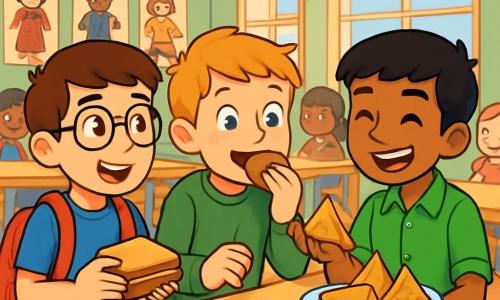
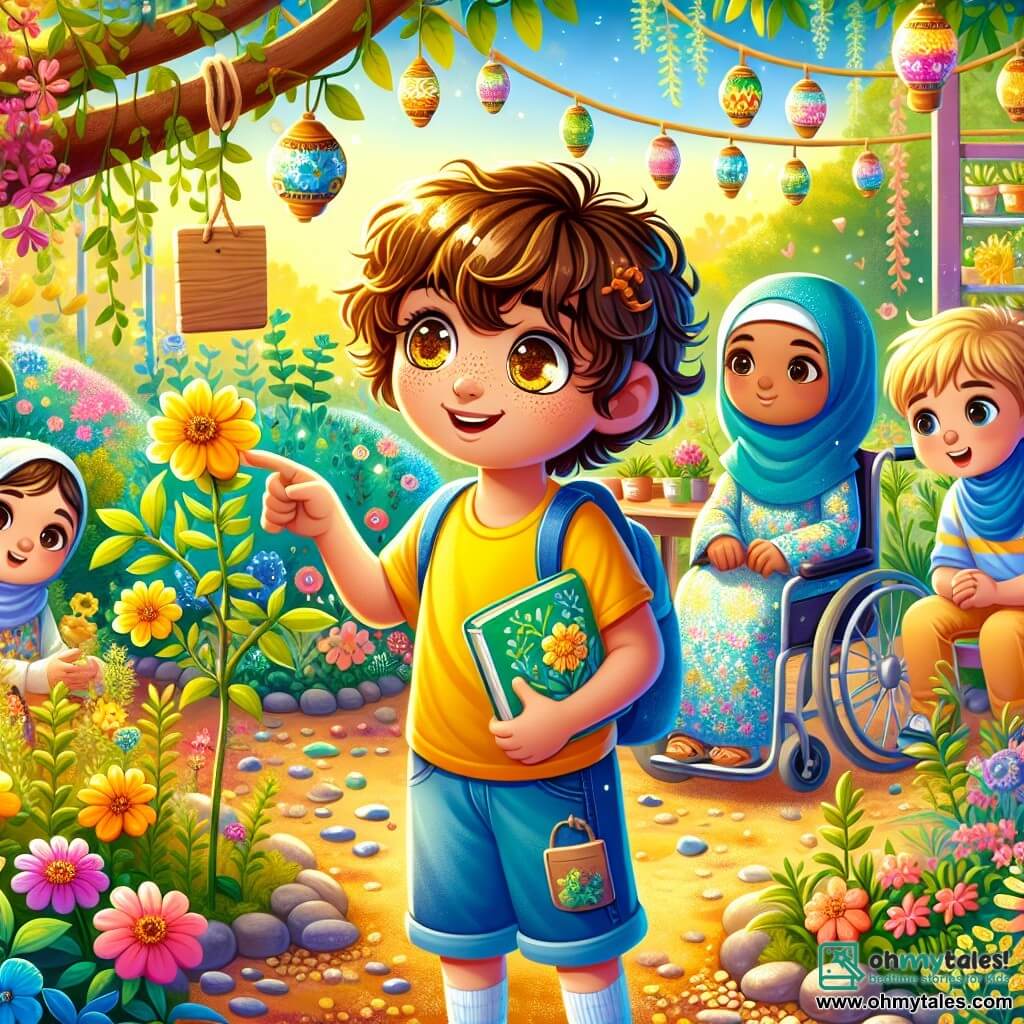
In the days that followed, fragments of stories began to gather in his head like shells on wet sand. Once, at recess, he listened as Nandi, who wore a bright blue hijab, described her grandmother's garden in a language that sounded like rain. "Our mango tree is the oldest. It remembers weddings," she had said with a proud grin. He asked her a question and she delighted in answering. At lunch, Leo, who used a wheelchair, passed Sam a comic and said, "My dad tells stories about rockets. He says the best stories are the ones you can almost taste." Somewhere in the noisy hallway, a new girl with hair like midnight spoke shyly about leaving another country last year, and how she kept a small jar of sand from the old beach in her bag.
Each conversation left a small bright pebble inside Sam — a tambourine of words and images that made his head hum. The map in his backpack felt less like a burden and more like a plan. He started to see the Story Garden like a patch of earth where all those pebbles might be placed, where different sounds and flavors could grow together.
When the teacher, Mr. Clarke, announced the day for planting, Sam realized his heart no longer thumped at the idea of speaking. It fluttered, yes, but also felt like a bird learning to find its direction. He could tell a piece of his life, and he could listen to what others brought. Stories, he was starting to understand, were not performances to be judged but doorways you opened so someone else could come in and see the inside of you.
He slept that night with the attic's memory and the map under his pillow, as if maps could help dreams find their way. He dreamed of a garden where every plant had a pocket for a story. The dream was soft and kind and smelled of lemon peel, and when he woke he had a single clear thought: tomorrow he would plant something true.
The Seed Swap
The school courtyard smelled like mulch and busy breath. The Story Garden project had turned the back of the playground into a promise: rows of soil, tiny wooden signs, and a crate of seeds as diverse as the class itself. There were sunflowers that stood like sentinels, small packets of basil and thyme with crisp photos on their fronts, and a little tin of purple nasturtium seeds that looked like confetti.
Mr. Clarke had given each child a small wooden tag and encouraged them to bring a seed that meant something to them. The rules were simple: plant a seed, write a short story to hang on the tag, and then listen on the night of the reading. He explained it with a storyteller's flourish and a wink. "Remember," he said, "stories are seeds too."
Sam had brought a packet of saffron crocus bulbs that his grandmother had wrapped in a tea towel. "They were her mother's," she had told him, tracing a faint scar on her thumb. "They bloom for a few weeks and then sleep, but they always come back. They are faithful in a way that makes me brave." Sam liked that thought — brave as a plant. He also carried his notebook, the map folded inside it like a secret letter.
At the table beside the garden, the students arranged their seeds and began to trade like merchants. Offers were practical and playful at once.
"Will you trade a sunflower for this packet of bean seeds?" Maya asked, eyes bright. Maya's family kept bees, and she could point out the favorite flowers of every insect in the yard.
Leo leaned forward and tapped the packet with a grin. "I'll swap my runner beans for that nasturtium. Nasturtiums are great for salads and for telling guests where to sit," he said, which made everyone laugh.
Sam placed the saffron bulbs gently into the soil and pressed with his fingertips until the dirt hugged them. It was careful, polite work, like tucking a child into bed. As he planted, students came by to look at his little tags and to ask questions. The more he answered, the more pieces of his story came into place.
"What's saffron?" asked Nandi, balancing the wooden tag like a compass.
"It's a spice," Sam said. "Very expensive. It smells like autumn in slow motion." He felt boggled at how quickly his own description pleased him. He had never thought of his family's spices as anything other than ordinary household treasure.
The class formed a small circle afterward, and they practiced reading short lines in turns. Each child stood and spoke, some with hands twisted, some with drama, some with the shy speed of someone hurrying through a rainstorm. Sam listened to Nandi describe a mango tree that had been planted for a wedding, to Maya's explanation of how bees taught patience, to Jacob's vivid memory of the ferry he took as a toddler, the water clapping like a drum under the hull.
Sam had kept the first sentence he had scribbled in the attic. "When I was small, my grandmother taught me to listen to the world like it was telling one long secret." He read it to the circle, his voice at first thin and then finding warmth as the words rolled out. They listened. When he spoke of the kitchen, the spices, the lucky coin in the apron pocket, he realized how pictures fell from his sentences — bright, small pictures like shells in people's hands.
"Why do you keep the coin?" asked Leo simply.
"It was my great-grandmother's," Sam said. "She put it there for people leaving home, and she told a story that if you carry it, you can find your way back to the things that matter."
Leo nodded as if that explained everything — which, sometimes, it did. The practice felt less like a test and more like standing by a fire where everyone took turns warming their hands.
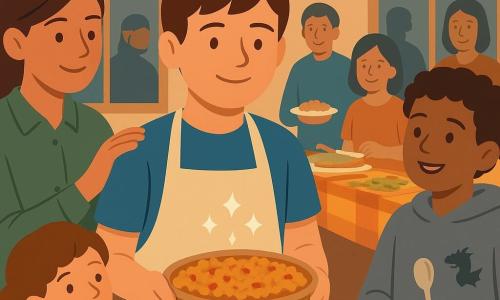
After school, the class began a seed swap day. Parents came with pots and stories of their own. Laila arrived with a tray of small pastries and a hand-tiled story tile she had made with the children last summer. She moved among the students like a small gust of warmth, touching shoulders and adjusting collars.
"Tell me about your tag, Sam," she said, peering at his careful handwriting.
"It's about the saffron," he said. "I wrote about how it snuck into bread at weddings and how we used to count the threads like tiny gold ladders."
She smiled. "Then invite people to climb." It was a strange sentence, funny and true. "Invite them to taste how you see."
Sam realized that half of telling a story was offering a taste: a spoonful of the way you remembered something. The other half was being ready to accept what others offered too. That thought made him feel full in a soft, warm way.
That afternoon, after the seed swap, a new girl named Hana stood at the edge of the garden. She had arrived recently with her father and a small suitcase of dreams. Her hair fell in quiet waves, and she held a small packet without a label.
"Can I sit here?" she asked Sam.
"Sure," he said, and moved his notebook so there was space beside him. Hana opened the packet and revealed a seed he did not recognize: small, glossy, and dark as a beetle's back.
"My grandmother used to call these 'night lanterns,'" she said, and her voice made small sparks in Sam's chest. "They bloom at dusk. In my old home, my grandmother would set them by the window, and the house looked like a constellation." She paused. "I keep them because my grandmother had hands like yours, Mrs. Laila's — always making things feel safer."
Sam found, to his surprise, that his cheeks were hot. He had not thought of his grandmother's hands being part of a larger map before. People carried similar things across very different places, and in those shared gestures there was a comfort that felt like a bridge.
They planted their seeds side by side, two tiny promises in the soil. "We should write about the bridge," Hana said, and Sam laughed because the word felt like a small bell that made everything clearer. In that bright, impatient afternoon, the garden began to weave itself into a map not drawn by a single hand but stitched by many.
The bell for the end of the day rang. Sam took one last look at the wooden tag swinging gently on its post, the words he had written curling in the breeze. He folded his notebook and felt the map burnish itself into memory. Tomorrow would be a walk — Mr. Clarke had planned a neighborhood Story Walk — and Sam, who had begun to like both telling and listening, felt ready to carry his part forward.
Walking the Stories
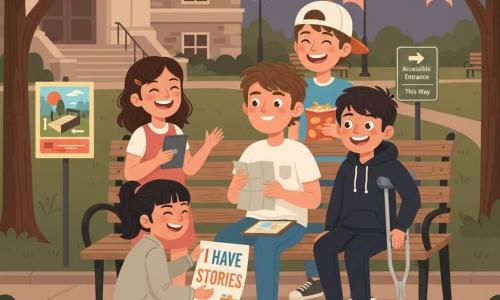
The Story Walk began on a blustery morning. Cold air dotted everyone's noses pink and the sky was the exact color of the inside of an old book. Parents and students spread into small groups, each with a map of places where the neighborhood's tales lived: the bakery with the cardamom bread, the river where an old boat waited like a sleeping wolf, the bench on the library steps haunted by lost library cards. Each stop promised a short listening and a chance to add a piece of their own story to the neighborhood mosaic.
Sam walked with Mr. Clarke's group, a line of elbows and laughter and quiet pockets of thought. They trod on pavement that had learned the sound of shoes and headed down streets where trees made a cathedral with their branches. The first stop was the bakery. Mr. D'Souza, who wore a cap and a grin, opened the glass case and let the class smell the pastries like an offering.
"This bread," he said, "was given to me by Mrs. Patel, who taught me to always store a little sweetness for storms." He told them a quick story about the time a storm took out the bakery's sign and how the community painted a new one together with a child's messy handprint in the corner. Sam thought about how people fixed things by gathering together, like stitches on a frayed sweater.
At the river, a bench waited. An old man named Mr. Alvarez sat there all afternoons, whittling wood into small boats. He told the group about the rivers in his own childhood and how each river taught him a different way to say goodbye. The students watched the boats bob in their hands and listened; many of them were hearing things that made them feel taller and smaller at the same time.
Along the walk, Sam practiced the art of listening. It was not just waiting for his turn. He learned to put curiosity at the front of his mind, to let his eyes soften and his breathing slow. When kids spoke, he tried to picture their words like pictures: Nandi's mango tree with ribboned branches, Maya's bees polishing the sunlight, Hana's night lanterns like tiny moons caught in jars. Each image stacked with the others, and by the end of the morning, Sam's head felt like a museum of small, luminous things.
At one house, a woman named Mrs. Okafor opened her garden gate and invited them in. Her yard was a galaxy of colors and birds. She handed the students a single cup of tea, different from the ones Sam had before, fragrant with ginger and lemongrass. "We keep tea when we tell stories," she said. "It helps the mouth remember the shape of honesty."
Sam took the cup and found himself thinking of small rules for listening. He decided, quietly, to try them as though they were tools: no interrupting unless it was a question that helped; look at the person; find a detail in their story and name it; allow silence to be part of the reply. He found that when he applied these rules, the world didn't feel like a theatre but like a room where people grew comfortable enough to take off heavy coats.
When it was his group's turn, Mr. Clarke stopped at a small patch of green under a lamp post. He encouraged anyone who felt moved to share a sentence from their tag. Sam had prepared a little more than a sentence now. He had practiced the taste he wanted to leave.
He stood and said, "My grandmother keeps a coin in her apron for luck. She puts it there for people leaving home." The words seemed to stretch into the air and become visible. He told them about the saffron threads and finding two places on his map: the ones inside his house and the ones outside, in the streets and benches. He said, "When I don't know where I belong, I remember the smell of cardamom and the sound of my grandmother humming. It helps."
After he finished, a hush hung like a soft blanket. Then Nandi raised her hand and said, "My mango tree remembers weddings. It remembers when people promise each other forever." Her voice quivered with the right shape of pride. The new girl, Hana, said, "In my old town, we lit lanterns for the night. My grandmother said the lanterns were questions." There was a small laugh, like a windchime caught in a happy gust.
A few people were quiet. Leo said nothing, but he rolled forward his chair and gently tapped the ground with a stick to make a rhythm. Mr. Clarke nodded at him, and Leo beamed with the secret knowledge that he had been heard even without words. The walk had taught them that listening could be many things — it could be an attentive face, a thoughtful question, or the gentle beat of a stick.
Midway through the walk, near the willow by the river, the group encountered a younger boy from another school who had wandered off. He looked lost, cheeks red from the cold and eyes searching like they had swallowed questions. Sam knelt down beside him and showed him the map from the attic. The boy's face brightened at the picture of the bakery and the river and the willow. "My grandma used to tell stories about boats like that," he said, shyly. Sam learned then that stories could make strangers into companions.
By the end of the day, the class returned to the garden with pockets full of small treasures: clipped petals, a sliver of rope, a pebble painted by an elderly neighbor. They hung new tags beside plants and rewound their invisible threads into the map Sam carried. The map now had more lines, not drawn by a single hand but signed by many: laughter, borrowed spices, hands that shaped bread, lanterns that asked questions. Sam tucked it back into his notebook, feeling something in him rearrange into a clearer, kinder shape.
That evening, walking home with his mother, his breath making small clouds, Sam started to see his neighborhood differently. It looked like a story quilt: mismatched squares sewn together with neat, careful stitches. It was diverse, bright, and strong because things were different, not despite them. He felt proud to be one of the stitches.
Night of Lanterns
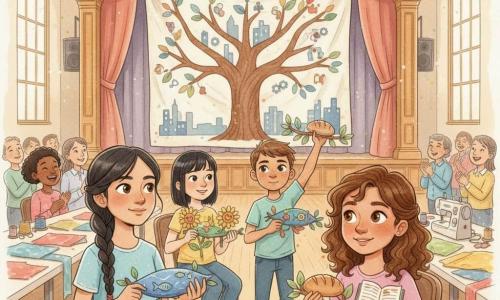
The night of the reading arrived soft and slow, like honey poured into a cup. The garden was a small world lit by lanterns and fairy lights, each glow a little promise. Parents and neighbors had come, filling benches and the low stone wall like a supportive shoreline. The wooden signs beside each plant bobbed gently, their stories written in children's hands.
Mr. Clarke stood by the compost heap and smiled like a lighthouse. "Tonight," he said, "we will read and we will listen. Remember that every voice matters."
The order was decided by a small wheel of paper that Mrs. Patel spun like a kind fortune. Sam's name was somewhere in the middle, which was exactly where he wanted to be. He still felt the flutter, but it had the soft hush of excitement rather than the prick of fear.
Before the readings began, they had a small ritual. Each child made a wish for their seed, not in words the world would necessarily hear but in the small breath you hold and then release. Sam closed his eyes and thought of safekeeping and of saffron threads climbing like tiny ladders out of the soil. He wished that people would come to know not only the map he carried but the kindness that folded within it.
The first reader was Maya, who stood with the quiet confidence of a child who knows the value of attention. She read about bees as if the insects themselves were hovering nearby, and everyone leaned forward to listen. After her, Nandi read about the mango tree, and her words tasted of golden fruit and ribboned branches. The adults clapped politely and then settled into a silence that felt ceremonial.
When Sam's turn came, his hands were steady. He walked to the lamp post where a small stool waited, the light making a halo that was warmer than he expected. He opened the tag and read his story aloud: the coin in the pocket, the saffron threads, the kitchen that hummed like a steady engine. He read about the map in the attic and about planting a seed beside Hana's night lanterns. His voice rose and fell; sometimes he paused to look at faces in the crowd. He noticed his grandmother sitting with her hands clasped, the lines around her eyes like parentheses. He felt the story settle into the garden like a seed finding soil.
When he finished, the silence lasted a single deep breath, and then people began to speak in small, unhurried ripples. Compliments were given, questions asked, and memories shared. The night had turned into a gentle exchange, each story opening to another like a tide.
Hana came forward and read about the lanterns in her old home, and then Leo stood with a small booklet of drawings that showed the places he had been with his family. His pictures were plain and honest and full of edges, and when he read, he read with a steady, resonant tone that made the lamplight tremble.
After every reading, neighbors told short replies — an aunt who had once hidden a coin like Sam's in her own pocket, a baker who remembered storms and the taste of community bread. A little boy from the front row told a joke and made everyone laugh, which loosened the air. The laughter was a bright, kind thing that stitched everyone a little closer.
Midway through the evening, an unexpected sound came from the edge of the garden: the soft strum of a guitar. Mr. Alvarez had brought his old instrument and played a tune that sounded older than grief and younger than spring. People hummed along; some tapped their feet. The music braided with the stories, and Sam felt the thin, secret thread he had carried since the attic bloom into something visible. He had told his story, and in doing so he had opened a small door for others to step through.
When the final reader finished, Mr. Clarke called everyone forward for a closing circle. "Tonight we have done exactly what we hoped," he said. "We have told and we have listened." He paused. "And some of you have brought seeds from places that stretch farther than this garden — seeds of courage, of memory, of being. Those are the seeds that make a place home."
Grandparents and parents moved closer with plates of sweet pastries and cups of tea. Laila hugged Sam and whispered, "You invited people to climb the coin ladder. You did well." Her voice was wet with pride, and when she kissed his forehead, the contact felt like a seal.
As the night wound down, people wandered the garden reading all the tags again, touching the wood as if to confirm that the words had been real. Sam walked between rows of planted things and read other children's sentences with a feeling of quiet wonder. Some of the tags were in other languages; some had drawings that made the words hum. He realized that diversity wasn't only about what people wore or the languages they spoke. It was about the different shapes that love, memory, and courage could take.
A woman from across the street, who had been listening from her window, came down and told Sam a story about a coin she had carried from a country that spoke a lilting language. She pressed a small folded paper into his hand and said simply, "Keep telling."
They lit the night lanterns at the end, holding small cups of oil and cloth and setting them free on the water of the river. The lanterns drifted with quiet dignity, each one a tiny planet moving through its own orbit. Sam watched as the light slid away, one after another, and felt an odd, steady warmth in his chest. The garden had not become less complicated. It had become fuller.
When they walked home under a sky stiched with faint stars, Sam and his mother moved slowly. He thought of the map folded into his notebook, and how it had begun in an attic and had now learned to touch the world. He had spoken, and he had listened. He had shared and received. The two things belonged together, and both had made him larger in a gentle way.
Home, Told Again
The morning after the reading was quiet. Small patches of garden glowed with late dew as though they were keeping last night's stories fresh. Sam went to the kitchen to find his grandmother humming while she rolled dough. The house smelled like warm spice and a sun that had not yet climbed high enough to be loud.
"How did it feel?" she asked as she worked, eyes bright.
"It felt like holding hands with people I don't know yet," Sam said, and the simile felt right. He sat at the table and opened his notebook. The map in the attic had folded itself into a new design. Places were connected by lines he had drawn with a pen, and next to them he had written dates and a few words to remind him of who had said what.
Laila wiped her hands and sat across from him. "Would you like to tell me more?" she asked.
He told her about the bakery and the river and the man who whittled tiny boats. He told her, too, about the little boy who had been lost and how the map had helped. As he spoke, Laila listened like a harbor taking in small boats. When he finished, she asked him questions that were both simple and sharp.
"Did anyone say something that surprised you?" she asked.
"Yes," Sam said. "Mr. Alvarez said each river taught him how to say goodbye. I had never thought of rivers that way."
"And you?" she asked. "What did you learn about yourself?"
Sam thought for a long time. He had been telling and listening for weeks now, and something inside him had shifted so that he no longer feared the scattered pieces. "I learned that my voice can be a bridge," he said. "And that I like other people's bridges. They make mine look less lonely."
Laila smiled and pinched his cheek. "Then keep walking bridges," she said.
Over the next days, the Story Garden kept breathing. People still stopped by, and the seeds began to show tiny, hopeful green. Conversations started up in its shade — about recipes and old jokes and the exact angle at which light made the hedges look like a painting. The neighborhood felt a little more like a town stitched together by listening; small doors that had once been closed stood ajar or at least had their curtains pulled back.
At school, some children found themselves daring to ask questions in class that they had been too shy to ask before. The act of telling made room for curiosity. Teachers noticed the difference, too. Mr. Clarke smiled like someone who knew the secret power of small rituals, like opening a book on the same page as someone else.
One afternoon, Sam and Hana returned to the garden during recess to find a new addition: a tiny stone path leading from the gate to the bench. Someone had painted little arrows and the phrase "Walk with your ears" in chalk. Sam looked at Hana and laughed.
"Who painted this?" he asked.
"Maybe the garden decided to speak back," she said, and they shared a quiet, companionable smile.
The garden, the map, the stories — none of it solved everything. Arguments still happened under the lamppost; icy words winded across the playground. But when things frayed, people remembered to listen. They remembered that stories do not have to be pretty to be important, and that differences were not gaps to be fixed but colors to be woven.
Sam's mother sat with him one afternoon and suggested he write a longer piece for the town newsletter. "People like to read about how things start," she said. "And the more you tell, the more it encourages others to tell too."
He did. He wrote about the attic map and the saffron threads and how stories could be like seeds. He wrote about the coin and the willow and the boy who had been lost but found by a map and a kind question. He read the piece aloud to his grandmother, who cried a little at the smell of the words and hugged him so hard his ribs complained.
"It sounds like home," she said simply.
Years passed, not in the rush of a tale but in the gentle accumulation of acts: the children from the project grew, seeds became plants, plants became small bushes, then larger ones. The garden became a place where noisy school lunches sometimes settled into peaceful chatter, where elders came to sit and remember the names of trees. Sam found himself, often and gladly, at the center of these small things, sometimes telling, often listening, always with the map in the back of his mind like a folded promise.
On the first anniversary of the Story Garden, the community gathered again to read new tags. Some of the children from that first night had grown taller, voices deeper, but there was a continuity of heart. Sam stood, as he always did, with a sense of soft anticipation. He read a new entry he had written about identity — about being two places folded together like paper cranes, about carrying a language inside that sometimes woke him in the night and asked to be spoken.
Afterward, a neighbor, Mrs. Okafor, came up and pressed her hands to his shoulders. "You have become brave in a new way," she said. "It is the bravery of returning. You told your story, and then you came back to hear others." Her words were small and exact, and they glowed.
That night, Sam walked home under a sky like a cloth of dark felt stitched with distant lights. He passed the willow by the river and paused, listening to the water make a hush against the shore. The garden lights twinkled behind him like the soft eyes of a city that keeps watch without demanding anything in return. He unfolded his map one last time and traced the lines he had drawn with his finger.
The lesson he kept returning to was very simple and true: telling your story is an offering, but listening is the way you invite others to accept it. When people listen, they are saying, in a quiet and profound way, "I see you." When you tell, you are saying, "Here is a piece of me." Together, those two acts braided something human and warm.
He slipped the map back into his notebook and walked the rest of the way home with his hands in his pockets and a soft smile on his face. Inside the house, lights burnt low and the kettle hummed like a contented animal. There were stories still to tell, and there would be new people whose lives would find small; bright places on the map. Sam felt, as he climbed into bed and pulled the blanket up to his chin, like someone who had learned the route of a very good path: step forward, speak, pause, listen, and then, always, step forward again.
He closed his eyes with the taste of cardamom on his tongue and the memory of lanterns on the river, and he slept in the comfortable knowledge that to be heard and to hear were twin kinds of home.