1. The Captain Who Measured Everything
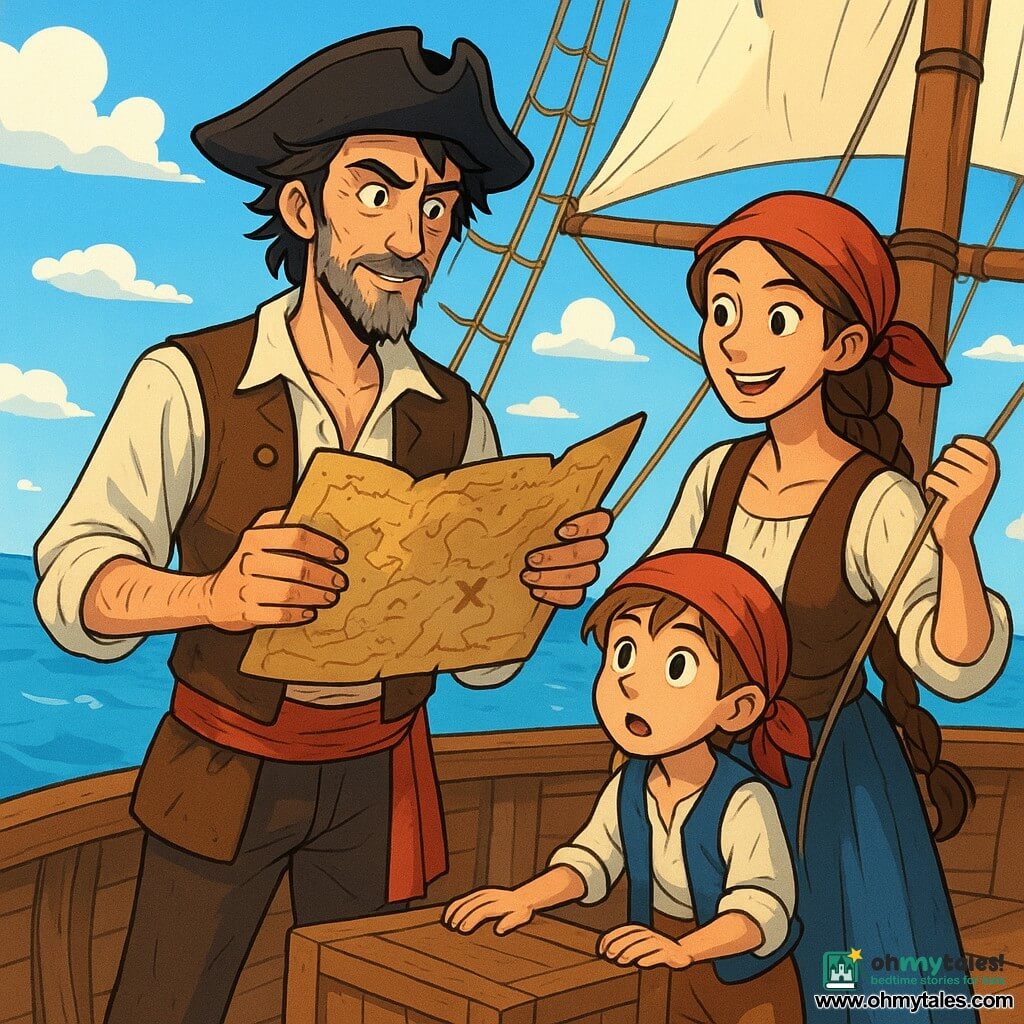
Captain Bram Blackthorn believed in order the way some pirates believed in luck. On his ship, the Sea Lark, ropes were coiled like cinnamon buns, the deck shone like a polished apple, and the crew ate at the same hour every day because Bram's brass pocket watch said so.
He was tall and lean, with weather-creased skin and steady gray eyes. He wore his tricorn hat at the same angle every morning. He kept rules written in a neat hand inside a leather book he called The Rules of the Sea Lark. He had rules about stacking barrels, rules about sharpening cutlasses, and a very important rule about not stepping on the ship's cat, Match. (The cat stepped on whoever he wanted.)
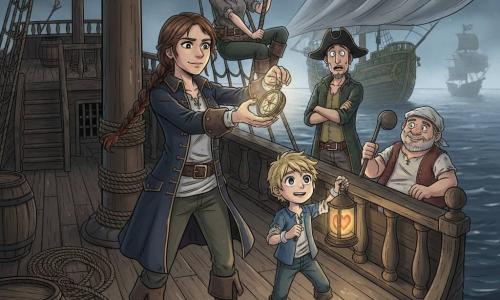
“Captain,” said Lark Calico, his first mate—a woman with a braid like a rope and a laugh like a gull's call—“you know you scare other pirates with all that tidiness.”
“Good,” Bram said, adjusting the hat by a hair. “Then they won't steal our lunch.”
What he didn't say, not even to Lark, was that he kept order because the sea did not. The sea had moods. It hid things. It took things. He had learned that as a cabin boy on a ship that never came home.
That morning, Bram spread a parchment on the captain's table and let the lantern glow across its cracked surface. It had been given to him by his old mentor, Captain Mire, who had vanished into fog three years ago and left Bram with a ship, a crew, and this: a riddle that promised a treasure no map could mark.
On the parchment, in a looping hand, were lines that looked like a sea shanty but felt like a wink:
When the tide twins rise and fall,
Count three words, take one, that's all.
Moon draws silver lines at night;
Follow where they point you right.
Where noon casts shadow sharp and small,
Speak the quiet word, then call.
Bram ran his finger under the words, lips moving. Counting three. Taking one. Writing each in his neat log with a stubby pencil.
“Tide. Rise. Count. One...” he murmured.
Old Gull, the cook, shuffled in with a mug of tea and a stringy ponytail. “Are you whispering sweet nothings to the paper again, Captain?”
“I am decoding a legacy,” Bram said, not looking up. “And your tea is two minutes early.”
Old Gull rolled his eyes. “The kettle didn't have a watch.”
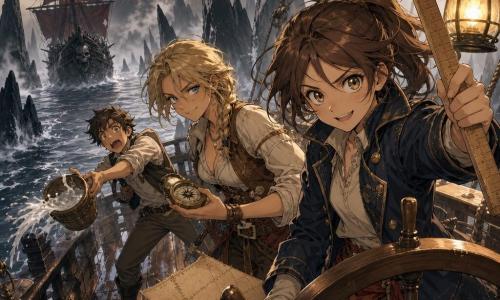
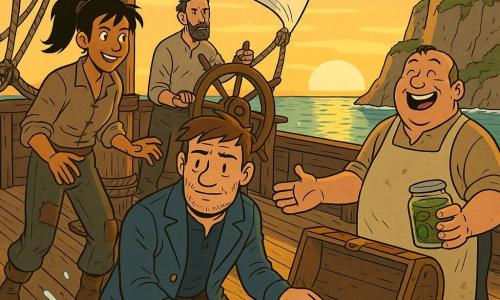
Out on deck, the crew of the Sea Lark trimmed the sails as the morning wind sighed. Pip and Tamsin—twin deckhands with matching freckles—leapt from coil to coil like acrobats. Theo, the navigator with a nose that could smell rain before any cloud appeared, squinted at the horizon. The parrot, Buttons, strutted along the rail, muttering, “Rule one, no crumbs. Rule two, bring peanuts.”
Bram straightened, eyes bright. “I have the first string,” he said. “Every third word makes a new line. Listen:
Tide twins, count one moon.
Lines point noon, shadow small.
Speak quiet, call.”
“That's a poem that needs a biscuit,” Old Gull said.
“It's a cipher,” Bram said, with a small smile that warmed his face like sunlight. “We sail when the tide splits into twin streams. We follow the moon lines—moonlight on the water—to a place where the noon shadow is shortest. And we say a quiet word. We call.”
Lark leaned on the doorframe. “And where, Captain, do we find twin tides and a noon shadow with manners?”
Bram folded the parchment with precise corners. He tapped the brass compass hanging at his belt. “The Whispering Keys. An island chain shaped like a sleeping whale. At noon, the island's standing stone throws a tiny shadow only once a day.”
Lark whistled. “That chain has fog thick as milk.”
Bram set his hat. “Then we'll bring spoons.”
He stepped onto the deck, and the crew straightened like a row of masts. “Crew of the Sea Lark!” Bram called. “We are bound for the Whispering Keys. We will need eyes sharp as gulls, minds clear as the sky, and the patience to do things properly.”
Pip saluted, upside down on a coil. “That's my least favorite part. But I'll try.”
“We'll do more than try,” Bram said. “We will succeed.”
“And if we don't?” Buttons asked.
“We'll try again,” Bram said, “but smarter.”
The sails bellied with wind, the hull hummed, and the Sea Lark slipped forward, a neat arrow on a restless blue page.
2. Fog with Teeth
The fog came in as if someone had poured it from a giant kettle. One moment the sea lay bright and hard, the next it was muffled cotton. The bell at the bow of the Sea Lark clanged softly with every shy wave. Across the damp, the scent of salt and rope and wet wood mingled.
“Whispering Keys,” Theo said, rubbing the bridge of his nose. “Smells like old secrets.”
“Buttons,” Bram said, “no flying. You'll be damp for days.”
Buttons fluffed up like a greening sponge. “Rule three: no damp parrots.”
Lark stood at the rail, her braid beaded with droplets. “Captain, d'you hear that?”
Bram did. It was the faintest thud-thud, a rhythm that didn't belong to the sea. He held up a hand, and the crew stilled. Even Match the cat paused mid-wash, one paw in the air.
Thud-thud.
“Drums?” Pip whispered.
“Not ours,” Tamsin said. “Off our starboard, maybe?”
Bram closed his eyes and listened. He counted heartbeats in between the drumbeats, measured the angle of sound and the thickness of the fog. He stepped to the wheel. “Theo, two points starboard. Lark, ready the smoke pots.”
“Ah,” Old Gull grunted. “Rival pirates who love noise.”
Bram's mouth twitched. “Captain Rake Redtooth loves noise. He loves reputation even more. He drums so people know he's coming.”
“And we don't?” Pip said.
“We don't,” Bram said. “We arrive.”
The Sea Lark slid sideways, quiet as a thought. From the fog to starboard, the drums grew louder. A shadow bulged. A figurehead snarled—red-painted teeth. The Blood Badger, Captain Rake's ship, shoved out of the fog like a grin.
A voice boomed across the mist. “Bram Blackthorn! Show your face so I can paint it on my sail!”
Lark cupped her hands around her mouth. “Rake! You keep that brush far from decent cloth!”
Bram stood calm at the wheel. He tapped the smoke pots with a knuckle. “On my count,” he murmured. “Three, two, one—”
Lark and the twins lit the pots. Smoke billowed, thick and heavy, more oily than fog. It sank low on the water and dragged along, a dark lane.
“Hold your breath,” Bram said. “And hold your nerve.”
They slipped into their own smoke, a ribbon of shadow. The Blood Badger barreled past, drums pounding, its captain a smear of crimson at the bow, waving a hat with a long feather.
“Where'd he go?” Rake's voice cracked. “He was right there!”
Bram guided the Sea Lark to the Badger's stern and then beyond, not a whisper of a swirl in their wake. When the drums thudded in the opposite direction, he let out the breath he had been counting.
“Smart as a fox with spectacles,” Old Gull said.
“It was teamwork,” Bram answered, and meant it. “The fog is Rake's mouth. We don't climb in.”
The fog thinned as midday crept closer. The sun became a pale coin burning through a silk scarf. The whisper took on a shape. Ahead, low in the water, lay a chain of islands like the gentle curve of a giant's back. White sand gleamed like teeth. On the largest island, a standing stone jutted, dark and finger-like.
“The sleeping whale,” Theo breathed.
Bram's pocket watch ticked. He eyed the stone, the sun, the edging of shadow. “We have thirteen minutes to make shore,” he said. “Lower the longboats. No splashing.”
“Rule four,” Buttons said. “No splashing.”
They slid ashore as the sun climbed to noon. The heat lifted the smell of crushed shells and warm leaves. From the center of the island, insects sang a shrill chorus. The standing stone waited, shadow thin and sharp as a blade.
Bram paced off exact steps, counting aloud. “Twenty to the north,” he said. “Fifteen to the east. Seven back to the center.”
“We could just hunt around until we trip over it,” Pip said.
“And we'd miss the point,” Bram replied. “The riddle is the path. If you follow it, the treasure changes you before you even touch it.”
“That sounds like a rule,” Lark said.
“It isn't,” Bram said, though it felt like one.
At the base of the stone, the shadow was three fingers long. Bram crouched and pressed a palm to the sand. Warm. Dry. He felt for a seam, a difference. Nothing.
“The quiet word,” Tamsin said, tugging on a strand of hair. “What is a quiet word?”
Bram frowned. He thought of the sea, loud and wild. He thought of his own voice, usually crisp. He thought of Captain Mire's voice, soft as worn rope when telling stories. Mire used to say, There's a word that unlocks more than any key.
“Please,” Bram said.
He didn't shout it. He didn't command it. He breathed it.
The sand shifted.
Lark jumped back. “Oh,” she said, delighted. “Oh.”
The sand streamed away like water down a drain, revealing a ring of stone with steps twisting into darkness. Cold air rose, smelling of damp rock and something like old iron and oranges.
“Torches,” Bram said. “Single file. No nonsense.”
“Rule five,” Buttons whispered. “No nonsense.”
They descended into the island's throat, the sea a distant hush above them.
3. The Echo of Bones
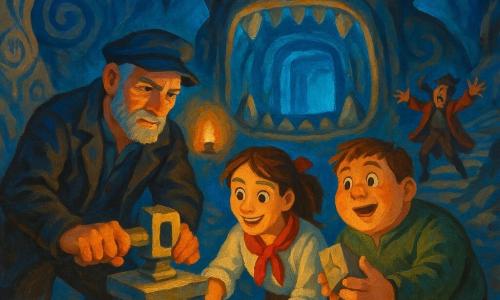
The tunnel swallowed their torchlight. Faint lines sketched themselves along the walls—marks made by hands, spirals and fishbones, stars and waves. The air tasted of limestone and the ghost of citrus. Underfoot, their boots scraped on grit and smoothed stone.
“Listen,” Lark said, her voice changed by the ground and close ledges. “Even whispers have elbows down here.”
Bram ran his fingers along the carved lines. He found a notch exactly the size of his thumb and pushed. A click, subtle as a blink, answered.
“The first of three,” he murmured. “Captain Mire liked threes.”
“You knew Captain Mire well,” Tamsin said, skipping a puddle.
“As well as anyone could know someone who loved secrets,” Bram said. He checked himself. “He loved adventure. He loved making people think.”
The path opened into a chamber where three tunnels split like a forked tongue. Above each tunnel, a small stone sat on a ledge. On the left, the stone was smooth and white. On the middle, it was rough and black. On the right, it was patterned with speckles like a quail's egg.
“Which?” Pip asked, peering in. “Left for light, middle for dark, right for… breakfast?”
Bram examined the lintel above the tunnels. Tiny letters, scratched deep, made a phrase:
Only those who count without numbers
Hear the song without sound.
He closed his eyes. He counted his breaths. He counted the pauses in the distant drip-drip. He heard, underneath, something like a rhythm. Not drums. Not footsteps. A low, steady thrum, as if the island had a heartbeat.
He held out his torch. The heat licked the black stone above the middle tunnel. A thin mist drifted down. It smelled faintly of oranges again. Bram smiled.
“The middle,” he said. “Heat draws the breath of this place. We follow the pulse.”
They moved into the middle passage. It narrowed until they had to turn sideways, squeezing past stone cool and slightly wet. The torch hissed as it brushed damp air. Pip made a face.
“If I get stuck, tell my ma I went in a heroic way,” he said.
“We'll grease you with Old Gull's stew and pull you through,” Lark said.
“Please don't,” Pip said.
“Only if you ask nicely,” Bram put in. Lark snorted.
The passage widened suddenly. They stumbled into a cavity shaped like the inside of a bell. Under their footsteps, bones rattled.
Tamsin froze. “That better be fish.”
It was. Fish bones, long and delicate, laid in spirals across the floor. In the center, a small stone pedestal rose, with a shallow bowl carved into its top. Next to it, a thin groove ran down to the floor.
“What's this game?” Old Gull muttered.
Bram looked up. The ceiling was pierced by small holes like stars. Thin strings hung down, almost invisible, each tipped with a tiny shell. A breeze breathed through the holes and set the shells clicking, a soft rattling like rain on glass.
“Song without sound,” Lark said.
“Not without sound,” Bram murmured. “Without words.” He pressed his ear to the bowl. It rang very faintly, a tone his bones felt more than his ears. He took out his pocket watch. The second hand ticked.
He counted shell clicks. He counted ticks. He let the numbers stack in his head until he saw a pattern. Every third click matched the second hand. Every fifth made the bowl hum.
“Three and five,” he said. “A measure.” He took a small canteen from inside his coat and poured exactly three gulps of water into the bowl, then five.
The pedestal trembled. The fish bones shivered, then rearranged themselves with a whispering scuttle. They formed an arrow pointing to a seam in the wall.
Pip clapped a hand over his mouth. “That's creepy.”
“That's clever,” Bram said. “Come on.”
He pushed at the seam and the wall slid aside. Beyond, blue light gleamed like a promise.
4. The Room of Blue Water
The passage opened into a cavern half filled with water so still the torchlight laid itself on it like silk. From some crack above, daylight poured through in a narrow, bright blade, and where it struck the water, the whole room shone the color of a kingfisher's wing.
A stone ledge crooked around the pool. On the far side, a low arch led to another tunnel. Between here and there lay a set of stepping stones, flat and slick.
“It's beautiful,” Tamsin whispered.
“And slippery,” Lark said.
Bram crouched. The stepping stones were spaced irregularly, some barely showing above the water, some higher. Etched into each stone was a different symbol—lines like waves, dots like stars, a shape like a fish eye, a spiral like a shell.
Theo pointed. “Captain. Look.”
On the wall in the light, letters revealed themselves in the glow. They formed a line:
Choose your step by what you know,
Water turns where winds don't go.
Bram neatened his thoughts. Wind brewed the surface. Water below followed other rules. He licked a finger and held it up. The air was still. But he watched the water. It shifted, barely. A curling that moved from right to left.
“The current moves that way,” he said. “The stones that have the shell symbol curve with the water. They'll be stable.”
“Or slick,” Old Gull warned.
“We'll help each other,” Bram said. “Ropes on. We go one by one. Speak what you plan, then do it.”
“Rule six,” Buttons said. “Speak what you plan.”
Bram went first. Shell symbol to shell symbol, he stepped, slow and careful. The stones were wet, but solid. He moved with precision, arms spread. His boot slipped on the third, his heart kicked, but Lark's steadying rope went taut.
“I've got you,” she called.
He reached the far ledge, turned, and nodded. “Next.”
They went across, one by one. Pip nearly plunged and then didn't, thanks to Tamsin's quick pull. The crew grinned breathlessly at each other, hearts drumming. When Old Gull made it with his stew belly intact, he patted the stone and said, “Thanks, shell.”
They ducked through the arch. The tunnel beyond sloped down. The air grew cooler, then cold. Their breath puffed silver. Bram's shoulder brushed the ceiling, then scraped. The tunnel pinched tight.
“Backpacks off,” Bram said. “Squeeze. We go feet first until we can't, then we wriggle. No one rush. We're snakes.”
“Snakes with hats,” Lark added, and Bram snorted in spite of himself.
The tunnel dropped them into a sharp turn and then out into a cavern where the ceiling arched like a cathedral made by tides. In the center, a plinth rose, carved and inlaid with shell and bits of glass that caught the light in a mosaic of sea and sky. On the plinth sat a chest.
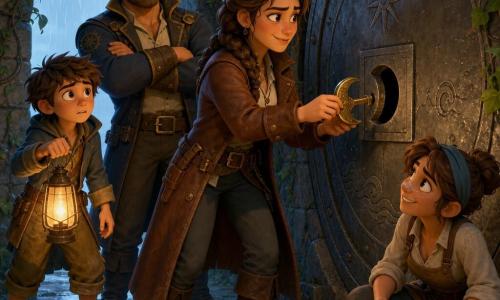
It was not large. It was worn, bound in green-stained copper. It had three locks and a line of letters scratched deep along its rim.
Pip held his breath. “Is that it?”
“It's an it,” Lark said.
Bram brushed his fingers over the letters:
Keys are three and none are metal:
One that you've already used,
One that you must freely settle,
One that you have always refused.
He thought of the first “key”—the word please. He rolled the second line in his mouth. Freely settle. The third—always refused—sat like a stone behind his tongue.
He looked at his crew. Lark with her braid and brave grin. Theo with his soft nose for storms. The twins, bright as sparks. Old Gull with his stew jokes. Buttons, useless and dear. He looked at the rules written in his head, the neat way he liked things, the way he clenched when the world didn't obey.
“The first key,” he whispered. “Please.”
He said it, and one of the three locks clicked open.
“The second,” he said, “we freely settle something.” He opened his coat and removed his pocket watch. The brass gleamed, warm from a hundred days of checking it, trusting it, keeping the world on time. He placed it on the plinth.
The second lock clicked.
Lark's eyes widened. “Captain—”
He held up a hand. “It's a symbol. We settle our hurry, our need to control the minutes. Just for now.”
“The third,” Old Gull said dryly, “is probably a vegetable.”
Bram smiled with half his mouth. Always refused. He thought of help. He had always been the one to help, to guide, to think three steps ahead. He had always refused to ask.
He turned to his crew. He felt his mouth go dry. He swallowed and said it anyway.
“Help me,” he said. “Please.”
The third lock clicked, loud as a bell.
Together, hands on the lid, they lifted. The chest opened like a breath let go.
Inside lay coins, yes, coins from places long gone and far away, but tucked among them were papers sealed in wax, tiny bottles of sand labeled in Captain Mire's hand—names like “Last Light of a Green Sea” and “Wind Stolen from a Storm”—and a compass, unlike any Bram had seen. Its needle did not spin to north. It swung and pointed at Theo, then Lark, then Bram himself.
On top of the papers was another parchment, corners worn by a worried thumb. Bram unfolded it with careful hands. The writing was clear, and it spoke in Mire's voice so strongly that Bram could almost hear the old captain's chuckle.
Bram, if you open this, you are who I hoped you'd be: careful, brave, stubborn as a barnacle. This isn't gold you can spend only once. This is knowledge. The maps show hidden harbors; the bottles hold tricks; the compass points to the person you trust most in the room, which might be you on bad days. Use them to protect your crew and to outwit pirates with more brawn than brains. And remember: treasure is not the chest. It's who lifts it with you.
Bram swallowed hard. He felt the ache under his sternum like a knot finally loosening.
The cavern shuddered.
“Ah,” Old Gull said. “The part where the cave tries to eat us.”
Rocks trembled dust into their hair. A crack stitched itself across the ceiling.
“Take what you can carry,” Bram said, voice steady. “Then move.”
They packed the compass, some coins to prove to themselves it happened, the maps. They left the bottles; they weren't greedy and they weren't fools. Bram tucked the letter close to his chest.
They hurried back through the tunnel, timing their steps across the pool. A stone slipped. Bram reached for Tamsin and wrenched his shoulder. Pain shot white through his arm.
“I'm fine,” he grunted, though his vision sparked. “Go.”
“We don't leave our Captain,” Lark said. “Rule seven.”
“I did not write that,” Bram said.
“We did,” Pip said, and grinned. “We use it on you.”
They crisscrossed ropes, made a human web, and pulled each other along. In the fishbone room, the bones rattled, but the arrow still pointed true. In the tight passage, they greased elbows with Old Gull's emergency biscuit butter.
They burst out into the sun, blinking, the sound of the sea like a miracle. The standing stone watched in silence. Above the white sand, the fog had burned off, leaving the sky clean and hard.
At the shore, the Sea Lark bobbed, loyal. Bram looked back at the island once, then set his jaw. “We go,” he said.
Behind the low spit of rock, the Blood Badger's red-toothed grin slid into view.
5. The Dance of Sails
Captain Rake Redtooth had a laugh like a rusty hinge and a feather that refused to lie flat on his hat. He saw Bram's crew and clapped his hands together like a delighted child.
“Treasure time!” he roared. “Let Uncle Rake hold your gold.”
“Let Uncle Rake hold this,” Lark called, and flung a rope. It thumped uselessly against the Blood Badger's hull.
Rake grinned wider. “Bram, my boring friend. I knew your tidy hands would find something worth stealing.”
Bram met his eyes. “Good afternoon, Captain Rake. I'd offer you tea, but you'd set the cups on fire.”
“Very likely,” Rake agreed. “Now be nice and give me your box, or I'll—”
He gestured with his cutlass. His crew beat their drums. The sound rolled across the water like distant thunder.
Bram gripped the Sea Lark's rail with his good hand. His shoulder throbbed. He looked at his crew; their faces were pale and bright. Fear and excitement, braided together.
“We can beat him,” Pip said, too loudly. “Right?”
“We can outthink him,” Bram said. “Theo, what breeze do we have?”
“Barely any,” Theo said, sniffing. “It's like the air forgot us.”
“Then we must remind it,” Bram said softly. “Everyone, to stations. Lark, smoke pots. Twins, get the light sails ready. Old Gull, take Match below. Buttons—”
“Shout helpful things?” Buttons squawked.
“If you can,” Bram said, almost smiling.
They shoved off from the sand as the Blood Badger advanced, oars chewing froth. Lark lit the smoke pots and tossed them overboard. They breathed oily darkness that clung to the water like syrup. The Sea Lark slid into it and vanished.
Bram's brain clicked. Through the smoke, through the thin breeze, he felt something—the memory of the blue room, the way water moves when wind cannot. He watched the way the smoke curled. It went where the current pulled it, left to right. He flashed a look at Theo.
“The current's our friend,” he said. “Angle us across it. We'll drift sideways faster than Rake can row.”
Theo nodded, eyes shining. “Aye, Captain.”
Lark grinned. “We dance without music.”
They swung the Sea Lark like a door on a hinge, let the smoke hide them, let the current carry them. The Blood Badger stumbled into the smoke and paused, coughing.
“Where are you?” Rake sang. “Come out, come out—”
Bram sucked in a breath as the Sea Lark slid out of the smoke and caught a cheek of wind. The light sails bellied, just a little. Enough. The ship glided forward, cutting the sun into shards on the water. The Blood Badger boomed behind them like an angry drum.
“Hold,” Bram said, voice low and calm and fierce. “Hold. Now.”
Theo turned the wheel, the light sails snapped, and the Sea Lark zipped past a jag of reef. Rake's ship lunged after—and scraped. Wood shrieked. The Blood Badger stuck, snapped, and swung around, its oars flailing like legs of a surprised beetle.
“Sorry!” Tamsin called, cupping her hands. “We'd love to help, but we can't!”
“Help yourselves!” Buttons added. “Rule eight: no running aground!”
Captain Rake shook his fist, then laughed, even as his ship splintered a little. “Next time, Bram!” he shouted, not angry, almost admiring. “You and your tricky math brain!”
“Teamwork brain,” Bram called back. The words were true and tasted good.
They cleared the reef and caught a real wind at last. It filled the Sea Lark with a proud shudder. The white line of the beach fell behind them, the standing stone shrinking into a dark comma on the horizon.
On deck, they whooped and pounded backs. Lark wrapped Bram's shoulder in a bandage soaked in something that made his eyes water.
“Why does it smell like lemon and pain?” he asked.
“It's lemon and pain,” Old Gull said. “But you'll heal.”
Bram opened the chest again and drew out the odd compass. The needle swung toward Lark, then toward Theo, then toward him and settled briefly on the cabin door where Match was scratching.
“It points to who you trust,” he said, voice thick. “Mire always liked to be sure.”
“What do the maps show?” Pip asked, hopping from foot to foot.
“Hidden inlets,” Theo said, scanning the neat lines. “Unmarked sandbars. Places to wait out a storm where no one will look.”
“And do we have to have rules about them?” Lark asked, teasing.
Bram thought. He tipped his hat with his good hand. “Only one: We share what we learn. No keeping safe harbors to yourself.”
“Rule nine,” Buttons croaked. “Share what you learn.”
They sailed through a sky like spilled milk, clouds all smudged gold. The sea had gone the blue of old bottles. By evening, the wind softened and the crew settled, bones worn and happy. The chest sat secured under a net, the treasure inside just weight enough to keep them honest.
6. Stars You Can Keep
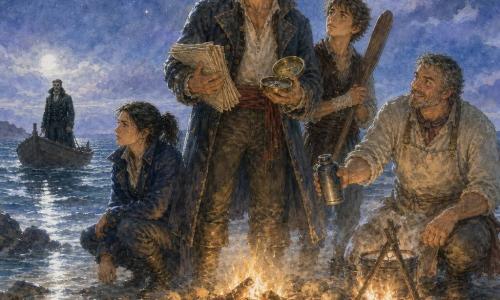
Night fell like velvet rubbed the right way. The deck cooled, smelled of tar and salt and the ghost of Old Gull's stew. The crew lay in odd comfortable poses. Pip's feet dangled from a coil. Tamsin hummed a tune she claimed the fishbones taught her. Theo traced lines from the new maps onto his own charts. Lark sat on the stairs, elbows on knees, watching the sky as if waiting for it to reveal a joke.
Bram took his leather-bound Rule Book from his coat and turned to a blank page. He'd always believed in rules because they made you brave before you had to be. But today he learned a different kind of brave.
He wrote, in careful script: Rule Ten — Ask for help. It doesn't make you smaller. It makes the team bigger.
He looked at the letter from Captain Mire again. Treasure is not the chest. It's who lifts it with you.
He went to the rail. The sea was a dark field. The sky was a deeper one. Above, stars pricked through like someone had carefully stitched them. Bram fancied he could see the faint threads.
Lark joined him. “We did well,” she said.
“We did,” Bram said. He surprised himself. He laughed, tired and private. “I lost a watch and found a rule.”
“You gained a crew that trusts you more than ever,” Lark said. “And that compass. It points at whoever's being most honest with you right now. Be careful.”
Bram held the compass up. The needle twitched toward Lark. He nodded, satisfied.
Buttons flapped up to the rail. “Rule eleven?” the parrot asked.
Bram thought. He watched Pip tickle Match's whiskers and not get scratched. He watched Old Gull pass a mug of warm something to Theo, even though Theo never asked. He watched Tamsin tuck a blanket around Pip's legs without comment. He felt the ship move under them, a living thing they all kept steady together.
“Rule eleven,” he said quietly. “When you make a plan, leave room in it for wonder.”
“Wonder?” Buttons rolled the word in his beak. “Is that like peanuts?”
“Better,” Bram said.
He looked up. The deep night seemed to lean down. He felt Captain Mire leaning with it. He felt his own heart relax and fill. He cleared his throat.
“I should say it,” he said, to the crew and the sky. “Thank you.”
They turned their heads, surprised, pleased. They didn't make a fuss. They didn't need to.
“Captain,” Theo said, pointing to the east. “Look.”
A light scratched across the dark, a brief bright line. Another, twin to it, burned and went out. Then a scatter of them, quick, quiet, brave, writing something the sea could never steal.
Pip gasped. Tamsin whispered, “Make wishes.”
Old Gull folded his arms and pretended his eyes stung because of the wind. Lark leaned her shoulder to Bram's, not hard enough to hurt, just so he'd feel it.
Bram tucked the letter into his coat. He laid his palm on the warm rail. He let the wonder in, the way a ship lets in wind.
The Sea Lark sailed on, and the crew watched in soft-held breath, while the night wrote its secret messages, shooting stars above the mast.